Quick Answer: Which Volvo EV Should You Buy?
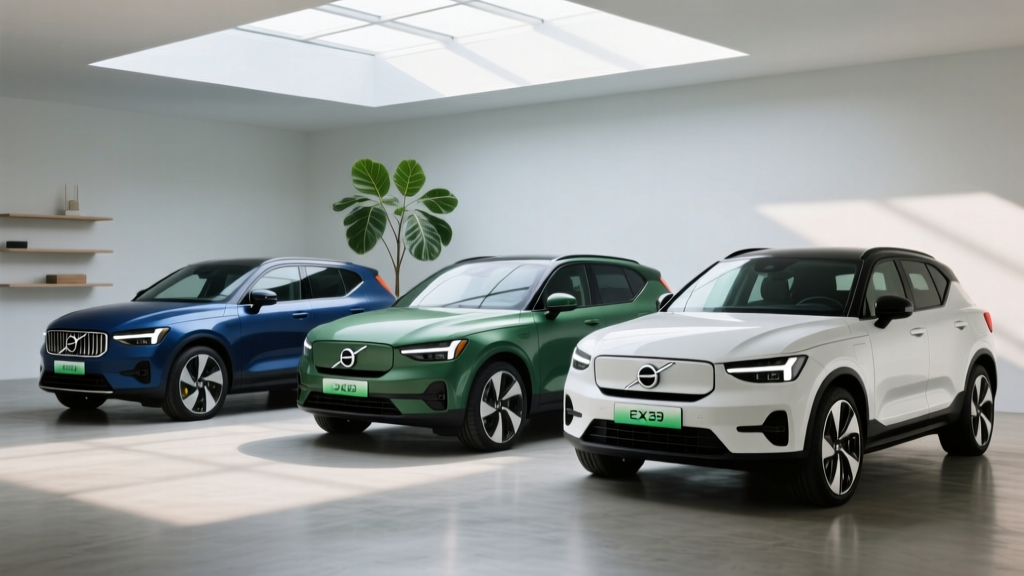
Volvo's 2026 EV lineup spans three distinct models. The EX30 starts at $36,345 and delivers up to 265 miles EPA — ideal for urban singles or couples. The XC40 Recharge (updated for 2025 and carried into 2026) offers up to 293 miles EPA from $53,550, suited for small families wanting proven tech. The flagship EX90 three-row SUV starts at $77,990 with up to 310 miles EPA, targeting luxury buyers who need space for six or seven. All three use NMC battery chemistry and support DC fast charging at 150-250 kW peak. Federal §30D tax credit eligibility varies by model, trim, and your income — more below.
The 2026 Volvo EV Lineup at a Glance
| Spec | EX30 Single Motor | EX30 Twin Motor | XC40 Recharge (Single) | XC40 Recharge (Twin) | EX90 Twin Motor | EX90 Twin Motor Perf. |
|---|---|---|---|---|---|---|
| Base MSRP | $36,345 | $46,195 | $53,550 | $56,050 | $77,990 | $86,345 |
| EPA Range | 265 mi | 261 mi | 293 mi | 254 mi | 310 mi | 300 mi |
| Battery (usable kWh) | 69 kWh (NMC) | 69 kWh (NMC) | 82 kWh (NMC) | 82 kWh (NMC) | 111 kWh (NMC) | 111 kWh (NMC) |
| Horsepower | 272 hp | 421 hp | 248 hp | 402 hp | 408 hp | 503 hp |
| 0-60 mph | 5.7 sec | 3.4 sec | 7.0 sec | 4.5 sec | 5.7 sec | 4.7 sec |
| Peak DC Charge | 153 kW | 153 kW | 200 kW | 200 kW | 250 kW | 250 kW |
| 10-80% DCFC Time | ~26 min | ~26 min | ~28 min | ~28 min | ~20 min | ~20 min |
| Level 2 (240V) Rate | 11 kW | 11 kW | 11 kW | 11 kW | 11 kW | 11 kW |
| MPGe (combined) | 104 MPGe | 97 MPGe | 98 MPGe | 89 MPGe | 84 MPGe | 80 MPGe |
| Battery Warranty | 8 yr / 100k mi | 8 yr / 100k mi | 8 yr / 100k mi | 8 yr / 100k mi | 8 yr / 100k mi | 8 yr / 100k mi |
Sources: fueleconomy.gov, Volvo Cars USA. Specs reflect 2025-2026 model year data; verify at purchase as trims may shift.
Real-World Range: What the EPA Sticker Doesn't Tell You
EPA 310 miles (EX90 Twin Motor) — Expect approximately 250-275 miles on the highway at 70-75 mph, and potentially 210-240 miles in cold weather (below 32°F) without preconditioning. The EX30's 265-mile EPA figure drops to roughly 215-230 highway miles in real-world testing.
Volvo's EPA figures assume a mix of city and highway driving at moderate temperatures. Highway driving at sustained speeds is the least efficient EV scenario — aerodynamic drag scales with the square of velocity. The boxy EX90 pays a noticeable efficiency penalty versus sleeker sedans.
Cold weather compounds this. NMC batteries lose roughly 15-30% of range in freezing temperatures due to increased internal resistance and cabin heating demands. The EX90 and XC40 Recharge include heat pumps (standard on most trims), which recover some of that loss by scavenging waste heat from the drivetrain rather than relying solely on resistive heating. The EX30's heat pump availability varies by market and trim — confirm before purchase if you live in a cold climate.
Preconditioning matters. If you use the Volvo app to warm the cabin and battery while still plugged in, you preserve range that would otherwise go to heating. On a DC fast charger, preconditioning also enables peak charge rates — arriving cold can add 10-15 minutes to a 10-80% session.
Charging Speed and the Curve Reality
Peak DC fast-charge rates are marketing numbers. Sustained rates are ownership numbers. Here's the distinction:
- EX90 (250 kW peak): Holds near-peak rates from roughly 10-40% SoC, then tapers progressively. A 10-80% session takes approximately 20 minutes on a 350 kW charger. On a 150 kW station, expect 30-35 minutes.
- XC40 Recharge (200 kW peak): Similar curve shape; 10-80% in ~28 minutes on a capable charger.
- EX30 (153 kW peak): The smaller battery means sessions are shorter in absolute time, but the lower peak means you'll wait ~26 minutes for 10-80%.
Above 80% SoC, all three models taper dramatically — this is normal lithium-ion behavior to protect cell longevity. Charging from 80-100% can take as long as 10-80%. For road trips, plan stops at 10-80% and move on.
| Level | Power | Miles Added/Hour (approx.) | Use Case |
|---|---|---|---|
| Level 1 (120V) | ~1.4 kW | 3-5 mi/hr | Overnight trickle; emergency only |
| Level 2 (240V, 48A) | ~11.5 kW | 30-40 mi/hr | Home/workplace daily charging |
| DC Fast (150-250 kW) | 150-250 kW | 500-900 mi/hr (peak) | Road trips; 10-80% in 20-30 min |
Home charging note: All three models accept 11 kW on Level 2 (240V, ~48A). A full overnight charge from 20% to 100% takes 7-11 hours depending on battery size. If your home has a 200A electrical panel with capacity, a Level 2 install typically runs $800-$2,000 (charger + electrician + permit). Older homes with 100A panels may need a $2,000-$4,000 panel upgrade — get a quote from a licensed electrician before committing to a purchase.
Volvo EV vs. Gas and Hybrid: Cost Comparison
Let's compare the XC40 Recharge Twin Motor against the gas XC40 B5 AWD and the XC60 Plug-in Hybrid to ground the economics.
| Metric | XC40 Recharge Twin (EV) | XC40 B5 AWD (Gas) | XC60 PHEV (T8) |
|---|---|---|---|
| Base MSRP | $56,050 | $41,550 | $59,250 |
| Est. §30D Credit | $0-$7,500* | $0 | $0-$7,500* |
| Effective Price (after credit) | $48,550-$56,050 | $41,550 | $51,750-$59,250 |
| Fuel/Energy Cost (15k mi/yr) | ~$600-$900/yr** | ~$1,800-$2,200/yr | ~$900-$1,400/yr |
| Maintenance (annual avg.) | ~$300-$500 | ~$700-$1,000 | ~$600-$900 |
| 5-Year Fuel + Maint. | ~$4,500-$7,000 | ~$12,500-$16,000 | ~$7,500-$11,500 |
* §30D credit depends on MSRP caps ($80k SUVs, $55k sedans), buyer income limits ($300k joint / $150k single), and battery critical-mineral sourcing. The XC40 Recharge's eligibility has fluctuated — verify at irs.gov and your dealer before purchase. The point-of-sale transfer option lets you apply the credit as a down payment reduction.
** Electricity cost assumes $0.14/kWh national average; varies significantly by state and utility. Home charging is cheaper; public DCFC can approach gas costs per mile.
5-Year Total Cost of Ownership: XC40 Recharge vs. Gas XC40
| Category | XC40 Recharge Twin | XC40 B5 Gas | Difference |
|---|---|---|---|
| Purchase (after credit) | $52,000 | $41,550 | +$10,450 |
| Fuel/Energy (5 yr) | $3,750 | $10,000 | -$6,250 |
| Maintenance (5 yr) | $2,000 | $4,250 | -$2,250 |
| Insurance (5 yr est.) | $11,500 | $9,000 | +$2,500 |
| Depreciation (est.) | $22,000 | $16,000 | +$6,000 |
| 5-Year Total | $91,250 | $80,800 | +$10,450 |
Estimates based on 15,000 miles/year, $3.50/gal gas, $0.14/kWh electricity, and average insurance premiums. EV insurance tends to run 15-25% higher due to repair costs and battery replacement risk. Your actual numbers depend on local fuel/electricity prices, driving habits, and insurance quotes.
The math: the XC40 Recharge costs roughly $10,000 more over five years, primarily due to higher purchase price and depreciation. However, if you qualify for the full §30D credit and charge predominantly at home, the gap narrows to $3,000-$5,000. For high-mileage drivers (20,000+ miles/year), the fuel savings can tip the balance.
What First-Time Volvo EV Buyers Need to Know
Common Misconceptions About Volvo EVs
| Myth | Fact |
|---|---|
| "Volvo EVs can't road trip — charging is too slow." | The EX90 charges 10-80% in ~20 minutes on a 250+ kW station. That's comparable to Tesla's Supercharger times. The real bottleneck is charger availability, not the car. |
| "The battery will need replacing in 5 years." | NMC batteries in modern Volvos are warrantied for 8 years/100,000 miles at 70% capacity retention. Real-world degradation data from similar platforms shows ~10-12% loss over 100k miles. Full replacement (rare) costs $15,000-$22,000, but most owners never need one. |
| "I need a Tesla to use Superchargers." | Volvo has not adopted NACS for 2026 models — they retain CCS1 connectors. However, Tesla has opened select Superchargers to CCS vehicles via the Magic Dock adapter, and the broader Electrify America, EVgo, and ChargePoint networks serve CCS natively. |
| "EVs are worse in winter." | Range drops 15-30% in freezing temps, yes. But EVs start instantly (no cold cranking), cabin heating is immediate with a heat pump, and regenerative braking works in all conditions. Preconditioning while plugged in mitigates most range loss. |
| "All Volvos qualify for the $7,500 tax credit." | Credit eligibility under §30D depends on MSRP caps, buyer income, and battery mineral sourcing — which changes periodically. Verify current eligibility at irs.gov and confirm with your dealer before signing. |
Home Charging: The Make-or-Break Factor
If you cannot charge at home or at work, EV ownership becomes significantly less convenient and more expensive. Public DC fast charging costs $0.30-$0.50/kWh in many markets — close to gasoline on a per-mile basis. Relying solely on public charging also means 20-40 minute stops multiple times per week.
Before buying, confirm:
- Your electrical panel has capacity for a 240V/48A circuit (or budget for a panel upgrade)
- Your landlord or HOA permits charger installation (if applicable)
- Your daily commute plus errands fit within 80% of your real-world range (leaving a buffer)
Volvo's Pilot Assist Is Level 2, Not Self-Driving
SAE Level 2 — Driver Supervision Required. Volvo's Pilot Assist provides adaptive cruise control and lane centering on highways. It does not drive the car autonomously. You must keep your hands on the wheel and eyes on the road at all times. This is comparable to Tesla Autopilot, Ford BlueCruise, and GM Super Cruise in automation level, though those competitors may offer more hands-off capability on mapped roads.
The EX90 introduces Volvo's new core computing architecture with LiDAR (from Luminar) standard on all trims. This hardware enables future over-the-air feature upgrades, but as of 2026, the system remains Level 2. Volvo has not announced a timeline for hands-off or eyes-off capability.
Decision Framework: Which Volvo EV Fits Your Life?
Choose the EX30 if:
- You're a single driver or couple without kids
- Your daily driving is under 80 miles round-trip
- You want the lowest entry price ($36,345) and best efficiency (104 MPGe)
- You don't need more than 31.4 cu-ft of cargo space
- You value urban maneuverability over long-distance comfort
Choose the XC40 Recharge if:
- You have a small family (1-2 kids) and need 25+ cu-ft cargo with seats up
- You want proven hardware (this platform has been on sale since 2021 with iterative updates)
- You value a balance of range (293 mi EPA single motor) and price (~$53-56k)
- You frequently drive 150-250 mile trips and want DCFC capability without flagship pricing
Choose the EX90 if:
- You need three rows (6-7 passengers) and have the budget ($78-86k+)
- You want the longest range (310 mi EPA) and fastest charging (250 kW peak, ~20 min 10-80%)
- LiDAR-equipped safety tech and Volvo's newest architecture matter to you
- You tow occasionally (up to 5,000 lbs rated)
- You accept that this is a first-generation platform with potential software maturation ahead
Consider a PHEV instead if:
- You lack reliable home or workplace charging
- You regularly drive 400+ miles in rural areas with sparse DCFC infrastructure
- You want EV-like daily commuting but gas flexibility for long trips without route planning
- The Volvo XC60 or XC90 Recharge PHEV offers 35-40 miles of electric-only range plus unlimited gas range
Federal Tax Credit Eligibility for Volvo EVs
§30D Clean Vehicle Credit Requirements (2026)
- MSRP Cap: ≤$80,000 for SUVs (EX30, XC40 Recharge, EX90 all qualify on base trims); ≤$55,000 for sedans
- Buyer Income Cap: ≤$300,000 joint / ≤$225,000 head of household / ≤$150,000 single (modified AGI)
- Battery Sourcing: Critical minerals and battery components must meet phased-in domestic/free-trade-agreement sourcing thresholds — this changes annually and has disqualified some models mid-year
- Point-of-Sale Transfer: You can transfer the credit to the dealer at purchase, reducing your down payment even if you owe less than $7,500 in taxes
- Verification: Check the current eligible vehicle list at fueleconomy.gov and confirm with your dealer — sourcing rules have shifted multiple times
Important caveat: Volvo manufactures the EX30 in China (for the initial production run) and the EX90 in South Carolina. The XC40 Recharge is built in Belgium. Manufacturing location and battery mineral sourcing directly affect §30D eligibility. The EX30's China production has complicated its credit status — verify before purchase. The EX90's US assembly improves its prospects, but battery component sourcing remains the variable.
Ownership Practicalities: Insurance, Depreciation, and Service
Insurance: EV insurance premiums run 15-25% higher than equivalent gas vehicles. The XC40 Recharge averages $2,200-$2,600/year nationally (varies by state, driving record, and coverage). The EX90 will likely command $3,000-$3,800/year given its MSRP. Get quotes before purchasing — the variance between insurers is enormous.
Depreciation: EVs have experienced steeper depreciation than gas vehicles in the 2023-2025 period, driven by Tesla price cuts, rapid technology improvement, and market saturation in some segments. Expect 40-55% depreciation over 5 years for Volvo EVs, versus 35-45% for comparable gas Volvos. Leasing can hedge this risk if you're uncertain about long-term value retention.
Service and Maintenance: EVs eliminate oil changes, spark plugs, transmission fluid, and exhaust system maintenance. Brake pads last significantly longer due to regenerative braking (often 100,000+ miles). You'll still need tire rotations, cabin air filters, brake fluid checks, and windshield washer fluid. Volvo's scheduled maintenance intervals are typically every 10,000 miles or 12 months, at $200-$400 per visit.
Dealer network: Volvo has ~550 US dealerships, but not all are equipped or trained for high-voltage EV service. Before buying, confirm your local dealer has EV-certified technicians. In some markets, mobile service or tow-to-hub arrangements apply for major battery or drivetrain work.
Frequently Asked Questions
Do Volvo EVs use NACS (Tesla) or CCS charging connectors?
As of 2026, Volvo retains the CCS1 connector on all US-market EVs. Volvo has not announced a switch to NACS, unlike Ford, GM, Rivian, and others. This means you'll use Electrify America, EVgo, ChargePoint, and other CCS networks natively. Some Tesla Superchargers are accessible via the Magic Dock CCS adapter, but not all.
How long does the battery last, and what does replacement cost?
Volvo warranties the high-voltage battery for 8 years or 100,000 miles, whichever comes first, with a capacity retention threshold of 70%. Real-world data from similar NMC platforms suggests 10-15% degradation at 100,000 miles under normal use. Full battery replacement costs $15,000-$22,000 depending on the model, but most batteries outlast the vehicle's economic life. Module-level repair (replacing individual degraded cell groups) is sometimes possible at lower cost.
Can I charge a Volvo EV on a standard 120V outlet?
Yes, but slowly. Level 1 (120V, 12A) delivers roughly 1.4 kW, adding 3-5 miles of range per hour. A full charge from 20% would take 40-70 hours depending on battery size. This works for emergency top-ups or very low-mileage drivers who can charge overnight every night. For daily use, a 240V Level 2 installation is strongly recommended.
Is the Volvo EX90 worth the premium over the XC40 Recharge?
The EX90 offers three rows, 310 miles of range, 250 kW DC fast charging, LiDAR, and Volvo's newest computing platform. The XC40 Recharge offers two rows, up to 293 miles, 200 kW charging, and proven hardware at $20,000-$30,000 less. If you need the third row and latest tech, the EX90 justifies the cost. If you don't, the XC40 Recharge is the more pragmatic choice. Note that the EX90 is a first-generation platform — early software bugs have been reported by some owners, though OTA updates address many issues over time.
How does cold weather affect Volvo EV range?
Expect 15-30% range reduction in sustained freezing temperatures (below 32°F), depending on driving speed, cabin heating use, and whether you precondition. The heat pump (standard on XC40 Recharge and EX90, availability varies on EX30) recovers waste heat and reduces the penalty. In extreme cold (-10°F or below), range loss can exceed 30%. If you live in Minnesota, Wisconsin, or similar climates, plan routes with a 30% buffer and prioritize preconditioning.
Does Volvo offer a plug-in hybrid alternative?
Yes. The XC60 Recharge and XC90 Recharge PHEVs offer 35-40 miles of electric-only range for daily commuting, plus a gas engine for unlimited range on long trips. They're ideal for buyers who lack reliable home charging or who regularly drive in areas with sparse DCFC infrastructure. PHEVs qualify for a smaller §30D credit (up to $7,500 if they meet sourcing requirements) and don't carry the range-anxiety tradeoff of a full BEV.