Volvo EV Cars: The Quick Answer
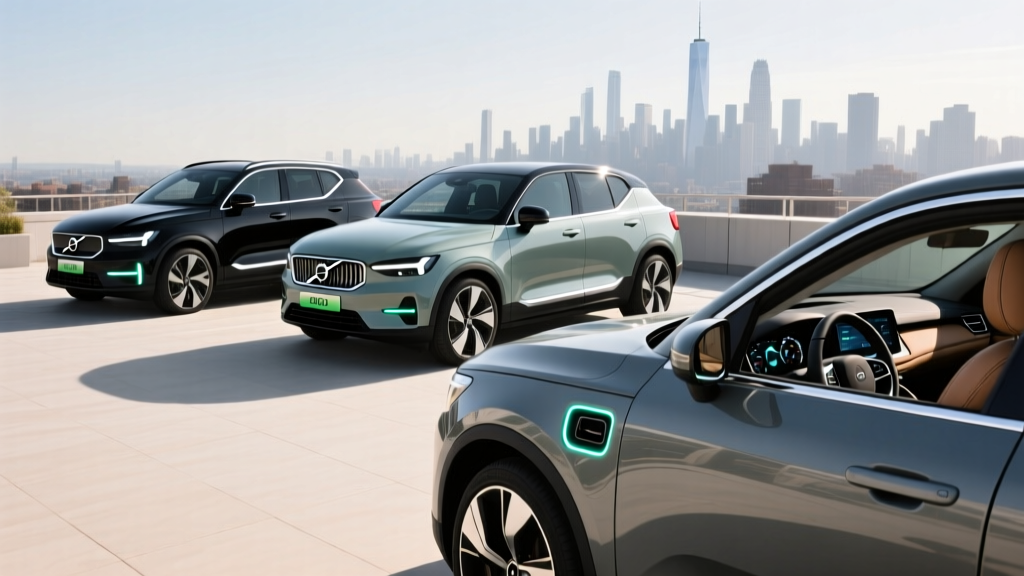
Volvo currently sells three fully electric models in the U.S. for 2026: the compact EX30 (starting ~$36,345, up to 265 miles EPA range), the midsize EX40 (formerly XC40 Recharge, starting ~$54,550, up to 293 miles), and the flagship three-row EX90 (starting ~$76,695, up to 310 miles). All use NMC lithium-ion batteries, support DC fast charging between 150–250 kW peak, and qualify for varying levels of the federal §30D tax credit depending on battery sourcing and buyer income. Real-world range typically drops 10–20% below EPA estimates in highway or cold-weather driving. Volvo's EV lineup prioritizes safety tech, minimalist Scandinavian design, and Google-based infotainment over maximum range-per-dollar, positioning them as premium alternatives to Tesla, BMW, and Genesis electric offerings.
Volvo's 2026 EV Lineup at a Glance
Volvo has committed fully to battery-electric vehicles, phasing out the "Recharge" plug-in hybrid branding. The current U.S. lineup covers three segments: subcompact luxury crossover (EX30), compact luxury crossover (EX40), and full-size luxury SUV (EX90). Here's how they stack up on paper:
| Spec | EX30 (Extended Range) | EX40 (Twin Motor) | EX90 (Twin Motor) |
|---|---|---|---|
| EPA Range | 265 mi | 293 mi | 310 mi (est.) |
| Battery (usable) | 69 kWh (NMC) | 82 kWh (NMC) | 111 kWh (NMC) |
| Peak DC Fast Charge | 153 kW | 200 kW | 250 kW |
| 10–80% DC Time | ~26 min | ~28 min | ~30 min |
| Level 2 Charge Rate | 11 kW | 11 kW | 11 kW |
| Horsepower | 272 hp (RWD) | 402 hp (AWD) | 496 hp (AWD) |
| 0–60 mph | 5.1 sec | 4.5 sec | 4.7 sec |
| Starting MSRP | $36,345 | $54,550 | $76,695 |
| Battery Warranty | 8 yr / 100,000 mi | 8 yr / 100,000 mi | 8 yr / 100,000 mi |
Real-World Range Reality Check
EPA estimates assume a mix of city and highway driving at moderate temperatures. Expect 220–240 miles from the EX30 and 250–270 miles from the EX40 in sustained 70+ mph highway driving. In sub-freezing winter conditions, NMC batteries typically lose 15–30% range without preconditioning. The EX90's large 111 kWh pack offers more buffer, but its heavy curb weight (~6,400 lbs) works against efficiency at speed.
Volvo EV vs. Gas Equivalent: What You Actually Save
The most common buyer question: does going electric with Volvo save money versus a gas-powered equivalent like the Volvo XC60 or a competitor like the BMW X3? The answer depends on your local electricity rate, annual mileage, and how long you keep the vehicle.
| Cost Factor (5 Years / 75,000 mi) | Volvo EX40 (EV) | Volvo XC60 B5 (Gas Mild-Hybrid) |
|---|---|---|
| Purchase Price (before incentives) | $54,550 | $48,350 |
| Federal Tax Credit (§30D) | Up to $3,750* | $0 |
| Fuel/Energy Cost | $3,900 (at $0.14/kWh avg) | $9,750 (at $3.50/gal, 25 MPG combined) |
| Maintenance (est.) | $1,800 | $3,500 |
| Insurance (est.) | $9,500 | $7,800 |
| 5-Year Total (approx.) | $66,000 | $69,400 |
*The EX40's §30D credit eligibility depends on battery component and critical mineral sourcing requirements per IRS rules. As of 2026, partial credit ($3,750) may apply if only one of the two sourcing thresholds is met. Buyer income caps ($150K single / $300K joint) and MSRP caps ($80K for SUVs) also apply. Consult a tax professional.
The EX40 breaks even around year 3–4 for most owners charging primarily at home. Public DC fast charging at $0.35–$0.50/kWh erodes savings significantly — a full EX40 charge at $0.45/kWh costs ~$37, nearly matching a gas fill-up. Home charging is where the economics work.
Charging the Volvo EV Fleet: What You Need to Know
All 2026 Volvo EVs use the NACS (Tesla-style) connector for both Level 2 AC and DC fast charging in North America, following Volvo's adoption of the standard. This means native access to Tesla Supercharger stations (over 20,000 stalls) without an adapter — a significant practical advantage over CCS-equipped competitors.
| Charging Level | Power | Miles Added Per Hour | Best For |
|---|---|---|---|
| Level 1 (120V household) | ~1.4 kW | 3–5 mi/hr | Overnight top-ups, low-mileage days |
| Level 2 (240V home) | 11 kW | 28–35 mi/hr | Daily home charging, full overnight refill |
| DC Fast Charge | 153–250 kW (peak) | ~150–250 mi in 15 min | Road trips, quick stops |
Charging curve reality: Peak kW figures apply only at low state-of-charge (typically 10–30%). All three models taper significantly above 80% SoC to protect battery health. A "10–80%" time of 28 minutes does not mean 0–100% in 37 minutes — the final 20% can add another 30–45 minutes. For road trips, plan to charge from 10% to 80% and keep moving.
For home Level 2 installation, budget $800–$2,500 total: a quality NACS wall connector ($400–$650), electrician labor for a 60-amp circuit ($400–$1,500), and possible panel upgrade ($500–$2,000 if your home has a 100-amp service). Homes with 200-amp panels usually need no upgrade.
Tax Credits and Incentives for Volvo EVs
Federal §30D tax credit eligibility for Volvo EVs is nuanced in 2026. The full $7,500 credit requires meeting both the battery component and critical mineral sourcing thresholds. Volvo sources battery cells from CATL (China) and LG Energy Solution, and the sourcing mix varies by model and production batch.
- MSRP Cap: All three Volvo EVs fall under the $80,000 SUV cap at base trim. Higher trims of the EX90 may exceed this — verify the specific window sticker.
- Buyer Income Cap: Modified AGI must not exceed $150,000 (single), $225,000 (head of household), or $300,000 (married filing jointly).
- Battery Sourcing: Check the VIN-specific eligibility on fueleconomy.gov at time of purchase — rules shift as sourcing agreements change.
- Point-of-Sale Transfer: You can transfer the credit to the dealer at purchase to reduce your out-of-pocket cost immediately, rather than waiting for a tax refund.
Many states offer additional rebates (California's CVRP, Colorado's state credit, etc.), but these vary by jurisdiction and funding availability. Check your state energy office for current programs.
Volvo EV Ownership: Practical Considerations
Who Should Buy a Volvo EV?
Volvo's electric lineup appeals to buyers who prioritize safety technology (standard Pilot Assist with run-off-road protection, intersection auto-braking), understated luxury (no massive screens or aggressive styling), and Google-integrated infotainment (native Google Maps navigation with route-based battery preconditioning). The EX30 targets urban professionals; the EX40 suits small families; the EX90 serves three-row buyers who want something distinct from the Tesla Model X or Rivian R1S.
Who Should Look Elsewhere?
If maximum range per dollar is your priority, the Hyundai Ioniq 5 (310+ mi, faster 800V charging) or Tesla Model Y (320+ mi, lower price) offer more efficiency. If you frequently tow, Volvo's EVs are not rated for heavy towing (the EX90 maxes at ~5,000 lbs, and towing cuts range by 30–40%). And if you lack access to home or workplace charging, the higher cost of public DC charging diminishes the economic case.
Decision Framework: Which Volvo EV Fits You?
Choose the EX30 if: You commute under 40 miles daily, live in an urban area, want the lowest entry price, and don't need rear-seat space for adults regularly.
Choose the EX40 if: You need a practical family crossover with AWD, want sub-5-second 0–60 performance, and take road trips 3–5 times per year.
Choose the EX90 if: You need three rows, want the latest Volvo safety tech (including LiDAR-equipped Pilot Assist), and budget allows for a $75K+ vehicle.
Consider a PHEV or gas alternative if: You regularly drive 400+ miles between charging opportunities, live in an apartment without charging access, or frequently tow over 3,500 lbs.
Common Volvo EV Misconceptions
| Myth | Fact |
|---|---|
| "Volvo EVs don't have enough range for road trips." | The EX40's 293 EPA miles and NACS Supercharger access means 200+ real miles between 15-minute charge stops — comparable to gas-car rest breaks. |
| "The battery will need expensive replacement in a few years." | NMC batteries in modern Volvos are warrantied for 8 years/100,000 miles at 70% capacity retention. Real-world degradation data shows ~10–15% loss over 150,000 miles with normal use. |
| "All Volvos qualify for the full $7,500 tax credit." | Credit eligibility varies by VIN, production date, and buyer income. Some may qualify for $3,750 or $0. Always verify before purchasing. |
| "Cold weather makes Volvo EVs unusable." | Range drops 15–30% in freezing temps, but the battery heat pump and preconditioning (via the Volvo app while plugged in) mitigate this significantly. Expect ~200 real miles from an EX40 in 20°F weather. |
| "Volvo's Pilot Assist is self-driving." | Pilot Assist is an SAE Level 2 driver-assistance system. It handles steering and speed on marked highways but requires constant driver supervision and hands-on-wheel attention. It is not autonomous. |
Frequently Asked Questions
Can I charge a Volvo EV at a Tesla Supercharger?
Yes. All 2026 Volvo EVs sold in North America come with the NACS charge port natively, giving you direct access to the Tesla Supercharger network without any adapter. This is one of Volvo's strongest practical advantages over remaining CCS-port vehicles.
How much does it cost to charge a Volvo EX40 at home?
At the U.S. average residential rate of ~$0.14/kWh, a full 82 kWh charge costs approximately $11.50 and adds ~293 EPA miles. That works out to roughly $0.04 per mile — about one-third the per-mile cost of a 25 MPG gas vehicle at $3.50/gallon.
What is Volvo's battery warranty coverage?
Volvo covers the high-voltage traction battery for 8 years or 100,000 miles, whichever comes first. The warranty guarantees at least 70% of original capacity retention. If degradation exceeds 30% within the warranty period, Volvo will repair or replace the battery at no cost.
Is the Volvo EX90 actually available to buy?
The EX90 began U.S. deliveries in late 2024 as a 2025 model and continues into the 2026 model year. However, production volumes remain limited, and wait times at dealerships can stretch 2–4 months depending on trim and configuration. Check local dealer inventory for availability.
How does Volvo's EV reliability compare to Tesla or Hyundai?
Volvo's EV reliability is still establishing a track record — the EX40 (formerly XC40 Recharge) has been on sale since 2021 and scores average to above-average in owner surveys. Tesla benefits from a longer data history but has inconsistent build quality ratings. Hyundai/Kia's E-GMP platform (Ioniq 5, EV6) has strong early reliability marks and faster 800V charging capability. According to IIHS, the EX40 earns Top Safety Pick+ honors, which remains a Volvo hallmark.
Do Volvo EVs hold their resale value?
EV depreciation has been steeper than gas vehicles industry-wide (averaging 45–55% over 3 years vs. 30–40% for gas). Volvo EVs depreciate in line with luxury EV averages. Leasing can mitigate this risk, and Volvo frequently offers subsidized lease deals that factor in estimated residual values.
Sources: fueleconomy.gov (EPA range and MPGe data), IRS §30D Clean Vehicle Credit, Volvo Cars USA official specifications. Pricing and credit eligibility current as of early 2026; verify at time of purchase.