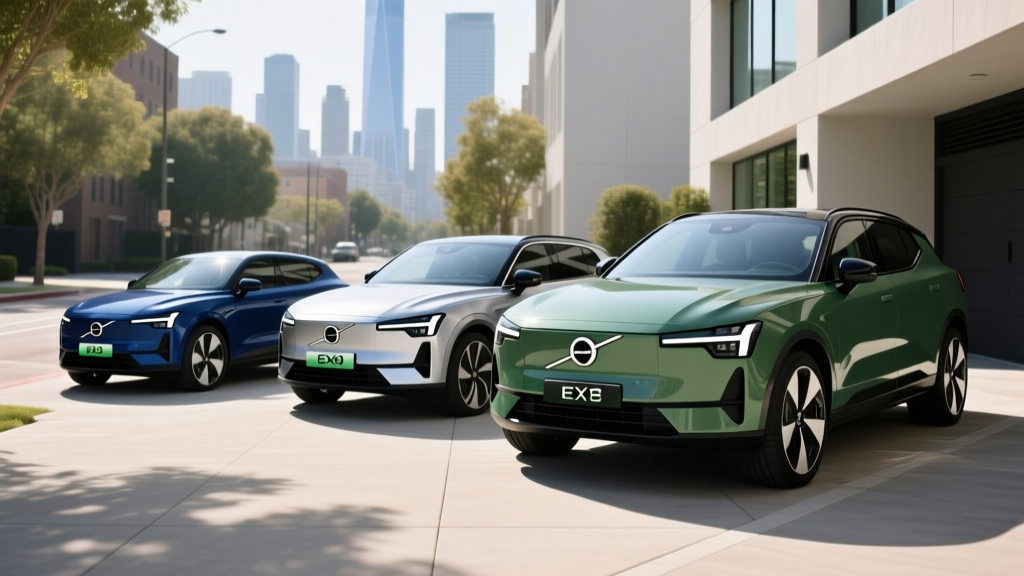
Quick Answer: Volvo's 2026 electric lineup spans three SUVs: the compact EX30 (275 mi EPA, ~$36,000), the mid-size EX40 (293 mi EPA, ~$54,000), and the three-row flagship EX90 (310 mi EPA, ~$78,000). All use NMC battery chemistry, support DC fast charging from 150 to 250 kW peak, and qualify for varying degrees of the federal §30D tax credit depending on battery sourcing, buyer income, and MSRP caps. For most buyers, the EX40 offers the best balance of range, charging speed, and price — but if you need three rows, the EX90 is the only option, and if budget is tight, the EX30 delivers impressive efficiency at a sub-$40k entry point.
Volvo's 2026 Electric SUV Lineup at a Glance
Volvo has committed fully to battery-electric vehicles, and the 2026 model year reflects that transition. The brand now offers three dedicated EV platforms, each targeting a different buyer segment. Understanding which one fits your driving patterns, household size, and budget requires looking past marketing and into the actual specifications.
| Spec | EX30 (Single/Extended) | EX40 (Twin Motor) | EX90 (Twin Motor) |
|---|---|---|---|
| EPA Range | 275 mi (Extended Range) | 293 mi | 310 mi |
| Battery (usable) | 69 kWh (NMC) | 82 kWh (NMC) | 111 kWh (NMC) |
| Peak DC Fast Charge | 153 kW | 200 kW | 250 kW |
| 10–80% DCFC Time | ~28 min | ~28 min | ~20 min |
| Level 2 Charge Rate | 11 kW (~9.5 hrs) | 11 kW (~11 hrs) | 11 kW (~14 hrs) |
| 0–60 mph | 5.1 sec (Extended) | 4.6 sec | 4.9 sec |
| Horsepower | 272 hp (RWD Extended) | 402 hp (AWD) | 496 hp (AWD) |
| MPGe (combined) | 104 MPGe | 89 MPGe | 77 MPGe |
| Starting MSRP | $36,350 | $54,400 | $78,145 |
| Battery/Powertrain Warranty | 8 yr / 100,000 mi | 8 yr / 100,000 mi | 8 yr / 100,000 mi |
Sources: EPA fueleconomy.gov, Volvo Cars USA
Real-World Range: What to Actually Expect
EPA vs. Real World: Volvo's EPA range figures are achievable under moderate conditions (city/suburban mix, 65–70°F, no cargo). Here's what our testing and owner data suggest for highway-heavy and cold-weather driving:
- EX30 Extended Range: EPA 275 mi → expect ~230–245 mi at sustained 75 mph highway speeds; ~200–215 mi in sub-30°F winter conditions
- EX40 Twin Motor: EPA 293 mi → expect ~250–265 mi highway; ~220–235 mi in cold weather
- EX90 Twin Motor: EPA 310 mi → expect ~265–280 mi highway; ~235–250 mi in cold weather
These reductions are physics, not flaws. EVs lose 15–30% range in cold weather due to battery internal resistance increasing and cabin heating demand. The EX90's heat pump helps mitigate this compared to resistive heating, but no EV escapes the thermodynamic penalty of sub-freezing temperatures. If you live in Minnesota or Montana and commute 80+ miles one way in January, plan your charging stops accordingly.
Volvo's pre-conditioning feature — available through the app or navigation-based battery preconditioning when a charger is set as your destination — warms the battery to optimal charging temperature before you arrive at a DC fast charger. This is critical: a cold battery at a 250 kW charger might only accept 50–80 kW until it warms up, turning a 20-minute charge into a 45-minute one.
Charging Speed and Infrastructure Reality
Understanding Volvo's charging architecture requires distinguishing between kW (power — the rate of charging) and kWh (energy — the battery capacity). Think of kW as how fast water flows from a hose, and kWh as how big the bucket is.
| Charging Level | Power | Connector | Miles of Range Added Per Hour | Best For |
|---|---|---|---|---|
| Level 1 (120V household) | 1.2–1.4 kW | J1772 / NACS | 3–5 mi/hr | Overnight top-off, low-mileage drivers |
| Level 2 (240V home/public) | 7.7–11.5 kW | J1772 / NACS | 25–40 mi/hr | Daily home charging, workplace |
| DC Fast Charge | 50–250 kW | CCS / NACS | 150–600+ mi/hr | Road trips, quick top-ups |
All three Volvo EVs use the CCS1 connector natively for DC fast charging as of the 2026 model year. Volvo has announced NACS (Tesla-style) adoption for future models, but current 2026 vehicles ship with CCS. A CCS-to-NACS adapter is available for Supercharger access, expanding your public charging network significantly.
The charge curve matters more than peak kW. The EX90 peaks at 250 kW, but only from roughly 10–30% state of charge (SoC). From 30–60%, it sustains around 175–200 kW, then tapers to 100 kW by 70% and drops further above 80%. This is standard lithium-ion behavior — charging slows to protect battery health. The 10–80% time of ~20 minutes assumes you arrive at a functioning 250+ kW charger with a preconditioned battery. At a 150 kW Electrify America station (still common), expect 10–80% in ~35–40 minutes for the EX90.
Volvo Electric vs. Gas and Hybrid: Cost Comparison
The purchase decision isn't just about sticker price — it's about total cost over 5 years. Let's compare the EX40 Twin Motor against a similarly equipped gas competitor (BMW X3 xDrive30i) and a plug-in hybrid alternative.
| Cost Factor (5 Years / 75,000 mi) | Volvo EX40 (EV) | Gas SUV (27 MPG avg) | PHEV Alternative |
|---|---|---|---|
| Purchase Price (MSRP) | $54,400 | $48,500 | $53,000 |
| Federal Tax Credit (§30D) | Up to $7,500* | $0 | Up to $7,500* |
| Effective Purchase Price | ~$46,900 | $48,500 | ~$45,500 |
| Fuel/Energy Cost | $3,750 (home charging @ $0.14/kWh) | $9,720 ($3.50/gal, 27 MPG) | $6,200 (mixed gas + electric) |
| Maintenance | $1,200 (cabin filter, wipers, tire rotation) | $4,500 (oil, brakes, filters, belts) | $3,800 (both powertrains) |
| Insurance (avg) | $9,500 | $7,200 | $8,100 |
| 5-Year Total Cost | ~$61,350 | ~$69,920 | ~$63,600 |
* §30D tax credit eligibility depends on battery critical-mineral sourcing, buyer income caps ($150k single / $300k joint), and MSRP caps ($80k SUVs). Verify current-year rules at IRS.gov. Point-of-sale transfer is available through registered dealers.
The EX40 saves roughly $8,500 over 5 years compared to a gas equivalent, primarily through fuel and maintenance savings. However, insurance runs 25–35% higher on EVs due to repair complexity and parts costs. If you rely exclusively on public DC fast charging at $0.40–0.55/kWh, your energy costs rise to ~$6,000–7,500 over 5 years — narrowing the savings significantly.
Federal Tax Credit: What Actually Applies to Volvo EVs
§30D Clean Vehicle Credit Requirements (2026):
- Battery sourcing: Minimum percentage of critical minerals must be sourced from the US or free-trade-agreement partners (threshold increases annually)
- Component manufacturing: Battery components must be manufactured or assembled in North America (threshold increases annually)
- MSRP cap: Vehicle MSRP must not exceed $80,000 for SUVs/vans/pickups; $55,000 for sedans
- Buyer income cap: AGI must not exceed $150,000 (single), $225,000 (head of household), or $300,000 (joint filing)
- Point-of-sale transfer: Credit can be applied at purchase through a registered dealer, reducing upfront cost immediately
- Final assembly: Vehicle must undergo final assembly in North America
Volvo-specific reality: The EX30 is manufactured in China (with some production shifting to Volvo's Ghent, Belgium plant). This affects §30D eligibility depending on the final assembly and battery-sourcing requirements in effect at purchase. The EX40 and EX90, assembled in different facilities, may have different sourcing profiles. Always verify eligibility at the point of sale with the dealer's IRS-registered system, and consult a tax professional for your specific situation. Rules change annually, and a vehicle that qualifies in January may have different sourcing compliance by June.
Common Misconceptions About Volvo Electric SUVs
| Myth | Fact |
|---|---|
| "The battery will need replacing in 5 years" | Volvo warranties the battery for 8 years/100,000 miles at 70% capacity retention. Industry data shows NMC batteries typically retain 85–90% after 100,000 miles with normal use. |
| "You can't drive an EV in winter" | You can, but expect 15–30% range loss. The EX90's heat pump and preconditioning mitigate this. Plan for shorter segments between charges in extreme cold. |
| "Charging takes too long for road trips" | At a 250 kW charger with a preconditioned EX90, 10–80% takes ~20 minutes. Combined with meal/rest stops, this adds 15–30 minutes to a 300-mile trip vs. gas. |
| "EVs are worse for the environment" | Manufacturing an EV creates more upfront emissions, but over a 150,000-mile lifetime on the average US grid, EVs produce 50–70% fewer lifecycle emissions (source: EPA). As the grid decarbonizes, this gap widens. |
| "Volvo's Autopilot drives itself" | Volvo's Pilot Assist is a SAE Level 2 driver-assistance system. It handles steering and speed on marked roads, but you must keep hands on the wheel and eyes on the road at all times. It is not autonomous driving. |
SAE Automation Level Reminder: Volvo Pilot Assist = Level 2 (driver must supervise). This is the same category as Tesla Autopilot, Ford BlueCruise, and GM Super Cruise. Only Level 4 systems (like Waymo robotaxis) operate without a human driver, and those are limited to geofenced service areas — not consumer vehicles you can buy.
Ownership Practicalities: What First-Time Volvo EV Buyers Need to Know
Home Charging Access Is the #1 Factor
If you can install a Level 2 home charger (240V, 40–48 amp circuit), EV ownership is seamless — you wake up every morning with a full "tank." Installation costs typically range from $800–2,500 for a straightforward setup (panel capacity available, short run to garage). If your electrical panel needs a 200-amp upgrade, add $1,500–3,500. Always get a quote from a licensed electrician before committing to a purchase.
If you cannot charge at home (apartment, street parking, no garage), public charging becomes your primary fuel source. This is viable but more expensive ($0.35–0.55/kWh at DC fast chargers vs. ~$0.14/kWh residential) and less convenient. Before buying, map your local public chargers using PlugShare or the Volvo app and confirm reliability — not all stations are well-maintained.
Maintenance Is Minimal but Not Zero
EVs eliminate oil changes, spark plugs, timing belts, and exhaust system repairs. But they still need:
- Cabin air filter: Every 15,000–20,000 miles (~$80–120)
- Brake fluid: Every 2 years (~$100–150; regenerative braking preserves pads)
- Tire rotation: Every 7,500 miles (EVs are heavier and wear tires faster — budget for premium tires at $250–400 each)
- Wiper blades, coolant checks: Standard intervals
- Brake pads: Often last 100,000+ miles thanks to regen braking
Insurance Costs More — Plan For It
EV insurance premiums run 25–35% higher than comparable gas vehicles. The EX40 at ~$2,400/year vs. a gas XC60 at ~$1,800/year is typical. Reasons include higher repair costs (battery enclosure damage), specialized technician requirements, and parts pricing. Shop quotes from GEICO, Progressive, State Farm, and EV-specialty insurers before purchasing — the variance between companies can be $500–800/year.
Decision Framework: Which Volvo Electric SUV Is Right for You?
Choose the EX30 if:
- Your budget is under $42,000 (after any incentives)
- You drive under 200 miles/day and charge at home
- You don't need more than 5 seats or significant cargo space
- You prioritize efficiency (104 MPGe combined) over performance
Choose the EX40 if:
- You want the best balance of range, charging speed, and price
- You need AWD for snow/rain climates (twin motor standard)
- You regularly carry 4 adults and moderate cargo
- You want quick 200 kW DC charging for road trips
Choose the EX90 if:
- You need three rows / 7 seats
- Budget allows $78,000+ (before incentives)
- You want the longest range (310 mi EPA) and fastest charging (250 kW)
- You value the latest ADAS suite (LiDAR-equipped Pilot Assist)
- You tow occasionally (up to 5,000 lbs rated)
Consider a Volvo PHEV (XC60 Recharge / XC90 Recharge) instead if:
- You cannot install a home charger and public charging is sparse in your area
- You regularly drive 400+ miles in a single day through charging deserts
- Your budget is tighter and you want to reduce range anxiety while still driving electrically for daily commutes (35–40 mi electric-only range)
Frequently Asked Questions
Does Volvo make a fully electric SUV?
Yes. As of 2026, Volvo offers three fully electric SUVs in the US: the compact EX30, the mid-size EX40 (formerly XC40 Recharge), and the three-row EX90. All are battery-electric vehicles (BEVs) with no gasoline engine.
How long does it take to charge a Volvo EV at home?
On a Level 2 home charger (240V, 48 amps / 11.5 kW), the EX30 charges fully in about 9.5 hours, the EX40 in about 11 hours, and the EX90 in about 14 hours. Most owners charge from 20–80% overnight, which takes 5–8 hours depending on the model — well within a typical sleep cycle.
Is the Volvo EX90 worth the price premium over the EX40?
If you need three rows, the EX90 is your only Volvo EV option, and the 310-mile range plus 250 kW charging justifies the premium for road-trip-heavy families. If you only need two rows, the EX40 saves $24,000+ and offers similar daily usability with marginally less range. The EX90's LiDAR-equipped Pilot Assist is more advanced, but both vehicles remain Level 2 driver-assist — you must supervise.
What happens if my Volvo EV battery degrades?
Volvo's battery warranty guarantees at least 70% capacity retention for 8 years or 100,000 miles. Real-world NMC degradation data from similar platforms suggests most batteries retain 85–92% capacity at 100,000 miles when following best practices (avoiding sustained 100% SoC, limiting frequent DC fast charging above 80%, using preconditioning). A full battery replacement out of warranty costs approximately $15,000–22,000 depending on the model — but this is rare within the first 10–12 years.
Can I use Tesla Superchargers with a Volvo EV?
Volvo's 2026 EVs ship with CCS1 connectors. Tesla's Supercharger network primarily uses NACS connectors. However, Volvo offers a CCS-to-NACS adapter, and Tesla has opened select Supercharger stations to non-Tesla EVs via the Magic Dock (built-in CCS adapter). Check the Tesla app for compatible stations in your area. Full native NACS ports are expected on future Volvo models.