Quick Answer: Volvo's 2026 EV Lineup at a Glance
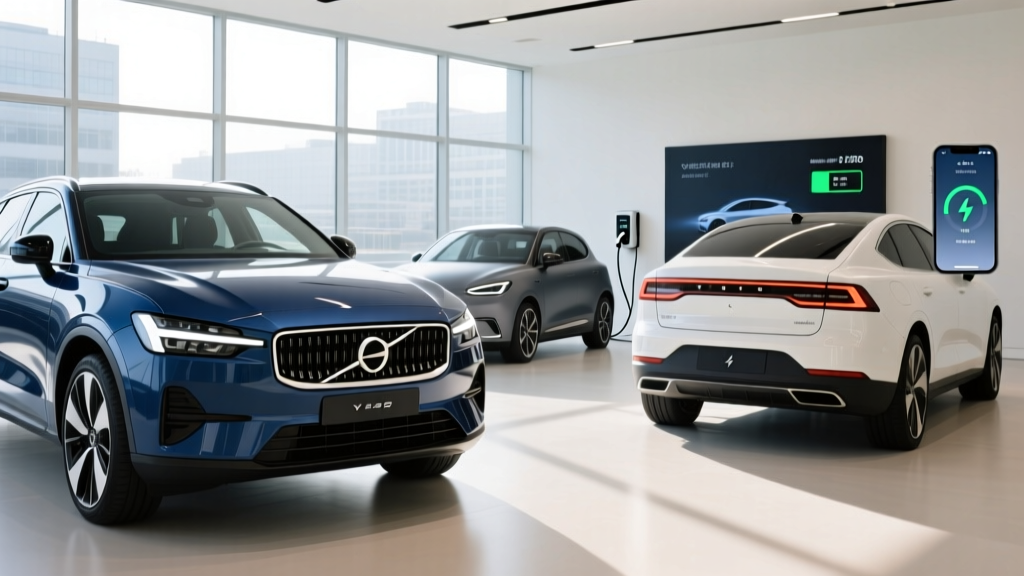
Volvo's fully electric lineup for the 2026 model year includes three vehicles: the compact EX30 (275 mi EPA, ~$36,000), the midsize EX40 (296 mi EPA, ~$53,000), and the three-row flagship EX90 (300+ mi EPA, ~$78,000). All three feature 800V-capable architectures for fast DC charging, Google built-in infotainment, and Volvo's Pilot Assist Level 2 driver-assistance system. If you can charge at home and your daily commute is under 60 miles, any of these will cover your routine driving without plugging in daily. The real decision comes down to passenger space, budget, and whether the §30D federal tax credit applies to your income and the vehicle's sourcing.
Volvo's 2026 Electric Car Lineup: Specs That Matter
Volvo has committed fully to electrification, and by 2026 the brand's EV portfolio has matured past early-adopter status into practical, daily-drivable territory. Here are the hard numbers across the three core models, drawn from EPA estimates and Volvo's official specifications.
| Spec | EX30 Single Motor | EX40 Twin Motor | EX90 Twin Motor |
|---|---|---|---|
| EPA Range | 275 mi | 296 mi | ~300 mi |
| Real-World Range (highway/cold) | ~210–240 mi | ~230–260 mi | ~235–265 mi |
| Battery (usable kWh) | 69 kWh (NMC) | 82 kWh (NMC) | 111 kWh (NMC) |
| Peak DC Charge Rate | 153 kW | 200 kW | 250 kW |
| 10–80% DC Charge Time | ~26 min | ~28 min | ~30 min |
| Level 2 Charge Rate | 11 kW (AC) | 11 kW (AC) | 11 kW (AC) |
| Horsepower | 272 hp | 408 hp | 496 hp |
| 0–60 mph | 5.4 sec | 4.5 sec | 4.7 sec |
| Efficiency (MPGe) | 114 MPGe combined | 95 MPGe combined | ~88 MPGe combined |
| Starting MSRP | $36,345 | $53,345 | $78,250 |
| Battery Warranty | 8 yr / 100,000 mi | 8 yr / 100,000 mi | 8 yr / 100,000 mi |
Volvo EVs vs. Gas and Hybrid Alternatives: Cost and Efficiency
Volvo still sells plug-in hybrids (the XC60 Recharge, XC90 Recharge, S60 Recharge) alongside its pure EVs. The question many buyers face: which powertrain actually saves money over five years? Let's compare the EX40 against the similarly sized XC60 Recharge PHEV and the gas-only XC60 B5.
| Metric | EX40 (BEV) | XC60 Recharge (PHEV) | XC60 B5 (Gas) |
|---|---|---|---|
| MSRP (base) | $53,345 | $58,450 | $47,350 |
| EPA Efficiency | 95 MPGe | 63 MPGe / 28 MPG gas | 26 MPG combined |
| Electric-Only Range | 296 mi | 35 mi | N/A |
| Annual Fuel/Energy Cost* | ~$620 | ~$1,100 | ~$2,150 |
| 5-Year Fuel/Energy Cost | ~$3,100 | ~$5,500 | ~$10,750 |
| Estimated Maintenance (5 yr) | ~$1,200 | ~$2,800 | ~$3,200 |
| 5-Year Total (vehicle + fuel + maint.) | ~$57,645 | ~$66,750 | ~$61,300 |
*Based on 15,000 mi/year, $0.16/kWh national average electricity, and $3.60/gallon regular unleaded. Your local rates will shift these numbers. Source: fueleconomy.gov.
The EX40's lower energy and maintenance costs close the MSRP gap with the gas XC60 within roughly 3–4 years of ownership. Against the XC60 Recharge PHEV, the EX40 wins on total cost decisively — the PHEV's higher MSRP and dual-powertrain maintenance (oil changes, spark plugs, transmission fluid) erode its efficiency advantage. However, if you lack home charging and frequently drive 300+ miles between stops, the PHEV's gas fallback removes the charging logistics problem entirely.
Real Ownership Costs: What Volvo EV Buyers Actually Spend
Sticker price is just the entry point. Here's a more complete picture of what owning a Volvo EV costs in 2026, using the EX40 Twin Motor as the representative model.
| Cost Category | 5-Year Estimate | Notes |
|---|---|---|
| Purchase Price (MSRP) | $53,345 | Higher trims (Ultra) add ~$4,000–$6,000 |
| Federal Tax Credit (§30D) | Up to $7,500 | Subject to income caps, MSRP limits, battery sourcing rules |
| Home Level 2 Charger Install | $800–$2,200 | 240V/48A circuit; panel upgrade may add $1,500–$3,000 |
| Electricity (Home Charging) | $2,800–$3,500 | Depends on local kWh rate; solar owners pay less |
| Public DC Fast Charging | $400–$900 | For road trips; ~$0.35–$0.50/kWh average |
| Insurance | $9,500–$12,500 | EV premiums run 15–25% higher than gas equivalents |
| Maintenance | $1,000–$1,500 | Cabin filter, wipers, brake fluid, tire rotation; no oil changes |
| Tires | $1,800–$2,800 | EVs wear tires 20–30% faster due to weight and torque |
The biggest variables are your electricity rate and insurance premium. Homeowners in states with cheap electricity (Washington, Idaho, Louisiana) may spend under $500/year to charge. Apartment dwellers relying on public chargers could spend $1,500+. Insurance for Volvo EVs tends to be above average — get quotes before purchasing, as premiums vary dramatically by ZIP code and driving record.
Tax Credits and Incentives: What Actually Applies to Volvo EVs
The federal §30D Clean Vehicle Credit offers up to $7,500, but eligibility is not universal. Here's the checklist as of 2026:
- MSRP Cap: SUVs (EX40, EX90) must be under $80,000; sedans/wagons under $55,000. The EX90's starting MSRP of $78,250 qualifies at base, but loaded trims may exceed the cap.
- Buyer Income Limits: AGI must not exceed $300,000 (joint), $225,000 (head of household), or $150,000 (single). Exceed these and you lose the credit entirely.
- Battery Sourcing: The $7,500 credit splits into two $3,750 halves — one for critical minerals, one for battery component assembly. Volvo sources NMC cells primarily from CATL and LG Energy Solution; sourcing compliance shifts annually. Check the IRS clean vehicle credit page for the current qualifying VIN list.
- Point-of-Sale Transfer: As of 2024+, you can transfer the credit to the dealer at purchase, reducing your out-of-pocket cost immediately rather than waiting for tax filing. This requires the dealer to be IRS-registered.
The EX30's $36,345 MSRP clears the cap easily, and its smaller battery may have different sourcing compliance than the EX90. Verify with your dealer and consult a tax professional — these rules change, and state-level incentives (which we won't quote here because they vary wildly) can stack on top.
Charging at Home and on the Road: What Volvo EV Owners Experience
All 2026 Volvo EVs use the NACS (North American Charging Standard) connector, giving native access to Tesla's Supercharger network — over 20,000 stalls in the U.S. This was a significant competitive advantage Volvo secured by adopting NACS early.
| Charging Level | Power | Miles Added per Hour | Typical Use Case |
|---|---|---|---|
| Level 1 (120V) | 1.4 kW | 3–5 mi/hr | Overnight top-up; emergency only |
| Level 2 (240V, 48A) | 11.5 kW | 30–38 mi/hr | Home daily charging; full charge in 7–10 hr |
| DC Fast Charge | 153–250 kW | 600–900 mi/hr (peak) | Road trips; 10–80% in 26–30 min |
At home, a Level 2 charger is essentially mandatory for convenient ownership. A full EX90 charge from empty on Level 2 takes about 10 hours — plug in at night, wake up full. Without home charging, you're making multiple weekly trips to public chargers, which adds real friction.
On road trips, Volvo's charge curve is competitive but not class-leading. The EX90 peaks at 250 kW but tapers significantly above 60% SoC. Expect the 10–80% charge to take roughly 30 minutes, with the final 20% adding another 25+ minutes if you push to 100%. On long trips, plan stops around the 10–80% window for the best time-to-miles ratio.
Common Misconceptions About Volvo EVs — Corrected with Data
| Myth | Fact |
|---|---|
| "EV batteries need replacing every few years at huge cost." | Volvo warranties its batteries for 8 years / 100,000 miles at 70% minimum capacity retention. Real-world NMC degradation data shows most packs lose 8–12% over 5 years — well within warranty. Full replacement, if needed, runs $12,000–$18,000 but is rare. |
| "Volvo EVs can't handle cold weather." | All 2026 Volvo EVs include a heat pump, which reduces cold-weather range loss compared to resistive heating. Expect ~20–30% range reduction at 20°F — significant but manageable with preconditioning. The EX90's 111 kWh battery means even at 70% real-world capacity in cold, you still have ~210 miles. |
| "Pilot Assist is self-driving." | Pilot Assist is an SAE Level 2 driver-assistance system. It handles adaptive cruise and lane centering on highways, but you must keep your hands on the wheel and eyes on the road. It does not navigate intersections, construction zones, or unmapped roads autonomously. |
| "Charging is always cheaper than gas." | Home charging at $0.12–$0.18/kWh is dramatically cheaper. But DC fast charging at $0.40–$0.55/kWh can approach or exceed the per-mile cost of a 30+ MPG gas car. If you rely exclusively on public charging, run the numbers for your local rates. |
| "Volvo's EVs are too expensive for normal buyers." | The EX30 starts at $36,345, and with a $7,500 credit (if eligible), the effective price drops to ~$28,845 — competitive with many gas compact SUVs. The EX40 and EX90 target premium buyers and are priced accordingly. |
Decision Framework: Which Volvo (or Volvo Alternative) Fits You?
Choose the EX30 if: You want the most affordable entry into Volvo's EV lineup, commute under 40 miles daily, rarely carry more than one passenger, and prioritize city agility over cargo space. It's also the strongest candidate for the full $7,500 tax credit given its price.
Choose the EX40 if: You need a practical midsize SUV with 296 miles of range, 408 hp for confident highway merging, and enough cargo room (25.3 cu ft behind the rear seats) for a family. This is Volvo's volume EV for good reason.
Choose the EX90 if: You need three rows, want Volvo's most advanced safety sensor suite (including lidar), and have the budget for a $78,000+ vehicle. The 111 kWh battery gives genuine road-trip confidence, but watch the MSRP cap on loaded trims.
Choose a Volvo PHEV (XC60/XC90 Recharge) instead if: You lack reliable home charging, regularly drive routes with sparse charging infrastructure, or want electric commuting (35 mi EV range) with gas fallback for long trips. The total cost of ownership is higher, but the flexibility is real.
Look outside Volvo if: You need maximum range (Hyundai Ioniq 6 at 361 mi EPA), the lowest price (Chevrolet Equinox EV at ~$33,000), or the fastest charging (Hyundai/Kia 800V platforms, 10–80% in ~18 min). Volvo's strengths are safety, build quality, and design — not segment-leading specs in every category.
Frequently Asked Questions
Are Volvo electric cars reliable?
Volvo's EVs use proven NMC battery chemistry and conventional permanent-magnet motor designs. Early EX40 models (formerly C40 Recharge) showed average reliability in consumer surveys, with most complaints centered on software glitches in the Google-based infotainment rather than powertrain failures. The mechanical simplicity of EVs — no transmission, no exhaust system, no timing belt — inherently reduces failure points compared to gas vehicles.
How long does a Volvo EV battery last?
Volvo guarantees at least 70% capacity retention over 8 years or 100,000 miles, whichever comes first. Industry-wide NMC data suggests typical degradation of 1.5–2.5% per year under normal use. That means a 10-year-old EX40 with 120,000 miles might retain 80–85% of its original capacity — still delivering ~240 miles of range from its 82 kWh pack.
Can I charge a Volvo EV at a Tesla Supercharger?
Yes. All 2026 Volvo EVs come with the NACS connector natively, providing direct access to Tesla's Supercharger network without an adapter. This is one of Volvo's strongest charging advantages — Tesla's network is widely regarded as the most reliable DC fast-charging infrastructure in the U.S.
Is the Volvo EX90 worth the premium over the EX40?
If you need three-row seating and value Volvo's latest safety hardware (lidar, advanced driver monitoring), the EX90 justifies its price. If you only need two rows, the EX40 offers similar build quality, faster 0–60 times, and nearly identical range at $25,000 less. The EX90 is a family hauler; the EX40 is a daily driver.
What should a first-time Volvo EV buyer prepare for?
Three things: (1) Install a Level 2 home charger before or immediately after delivery — budget $800–$2,200 for equipment and electrician labor. (2) Download the Volvo Cars app and set up charging schedules to take advantage of off-peak electricity rates. (3) Get insurance quotes early — EV premiums can be 15–25% higher than comparable gas models, and shopping around can save $200–$400/year.