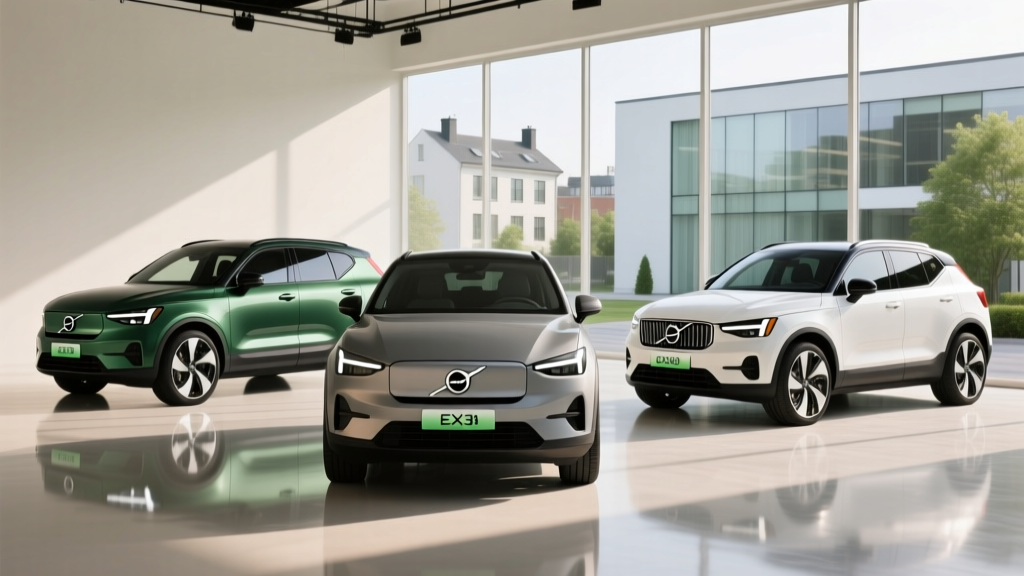
Quick Answer: Volvo's electric car lineup in 2026 centers on three models: the compact EX30 (EPA est. ~265 miles, starting ~$36,345), the flagship three-row EX90 (EPA est. ~310 miles, starting ~$76,695), and the established XC40 Recharge / C40 Recharge twins (EPA est. ~293 miles, starting ~$54,950). Whether a Volvo EV is worth it depends heavily on your charging access, budget, and whether you qualify for the federal §30D tax credit (up to $7,500, subject to income, MSRP caps, and battery-sourcing rules). Volvo EVs excel in safety tech, build quality, and Scandinavian design, but they carry premium pricing and their public charging reliability depends on your local infrastructure. Below, we break down exact specs, real-world range, ownership costs, and a decision framework to help you choose.
Volvo's Electric Car Lineup: 2026 Specs at a Glance
Volvo has committed to full electrification, and its 2026 lineup reflects a transition from converted ICE platforms (XC40/C40 Recharge) to dedicated EV architectures (EX30 on SEA, EX90 on SPA2). Here is how the core models stack up on paper.
| Spec | EX30 Single Motor | EX30 Twin Motor | XC40 Recharge | EX90 Twin Motor |
|---|---|---|---|---|
| EPA Range (est.) | ~265 mi | ~250 mi | ~293 mi | ~310 mi |
| Battery (usable kWh) | 69 kWh (NMC) | 69 kWh (NMC) | 82 kWh (NMC) | 111 kWh (NMC) |
| Peak DC Fast Charge | 153 kW | 153 kW | 200 kW | 250 kW |
| 10–80% DCFC Time | ~26 min | ~26 min | ~28 min | ~30 min |
| Level 2 Charge Rate | 11 kW | 11 kW | 11 kW | 11 kW |
| Horsepower | 272 hp | 422 hp | 402 hp | 496 hp |
| 0–60 mph | 5.4 sec | 3.4 sec | 4.5 sec | 4.7 sec |
| Base MSRP | $36,345 | $45,545 | $54,950 | $76,695 |
| Battery Warranty | 8 yr / 100k mi | 8 yr / 100k mi | 8 yr / 100k mi | 8 yr / 100k mi |
Sources: fueleconomy.gov, Volvo Cars USA. Specs reflect 2025–2026 model year estimates; confirm with your dealer for exact trim availability.
Real-World Range Reality Check: EPA estimates assume mixed driving at moderate temperatures. In our experience and consistent with third-party testing, expect 10–15% range reduction at sustained highway speeds (75+ mph) and 20–30% loss in sub-freezing winter conditions without preconditioning. The EX30 Single Motor's 265-mile EPA sticker may deliver ~220–235 miles on a cold highway day. The EX90's large 111 kWh battery provides more buffer, but its weight and aerodynamic profile still mean ~260–280 miles real-world highway. Always plan road trips around 80% of the EPA figure for a safety margin.
Volvo EV vs. Gas Volvo: Cost and Efficiency Compared
The most common cross-shop for Volvo EV buyers is against the brand's own mild-hybrid gas models — the XC40 B5 and XC90 B6. Here is how the economics compare over five years of ownership (75,000 miles).
| Factor | EX30 Single Motor | XC40 B5 (Gas Mild-Hybrid) | EX90 Twin Motor | XC90 B6 (Gas Mild-Hybrid) |
|---|---|---|---|---|
| Base MSRP | $36,345 | $41,650 | $76,695 | $59,550 |
| Est. Fed. Tax Credit (§30D) | Up to $7,500* | $0 | Up to $7,500* | $0 |
| Effective Purchase Price | ~$28,845 | $41,650 | ~$69,195 | $59,550 |
| Fuel/Energy Cost (5 yr) | ~$3,750** | ~$7,500 | ~$4,800** | ~$9,000 |
| Maintenance (5 yr) | ~$1,800 | ~$3,500 | ~$2,200 | ~$4,200 |
| 5-Year Total Cost*** | ~$34,395 | ~$52,650 | ~$76,195 | ~$72,750 |
* §30D credit eligibility depends on buyer income (≤$150k single / $300k joint), MSRP caps ($55k cars / $80k SUVs), and battery critical-mineral sourcing. The EX30's eligibility is subject to evolving sourcing rules — verify at IRS.gov or with a tax professional before purchasing.
** Based on $0.14/kWh national average for home charging; public DCFC costs $0.30–$0.50/kWh and would raise energy costs. Gas calculated at $3.50/gal.
*** Excludes insurance, registration, and depreciation. Insurance premiums for Volvo EVs typically run 10–20% higher than their gas counterparts.
The EX30 emerges as a clear value winner against the gas XC40, especially with the tax credit. The EX90 is a closer call against the XC90 — the EV saves on fuel and maintenance but carries a higher sticker, and the credit only partially closes the gap.
Real Costs of Owning a Volvo Electric Car
Beyond the sticker price, Volvo EV ownership involves several cost categories that first-time buyers should budget for honestly.
| Cost Category | Details | Estimated Annual Cost |
|---|---|---|
| Home Level 2 Charger Install | 40A–48A hardwired unit; $600–$1,200 for equipment, $800–$2,500 for electrician (varies by panel capacity and run length) | $1,400–$3,700 one-time |
| Home Charging (electricity) | ~3,000 kWh/yr at 12,000 mi/yr; $0.12–$0.18/kWh depending on utility | $360–$540 |
| Public DCFC (road trips) | ~500 kWh/yr at $0.35–$0.50/kWh | $175–$250 |
| Insurance | EV premiums average 10–20% above gas equivalent; shop around | $1,800–$2,800 |
| Maintenance | No oil changes; brake pad life extended by regen; cabin air filter, tire rotation, wiper fluid | $300–$500 |
| Tires | EVs are heavier and produce instant torque — expect tire replacement at 25,000–35,000 mi | $800–$1,400 per set |
Home charging access is the single biggest ownership variable. If you can install a Level 2 charger at home (240V, 40–48 amps), a Volvo EV is a low-friction daily driver — you wake up with a full "tank" every morning. If you rely solely on public charging, costs roughly double and convenience drops significantly. Volvo's partnership with ChargePoint and access to the Tesla Supercharger network (via adapter for NACS-equipped models) helps, but public infrastructure remains uneven, especially in rural areas and apartment complexes.
Panel upgrade caveat: Many older homes have 100-amp electrical panels. Adding a 48A Level 2 charger (which draws ~57A continuous) may require a panel upgrade to 200A, costing $1,500–$3,500 additional. Get a licensed electrician to assess your panel before committing to a charger purchase.
Charging Speed and the Real-World Charging Curve
Volvo's DC fast-charging specs are competitive but not class-leading. Understanding the charging curve — how charge speed tapers as the battery fills — is critical for road-trip planning.
| Charging Level | Power (kW) | Miles Added per Hour | Typical Use Case |
|---|---|---|---|
| Level 1 (120V household) | 1.4 kW | ~4–5 mi/hr | Overnight top-up, emergencies |
| Level 2 (240V home/public) | 11 kW | ~32–38 mi/hr | Daily home charging, workplace |
| DC Fast Charge (EX30) | Peak 153 kW | ~150–180 mi in 10 min | Road trips |
| DC Fast Charge (EX90) | Peak 250 kW | ~180–220 mi in 10 min | Road trips |
Here is what the spec sheet does not tell you: peak kW is not sustained kW. The EX90 may hit 250 kW at a low state of charge (10–20%), but the charge curve tapers significantly above 50% and drops sharply past 80%. A realistic 10–80% session at a 350 kW Electrify America or Tesla Supercharger station takes ~30 minutes for the EX90. The EX30's 153 kW peak means a 10–80% session in ~26 minutes at a compatible station.
Preconditioning matters. Volvo's battery thermal management system works best when the car navigates to a charger via the built-in navigation, which triggers battery preconditioning — warming or cooling the pack to optimal temperature. Arriving at a DCFC without preconditioning (especially in cold weather) can cut charge speeds by 30–50%. Always route through the car's nav system on road trips.
Volvo EV Myths vs. Facts
| Myth | Fact |
|---|---|
| "The battery will need replacing in a few years and cost $20,000." | Volvo's NMC batteries are warrantied for 8 years / 100,000 miles at 70% capacity retention. Industry data shows modern NMC packs degrade ~10–15% over 150,000 miles under normal use. Full replacement is rare and covered under warranty if degradation exceeds the threshold. |
| "Volvo EVs are fully self-driving." | Volvo's Pilot Assist is a SAE Level 2 driver-assistance system. It provides adaptive cruise and lane-centering, but the driver must remain fully engaged, hands on or near the wheel, and eyes on the road. It is not autonomous. |
| "I cannot road-trip in a Volvo EV." | With the expanding Supercharger network (accessible via NACS adapter or native port on newer models) and improving CCS infrastructure, road-tripping is viable for most corridors. Plan stops around 200-mile intervals and budget 25–35 minutes per charge stop. |
| "I will save money immediately." | Savings depend on your electricity rate, gas price, mileage, and tax-credit eligibility. High-mileage drivers in states with cheap electricity and available credits see payback in 2–3 years. Low-mileage drivers may take 5+ years to recoup the EV price premium. |
| "Cold weather makes EVs useless." | Cold reduces range by 20–30%, but preconditioning the cabin and battery while plugged in mitigates this. Volvo's heat pump (standard on EX90, available on EX30) recovers waste heat to improve winter efficiency. Plan for shorter range; the car remains fully functional. |
Safety, Tech, and the Volvo EV Ownership Experience
Volvo's brand identity is safety, and its EVs carry that forward. The EX90 introduces a roof-mounted Luminar lidar sensor, enabling more precise object detection at distance — a hardware advantage over camera-only systems. Volvo's stated goal is zero fatalities in its new vehicles, and its EVs come standard with:
- Run-off-road protection and side-impact airbags
- Pilot Assist (Level 2 adaptive cruise + lane-centering)
- Blind-spot intervention with steering assist
- Intersection auto-braking
- Post-collision braking
On the tech side, Volvo has moved to a Google Built-in infotainment system across its EV lineup, meaning Google Maps, Google Assistant, and the Play Store are native. This is a strong point for navigation and voice commands but means Apple CarPlay availability has been inconsistent — check your specific model year and software version. Over-the-air (OTA) updates are standard and have added features like improved charge scheduling and range estimation refinements post-launch.
One honest limitation: Volvo's EV software has had growing pains. Early EX30 and EX90 owners reported infotainment bugs and delayed feature rollouts. The situation has improved with OTA patches, but Volvo's software maturity still trails Tesla's and Hyundai/Kia's in responsiveness and polish.
Driver-Assist Level Reminder: Volvo's Pilot Assist and the EX90's enhanced driver-understanding system (which uses an interior camera to monitor driver attention) are SAE Level 2. You are the driver. The car assists with steering and speed but does not replace your judgment, awareness, or legal responsibility. Hands-free systems like GM's Super Cruise or Ford's BlueCruise (on approved highways) are also Level 2. No consumer vehicle sold in the US is Level 3 or above for general use.
Decision Framework: Which Volvo Electric Car Is Right for You?
Choose the EX30 Single Motor if:
- You want the most affordable entry into a premium EV
- Your daily commute is under 60 miles round-trip
- You have home Level 2 charging access
- You do not regularly need rear-seat or cargo space for more than two passengers
- Budget target: under $40,000 MSRP, ~$29,000 after potential tax credit
Choose the EX30 Twin Motor if:
- You want all-wheel drive and 3.4-second 0–60 performance
- You live in a region with frequent rain, snow, or mountain passes
- You accept a ~15-mile range trade-off for the extra power
- Budget target: ~$45,500 MSRP
Choose the XC40 / C40 Recharge if:
- You want a proven platform with several model years of refinement
- You need more cargo space (XC40: 19.3 cu ft behind rear seats) than the EX30 offers
- You prefer a slightly larger compact SUV footprint
- Budget target: ~$55,000 MSRP, check §30D MSRP cap eligibility
Choose the EX90 if:
- You need three rows and seating for up to seven
- You want maximum range (~310 mi EPA) and the latest lidar-enhanced safety hardware
- You are cross-shopping the Tesla Model X, BMW iX, or Mercedes EQS SUV
- Budget target: $76,695+ MSRP; qualifies under the $80,000 SUV cap for §30D
Reconsider a Volvo EV entirely if:
- You have no access to home or workplace Level 2 charging and live in an area with sparse public DCFC infrastructure
- You regularly drive 300+ miles in a single day in cold weather and cannot tolerate 30-minute charge stops
- Your budget is tight and you would benefit more from a Toyota RAV4 Hybrid (~$32,000, 41 MPG combined, no charging needed)
Frequently Asked Questions
Does Volvo's electric car qualify for the $7,500 federal tax credit?
It depends on the model, your income, and current battery-sourcing rules. Under IRS §30D, the buyer must meet income caps ($150,000 single / $300,000 joint), the vehicle must be under the MSRP cap ($55,000 for cars, $80,000 for SUVs/vans/trucks), and the battery must meet critical-mineral and component sourcing thresholds that tighten annually. The EX30 at $36,345 falls under the car cap, but its eligibility hinges on sourcing rules that have shifted multiple times. The EX90 at $76,695 fits under the SUV cap. Always verify current eligibility on IRS.gov or consult a tax professional before relying on the credit in your budget. As of 2026, the credit can be transferred to the dealer at point of sale as an immediate price reduction.
How long does it take to charge a Volvo EV at home?
On a Level 2 home charger (240V, 48A / 11.5 kW), the EX30's 69 kWh battery charges from 10–100% in roughly 6.5 hours — easily overnight. The EX90's 111 kWh battery takes about 10 hours from 10–100%, which still fits within an overnight window if you plug in by early evening. On a standard 120V Level 1 outlet, expect ~4 miles of range per hour of charging — adequate only for low-mileage drivers or emergency top-ups.
How does Volvo's EV range compare to Tesla or Hyundai?
Volvo's range figures are competitive but not class-leading. The EX90's ~310-mile EPA estimate trails the Tesla Model X (~335 mi) and is comparable to the BMW iX xDrive50 (~307 mi). The EX30's ~265 miles is below the Hyundai Kona Electric (~261 mi) and Chevy Equinox EV (~319 mi). Where Volvo differentiates is build quality, safety hardware, and interior materials — not maximum range per dollar.
What happens if the battery degrades?
Volvo warranties its EV batteries for 8 years or 100,000 miles, whichever comes first, guaranteeing at least 70% of original capacity. If your battery falls below this threshold within the warranty period, Volvo will repair or replace it at no cost. Real-world data from similar NMC packs in the industry suggests 10–15% degradation over 150,000 miles under normal use. Avoid routinely charging to 100% or letting the pack sit at 0% for extended periods to maximize longevity — a 20–80% daily charging window is ideal for NMC chemistry.
Can I use Tesla Superchargers with a Volvo EV?
Yes, with a caveat. Volvo has been transitioning to the NACS (North American Charging Standard) connector on newer models. If your Volvo has a native CCS port (most 2024–2025 models), you will need a CCS-to-NACS adapter to access Tesla Superchargers. Newer 2026 models may ship with a native NACS port. Volvo's in-car navigation is being updated to include Supercharger locations. Always confirm adapter compatibility with your specific model and port type before relying on the Supercharger network.
Is a Volvo plug-in hybrid (PHEV) a better choice than a full EV?
If you lack reliable home charging or frequently take long road trips through charging deserts, a Volvo Recharge PHEV (like the XC60 or XC90 T8) offers 35–40 miles of electric-only range for daily commutes plus a gas engine for longer trips. The trade-off: you maintain two powertrains (oil changes, spark plugs, plus a smaller battery), and the purchase price is comparable to the EV. For drivers with home charging and commutes under 50 miles, the full EV delivers lower running costs and simpler maintenance. For mixed-use drivers without guaranteed charging, the PHEV is a pragmatic bridge.