Quick Verdict: Volvo's Sporty Electric Crossover Gets a 2026 Refresh
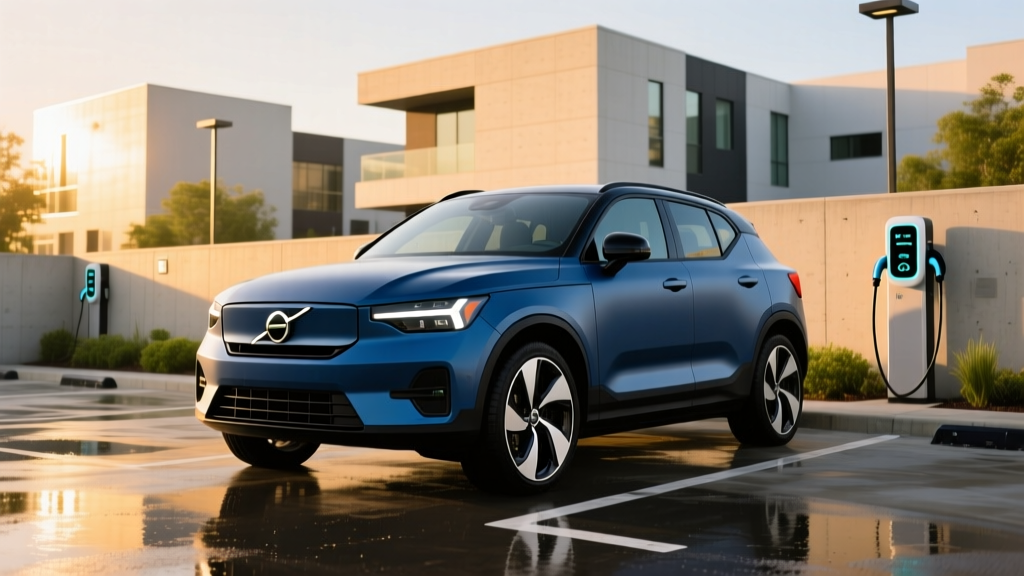
For 2026, Volvo has renamed the C40 Recharge to the EX40 in most global markets, aligning it with the EX30 and EX90 naming convention. Under the new badge, Volvo's compact electric coupe-SUV returns with meaningful updates: a revised 82 kWh (usable) battery pack, faster DC charging, and a new rear-wheel-drive single-motor variant that dramatically improves EPA range. The dual-motor all-wheel-drive model soldiers on for buyers who prioritize traction and acceleration over maximum miles per charge.
The EX40 (still widely searched as the "Volvo C40 electric") occupies a specific niche: a premium, design-forward subcompact EV crossover with genuine luxury materials, Google Built-in infotainment, and Volvo's standard Pilot Assist driver-aid suite. It's not the roomiest in its class, nor the longest-range, but it delivers a refined driving experience that few rivals match at this price point.
| Spec | Single Motor (RWD) | Twin Motor (AWD) |
|---|---|---|
| EPA Range | 293 miles | 254 miles |
| Battery (usable) | 82 kWh (NMC) | 82 kWh (NMC) |
| Horsepower | 295 hp | 402 hp |
| 0–60 mph | 6.2 sec | 4.5 sec |
| Drivetrain | RWD | AWD (dual motor) |
| Max DC Charge Rate | 200 kW | 200 kW |
| 10–80% DC Time | ~28 min | ~28 min |
| Level 2 Rate | 11 kW (~37 mi/hr) | 11 kW (~37 mi/hr) |
| MPGe (combined) | 103 MPGe | 87 MPGe |
| kWh/100 mi | 33 kWh | 39 kWh |
| Base MSRP | $54,950 | $58,950 |
Real-World Range vs. EPA Estimates
EPA Sticker: 293 miles (RWD) / 254 miles (AWD)
Real-World Expectation: 240–270 miles highway (RWD); 200–230 miles highway (AWD). In cold weather (below 32°F), expect a 20–30% reduction, dropping the RWD model to roughly 185–220 miles on a full charge.
The EPA numbers for the 2026 EX40 represent a meaningful improvement over the final C40 Recharge model year, thanks largely to the larger 82 kWh usable battery and the efficiency gains of the single-motor RWD layout. The Twin Motor AWD variant sacrifices roughly 40 miles of range for the added traction and 107 extra horsepower — a trade-off that makes sense in snowy climates but is harder to justify for temperate-region commuters.
In mixed suburban driving at moderate temperatures (55–75°F), owners consistently report hitting within 5–8% of the EPA sticker. Highway driving at sustained 70–75 mph speeds is where the EX40's bluff coupe-SUV aero profile shows its limitations — the steeply raked windshield and raised ride height create more drag than a sedan like the Polestar 2 or Hyundai Ioniq 6. Cold-weather range loss is significant, as with all NMC packs, but the EX40's standard heat pump helps mitigate cabin-heating energy draw compared to resistance-heater-equipped rivals.
Charging Speed and Home Setup
The 2026 EX40 supports up to 200 kW peak DC fast charging via its CCS1 connector (NACS adapter available through Volvo for Tesla Supercharger access). While 200 kW trails the 250–350 kW peaks of Hyundai/Kia's E-GMP platform, it's competitive for this segment and sufficient for most road-trip scenarios.
| Charging Level | Power | Speed / Time |
|---|---|---|
| Level 1 (120V household) | ~1.4 kW | ~4–5 miles per hour |
| Level 2 (240V home/public) | 11 kW max | ~37 miles per hour; 0–100% in ~9 hours |
| DC Fast Charge | 200 kW peak | 10–80% in ~28 minutes |
Charge curve reality check: The 200 kW peak is sustained only between approximately 10–40% state of charge. Above 60%, the curve tapers significantly — charging from 80–100% on DC can take an additional 20+ minutes. For road trips, plan your stops around 10–80% sessions to minimize time at the charger.
For home charging, the 11 kW onboard charger means a full Level 2 session (using a 48-amp hardwired charger on a 60-amp circuit) replenishes the 82 kWh pack in roughly 8.5–9 hours. Most owners will wake up to a full battery every morning with a standard overnight session. If your home electrical panel is already at capacity, budget $1,500–$3,000 for a panel upgrade — a common gotcha for older homes.
Performance, Drivetrain, and Driving Dynamics
The Twin Motor AWD variant delivers 402 hp and 494 lb-ft of torque, launching the EX40 to 60 mph in a brisk 4.5 seconds. That's genuinely quick for a luxury compact crossover and puts it in the same performance bracket as the BMW iX xDrive40 and Audi Q4 e-tron 55.
The single-motor RWD model (295 hp, 361 lb-ft) is no slouch at 6.2 seconds to 60 mph, and it offers a noticeably different driving character — lighter on its feet at the front axle with more natural steering feel. For daily commuting and around-town driving, the RWD variant is the more engaging choice.
Volvo's one-pedal driving mode is well-calibrated, with progressive regenerative braking that brings the EX40 to a near-stop without touching the brake pedal. The standard Pilot Assist system provides adaptive cruise control and lane centering — this is a SAE Level 2 driver-assistance system, meaning you must keep your hands on the wheel and remain fully engaged at all times. It is not a self-driving system.
Interior, Tech, and Cargo Space
The EX40 interior carries over Volvo's minimalist Scandinavian design language, anchored by a 9-inch vertical touchscreen running Google Built-in — a full integration of Google Maps, Google Assistant, and the Google Play Store directly into the vehicle's infotainment system. Navigation via Google Maps is a standout feature, as it integrates real-time traffic, charger availability, and battery-aware route planning natively.
Material quality is a strong suit: Volvo uses 100% leather-free upholstery (a textile/wool blend or synthetic leather depending on trim), recycled plastics, and sustainably sourced wood or aluminum trim. Build quality and cabin isolation are excellent, with minimal wind and road noise at highway speeds.
Cargo and passenger dimensions:
- Rear cargo (behind 2nd row): 14.5 cu ft
- Cargo with rear seats folded: 49.0 cu ft
- Front trunk (frunk): 1.1 cu ft (small storage cubby for charging cables)
- Rear legroom: 36.1 inches
- Front headroom: 39.4 inches
The sloping roofline — the defining design feature that separates the EX40/C40 from the boxier XC40 Recharge (now EX40's sibling, the XC40 electric, rebranded as well) — costs you roughly 2 cu ft of cargo space and noticeably reduces rear headroom for taller passengers. If cargo utility is a priority, the XC40 Recharge/EX40 wagon variant is the more practical pick.
Pricing, Trims, and Federal Tax Credit Eligibility
The 2026 Volvo EX40 is offered in three trims for both the single-motor and twin-motor configurations: Core (base), Plus, and Ultimate.
| Trim | Single Motor (RWD) | Twin Motor (AWD) |
|---|---|---|
| Core | $54,950 | $58,950 |
| Plus | $57,950 | $61,950 |
| Ultimate | $61,950 | $65,950 |
Federal EV Tax Credit (§30D) — Key Considerations:
- MSRP Cap: The EX40 qualifies as an SUV under IRS guidelines, so the MSRP cap is $80,000. All trims fall well under this threshold.
- Buyer Income Cap: Adjusted gross income must not exceed $150,000 (single), $225,000 (head of household), or $300,000 (joint filing) to claim the credit.
- Battery Sourcing: The credit amount (up to $7,500) depends on critical-mineral and battery-component sourcing requirements that change annually. Volvo sources battery cells from CATL and LG Energy Solution; the exact credit amount for 2026 model-year vehicles depends on current-year IRS guidance on mineral sourcing. Check the latest rules at IRS.gov §30D.
- Point-of-Sale Transfer: If eligible, you can transfer the credit to the dealer at purchase, reducing your out-of-pocket cost immediately rather than waiting for a tax refund.
With the full $7,500 credit, the base EX40 Core RWD effectively starts around $47,450 — competitive with the Tesla Model Y Long Range and significantly undercutting the BMW iX. Always verify current-year eligibility with a tax professional before relying on credit assumptions.
Efficiency and Ownership Costs
The single-motor EX40 achieves 103 MPGe combined (33 kWh/100 mi), while the twin-motor AWD drops to 87 MPGe (39 kWh/100 mi), per fueleconomy.gov. These are mid-pack figures — the Hyundai Ioniq 5 (114 MPGe) and Tesla Model Y (122 MPGe) are notably more efficient, while the Audi Q4 e-tron (95 MPGe) trails.
At the U.S. average electricity rate of ~$0.17/kWh, charging the RWD EX40 costs roughly $5.61 per 100 miles driven. Compare that to a gas crossover averaging 28 MPG at $3.40/gallon ($12.14 per 100 miles), and the EX40 saves approximately $6.50 per 100 miles on energy — or about $975 annually for a 15,000-mile driver.
Volvo's battery and powertrain warranty covers 8 years or 100,000 miles (whichever comes first), with a capacity-retention threshold of 70% of original capacity. This is industry-standard and matches most competitors. The vehicle limited warranty is 4 years/50,000 miles.
Pros and Cons
Pros
- Premium Scandinavian interior with leather-free, sustainable materials
- Google Built-in infotainment with native Google Maps EV routing
- Standard heat pump improves cold-weather efficiency
- 200 kW DC fast charging is adequate for road trips
- Strong safety ratings and comprehensive standard ADAS suite
- RWD single-motor variant offers 293 miles of range
Cons
- Sloping roofline cuts rear headroom and cargo space vs. XC40
- Efficiency (MPGe) trails top rivals like Ioniq 5 and Model Y
- Tiny 1.1 cu ft frunk — barely fits a charge cable
- No NACS port built-in (adapter required for Superchargers)
- Starting price above $54K before options, even for base RWD
- Rear visibility compromised by thick C-pillars and small rear window
Who Should Buy the 2026 Volvo EX40?
Choose the EX40 if: You want a premium, design-forward electric crossover with excellent build quality, Google-native infotainment, and Volvo's safety-first engineering. Ideal for style-conscious commuters and small households who prioritize cabin refinement and brand cachet over maximum cargo space or best-in-class efficiency.
Look elsewhere if: You need maximum range (consider the Hyundai Ioniq 5 at 311 mi EPA or Tesla Model Y at 320 mi), you regularly haul tall rear passengers or bulky cargo (the XC40 Recharge or Kia EV6 offer more headroom), or you want the lowest cost per mile of electric range (the Chevrolet Equinox EV and Tesla Model Y offer better value per kWh).
Frequently Asked Questions
What is the real-world range of the 2026 Volvo EX40 (C40 Recharge)?
In temperate conditions with mixed driving, expect 265–280 miles from the RWD model and 225–245 miles from the AWD model. Sustained highway driving at 75 mph reduces range by roughly 10–15%, and cold weather (below freezing) can cut range by 20–30% depending on cabin-heating demand.
How fast does the EX40 charge at home and on the road?
At home on a Level 2 (240V, 48-amp) charger, the EX40 adds about 37 miles of range per hour, fully recharging overnight in roughly 9 hours. On a DC fast charger, it peaks at 200 kW and charges from 10–80% in approximately 28 minutes under ideal conditions.
Does the 2026 Volvo EX40 qualify for the $7,500 federal EV tax credit?
The EX40 meets the MSRP cap ($80,000 for SUVs) and all trims are under it. However, the actual credit amount depends on battery-component and critical-mineral sourcing rules that the IRS updates annually, as well as your personal income eligibility. Verify current-year rules at IRS.gov and consult a tax professional.
Is the EX40 worth buying vs. the Tesla Model Y or Hyundai Ioniq 5?
The EX40 wins on interior luxury, build quality, and brand prestige. The Model Y wins on range (320 mi), efficiency (122 MPGe), Supercharger network access, and cargo space. The Ioniq 5 wins on charging speed (350 kW peak), efficiency, and value pricing. If premium materials and Google-native tech matter more to you than maximum range or the lowest price, the EX40 is a compelling choice.
What battery chemistry does the EX40 use?
The 2026 EX40 uses an NMC (nickel manganese cobalt) lithium-ion battery pack with 82 kWh of usable capacity. NMC offers higher energy density than LFP, which helps maximize range in a compact package, but it's more sensitive to sustained 100% state of charge. For daily driving, Volvo recommends charging to 80–90% to preserve long-term battery health.
Can the EX40 use Tesla Superchargers?
Yes, but not natively. The EX40 uses a CCS1 charge port. Volvo offers a NACS adapter that enables access to Tesla's Supercharger network (V3 and V4 stalls with CCS compatibility). Charging speeds on Superchargers will be limited by the adapter and the EX40's 200 kW peak, but it significantly expands your public-charging options on road trips.