Quick Verdict: The Volvo C40 EV at a Glance
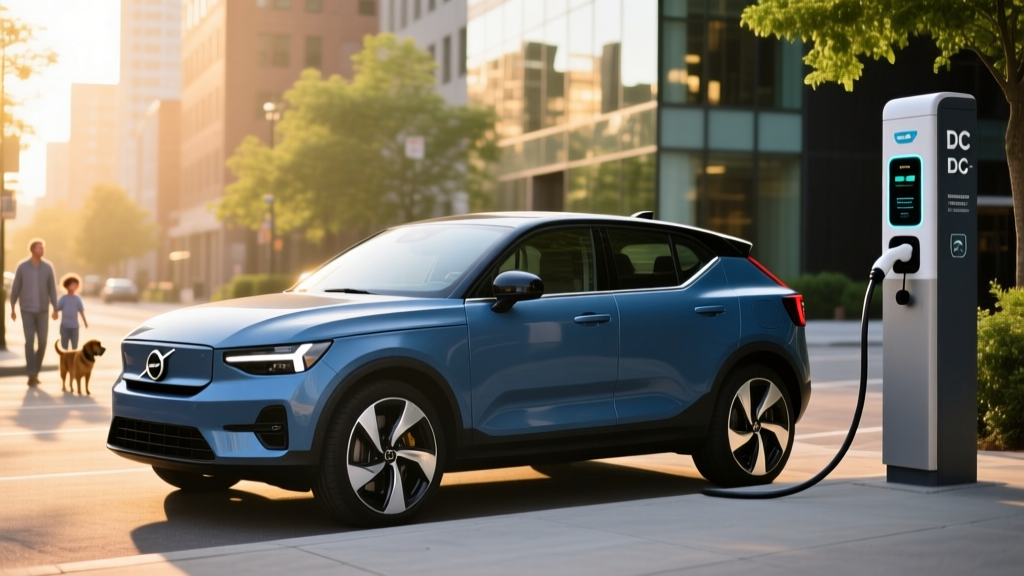
The Volvo C40 Recharge (now badged as the EC40 in some markets for 2025–2026) is Volvo's coupe-styled electric subcompact SUV, built on the same CMA platform as the EX40 (formerly XC40 Recharge). It pairs Scandinavian minimalism with legitimate dual-motor performance and a usable 82 kWh battery. For 2026, it remains a compelling choice for buyers who want luxury-brand fit and finish, standard all-wheel drive, and a distinct roofline — but it faces stiff competition from the Tesla Model Y, BMW iX1, and Hyundai Ioniq 5 on efficiency and interior volume.
| Spec | Single Motor (RWD) | Twin Motor (AWD) |
|---|---|---|
| EPA Range | 293 miles | 254 miles |
| Battery (usable) | 82 kWh (NMC) | 82 kWh (NMC) |
| Horsepower | 248 hp | 402 hp |
| 0–60 mph | 6.9 sec | 4.5 sec |
| Max DC Fast Charge | 200 kW | 200 kW |
| 10–80% DC Time | ~28 min | ~28 min |
| Level 2 (AC) | 11 kW (~37 mi/hr) | 11 kW (~37 mi/hr) |
| MPGe (combined) | 98 MPGe | 87 MPGe |
| Drivetrain | RWD | AWD (dual motor) |
| Base MSRP | $54,950 | $58,950 |
Range and Efficiency: EPA Sticker vs. Real-World Driving
EPA Estimated Range: 293 miles (Single Motor RWD) / 254 miles (Twin Motor AWD)
Real-World Expectation: Plan for 230–260 miles in mixed highway driving for the RWD model, and roughly 200–230 miles for the AWD variant. At sustained 75 mph highway speeds, efficiency drops to around 3.2–3.5 kWh/mile. In cold weather (below 32°F), expect a 20–30% reduction, bringing the Twin Motor down to approximately 175–195 miles of usable range before you'll want to find a charger.
The C40's 82 kWh usable battery pack uses NMC (nickel manganese cobalt) chemistry supplied by CATL and LG Energy Solution, depending on production batch. NMC delivers higher energy density than LFP, which helps the C40 achieve its EPA numbers in a relatively compact footprint — but it also means Volvo recommends keeping the state of charge between 20% and 90% for daily use to maximize long-term battery health.
Efficiency is where the C40 shows its age against newer platforms. The Single Motor RWD achieves 98 MPGe combined (34 kWh/100 mi) according to fueleconomy.gov, which is respectable but trails the Hyundai Ioniq 5 RWD (114 MPGe) and Tesla Model Y RWD (119 MPGe). The Twin Motor AWD drops to 87 MPGe (39 kWh/100 mi), reflecting the energy cost of the second motor and added weight.
One practical advantage: the C40 comes standard with a heat pump in all trims for 2026, which mitigates cold-weather range loss during cabin heating. Without preconditioning, though, DC fast-charge speeds will still be throttled in winter. Always use the Volvo Cars app to precondition the battery 20–30 minutes before arriving at a fast charger.
Charging Performance: DC Fast, Level 2, and the Curve Reality
The C40 supports up to 200 kW peak DC fast charging on CCS1-equipped vehicles (or NACS on models built for the North American market post-2025). Here's what that means in practice:
| Charge Level | Power | Speed | Notes |
|---|---|---|---|
| Level 1 (120V) | 1.4 kW | ~4 mi/hr | Emergency/trickle only |
| Level 2 (240V, 48A) | 11 kW | ~37 mi/hr | Full charge in ~8.5 hours |
| DC Fast (peak) | 200 kW | ~140 mi in 10 min | Peak rate at 10–30% SoC only |
| DC Fast (10–80%) | Avg ~120 kW | ~28 minutes | Curve tapers hard above 80% |
The critical detail most spec sheets omit: the 200 kW peak is only sustained between roughly 10% and 30% state of charge. From 30–60%, the C40 holds a respectable 140–160 kW. Above 60%, it tapers to under 100 kW, and above 80%, charging drops below 50 kW as the battery management system protects cell longevity. This means a 10–80% session averages around 120 kW — perfectly adequate for road-trip stops at Electrify America or EVgo stations, but not class-leading.
For home charging, the 11 kW onboard AC charger is a strong point. On a 48-amp Level 2 circuit (the most common home installation), you'll add roughly 37 miles of range per hour, or recover a full battery overnight in about 8.5 hours. This requires a NEMA 14-50 outlet or hardwired Wall Connector installed on a 60-amp breaker — budget $800–$1,500 for professional installation depending on your panel capacity and run length.
Performance and Driving Dynamics
The Twin Motor AWD variant delivers 402 horsepower and 494 lb-ft of torque, launching the C40 from 0–60 mph in 4.5 seconds. That's genuinely quick for a subcompact luxury SUV, and the instant torque delivery makes highway merging effortless. The Single Motor RWD model produces 248 hp and 361 lb-ft, reaching 60 mph in 6.9 seconds — adequate for daily commuting but noticeably less exciting.
Ride quality is where the CMA platform earns its keep. The C40 uses a MacPherson strut front suspension and multi-link rear, tuned for comfort over sportiness. Road noise is well-suppressed, and the 4,500+ lb curb weight (AWD) gives it a planted feel at highway speeds. The steering is light but precise, and the one-pedal driving mode offers aggressive regen that can bring the car to a full stop without touching the brake pedal.
Ground clearance is 6.9 inches, which is fine for snow and light gravel but not designed for off-road use. Towing capacity is rated at 2,000 lbs with the factory tow package — enough for a small utility trailer but not a camper.
Interior, Cargo, and Daily Livability
The C40's coupe-like roofline is its most distinctive design feature — and its biggest practical compromise. Front headroom is generous at 39.4 inches, and the seats are among the best in the segment: firm, supportive, and available in a leather-free Microtech upholstery that feels premium. The 9-inch portrait touchscreen runs Google Built-In (Google Maps, Google Assistant, Play Store), which is intuitive and responsive, though some buyers may miss Apple CarPlay — it was added back for 2025 and continues into 2026.
Where the C40 loses ground is rear-seat and cargo space:
- Rear legroom: 36.1 inches (tight for tall adults on long trips)
- Rear headroom: 37.0 inches (the sloping roofline cuts into space)
- Cargo behind rear seats: 18.2 cu ft
- Cargo with seats folded: 49.3 cu ft
- Front trunk (frunk): 1.1 cu ft (barely fits a charging cable bag)
Compare that to the Tesla Model Y (30.2 cu ft cargo, 72.1 cu ft folded) or even the Hyundai Ioniq 5 (27.2 cu ft), and the C40's practicality gap becomes clear. This is a car for singles, couples, or small families who prioritize style and build quality over maximum hauling capacity.
Pricing, Trims, and Federal Tax Credit Eligibility
For 2026, the Volvo C40 / EC40 is offered in three trims:
| Trim | Drivetrain | MSRP | Est. After §30D Credit* |
|---|---|---|---|
| Core | Single Motor RWD | $54,950 | $47,450 |
| Plus | Twin Motor AWD | $58,950 | $51,450 |
| Ultimate | Twin Motor AWD | $62,950 | $55,450 |
*Assumes full $7,500 §30D credit eligibility. Actual credit varies by buyer income, battery sourcing, and point-of-sale transfer rules.
The IRS §30D clean vehicle credit offers up to $7,500, but eligibility is layered:
- MSRP cap: SUVs must be under $80,000 — the C40 clears this easily.
- Buyer income cap: Modified AGI must not exceed $150,000 (single) / $300,000 (joint) / $225,000 (head of household).
- Battery sourcing: The $3,750 critical minerals component and $3,750 battery assembly component depend on whether the cells and minerals meet US free-trade-agreement requirements. Volvo sources from CATL (China) and LG (South Korea/US), and qualifying components shift annually. Check the latest DOE qualifying list before purchase.
- Point-of-sale transfer: You can transfer the credit to the dealer at purchase, reducing your out-of-pocket cost immediately — no need to wait for tax filing.
Destination charges add approximately $1,295. The Ultimate trim includes Pilot Assist (Level 2 driver assistance), a Harman Kardon audio system, 360-degree camera, and a panoramic glass roof. ADAS note: Volvo's Pilot Assist is an SAE Level 2 system — it provides lane centering and adaptive cruise, but the driver must remain fully engaged at all times.
Warranty and Battery Longevity
Volvo covers the C40 with the following warranty structure:
- Basic vehicle: 4 years / 50,000 miles
- Battery & electric powertrain: 8 years / 100,000 miles (whichever comes first)
- Battery capacity retention: Volvo warrants that the high-voltage battery will retain at least 70% of its original capacity over the 8-year/100,000-mile period
- Corrosion: 12 years unlimited mileage
- Roadside assistance: 4 years unlimited mileage
The 70% retention threshold is standard for the industry (matching Tesla, BMW, and Hyundai). Real-world degradation data from early 2022–2024 C40 owners suggests approximately 5–8% capacity loss over the first 60,000 miles, with the curve flattening significantly afterward. Following Volvo's recommended 20–90% daily charge window and avoiding repeated DC fast-charging in extreme heat will help keep degradation minimal.
If a replacement is needed out of warranty, expect $12,000–$18,000 for the battery pack plus labor — a cost worth factoring into long-term ownership plans if you intend to keep the vehicle past 150,000 miles.
How the C40 Stacks Up Against Competitors
Pros
- Premium Scandinavian interior with excellent seats
- Standard heat pump across all trims
- Strong 402 hp Twin Motor performance
- 11 kW AC charging (faster than many rivals)
- Google Built-In infotainment is intuitive
- Under $80K MSRP — clears §30D tax credit cap
Cons
- Cargo and rear-seat space trail competitors significantly
- Efficiency (87–98 MPGe) lags Tesla Model Y and Ioniq 5
- 200 kW peak DC charging is mid-pack for 2026
- Small frunk is nearly useless
- Coupe roofline limits practicality for families
- Battery sourcing may limit §30D credit to partial amount
Choose the Volvo C40 if: You value build quality, distinctive design, and a premium cabin over maximum cargo space. You're a single professional or couple who commutes under 50 miles daily and has home Level 2 charging. You want AWD performance without stepping up to a larger, more expensive EV.
Look elsewhere if: You regularly carry rear-seat passengers or need cargo versatility (consider the Model Y or Ioniq 5). You take frequent 300+ mile road trips and want the fastest possible DC charging (the Hyundai Ioniq 5 peaks at 240 kW on 800V architecture). Maximum efficiency and lowest cost-per-mile are your priorities.
Frequently Asked Questions
What is the real-world range of the Volvo C40 EV?
The EPA rates the Single Motor RWD at 293 miles and the Twin Motor AWD at 254 miles. In real-world mixed driving at moderate temperatures, expect 240–270 miles (RWD) and 210–235 miles (AWD). Highway-only driving at 75 mph reduces those figures by 10–15%, and cold weather below freezing can cut range by 20–30% without preconditioning.
How fast does the Volvo C40 charge at home and on the road?
At home on a 240V Level 2 charger (48 amps), the C40 charges at up to 11 kW, adding roughly 37 miles of range per hour — a full charge takes about 8.5 hours. On DC fast chargers, it peaks at 200 kW and reaches 10–80% in approximately 28 minutes, though the charge curve tapers significantly above 60% SoC.
Does the Volvo C40 qualify for the $7,500 federal EV tax credit?
It can, but eligibility depends on several factors under IRS §30D: your income must fall below the AGI caps ($150K single / $300K joint), the MSRP is under the $80K SUV cap, and the battery must meet critical-mineral and component-sourcing requirements that change annually. Check the DOE's qualifying vehicle list at the time of purchase, and consult a tax professional. The credit can be transferred to the dealer at point of sale to reduce your purchase price immediately.
Is the Volvo C40 worth buying over a Tesla Model Y or Hyundai Ioniq 5?
The C40 wins on interior material quality, seat comfort, and Scandinavian design appeal. The Model Y offers substantially more cargo space (30.2 vs 18.2 cu ft), better efficiency (119 vs 98 MPGe), and access to the Supercharger network. The Ioniq 5 charges faster (240 kW peak on 800V) and offers more interior volume at a lower price. If cabin luxury matters more than practicality, the C40 is the pick — otherwise, the competitors offer more for the money.
How long will the Volvo C40 battery last?
Volvo warranties the 82 kWh NMC battery for 8 years / 100,000 miles with a minimum 70% capacity retention guarantee. Real-world data from early C40 owners shows 5–8% degradation over the first 60,000 miles. With proper care (avoiding 100% charges, minimizing extreme-heat DC fast charging), the battery should provide reliable service well beyond 150,000 miles. Out-of-warranty replacement costs $12,000–$18,000.
Does the Volvo C40 have self-driving capabilities?
No. The C40 offers Volvo's Pilot Assist, which is an SAE Level 2 driver-assistance system. It provides adaptive cruise control and lane-centering on highways, but the driver must keep hands on the wheel and remain fully attentive at all times. It does not navigate autonomously, change lanes on its own, or handle complex urban driving.