Quick Verdict: Volkswagen vs Tesla in 2026
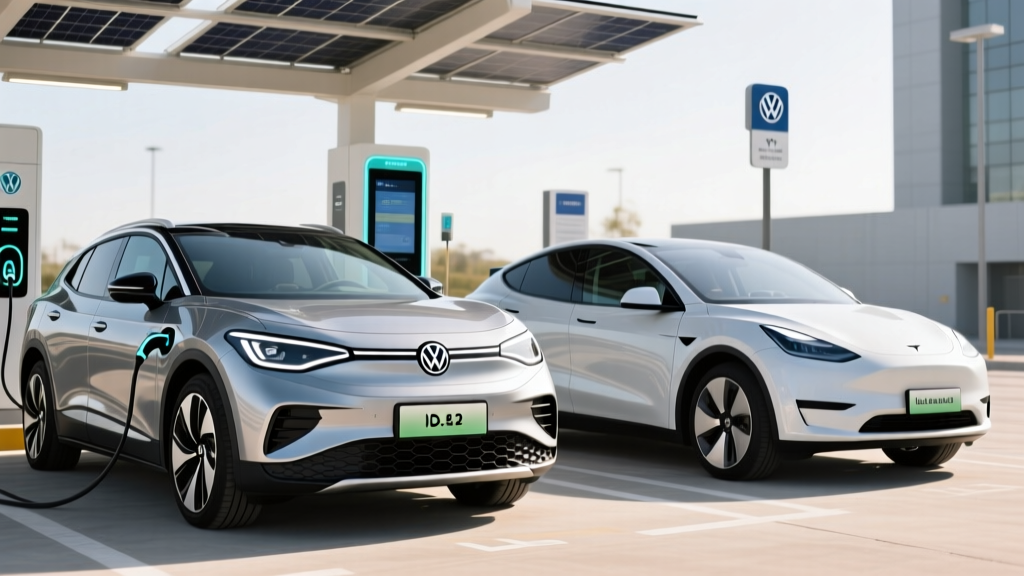
The Volkswagen ID.4 and Tesla Model Y occupy the same compact electric SUV segment but serve fundamentally different buyer philosophies. The ID.4 prioritizes ride comfort, straightforward controls, and aggressive pricing after incentives. The Model Y leans on efficiency, the Supercharger network, and over-the-air software evolution. Both seat five, both offer all-wheel drive, and both qualify for federal tax credits under the right conditions — but the ownership experience diverges the moment you plug in for the first time.
If you're searching for a Volkswagen Tesla comparison to decide which compact EV SUV to buy in 2026, this profile breaks down every spec that matters: real-world range, charging curves, battery chemistry, interior dimensions, and the true cost after the §30D federal tax credit.
| Spec | 2026 VW ID.4 Pro S AWD | 2026 Tesla Model Y Long Range AWD |
|---|---|---|
| EPA Range | 275 mi | 320 mi |
| Battery (usable) | 82 kWh (NMC) | ~78 kWh (NMC) |
| Max DC Fast Charge | 175 kW | 250 kW |
| 10–80% DC Time | ~28 min | ~22 min |
| Level 2 Home Rate | 11 kW (~37 mi/hr) | 11.5 kW (~44 mi/hr) |
| 0–60 mph | 5.7 sec | 4.8 sec |
| Horsepower | 295 hp | 384 hp |
| Drivetrain | Dual-motor AWD | Dual-motor AWD |
| MPGe (combined) | 104 MPGe | 122 MPGe |
| Base MSRP | $46,195 | $48,990 |
| Battery Warranty | 8 yr / 100,000 mi | 8 yr / 120,000 mi |
Range & Efficiency: EPA Stickers vs Real-World Miles
VW ID.4 Pro S AWD: EPA 275 mi. Expect ~240–255 mi on highway road trips at 70–75 mph; ~195–215 mi in sub-30°F winter conditions with cabin heating.
Tesla Model Y LR AWD: EPA 320 mi. Expect ~275–295 mi highway; ~230–250 mi in freezing temperatures. The heat pump helps, but cold still cuts 20–25%.
The Model Y's efficiency advantage is measurable. At 122 MPGe combined versus the ID.4's 104 MPGe, the Tesla uses roughly 27 kWh per 100 miles compared to the VW's 32 kWh per 100 miles, per EPA data at fueleconomy.gov. Over 12,000 miles of annual driving, that translates to about 180 fewer kWh consumed — roughly $25–$40 in annual electricity savings depending on your local rate.
Where the ID.4 claws back ground is in ride comfort. Its longer wheelbase tuning and softer damping make it the quieter, more composed cruiser on broken pavement. If your commute includes rough county roads, the VW's compliance matters more than 45 extra EPA miles.
Charging Speed: DC Fast Charging and Home Level 2
Charging speed is where Tesla's engineering lead shows most clearly. The Model Y's 250 kW peak DC fast-charge capability on V3 Superchargers delivers a 10–80% session in approximately 22 minutes under optimal battery preconditioning. The ID.4 peaks at 175 kW and requires around 28 minutes for the same session — a six-minute gap that compounds on multi-stop road trips.
Both vehicles taper charge speed significantly above 80% state of charge. Expect the final 80–100% to take an additional 20–30 minutes on either platform. For daily driving, charge to 80% and go.
| Charging Level | VW ID.4 | Tesla Model Y |
|---|---|---|
| Level 1 (120V, 1.4 kW) | ~4 mi/hr | ~4 mi/hr |
| Level 2 (240V, 11–11.5 kW) | ~37 mi/hr | ~44 mi/hr |
| DC Fast (peak kW) | 175 kW | 250 kW |
| DC 10–80% Time | ~28 min | ~22 min |
| Connector (2026) | NACS (Supercharger compatible) | NACS (native) |
A critical 2026 update: Volkswagen now equips the ID.4 with the NACS charge port, granting access to Tesla's Supercharger network — over 20,000 stalls in North America. This eliminates the biggest historical disadvantage VW had against Tesla for road-trip charging. However, Supercharger stall availability at peak holiday travel remains a factor; Tesla owners still get the most seamless plug-and-charge handshake, while VW drivers may need to authenticate through the Tesla app at some stalls.
For home Level 2 charging, both vehicles need a 48-amp hardwired wall connector on a 60-amp circuit to reach their maximum AC charge rates. Budget $800–$2,000 for professional installation depending on panel proximity and local permit fees — more if your home needs a 200-amp service upgrade.
Performance & Drivetrain
The Model Y Long Range AWD hits 60 mph in 4.8 seconds with 384 hp from its dual-motor setup. The ID.4 Pro S AWD delivers 295 hp and a 5.7-second 0–60 time. Both are genuinely quick for daily merging and passing — neither feels underpowered.
Where they differ is in character. The Model Y's firmer suspension and lower center of gravity give it sharper cornering composure, but you feel every expansion joint. The ID.4 absorbs road imperfections with a maturity that feels closer to an Audi Q5 than a typical compact crossover. If you value a planted, sporty feel, Tesla wins. If you want isolation from potholes and highway drone, VW takes the category.
Neither vehicle is rated for serious towing — the Model Y maxes at 3,500 lbs and the ID.4 at 2,700 lbs. For light trailer or bike-rack duty, both suffice, but neither replaces a body-on-frame SUV for boat hauling.
Interior, Cargo & Technology
Interior packaging is close but meaningfully different in layout:
| Dimension | VW ID.4 | Tesla Model Y |
|---|---|---|
| Cargo (rear seats up) | 30.3 cu ft | 30.2 cu ft |
| Cargo (seats folded) | 64.2 cu ft | 72.1 cu ft |
| Front Legroom | 41.1 in | 41.8 in |
| Rear Legroom | 37.6 in | 35.2 in |
| Front Trunk (Frunk) | None | 4.1 cu ft |
The ID.4's rear seat legroom advantage (37.6 vs 35.2 inches) is noticeable for adult passengers on longer drives. The Model Y's sloping roofline cuts into rear headroom for taller riders and limits cargo height with seats folded, though its total folded volume is larger thanks to a deeper load floor and a usable frunk.
On technology, Tesla's minimalist 15.4-inch touchscreen controls nearly everything — climate, mirrors, glovebox. There are no physical buttons. Some buyers love the clean aesthetic; others find it distracting while driving. Volkswagen's 12.9-inch infotainment screen retains a physical volume knob and haptic climate controls, though VW's software has historically lagged Tesla's in responsiveness. The 2026 ID.4 runs VW's updated 4.0 infotainment platform with improved voice recognition and faster map rendering.
For driver assistance, both vehicles offer SAE Level 2 systems — meaning the driver must remain fully attentive at all times. Tesla's Autopilot (standard) and optional FSD (Supervised) are capable on highways but require hands-on-wheel monitoring. VW's Travel Assist provides competent adaptive cruise and lane centering but lacks Tesla's navigation-on-autopilot sophistication. Neither system is self-driving.
Pricing, Trims & Federal Tax Credit Eligibility
| Trim | MSRP | Est. After §30D Credit* |
|---|---|---|
| VW ID.4 Standard (RWD) | $39,735 | ~$32,235 |
| VW ID.4 Pro S AWD | $46,195 | ~$38,695 |
| Tesla Model Y Long Range AWD | $48,990 | ~$41,490 |
| Tesla Model Y Performance AWD | $52,490 | ~$44,990 |
*Assumes full $7,500 §30D credit eligibility. Actual credit depends on income, battery sourcing, and MSRP caps. See IRS rules below.
The §30D federal EV tax credit is not automatic. Under current IRS rules, eligibility requires:
- MSRP cap: SUVs must be at or below $80,000 (both vehicles qualify)
- Buyer income cap: AGI ≤ $150,000 single / $300,000 joint filers
- Battery sourcing: Critical minerals and battery components must meet phased-in domestic/free-trade sourcing thresholds — these requirements tighten annually through 2030
- Point-of-sale transfer: As of 2024+, buyers can transfer the credit to the dealer for an immediate price reduction at purchase, rather than waiting to claim on tax returns
Both the ID.4 (assembled in Chattanooga, TN) and the Model Y (Fremont, CA / Austin, TX) have historically qualified for the full $7,500 credit, but battery component and critical mineral sourcing rules change yearly. Always verify current eligibility on the IRS clean vehicle credit page or with your tax professional before signing a purchase agreement.
Battery, Warranty & Long-Term Ownership
Both vehicles use nickel-manganese-cobalt (NMC) lithium-ion battery packs optimized for energy density. Neither offers an LFP (lithium iron phosphate) variant in AWD trims for 2026, though the RWD ID.4 Standard and the base Model Y RWD have used LFP chemistry in prior model years for cost savings and cycle-life longevity at the trade-off of slightly lower range and cold-weather performance.
Warranty coverage is competitive:
| Coverage | VW ID.4 | Tesla Model Y |
|---|---|---|
| Battery / Powertrain | 8 yr / 100,000 mi | 8 yr / 120,000 mi |
| Capacity Retention Threshold | 70% | 70% |
| Bumper-to-Bumper | 4 yr / 50,000 mi | 4 yr / 50,000 mi |
Real-world degradation data from fleet studies suggests both packs retain approximately 88–92% capacity after 100,000 miles under normal use. DC fast-charging exclusively will accelerate degradation; if you can charge at home on Level 2 for 80%+ of sessions, expect slower capacity loss. Battery replacement out of warranty runs $12,000–$18,000 for either vehicle — a figure worth considering for second-ownership plans beyond the warranty window.
Pros, Cons & Who Should Buy Which
VW ID.4 — Pros
- Lower entry price after incentives (~$32K base)
- Superior ride comfort and cabin quietness
- More rear-seat legroom for adult passengers
- Now Supercharger-compatible with NACS port
- Physical controls for volume and climate
VW ID.4 — Cons
- 45 fewer EPA miles than Model Y
- Slower DC fast charging (175 vs 250 kW)
- No frunk for additional cargo
- Infotainment still catching up to Tesla
- Lower efficiency (104 vs 122 MPGe)
Tesla Model Y — Pros
- Best-in-class efficiency (122 MPGe)
- Fastest DC charging in segment (250 kW)
- Native Supercharger integration — seamless road trips
- Strongest acceleration (4.8 sec 0–60)
- Largest folded-cargo volume (72.1 cu ft)
Tesla Model Y — Cons
- Higher starting price
- Firm ride — feels every road imperfection
- Tighter rear legroom (35.2 in)
- No physical buttons — everything on the screen
- FSD costs extra and remains Level 2 only
Choose the VW ID.4 if: You prioritize ride comfort, back-seat space for kids or adults, and want the lowest possible purchase price after the federal credit. It's the better family commuter for mixed road conditions.
Choose the Tesla Model Y if: You road-trip frequently and want the fastest, most reliable DC charging network. The efficiency advantage and extra range reduce charging stops, and the cargo volume suits active lifestyles with gear.
Frequently Asked Questions
What is the real-world range of the ID.4 and Model Y?
The VW ID.4 AWD delivers an EPA-estimated 275 miles, but expect 240–255 miles on sustained highway driving and as low as 195–215 miles in freezing weather. The Tesla Model Y LR AWD rates at 320 miles EPA, with real-world highway range around 275–295 miles and 230–250 miles in deep cold.
How fast does each vehicle charge at home and on the road?
On Level 2 home charging, the ID.4 adds ~37 miles of range per hour and the Model Y adds ~44. On DC fast chargers, the ID.4 peaks at 175 kW (10–80% in ~28 min) while the Model Y peaks at 250 kW (10–80% in ~22 min).
Does the VW ID.4 or Tesla Model Y qualify for the $7,500 federal tax credit?
Both vehicles have historically qualified for the full §30D credit, but eligibility depends on your income (≤$300K joint), the vehicle's MSRP (≤$80K for SUVs — both pass), and battery component/critical-mineral sourcing requirements that tighten annually. Verify on irs.gov before purchase.
Is the Volkswagen ID.4 worth buying over the Tesla Model Y?
Yes, if you value ride comfort, lower pricing, and back-seat space. The ID.4 is the pragmatic family choice. The Model Y wins for efficiency, charging speed, and road-trip convenience via the Supercharger network. With VW's 2026 NACS adoption, the charging-network gap has narrowed significantly.
Can VW use Tesla Superchargers in 2026?
Yes. The 2026 ID.4 ships with a native NACS charge port, granting access to Tesla's Supercharger network. You may need to initiate charging via the Tesla app at some stalls, but the physical connection is direct — no adapter required.
What battery chemistry do these vehicles use?
Both the ID.4 Pro S AWD and Model Y LR AWD use NMC (nickel-manganese-cobalt) lithium-ion chemistry, balancing energy density with longevity. LFP variants may be available in base RWD trims — check current model-year configurations with your dealer.