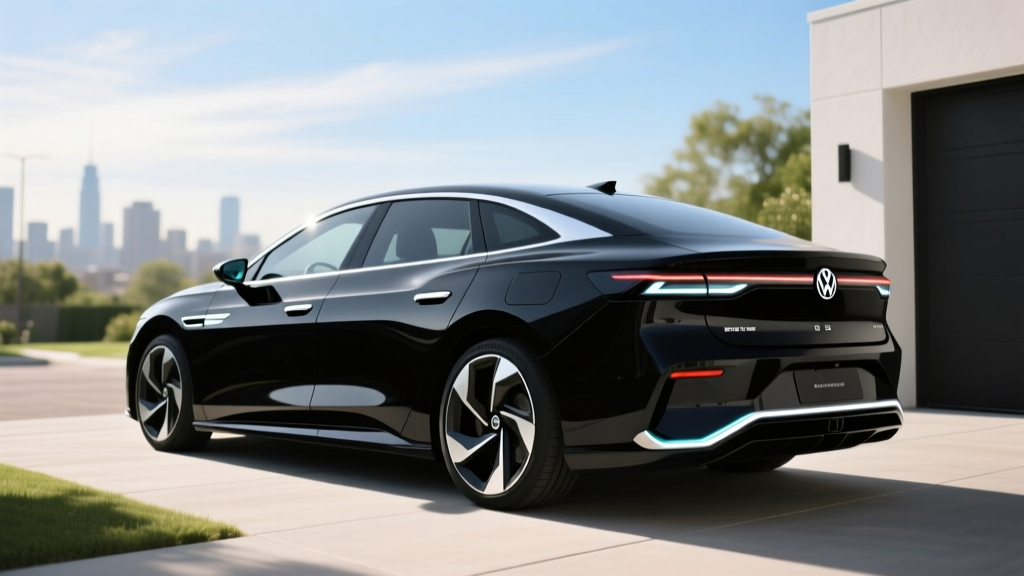
After years of anticipation and repeated delays, the Volkswagen ID.7 has officially landed on American soil for the 2026 model year. Positioned as VW's flagship electric sedan — and the spiritual EV successor to the Passat — the ID.7 enters a competitive segment occupied by the Tesla Model 3, Hyundai Ioniq 6, and BMW i4. But with a spacious fastback body, a large battery, and Volkswagen's latest MEB platform refinements, the ID.7 aims to win buyers who want comfort and range over sport-sedan dynamics.
Here's everything US buyers need to know about the ID.7's real-world range, charging speeds, pricing, tax credit eligibility, and whether it's the right electric sedan for your driveway.
Volkswagen ID.7: Full US Spec Overview
| Specification | ID.7 Pro S (RWD) | ID.7 GTX (AWD) |
|---|---|---|
| EPA Range (est.) | 340 miles | 295 miles |
| Battery (usable) | 86 kWh (NMC) | 86 kWh (NMC) |
| Drivetrain | Rear-Wheel Drive | Dual-Motor AWD |
| Horsepower | 282 hp | 335 hp |
| 0–60 mph | 6.5 sec | 5.2 sec |
| Max DC Fast Charge | 175 kW | 175 kW |
| 10–80% DC Charge Time | ~30 min | ~30 min |
| Level 2 Home Charge Rate | 11 kW (AC) | 11 kW (AC) |
| Efficiency (combined) | 115 MPGe / 29 kWh/100mi | 100 MPGe / 34 kWh/100mi |
| Cargo Volume | 19.4 cu ft (rear seats up) | 19.4 cu ft (rear seats up) |
| Rear Legroom | 39.2 inches | 39.2 inches |
| Base MSRP | $52,995 | $58,995 |
| Battery/Powertrain Warranty | 8 yr / 100,000 mi | 8 yr / 100,000 mi |
Real-World Range: What to Expect Beyond the EPA Sticker
The Pro S trim's 340-mile EPA estimate is the headline figure and puts the ID.7 near the top of the electric-sedan segment for range. But as with any EV, that number represents a laboratory blend cycle — not what you'll see on a 75 mph interstate run in January.
- City / moderate driving (65°F): ~330–350 miles — EVs excel at low-speed regen-heavy driving.
- Highway (70–75 mph, 65°F): ~270–290 miles — aerodynamic drag cuts into the large battery's advantage.
- Cold weather (20–30°F, highway): ~220–250 miles — expect 25–35% range loss without preconditioning; the ID.7's standard heat pump mitigates some of this.
- Mixed real-world average: ~280–310 miles for most owners in temperate climates.
The ID.7's 86 kWh usable battery (NMC chemistry) is one of the largest in its class, giving it a buffer that makes 300+ mile real-world trips achievable in most conditions. The standard heat pump — a feature still optional or absent on some competitors — is a meaningful advantage for buyers in northern US states. NMC chemistry delivers higher energy density than LFP, which is why VW can package this much capacity in a sedan footprint, though it does mean you'll want to follow the 20–80% daily charging recommendation to maximize long-term battery health.
Charging Speed: DC Fast Charging and Home Level 2
The ID.7 peaks at 175 kW on DC fast chargers, a respectable figure for the MEB platform but not class-leading. Hyundai's Ioniq 6, with its 800-volt architecture, can peak at 235 kW and sustain higher rates through the charge curve. Here's how the ID.7 stacks up across charging levels:
| Charging Level | Power / Rate | Speed (Approx.) |
|---|---|---|
| Level 1 (120V household) | ~1.4 kW | ~4–5 miles per hour |
| Level 2 (240V home, 48A) | 11 kW | ~35 miles per hour; full charge in ~9 hrs |
| DC Fast Charge (peak) | 175 kW | 10–80% in ~30 min; ~120 mi in 10 min (optimal) |
Charging-curve reality check: The 175 kW peak occurs between roughly 10–30% State of Charge. Beyond 50% SoC, the rate tapers to approximately 100–120 kW, and above 80% it drops sharply to protect battery longevity. On a road trip, plan your stops around the 10–80% window for the fastest throughput — charging from 80–100% at a DC fast charger is painfully slow and rarely worth the wait.
For home charging, the 11 kW onboard AC charger is a strong point. With a 48-amp Level 2 wallbox (such as a ChargePoint Home Flex or Emporia Vue), you'll add roughly 35 miles of range per hour, meaning an overnight session easily replenishes a full day's driving. Most ID.7 owners will rarely need public charging for daily use.
Pricing, Trims, and Federal Tax Credit Eligibility
The 2026 ID.7 launches in two trims for the US market:
| Trim | Base MSRP | As-Tested (est.) | §30D Tax Credit Eligibility |
|---|---|---|---|
| ID.7 Pro S (RWD) | $52,995 | $55,500–$57,000 | Likely $3,750 (partial — see below) |
| ID.7 GTX (AWD) | $58,995 | $62,000–$64,500 | Eligibility uncertain — sourcing dependent |
Federal tax credit breakdown (IRS §30D, 2026 rules):
- MSRP cap: Sedars are capped at $55,000 MSRP. The Pro S at $52,995 qualifies; the GTX at $58,995 exceeds the cap and is ineligible for the federal credit.
- Buyer income limits (2026): AGI must not exceed $150,000 (single), $225,000 (head of household), or $300,000 (joint).
- Battery sourcing: The ID.7's NMC battery is manufactured in Europe. As of 2026, the critical-minerals and battery-component requirements are phased in at 80% and 100% respectively. VW's supply chain partially meets the critical-minerals requirement but does not yet fully satisfy the battery-component rule, likely yielding $3,750 (half credit) for the Pro S rather than the full $7,500.
- Point-of-sale transfer: Eligible buyers can apply the credit as a discount at the dealership rather than waiting for a tax refund, per IRS rules.
For the latest sourcing determinations, consult the IRS clean vehicle manufacturer list before purchasing. State incentives (California's CVRP, Colorado's tax credit, etc.) may stack on top and can significantly reduce effective cost — check your state's energy office for current programs.
Performance and Driving Dynamics
The ID.7 Pro S sends 282 horsepower to the rear wheels via a single APP550 electric motor — VW's latest-generation MEB drive unit, which delivers improved efficiency and torque response over the older APP310 found in the ID.4. The 0–60 mph time of 6.5 seconds is adequate for merging and passing, though it trails the Tesla Model 3 Long Range (5.8 sec) and the Hyundai Ioniq 6 (5.1 sec AWD).
The GTX dual-motor variant bumps output to 335 hp and drops the sprint to 5.2 seconds, with AWD traction that makes a tangible difference in rain and snow. Neither trim is a sports sedan — the ID.7's tuning prioritizes ride comfort, cabin quietness, and long-distance composure. The steering is light and numb by enthusiast standards, but the chassis absorbs highway imperfections with a maturity that feels distinctly German.
Regenerative braking offers three levels via steering-wheel paddles (including a coasting mode), but Volkswagen still does not offer true one-pedal driving with a complete stop. This is a persistent omission that frustrates EV veterans accustomed to Nissan Leaf or Chevrolet Bolt behavior. Expect to use the brake pedal for final stops.
Interior Space, Technology, and Daily Usability
The ID.7's fastback silhouette yields 19.4 cubic feet of cargo volume behind the rear seats — more than a Model 3 (23 cu ft including the frunk, but with a traditional trunk opening) and comparable to a midsize hatchback. The wide liftgate opening makes loading bulky items easier than in a conventional sedan trunk. Rear legroom at 39.2 inches is generous, and the flat floor (no transmission tunnel) means a comfortable middle seat for short trips.
Infotainment and tech highlights:
- 15-inch center touchscreen running VW's ID.Software 4.0 — a major improvement over earlier ID. models, with faster response, better menu logic, and a backlighted slider bar for volume and climate (finally addressing the most-criticized element of the ID.4's interior).
- Augmented-reality head-up display (AR-HUD) projects navigation arrows and speed onto the windshield in the driver's sightline.
- Standard Travel Assist with adaptive cruise control and lane-centering — a competent SAE Level 2 system for highway use, though it requires hands-on-wheel supervision and does not offer hands-free operation like GM's Super Cruise or Ford's BlueCruise.
- Park Assist Plus with memory parking — the car can learn and repeat parking maneuvers in tight garages.
- Standard heated and ventilated front seats on Pro S; GTX adds massaging driver seat.
How the ID.7 Stacks Up Against Key Competitors
| Spec | VW ID.7 Pro S | Tesla Model 3 LR | Hyundai Ioniq 6 SE LR |
|---|---|---|---|
| EPA Range | 340 mi | 363 mi | 361 mi |
| Battery | 86 kWh NMC | 79 kWh (NMC/LFP) | 77.4 kWh NMC |
| DC Fast Charge Peak | 175 kW | 250 kW | 235 kW (800V) |
| 10–80% Time | ~30 min | ~25 min | ~18 min |
| 0–60 mph | 6.5 sec | 4.2 sec (AWD) | 5.1 sec (AWD) |
| Base MSRP | $52,995 | $47,740 | $42,450 |
| Federal Credit (est.) | $3,750 | $7,500 | $7,500 |
| Cargo (rear seats up) | 19.4 cu ft | 23 cu ft (incl. frunk) | 12.3 cu ft |
| Rear Legroom | 39.2 in | 35.3 in | 35.7 in |
The bottom line in comparisons: The Model 3 wins on price, charging speed, performance, and Supercharger network access. The Ioniq 6 undercuts everyone on price and charges the fastest. But the ID.7 fights back where it matters for comfort-focused buyers: it has the best rear-seat space in this trio, the smoothest ride quality, a hatchback liftgate, and a cabin that feels a tier above in material quality and noise isolation.
Who Should Buy the Volkswagen ID.7?
- You prioritize ride comfort and cabin quietness over acceleration.
- Rear-seat passenger space and a hatchback cargo area are must-haves.
- You commute 40–80 miles daily and want to charge at home 1–2 times per week.
- You value VW's dealer network for service and warranty work.
- Fastest DC charging is critical (Ioniq 6's 18-min 10–80% is hard to beat).
- You need the lowest purchase price (Model 3 and Ioniq 6 are thousands cheaper).
- You want hands-free highway driving (GM Super Cruise or Ford BlueCruise vehicles).
- You want one-pedal driving with a complete stop (Nissan Ariya, Hyundai Ioniq 6).
Pros and Cons at a Glance
- 340-mile EPA range is excellent for a sedan in this price range
- Spacious rear seat (39.2" legroom) and practical hatchback cargo area
- Refined, quiet ride quality ideal for long highway commutes
- Standard heat pump improves cold-weather efficiency
- Improved infotainment (ID.Software 4.0) over earlier VW EVs
- 11 kW AC onboard charger for fast home replenishment
- 175 kW DC fast charging is slower than key rivals (Ioniq 6: 235 kW)
- No one-pedal driving to a full stop
- Partial ($3,750) federal tax credit due to battery sourcing; GTX is ineligible
- Higher starting price than Model 3 and Ioniq 6
- No front trunk (frunk) — MEB platform doesn't offer one
- Travel Assist is competent but not hands-free like Super Cruise
Frequently Asked Questions
What is the real-world range of the Volkswagen ID.7?
The EPA rates the ID.7 Pro S at 340 miles. In real-world mixed driving, expect 280–310 miles in temperate weather, 270–290 miles on the highway at 70+ mph, and 220–250 miles in cold winter conditions. The standard heat pump helps reduce cold-weather losses compared to EVs without one.
How fast does the ID.7 charge at home and on DC fast chargers?
At home on a 48-amp Level 2 charger (240V), the ID.7 charges at 11 kW, adding roughly 35 miles per hour and reaching a full charge in about 9 hours. On DC fast chargers, it peaks at 175 kW, achieving 10–80% in approximately 30 minutes. The charging curve tapers significantly above 80% SoC.
Does the Volkswagen ID.7 qualify for the $7,500 federal EV tax credit?
The ID.7 Pro S ($52,995 MSRP) is under the $55,000 sedan cap and likely qualifies for $3,750 (half credit) due to partial compliance with battery-sourcing requirements. The GTX trim ($58,995) exceeds the MSRP cap and is ineligible for the federal credit. Always verify current eligibility on the IRS clean vehicle list before purchase.
Is the ID.7 worth buying over the Tesla Model 3 or Hyundai Ioniq 6?
It depends on your priorities. The ID.7 wins on rear-seat space, ride comfort, hatchback practicality, and cabin refinement. The Model 3 wins on price, performance, charging speed, and Supercharger access. The Ioniq 6 wins on price and DC charging speed. If comfort and space matter more than sporty dynamics or the lowest cost, the ID.7 is a strong pick.
What is the ID.7's battery warranty?
Volkswagen covers the ID.7's high-voltage battery and electric powertrain for 8 years or 100,000 miles, whichever comes first. The warranty guarantees the battery will retain at least 70% of its original capacity during that period, which is industry-standard.
Does the ID.7 have a frunk (front trunk)?
No. Like other MEB-platform vehicles (ID.4, ID.Buzz), the ID.7 does not have a front trunk. The space under the hood houses power electronics and HVAC components. All cargo capacity (19.4 cu ft) is in the rear hatchback area.
The Volkswagen ID.7 arrives in the US as a mature, comfort-first electric sedan that prioritizes real-world livability over spec-sheet superlatives. Its 340-mile range, spacious cabin, and refined ride make it one of the most practical EVs for families and commuters who don't need a crossover. The pricing and partial tax credit are legitimate hurdles, but for buyers who value the details — a quiet cabin, a usable back seat, and a hatchback that swallows weekend gear — the ID.7 makes a compelling, if not class-dominating, case.