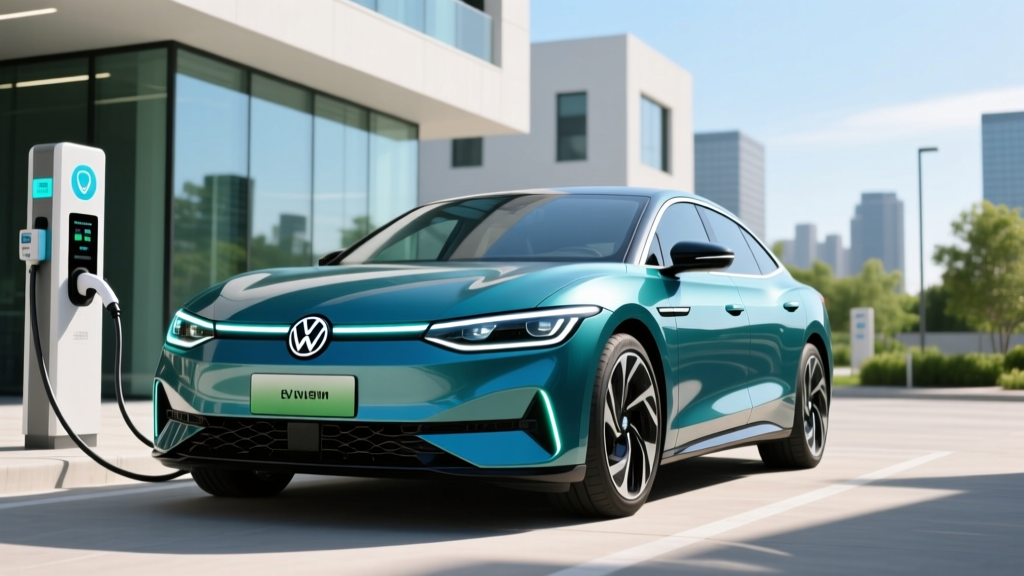
If you've been watching the midsize electric sedan segment, the Volkswagen ID.7 has likely been on your radar since its global reveal. Now that it's arrived on US soil for the 2026 model year, the big question isn't just whether it's a good car — it's whether the numbers make sense for your garage and your wallet. We've analyzed the specs, driven comparable VW MEB-platform vehicles, and dug into the lease math to give you a clear picture of what Volkswagen's flagship electric sedan actually delivers.
The ID.7 positions itself as the electric Passat successor: a roomy, comfortable, long-range daily driver aimed squarely at commuters and small families who want something more substantial than a compact crossover but aren't ready to jump to a luxury badge. Here's everything you need to know before you sign any paperwork.
Range, Battery, and Real-World Efficiency
The 2026 Volkswagen ID.7 Pro S comes equipped with an 86 kWh usable battery pack (91 kWh gross) using NMC (nickel manganese cobalt) chemistry. This is the larger of VW's MEB battery options and is specifically chosen for the US market to maximize range on highway-heavy American commutes.
| Spec | Value |
|---|---|
| EPA Estimated Range | 301 miles |
| Battery (Usable / Gross) | 86 kWh / 91 kWh (NMC) |
| Efficiency | 110 MPGe combined / 30 kWh/100 mi |
| Drivetrain | Rear-wheel drive (single motor) |
| Horsepower | 282 hp |
| 0–60 mph | 6.5 seconds |
| Max DC Fast Charge | 175 kW |
| Level 2 Charge Rate | 11 kW (~37 mi/hr) |
| Cargo Volume | 19.4 cu ft (trunk) |
| Rear Legroom | 39.1 inches |
| Base MSRP | $54,995 |
| Battery Warranty | 8 years / 100,000 miles |
Efficiency lands at an EPA-rated 110 MPGe combined, which translates to about 30 kWh per 100 miles. That's competitive with the Hyundai Ioniq 6 (140 MPGe) but slightly behind it, and roughly on par with the Tesla Model 3 Long Range. For a sedan of this size and weight (approximately 4,700 lbs), it's respectable — though the Ioniq 6's more aggressive aerodynamic shaping gives it an edge in highway efficiency.
Charging Speed: DC Fast and Home Level 2
Charging capability is where the ID.7 shows both its strengths and its compromises relative to the fastest-charging competition.
| Charging Level | Power | Speed / Time |
|---|---|---|
| Level 1 (120V household) | ~1.4 kW | ~5 miles per hour |
| Level 2 (240V home / public) | 11 kW | ~37 miles per hour; 0–100% in ~9 hours |
| DC Fast Charge (peak) | 175 kW | 10–80% in approximately 28 minutes |
The 175 kW peak DC fast-charge rate is the key number here. On a 350 kW Electrify America or compatible CCS station, the ID.7 will ramp up to its 175 kW peak in the 10–30% state-of-charge window, then progressively taper. By the time you hit 60% SoC, you're likely seeing 100–120 kW, and above 80% it drops further to protect battery longevity. The 10–80% time of roughly 28 minutes is adequate for road trips but trails the Hyundai Ioniq 6 (which can hit 235 kW and do 10–80% in about 18 minutes on an 800V architecture).
For daily home charging, the 11 kW onboard charger is solid. Plugging into a Level 2 wallbox or hardwired unit at 48 amps will add roughly 37 miles of range per hour — meaning a full overnight session easily replenishes any daily commute. The ID.7 uses the CCS1 connector standard; with the industry shift toward NACS, VW has indicated that future model years may adopt the Tesla-style plug, but for 2026, you'll use CCS at public stations or a CCS-to-NACS adapter at Tesla Superchargers where VW has been granted access.
Pricing, Trim Levels, and Lease Deal Analysis
The 2026 ID.7 launches in the US in a single well-equipped trim: the Pro S, starting at $54,995 (including destination). This is a deliberate simplification by VW — rather than offering a stripped base model, the Pro S comes loaded with features that would be optional on competitors.
| Item | Amount |
|---|---|
| Pro S Base MSRP (incl. destination) | $54,995 |
| Typical as-tested (with packages) | $56,500–$58,000 |
| Estimated monthly lease (36 mo / 10K mi, tier 1 credit) | $499–$599/mo |
| Federal Tax Credit (§30D) — if purchasing | Up to $7,500 (see eligibility below) |
Understanding the lease math: Lease deals on the ID.7 will vary significantly by region, dealer, and your credit tier. Volkswagen Credit typically structures 36-month leases with money factors that, at tier 1 credit (720+ FICO), translate to effective rates around 4–6% in the current environment. Expect lease offers in the $499–$599 per month range with $3,500–$4,500 due at signing for a 10,000-mile annual allowance. Some dealers in competitive markets may push below $500/mo with incentives.
One critical lease advantage: under current IRS rules, leased EVs can benefit from the commercial clean vehicle credit (§45W), which the leasing company receives and can pass through as a capitalized-cost reduction — effectively a $7,500 discount baked into the lease. This bypasses the MSRP caps, income limits, and battery-sourcing requirements that apply to the §30D purchase credit. Ask the dealer explicitly whether the lease quote reflects this pass-through.
Federal Tax Credit Eligibility (If Purchasing)
If you're considering buying rather than leasing, the §30D federal EV tax credit has specific requirements you must meet. According to IRS guidelines, eligibility depends on multiple factors:
- MSRP Cap: Sedars are capped at $55,000 MSRP. The ID.7 Pro S at $54,995 clears this threshold — but adding certain packages could push it over. Verify the final MSRP on the window sticker.
- Buyer Income Limits: Modified adjusted gross income must not exceed $150,000 (single), $225,000 (head of household), or $300,000 (joint filers).
- Battery Sourcing: The credit is split into two halves ($3,750 + $3,750) based on critical-mineral sourcing and battery-component manufacturing requirements. VW's supply chain for the US-spec ID.7 determines how much of the full $7,500 you'll actually receive — this can change by model year and production batch.
- Point-of-Sale Transfer: You can transfer the credit to the dealer at purchase, reducing your out-of-pocket cost immediately rather than waiting for tax filing.
The leasing route often simplifies this considerably, which is why many ID.7 shoppers will find lease deals more attractive than purchase incentives.
Performance, Ride, and Daily Driving Impressions
The ID.7 Pro S sends 282 horsepower to the rear wheels via a single permanent-magnet synchronous motor. The 0–60 mph time of 6.5 seconds places it firmly in "adequately quick" territory — this is not a performance sedan, and it doesn't pretend to be. The instant torque delivery makes it feel responsive around town and confident for highway merging, but the Tesla Model 3 Long Range (5.8 seconds to 60) and the Ioniq 6 (5.1 seconds with AWD) are noticeably quicker.
Where the ID.7 earns its keep is ride quality. VW has tuned the suspension for comfort over sportiness, with compliant damping that absorbs broken pavement without the floatiness that plagued earlier ID.4 models. The steering is light and precise if not particularly communicative. The turning circle is tight for a sedan of this length, thanks to the rear-wheel-drive layout and MEB platform's short overhangs.
Regenerative braking offers multiple modes selectable via steering-wheel paddles: a coast mode (no regen), moderate regen, and a strong regen setting that approaches one-pedal driving but doesn't quite bring the car to a full stop. VW's philosophy here differs from Nissan or GM — they prefer blending regen with the friction brakes for a more natural pedal feel, which some EV veterans love and others find insufficiently aggressive.
Interior Space, Technology, and Drawbacks
The ID.7's interior is where it makes its strongest case against the competition. At 195.3 inches long with a 116.1-inch wheelbase, it offers genuine midsize-sedan roominess. Rear legroom of 39.1 inches rivals the Toyota Camry and significantly exceeds the Tesla Model 3's 35.3 inches. The trunk provides 19.4 cubic feet — generous for a sedan and enough for a family road trip's luggage.
The infotainment system runs VW's latest ID. Software 4.0 on a 15-inch touchscreen. This is a meaningful upgrade from the laggy, frustrating ID. Software 2.x that drew so much criticism in early ID.4 models. Response times are quick, the interface is logical, and wireless Apple CarPlay and Android Auto are standard. A head-up display with augmented-reality navigation overlays is included on the Pro S.
The driver-assistance suite, branded Travel Assist, combines adaptive cruise control with lane-centering and operates as a SAE Level 2 system. This means you must keep your hands on the wheel (or near it, with capacitive sensing) and your eyes on the road at all times. It works well on highways and reduces fatigue on long trips, but it is not autonomous driving. VW also includes Park Assist Plus with memory parking, which can learn and repeat specific parking maneuvers — a genuinely useful feature for tight home garages.
Pros
- 301-mile EPA range covers most commutes and road trips comfortably
- Spacious rear seat and trunk — true midsize sedan room
- Refined ride quality; comfortable and quiet at highway speeds
- Standard heat pump improves cold-weather efficiency
- Updated ID. Software 4.0 resolves earlier infotainment complaints
- Lease deals can leverage $7,500 commercial credit pass-through
Cons
- 175 kW peak DC charging trails Ioniq 6's 235 kW capability
- No AWD option at launch — single-motor RWD only
- $54,995 starting price is above Model 3 Long Range
- Touch-sensitive steering wheel controls can be finicky
- CCS1 connector may require adapter for Tesla Supercharger access
- 282 hp feels adequate but not exciting in this price class
How the ID.7 Stacks Up Against Key Competitors
| Spec | VW ID.7 Pro S | Tesla Model 3 LR | Hyundai Ioniq 6 SEL |
|---|---|---|---|
| EPA Range | 301 mi | 341 mi | 361 mi |
| Battery (usable) | 86 kWh (NMC) | 75 kWh (NMC) | 77.4 kWh (NMC) |
| Peak DC Charge | 175 kW | 250 kW | 235 kW |
| 10–80% DC Time | ~28 min | ~25 min | ~18 min |
| 0–60 mph | 6.5 sec | 4.2 sec | 5.1 sec (AWD) |
| Base MSRP | $54,995 | $47,740 | $42,715 |
| Rear Legroom | 39.1 in | 35.3 in | 35.1 in |
| Drivetrain | RWD | AWD | RWD / AWD |
The comparison reveals the ID.7's positioning clearly: it's the most expensive of the three, offers less range and slower charging than both competitors, but delivers significantly more rear-seat room and a more traditionally comfortable ride. If back-seat space and ride quality are your top priorities, the ID.7 has a legitimate advantage. If you want the most range, fastest charging, or lowest price, the Ioniq 6 and Model 3 are stronger picks.
Who Should Lease the Volkswagen ID.7?
Best for: Commuters and small families who prioritize interior space, ride comfort, and a traditional sedan experience over maximum performance or the absolute longest range. If you regularly carry rear-seat passengers — kids in car seats, teenagers, or adult passengers — the ID.7's back seat is meaningfully better than the Model 3 or Ioniq 6. It also suits buyers who want to lease rather than buy, since the commercial-credit pass-through on leases simplifies the incentive picture.
Look elsewhere if: You need AWD for snowy climates (not available at launch), you regularly road-trip and want the fastest possible charging, or you're budget-sensitive and want the most range per dollar. The Ioniq 6 wins on efficiency and charging speed; the Model 3 wins on performance and Supercharger network access.
Warranty and Long-Term Ownership
Volkswagen backs the ID.7's battery pack with an 8-year / 100,000-mile warranty, guaranteeing a minimum of 70% capacity retention over that period. The vehicle limited warranty covers 4 years / 50,000 miles, which is standard for the segment. VW's scheduled maintenance costs are low for the first two years thanks to included complimentary maintenance, and EVs generally require less routine service than combustion vehicles — no oil changes, no transmission fluid, and reduced brake wear thanks to regenerative braking.
According to fueleconomy.gov, the ID.7's estimated annual electricity cost is approximately $650 based on 15,000 miles of driving and national average electricity rates — roughly equivalent to $0.043 per mile. Compare that to a similar gas sedan at 30 MPG and $3.50/gallon, which comes to about $0.117 per mile. Over five years, the fuel savings alone can exceed $5,500, though this varies by local electricity rates and whether you can charge at home on a Level 2 circuit.
Frequently Asked Questions
What is the real-world range of the Volkswagen ID.7?
The EPA rates it at 301 miles, but real-world mixed driving typically yields 260–280 miles. Sustained highway driving at 75 mph drops that to roughly 245–260 miles, and cold weather (below 30°F) can reduce range to 210–235 miles. The standard heat pump helps, but doesn't eliminate winter range loss.
How fast does the ID.7 charge at home and on the road?
At home on a Level 2 (240V) charger, the 11 kW onboard charger adds about 37 miles of range per hour, with a full charge taking roughly 9 hours. On DC fast chargers, it peaks at 175 kW and can go from 10–80% in approximately 28 minutes — slower than the Ioniq 6 but adequate for most road trips with planned stops.
How much does the ID.7 cost after tax credits?
The base MSRP is $54,995. If you purchase and qualify for the full §30D credit (meeting income, MSRP, and battery-sourcing requirements), your effective cost could drop to around $47,495. If you lease, the dealer may pass through the $7,500 commercial credit as a cap-cost reduction, lowering monthly payments significantly — potentially into the $450–$500/mo range depending on terms.
Does the Volkswagen ID.7 qualify for the federal EV tax credit?
It can, but eligibility depends on your income (under $150K single / $300K joint), the final MSRP staying under $55,000, and VW's battery-sourcing compliance for the specific production batch. The safest route to the full incentive is leasing, where the commercial credit (§45W) applies without the same restrictions. Always verify current rules at IRS.gov and confirm with your tax professional.
Is the ID.7 worth leasing over a Tesla Model 3 or Hyundai Ioniq 6?
It depends on your priorities. If rear-seat space, ride comfort, and a traditional sedan feel matter most, the ID.7 is worth a serious look — especially with competitive lease deals. If you want maximum range, fastest charging, or the lowest monthly payment, the Ioniq 6 and Model 3 have clear advantages. Test-drive all three and compare actual lease quotes from your local dealers before deciding.
Does the ID.7 have all-wheel drive?
Not at launch for the 2026 model year. The US-spec ID.7 is offered only in rear-wheel-drive Pro S trim. VW has produced AWD versions (badged GTX in Europe), but these have not been confirmed for the US market. If AWD is essential for your climate, the Tesla Model 3 Long Range or Hyundai Ioniq 6 with AWD are available alternatives.