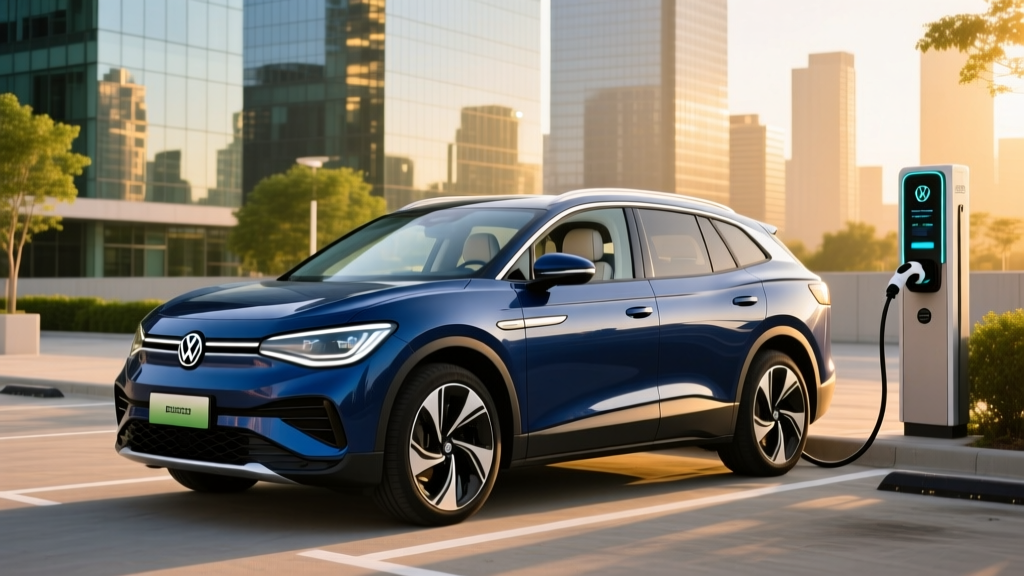
The Volkswagen ID.6 is VW's largest electric SUV built on the MEB platform, slotted above the ID.4 with three rows of seating and a longer wheelbase. Originally launched for the Chinese market, the ID.6 has drawn consistent interest from US buyers looking for a mainstream three-row electric crossover. As of early 2026, Volkswagen has not confirmed US availability for the ID.6 — this review is based on the latest global-spec model and VW's announced powertrain updates, with US pricing and availability marked as preliminary where applicable.
If VW brings the ID.6 to North America, it would compete directly with the Kia EV9, Hyundai Ioniq 9, and Tesla Model X in the three-row electric SUV segment. Here's everything we know about range, charging, performance, pricing, and whether this electric family hauler is worth the wait.
Volkswagen ID.6 Specs at a Glance
| Attribute | ID.6 Pro (RWD) | ID.6 GTX (AWD) |
|---|---|---|
| Battery (usable) | 77 kWh (NMC) | 77 kWh (NMC) |
| WLTP Range | ~340 mi (550 km) | ~310 mi (500 km) |
| Est. EPA Range | ~275-290 mi* | ~250-265 mi* |
| Horsepower | 201 hp | 295 hp |
| 0-60 mph (est.) | ~8.5 sec | ~6.5 sec |
| Drivetrain | Rear-wheel drive | Dual-motor AWD |
| Max DC Fast Charge | 135 kW | 135 kW |
| 10-80% DCFC Time | ~30 min | ~30 min |
| Level 2 Charge Rate | 11 kW (AC) | 11 kW (AC) |
| Seating | 6 or 7 passengers | 6 or 7 passengers |
| Est. US Base MSRP | ~$48,000-$52,000* | ~$55,000-$58,000* |
*Estimated based on WLTP-to-EPA conversion (~15-20% reduction) and projected US pricing. Final EPA figures and MSRP will be confirmed if/when VW announces US availability.
Real-World Range: What to Actually Expect
Real-World Expectations:
• City/suburban driving: ~280-300 mi — regenerative braking recovers energy in stop-and-go traffic
• Highway (70-75 mph sustained): ~230-255 mi — the boxy SUV profile creates aero drag at speed
• Cold weather (below 32°F): ~195-225 mi — NMC chemistry loses 15-25% capacity in freezing temps without preconditioning
• Full load (7 passengers + cargo): Subtract ~10-15 mi from any scenario above
The ID.6 uses a 77 kWh usable (82 kWh gross) NMC (nickel-manganese-cobalt) battery pack mounted in the MEB skateboard floor. NMC chemistry offers higher energy density than LFP, which matters in a large three-row SUV where packaging space is at a premium. However, NMC cells are more sensitive to sustained high state-of-charge storage and extreme cold than LFP alternatives.
The WLTP range figure of 550 km (340 mi) for the RWD Pro looks impressive, but WLTP testing is notably more generous than the US EPA cycle. Based on the ID.4's WLTP-to-EPA conversion ratio (~17% reduction), we project an EPA rating around 275-290 miles for the rear-drive model. That's competitive with the Kia EV9 Light Range (~304 mi EPA) but falls short of the EV9 Long Range's 304-310 miles from its larger 100 kWh pack.
For families doing a mix of suburban commuting and occasional highway trips, expect roughly 250 miles of comfortable range before needing to plan a charge stop. That's adequate for most daily use but means road trips over 200 miles will require at least one DC fast-charge stop.
Charging Speed: DC Fast Charge and Home Level 2
The ID.6 supports up to 135 kW peak DC fast charging via CCS (or NACS with adapter, depending on market). Here's how that translates in practice:
| Charging Level | Power | Speed | Notes |
|---|---|---|---|
| Level 1 (120V) | ~1.4 kW | ~4-5 mi/hr | Emergency/trickle only; ~55+ hours for full charge |
| Level 2 (240V, 48A) | 11 kW | ~32-36 mi/hr | Full charge in ~7-8 hours; ideal for overnight home charging |
| DC Fast Charge | Up to 135 kW peak | 10-80% in ~30 min | Peak rate sustained to ~50% SoC, then tapers; expect ~100 kW average |
The 135 kW peak charge rate is the ID.6's most notable limitation versus newer competitors. The Kia EV9 supports up to 210 kW (using its 800V architecture), achieving a 10-80% charge in roughly 20 minutes. The Hyundai Ioniq 9 is expected to match or exceed that. At 135 kW on a 400V MEB architecture, the ID.6's charging curve holds peak rate from roughly 10-50% state of charge, then tapers progressively — from 135 kW down to ~80 kW by 65% SoC, and ~50 kW by 80%.
On a road trip, that 30-minute 10-80% charge is workable but not class-leading. If VW updates the ID.6 for future model years with the PPE platform (800V, as seen in the Porsche Macan EV and Audi Q6 e-tron), expect charge rates above 250 kW.
For home charging, the 11 kW onboard AC charger is solid. On a Level 2 home charger (240V, 48-amp circuit), you'll add roughly 32-36 miles of range per hour, meaning a depleted battery recovers fully overnight in about 7-8 hours. Most owners charging from 20-80% daily will wake up fully topped off every morning.
Performance, Efficiency, and Drivetrain
The ID.6 Pro (rear-wheel drive) produces 201 horsepower from a single rear-mounted permanent-magnet synchronous motor. The 0-60 mph time of approximately 8.5 seconds is leisurely by EV standards — this is a comfort-oriented family cruiser, not a performance SUV. Acceleration is smooth and linear, with the instant torque characteristic of electric motors making city merging effortless even if the stopwatch numbers aren't thrilling.
The GTX variant adds a front induction motor for dual-motor all-wheel drive, boosting output to 295 hp and dropping the 0-60 time to roughly 6.5 seconds. The AWD system also provides better traction in rain and light snow, a meaningful upgrade for buyers in northern climates.
Efficiency is projected around 95-105 MPGe combined (roughly 30-33 kWh/100 mi) for the RWD model. The AWD GTX will be less efficient, closer to 85-90 MPGe combined. These figures are typical for a three-row electric SUV — the Kia EV9 RWD achieves 99 MPGe combined per fueleconomy.gov.
One advantage of the MEB platform's rear-wheel-drive default: the turning circle is surprisingly tight for a vehicle this size, thanks to the front wheels being freed from driveshaft duties. VW quotes a turning diameter around 36 feet, comparable to many midsize crossovers despite the ID.6's larger footprint.
Interior Space, Cargo, and Technology
The ID.6's primary selling point is three-row seating in a package that's only marginally longer than the ID.4. The extended wheelbase (~115 inches) translates to genuinely usable third-row space — adults under 5'8" can sit comfortably for short trips, and children or teens will have no complaints on longer drives.
Interior dimensions (estimated, global spec):
- Second-row legroom: ~37-38 inches
- Third-row legroom: ~30-32 inches
- Cargo behind 3rd row: ~15-18 cu ft
- Cargo behind 2nd row (3rd row folded): ~42-46 cu ft
- Max cargo (all rear seats folded): ~72-78 cu ft
Available in both six-passenger (captain's chairs in row two) and seven-passenger (bench) configurations, the ID.6 offers flexibility for different family needs. The captain's chair layout provides a walk-through to the third row and more individual comfort; the bench maximizes total seating.
On the tech front, the ID.6 runs VW's latest ID.Software with a 12-inch central touchscreen, a compact digital instrument cluster, and an available augmented-reality head-up display. Wireless Apple CarPlay and Android Auto are standard. The infotainment system has been a weak point in earlier MEB vehicles — VW's software team has made meaningful improvements in responsiveness and menu logic for the latest generation, though some owners still report occasional lag versus competitors' systems.
Driver-assistance features include VW's IQ.DRIVE suite: adaptive cruise control with stop-and-go, lane-keeping assist, front and rear automatic emergency braking, and Travel Assist (a SAE Level 2 highway driving assist that combines steering and speed control). Travel Assist works well on divided highways but requires hands on the wheel — it is not a self-driving system.
Pricing, Trims, and Federal Tax Credit Eligibility
Volkswagen has not confirmed US pricing for the ID.6 as of early 2026. Based on its positioning in global markets and the current US EV pricing landscape, here's our projected MSRP structure:
| Trim | Est. MSRP | Est. After §30D Credit | Credit Eligibility |
|---|---|---|---|
| ID.6 Pro (RWD) | ~$48,000-$52,000 | ~$40,500-$44,500 | Up to $7,500* |
| ID.6 Pro S (RWD) | ~$52,000-$55,000 | ~$44,500-$47,500 | Up to $7,500* |
| ID.6 GTX (AWD) | ~$55,000-$58,000 | ~$47,500-$50,500 | Up to $7,500* |
Federal EV Tax Credit (§30D) — Key Requirements for 2026:
- MSRP cap: SUVs/vans/pickups must be under $80,000 — all ID.6 trims should qualify
- Buyer income cap: AGI must not exceed $150,000 (single), $225,000 (head of household), or $300,000 (joint filers)
- Battery sourcing: Critical minerals and battery components must meet escalating domestic-sourcing thresholds — VW's supply chain compliance will determine whether the full $7,500 is available or only $3,750
- Point-of-sale transfer: Eligible buyers can transfer the credit to the dealer at purchase, reducing the purchase price directly rather than waiting for a tax refund
- North American assembly: Final assembly must occur in North America — this is the biggest uncertainty for the ID.6, as current production is in China (Anting and Foshan plants)
For detailed and current rules, consult IRS.gov's clean vehicle credit page or speak with a tax professional. If VW does not shift ID.6 assembly to a North American plant (such as its Chattanooga, TN facility), the vehicle will not qualify for the §30D credit regardless of price or buyer income. This is the single most important variable for US-market viability.
How the ID.6 Compares to Key Rivals
The three-row EV SUV segment has grown considerably. Here's how the ID.6 stacks up against its most likely US competitors:
| Spec | VW ID.6 (est.) | Kia EV9 (LR RWD) | Tesla Model X (LR) |
|---|---|---|---|
| EPA Range | ~275-290 mi | 304 mi | 335 mi |
| Battery | 77 kWh (NMC) | 100 kWh (NMC) | 100 kWh (NMC) |
| DC Fast Charge | 135 kW | 210 kW | 250 kW |
| 10-80% Time | ~30 min | ~20 min | ~22 min |
| Seating | 6 or 7 | 6 or 7 | 5, 6, or 7 |
| Base MSRP | ~$48,000* | $54,900 | $79,990 |
| Tax Credit | Uncertain* | Up to $7,500 | $0 (over MSRP cap) |
The ID.6's potential advantage is price — if VW prices it aggressively under $50,000, it undercuts the EV9 by several thousand dollars. But the Kia's faster charging, longer range from a bigger battery, and confirmed tax-credit eligibility make it the safer bet for buyers who need a three-row EV today. The Tesla Model X offers superior range and charging but costs nearly double.
Pros
- Genuinely usable third row in a manageable footprint
- Potential sub-$50K starting price (if US-spec confirmed)
- Comfortable ride quality and quiet cabin on MEB platform
- Tight turning circle for a 3-row SUV
- Available 6- or 7-passenger layouts
- AR head-up display and latest VW software
Cons
- 135 kW DC charging is slow vs. 800V rivals (EV9: 210 kW)
- US availability unconfirmed — may not be sold stateside
- China-built: likely ineligible for §30D tax credit unless production moves
- Smaller battery (77 kWh) limits range vs. 100 kWh competitors
- RWD Pro 0-60 of ~8.5 sec is sluggish for the price point
- VW infotainment still trails Hyundai/Kia and Tesla in responsiveness
Battery Warranty and Long-Term Ownership
VW's global battery warranty for MEB vehicles covers 8 years or 100,000 miles (160,000 km), whichever comes first, with a capacity retention threshold of 70%. This means VW guarantees the battery will retain at least 70% of its original usable capacity during the warranty period. If degradation drops below that threshold, VW will repair or replace modules to bring it back above 70%.
NMC batteries in the MEB platform have shown moderate degradation in real-world use — ID.4 owners typically report 5-8% capacity loss over the first 60,000 miles, well within the warranty buffer. To maximize longevity, VW recommends:
- Setting a daily charge limit of 80% for routine use (reserving 100% for road trips)
- Using preconditioning before DC fast charging (the car's navigation system does this automatically when a charger is set as your destination)
- Avoiding prolonged storage above 90% or below 10% state of charge
A full battery pack replacement out of warranty is estimated at $12,000-$16,000 for MEB-platform vehicles, though individual module replacement (for localized cell failures) costs significantly less.
Who Should Consider the Volkswagen ID.6?
- You need three rows but don't want to pay EV9 Long Range or Model X prices
- Your daily driving is under 60 miles round-trip (range is more than adequate)
- You prioritize ride comfort and cabin quietness over acceleration and charge speed
- VW confirms North American assembly (enabling tax credit eligibility)
- You take frequent road trips — the 135 kW charge rate and ~275 mi range add time to long drives
- You need confirmed §30D tax credit eligibility now — the Kia EV9 is assembled in Georgia and qualifies
- You want the fastest-charging 3-row EV available — the EV9's 800V architecture is a generation ahead
- You live in a cold climate and need maximum range — a larger battery pack provides more buffer
Frequently Asked Questions
Is the Volkswagen ID.6 available in the United States?
As of early 2026, VW has not confirmed US sales of the ID.6. It is currently sold in China and select other markets. VW has hinted at expanding its US EV lineup beyond the ID.4 and ID.7, but no official announcement has been made. If confirmed, expect availability no earlier than the 2027 model year.
What is the real-world range of the VW ID.6?
Based on WLTP-to-EPA conversion, expect approximately 275-290 miles (RWD) or 250-265 miles (AWD) in mixed driving. Highway-only driving at 70+ mph reduces this to roughly 230-255 miles. Cold weather (below freezing) can drop range by 15-25%, yielding as low as 195-225 miles without battery preconditioning.
How fast does the ID.6 charge?
The ID.6 peaks at 135 kW on a DC fast charger, achieving a 10-80% charge in approximately 30 minutes. On a Level 2 home charger (240V, 11 kW), a full charge takes about 7-8 hours. This is slower than 800V competitors like the Kia EV9 (210 kW, ~20 min 10-80%).
Does the ID.6 qualify for the $7,500 federal EV tax credit?
Almost certainly not under current rules. The §30D credit requires North American final assembly, and the ID.6 is manufactured in China. Unless VW relocates production to its Chattanooga, TN plant or another NA facility, the ID.6 will not qualify regardless of price or buyer income. Always verify current rules at IRS.gov.
Is the VW ID.6 worth buying vs. the Kia EV9?
If VW prices the ID.6 under $50,000 and resolves the tax-credit assembly issue, it could offer strong value. However, the Kia EV9 currently provides longer EPA range (304 mi), faster DC charging (210 kW), confirmed US availability, and §30D eligibility — making it the more practical choice for most three-row EV buyers in 2026.
How much cargo space does the ID.6 have?
Approximately 15-18 cu ft behind the third row, 42-46 cu ft with the third row folded, and 72-78 cu ft with all rear seats folded. These figures are competitive with the segment but less than the Kia EV9's maximum 81.7 cu ft.