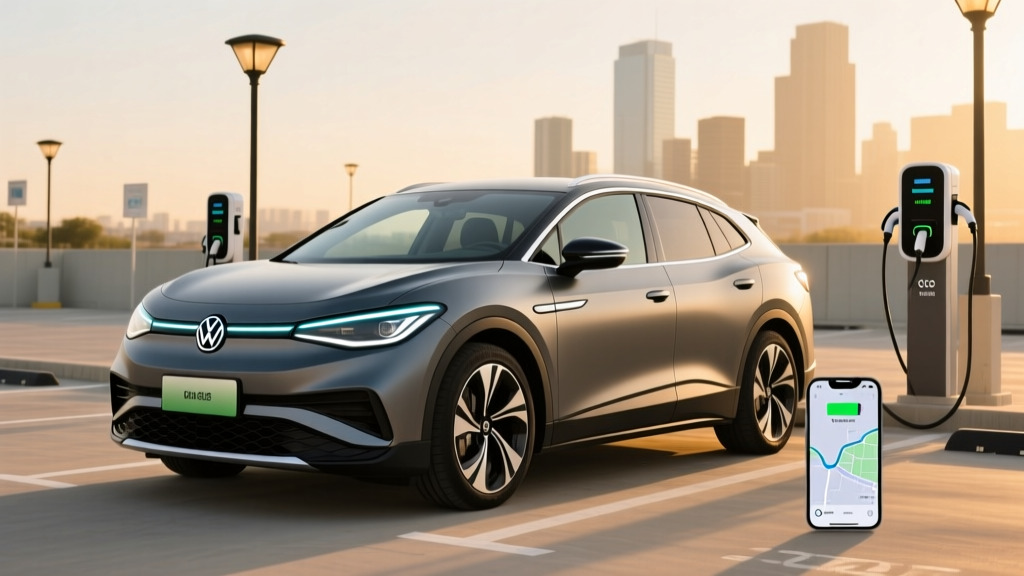
The Volkswagen ID.5 has been a staple in European EV markets since 2021, but its long-awaited arrival in North America gives U.S. buyers a new coupe-SUV option in the increasingly crowded midsize electric crossover segment. Built on VW's MEB platform — the same architecture underpinning the ID.4 — the ID.5 trades a sliver of cargo practicality for a sleeker roofline, slightly improved aerodynamics, and a more aggressive stance. For 2026, Volkswagen has confirmed U.S. availability in both Pro S (rear-wheel drive) and GTX (all-wheel drive) trims, with pricing that positions it squarely against the Hyundai Ioniq 5, Ford Mustang Mach-E, and Tesla Model Y.
After spending time with the ID.5's specifications, charging behavior, and real-world driving characteristics, here's what prospective buyers need to know before putting down a deposit.
2026 Volkswagen ID.5 Specifications at a Glance
| Spec | ID.5 Pro S (RWD) | ID.5 GTX (AWD) |
|---|---|---|
| EPA Range | 275 miles (est.) | 252 miles (est.) |
| Battery (Usable) | 77 kWh, NMC | 77 kWh, NMC |
| Horsepower | 282 hp | 335 hp |
| 0-60 mph | 6.7 sec | 5.4 sec |
| Drivetrain | Rear-Wheel Drive | Dual-Motor AWD |
| DC Fast Charge (Peak) | 175 kW | 175 kW |
| 10-80% DCFC Time | ~28 min | ~28 min |
| Level 2 Charge Rate | 11 kW (~37 mi/hr) | 11 kW (~37 mi/hr) |
| MPGe (Combined) | 104 MPGe (est.) | 93 MPGe (est.) |
| Efficiency | 32 kWh/100 mi | 36 kWh/100 mi |
| Cargo (Behind Rear Seats) | 19.2 cu ft | 19.2 cu ft |
| Cargo (Seats Folded) | 54.1 cu ft | 54.1 cu ft |
| Rear Legroom | 37.6 in | 37.6 in |
| Base MSRP | $51,990 | $57,490 |
| Battery/Powertrain Warranty | 8 yr / 100,000 mi | 8 yr / 100,000 mi |
Note: EPA range and MPGe figures are manufacturer estimates pending final EPA certification. Numbers reflect 2026 model-year projections based on the updated MEB85 battery pack. Source: Volkswagen USA.
Range and Efficiency: What the EPA Sticker Doesn't Tell You
EPA Estimate: 275 miles (Pro S) / 252 miles (GTX)
Expect in mixed real-world driving: ~245-260 miles (Pro S), ~225-240 miles (GTX)
Sustained highway (75 mph): ~230-245 miles (Pro S)
Cold weather (below 32°F): Reduce all figures by 20-30%, yielding ~180-210 miles
The ID.5 uses a 77 kWh usable (82 kWh gross) NMC (nickel manganese cobalt) battery pack — the upgraded MEB85 version that VW introduced for the 2025 model year in Europe. This is a meaningful improvement over the original 77 kWh pack, with better energy density and slightly faster charging capability.
With a drag coefficient of 0.26, the ID.5's coupe-like roofline gives it a slight aerodynamic edge over the boxier ID.4 (Cd 0.28). That translates to roughly 5-8 additional miles of range at highway speeds, which is where aerodynamic drag matters most. In city driving with frequent regenerative braking opportunities, the difference narrows.
Efficiency lands at an estimated 32 kWh per 100 miles for the RWD Pro S, which is competitive but not class-leading. The Hyundai Ioniq 5 Long Range achieves around 30 kWh/100mi, and the Tesla Model Y Long Range sits at roughly 28 kWh/100mi. The ID.5's heavier curb weight (~4,700 lbs) and VW's thermal management strategy explain the gap.
Cold-weather reality check: NMC chemistry loses more capacity in freezing temperatures than LFP alternatives. Without preconditioning the battery (which the ID.5 supports via the infotainment navigation routing to a charger), expect a 20-30% range reduction in sustained sub-freezing conditions. A heat pump is standard on U.S. models, which helps cabin efficiency but doesn't fully offset the battery's cold-weather losses.
Charging Speed: DC Fast Charging and Home Level 2
| Charging Level | Power | Speed (Miles Added) | Time |
|---|---|---|---|
| Level 1 (120V household) | 1.4 kW | ~4 mi/hr | ~55 hrs (0-100%) |
| Level 2 (240V home/public) | 11 kW | ~37 mi/hr | ~7.5 hrs (0-100%) |
| DC Fast Charge (peak) | 175 kW | ~210 mi/hr (peak) | ~28 min (10-80%) |
The ID.5's 175 kW peak DC fast-charging rate is respectable but no longer exceptional in 2026. Competitors like the Hyundai Ioniq 5 (peak 240 kW with its 800V architecture) and the Kia EV6 (also 800V) can add range significantly faster on compatible chargers. The Tesla Model Y, while limited to roughly 250 kW peak, benefits from the Supercharger network's reliability.
Charging curve reality: The 175 kW peak only holds between roughly 10-30% state of charge. From 30-60%, expect sustained rates around 125-140 kW. Above 80%, charging tapers sharply to protect the NMC cells, dropping below 50 kW. This is standard behavior for 400V NMC packs, but it means the full 10-80% session averages closer to 120 kW rather than the headline 175 kW number.
For home charging, the 11 kW onboard charger is a strong point. On a 48-amp Level 2 circuit (the most common home installation), you'll recover roughly 37 miles of range per hour, meaning an overnight session easily replenishes a full day's driving. A licensed electrician will typically quote $800-$2,000 for a Level 2 installation depending on panel capacity and run length — factor this into your purchase budget.
The ID.5 comes equipped with the NACS (North American Charging Standard) port for 2026, giving it native access to Tesla Supercharger stations without an adapter. This is a significant practical advantage for road-trip charging, as the Supercharger network remains the most reliable DC fast-charging infrastructure in the U.S. according to multiple owner surveys.
Performance and Driving Dynamics
The Pro S trim's single rear motor produces 282 horsepower, delivering a 6.7-second 0-60 mph time. That's adequate for merging and passing but won't win any stoplight races against the dual-motor competition. The rear-wheel-drive layout gives the ID.5 a more natural, balanced feel through corners compared to front-wheel-drive EVs, and the low center of gravity from the floor-mounted battery keeps body roll well-controlled.
The GTX trim's dual-motor AWD setup bumps output to 335 hp and drops the 0-60 to 5.4 seconds. The additional front motor provides genuine traction benefits in rain and snow, and the torque distribution makes the GTX feel more planted during aggressive cornering. For buyers in northern climates, the AWD traction advantage often justifies the $5,500 premium and ~23-mile range sacrifice.
Ride quality is a VW strength — the ID.5 absorbs highway expansion joints and potholes with the composed, slightly firm demeanor that characterizes the brand. The adaptive damping system (standard on GTX, optional on Pro S) lets you toggle between a comfort-oriented setup and a tighter sport mode. Steering is light and precise, though it lacks the feedback that driving enthusiasts might want.
Regenerative braking: The ID.5 offers adjustable regen through steering-wheel paddles (three levels) and a "B" mode for stronger one-pedal-style driving. However, VW's system doesn't quite bring the car to a complete stop at the lowest speeds — you'll still need the brake pedal for final halts, unlike the true one-pedal driving in a Nissan Leaf or Chevrolet Bolt.
Interior, Tech, and Cargo Practicality
The coupe-SUV roofline is the ID.5's defining design choice, and it creates a tradeoff. Rear headroom is slightly reduced compared to the ID.4 (roughly 0.8 inches less), though most passengers under 6'2" won't notice. Rear legroom at 37.6 inches is generous and matches the ID.4 exactly. The panoramic glass roof on the Pro S and GTX creates an airy cabin that offsets the lower roofline visually.
Cargo space behind the rear seats comes in at 19.2 cubic feet — noticeably less than the ID.4's 30.3 cu ft and the Tesla Model Y's 30.2 cu ft. Fold the 60/40 split rear seats and the ID.5 opens up to 54.1 cu ft, which handles luggage for a week-long trip or bulk hardware-store runs. A small front trunk (frunk) is absent — the MEB platform's front-end packaging houses the HVAC and power electronics, leaving no room for front storage.
The infotainment system runs VW's ID.Software 4.0, a substantial improvement over the laggy, frustrating ID.Software 2.x that plagued early ID.4 models in the U.S. Response times are faster, the interface is more intuitive, and wireless Apple CarPlay/Android Auto is standard. The 12.9-inch touchscreen is angled toward the driver, and a small 5.3-inch digital instrument cluster sits behind the steering wheel. Voice control has improved markedly, though physical shortcut buttons for climate and volume remain absent — a persistent complaint from VW owners.
Driver assistance: The ID.5 comes standard with Volkswagen's IQ.DRIVE suite, which includes adaptive cruise control with stop-and-go, lane centering, blind-spot monitoring, and rear cross-traffic alert. This is an SAE Level 2 driver-assist system — it requires the driver to remain fully engaged with hands on the wheel and eyes on the road. It is not autonomous driving. Travel Assist (highway lane centering combined with ACC) works well on interstates but can struggle with faded lane markings and construction zones.
Pricing, Trims, and Federal Tax Credit Eligibility
| Trim | Base MSRP | Destination | Total Before Credit |
|---|---|---|---|
| ID.5 Pro S (RWD) | $51,990 | $1,295 | $53,285 |
| ID.5 GTX (AWD) | $57,490 | $1,295 | $58,785 |
The ID.5's pricing places it in a competitive but challenging position. The base Pro S at roughly $53,285 out-the-door undercuts the Tesla Model Y Long Range ($48,990 in 2026) but exceeds the Hyundai Ioniq 5 SEL AWD (~$50,500). The GTX at ~$58,785 pushes into territory where buyers cross-shop the BMW iX xDrive40 and the Ford Mustang Mach-E GT.
Federal Tax Credit: Does the ID.5 Qualify?
- MSRP Cap: The ID.5 qualifies as an SUV under IRS rules, meaning the $80,000 MSRP cap applies (not the $55,000 sedan cap). Both trims clear this threshold.
- Buyer Income Cap: Adjusted gross income must not exceed $150,000 (single), $225,000 (head of household), or $300,000 (married filing jointly).
- Battery Sourcing (§30D): The $7,500 credit splits into two $3,750 halves — one for critical minerals sourcing and one for battery component manufacturing. Volkswagen's MEB battery supply chain involves LG Energy Solution cells. As of 2026, the ID.5 is expected to qualify for at least $3,750 and potentially the full $7,500 depending on final critical-mineral sourcing verification. Confirm current eligibility at fueleconomy.gov before purchasing.
- Point-of-Sale Transfer: Under current IRS rules, you can transfer the credit to the dealer at purchase, reducing your out-of-pocket cost immediately rather than waiting for a tax refund. This requires dealer participation.
Bottom line on pricing: A qualifying buyer taking the full $7,500 credit would see the Pro S drop to an effective price of ~$45,785 — a compelling value for a well-equipped, 275-mile EV with NACS charging access. However, confirm your personal eligibility with a tax professional, as individual circumstances (income, tax liability, prior credit usage) vary. Full IRS rules are published at irs.gov.
How Does the ID.5 Compare to Key Competitors?
| Attribute | VW ID.5 Pro S | Hyundai Ioniq 5 SEL AWD | Tesla Model Y LR | Ford Mach-E Premium |
|---|---|---|---|---|
| EPA Range | 275 mi | 290 mi | 320 mi | 290 mi |
| Battery | 77 kWh NMC | 77.4 kWh NMC | 75 kWh NMC | 91 kWh NMC |
| Peak DCFC | 175 kW | 240 kW | 250 kW | 150 kW |
| 10-80% Time | ~28 min | ~18 min | ~25 min | ~36 min |
| 0-60 mph | 6.7 sec | 5.2 sec (AWD) | 5.0 sec | 5.1 sec (AWD) |
| Cargo (rear seats up) | 19.2 cu ft | 27.2 cu ft | 30.2 cu ft | 29.7 cu ft |
| NACS Native | Yes | Yes (2026) | Yes | Yes (2026) |
| Base MSRP | $51,990 | $50,500 | $48,990 | $51,995 |
The ID.5's strongest competitive advantages are its ride quality, build materials (which feel a step above the Mach-E and Model Y interiors), and NACS Supercharger access. Its weaknesses relative to the field are cargo volume (the sloping roofline costs it dearly here), DC fast-charging speed (175 kW trails the Ioniq 5's 800V architecture significantly), and overall range (the Model Y's efficiency advantage is substantial).
Pros and Cons: The Honest Assessment
- Composed, refined ride quality that outclasses most competitors
- NACS native charging — full Supercharger access
- Strong 11 kW Level 2 onboard charger for fast home replenishment
- Improved ID.Software 4.0 is responsive and reliable
- Heat pump standard across all trims
- Competitive pricing after federal tax credit
- Cargo volume (19.2 cu ft) trails every major competitor
- 175 kW peak DCFC is mid-pack; 800V rivals charge notably faster
- No frunk for additional storage
- Touch-sensitive climate controls still absent — screen-only interface
- Real-world highway range falls meaningfully short of EPA sticker
- Regen doesn't achieve full one-pedal stop
Who Should Buy the Volkswagen ID.5?
- You prioritize ride comfort and cabin refinement over maximum cargo space
- You want native NACS/Supercharger access for reliable road-trip charging
- You charge primarily at home and value the 11 kW onboard charger
- You prefer VW's understated, European design language over polarizing alternatives
- You live in a moderate climate where cold-weather range loss is manageable
- You need maximum cargo volume (choose Model Y or Mach-E)
- You take frequent long road trips and want the fastest possible DC charging (Ioniq 5 / EV6)
- You regularly face sub-freezing winters and want LFP chemistry's cold resilience
- Budget is the top priority and the Model Y's lower MSRP matters
The ID.5 occupies a specific niche: it's the comfort-and-refinement choice in the midsize electric crossover segment. It won't win spec-sheet wars on range, charging speed, or cargo volume, but it delivers a driving experience that feels more premium than its price suggests. For buyers who value how a car feels over how it measures up on paper, the ID.5 makes a compelling case.
Frequently Asked Questions
What is the real-world range of the Volkswagen ID.5?
The EPA estimates 275 miles for the Pro S and 252 miles for the GTX. In real-world mixed driving, expect 245-260 miles (Pro S) and 225-240 miles (GTX). Sustained highway driving at 75+ mph and cold weather will reduce these figures further — plan for 180-210 miles in deep winter conditions.
How fast does the ID.5 charge at home and on the road?
On a Level 2 home charger (240V, 48A), the ID.5 charges at 11 kW, adding roughly 37 miles of range per hour — a full charge takes about 7.5 hours. On a DC fast charger, it peaks at 175 kW and reaches 10-80% in approximately 28 minutes, though the charging curve tapers significantly above 60%.
Does the Volkswagen ID.5 qualify for the $7,500 federal EV tax credit?
The ID.5 qualifies under the $80,000 MSRP SUV cap. Full $7,500 eligibility depends on battery critical-mineral sourcing and component manufacturing rules under IRS §30D, plus buyer income limits ($150K single / $300K joint). Verify current eligibility at fueleconomy.gov and consult a tax professional before purchasing.
Is the VW ID.5 worth buying over the Tesla Model Y or Hyundai Ioniq 5?
The ID.5 excels in ride quality, interior materials, and overall refinement. However, the Model Y offers more range (320 mi), more cargo space (30.2 cu ft), and a lower base price ($48,990). The Ioniq 5 charges significantly faster (18 min 10-80%) with its 800V architecture. If comfort and build quality are your top priorities, the ID.5 is competitive. If range, cargo, or charging speed lead your checklist, look at the alternatives.
Does the ID.5 have a front trunk (frunk)?
No. The MEB platform's front-end packaging does not accommodate a frunk. All storage is in the rear cargo area (19.2 cu ft behind rear seats, 54.1 cu ft with seats folded).
What is the battery warranty on the ID.5?
Volkswagen covers the ID.5's high-voltage battery and electric powertrain for 8 years or 100,000 miles, whichever comes first. The warranty guarantees the battery will retain at least 70% of its original capacity during that period — a standard threshold for the industry.