Quick Verdict: A Practical EV That Actually Tow
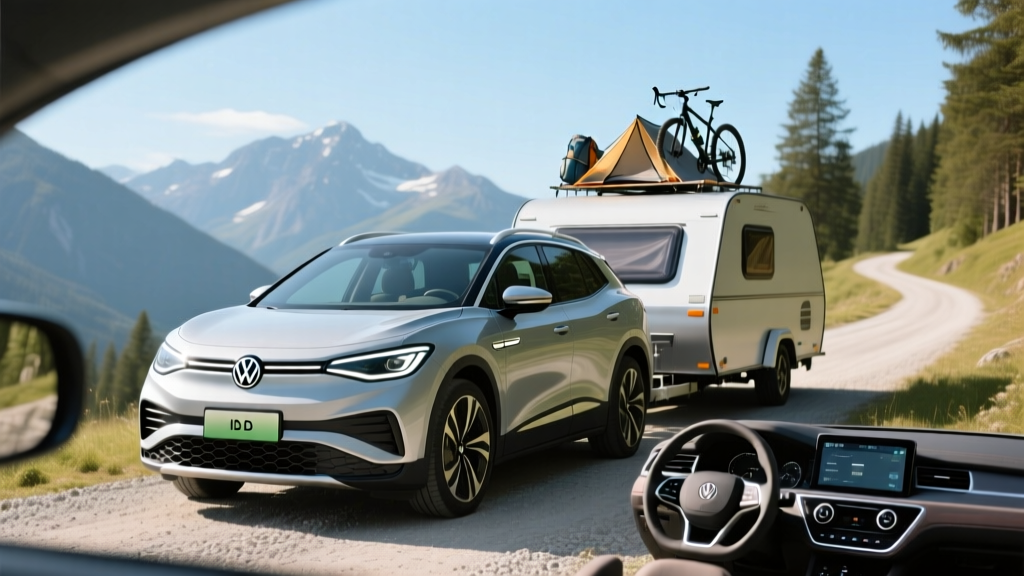
The Volkswagen ID.4 occupies a rare position in the compact electric SUV segment: it's one of the few models buyers actually choose when towing is part of the equation. With the dual-motor AWD configuration, the Volkswagen ID.4 towing capacity reaches 2,700 pounds — enough for a light utility trailer, a pair of dirt bikes, or a small aluminum boat. The single-motor RWD version drops that figure to 2,000 pounds, which still outpaces many electric crossovers in its price bracket.
But towing is only one part of the ownership picture. This review covers the ID.4's real-world range, charging behavior, pricing after federal incentives, and whether its compromises in software and charging speed are worth the practical utility it delivers.
| Spec | RWD (Standard/Pro) | AWD (Pro S / Pro S Plus) |
|---|---|---|
| EPA Range | 291 mi (Standard) / 275 mi (Pro) | 263 mi (Pro S) / 245 mi (Pro S Plus) |
| Battery (Usable) | 62 kWh (Standard) / 82 kWh (Pro) | 82 kWh NMC |
| Horsepower | 201 hp | 295 hp |
| 0-60 mph | 7.7 sec | 5.4 sec |
| Max DC Fast Charge | 140 kW (Std) / 175 kW (Pro) | 175 kW |
| 10-80% DCFC Time | ~30 min (Std) / ~28 min (Pro) | ~28 min |
| Level 2 Home Rate | 11 kW (~37 mi/hr) | 11 kW (~37 mi/hr) |
| Towing Capacity | 2,000 lbs | 2,700 lbs |
| MPGe (Combined) | 107 MPGe | 101 MPGe |
| Base MSRP | $39,735 | $46,135 |
Range, Efficiency, and Real-World Expectations
The ID.4's EPA range varies significantly by trim and drivetrain. The entry-level Standard trim with the 62 kWh battery achieves an EPA-estimated 291 miles, while the 82 kWh Pro AWD tops out at 263 miles. The fully loaded Pro S Plus AWD drops further to 245 miles due to larger 20-inch wheels and added weight.
EPA figures assume mixed driving. Expect ~220-240 miles on the highway at 70-75 mph in the 82 kWh AWD models, and ~190-210 miles in freezing temperatures without preconditioning. The heat pump (standard on Pro trims and above) mitigates cold-weather losses by roughly 10-15% compared to resistive cabin heating. If you regularly tow, plan for a 30-50% range reduction depending on trailer weight and aerodynamics — a 2,700-lb load at highway speed will compress the AWD Pro S to roughly 140-170 miles between charges.
Efficiency lands at 107 MPGe combined for the RWD Pro and 101 MPGe for the AWD Pro S, translating to roughly 31-34 kWh per 100 miles. That's competitive with the Hyundai Ioniq 5 and slightly behind the Tesla Model Y, but the ID.4 prioritizes ride comfort over aero optimization.
Charging: Speeds, Connectors, and Curve Behavior
Volkswagen equips the ID.4 with a CCS1 connector and supports DC fast charging at up to 175 kW on 82 kWh battery models (140 kW on the Standard 62 kWh). The 10-80% charge takes approximately 28 minutes under ideal conditions — adequate for road trips but noticeably slower than Hyundai/Kia's 800V architecture, which can do the same in roughly 18 minutes.
| Charging Level | Power | Approx. Speed | Notes |
|---|---|---|---|
| Level 1 (120V) | 1.2 kW | ~4 mi/hr | Emergency/trickle only |
| Level 2 (240V, 48A) | 11 kW | ~37 mi/hr | Full charge in ~8.5 hrs (82 kWh) |
| DC Fast (Peak) | 175 kW | ~220 mi/hr (at peak) | 10-80% in ~28 min |
Charging curve reality: The ID.4 peaks at 175 kW only briefly between roughly 10-30% state of charge, then tapers progressively. From 50-80%, expect sustained rates closer to 80-100 kW. Preconditioning the battery (initiated automatically when you navigate to a DC fast charger) is essential to hit peak rates — without it, especially in cold weather, you may see peak rates cut in half.
At home on a Level 2 charger, the 11 kW onboard charger adds about 37 miles of range per hour, meaning a full overnight charge is easily achievable. Volkswagen includes three years of complimentary 30-minute charging sessions on the Electrify America network, which remains a meaningful ownership perk for road-trippers.
Performance and Drivetrain
The rear-wheel-drive ID.4 delivers 201 horsepower from a single permanent-magnet motor on the rear axle. The 0-60 mph time of 7.7 seconds is adequate for merging and passing but won't thrill anyone coming from a performance sedan. The AWD dual-motor variant bumps output to 295 hp and drops the 0-60 sprint to 5.4 seconds, which feels genuinely quick in a compact crossover.
Ride quality is where the ID.4 earns its reputation. VW tuned the suspension for comfort over sportiness — the result is a compliant, quiet highway cruiser that absorbs road imperfections with the confidence of a vehicle a class above. Steering is light and precise if uncommunicative, and the turning radius is remarkably tight for a crossover, making it easy to maneuver in urban settings.
Regenerative braking offers two modes: a coasting "D" mode that lets the car glide freely, and a "B" mode with stronger regen that approaches one-pedal driving but doesn't bring the vehicle to a complete stop. Drivers accustomed to full one-pedal driving in a Tesla or Nissan Leaf may find the ID.4's regen tuning conservative.
Towing Capacity: What the ID.4 Can (and Can't) Pull
The headline number: 2,700 pounds for AWD models, 2,000 pounds for RWD. That puts the ID.4 ahead of the Hyundai Ioniq 5 (1,653 lbs with AWD) and competitive with the Ford Mustang Mach-E (varies by config, typically 1,500-2,200 lbs without a dedicated tow package). The Tesla Model Y, by contrast, is rated at 3,500 pounds with the optional tow hitch.
Practically, 2,700 pounds covers:
- A 5x8 enclosed utility trailer loaded with furniture (~2,200 lbs)
- A small aluminum fishing boat on a single-axle trailer (~2,000-2,500 lbs)
- A tandem-axle motorcycle trailer with two bikes (~1,800-2,400 lbs)
- A light teardrop camper (~1,500-2,200 lbs)
What it does not cover: full-size travel trailers, horse trailers, car haulers, or any load exceeding 2,700 lbs including tongue weight. The factory-installed tow hitch includes a wiring harness and is available as a dealer-installed accessory. Note that towing significantly compresses range — plan charging stops accordingly and avoid towing on routes with sparse DC fast-charging infrastructure.
Interior, Cargo, and Technology
The ID.4 cabin emphasizes space and simplicity. Rear legroom measures 37.6 inches, which is generous for the segment and accommodates adults comfortably on longer drives. Cargo volume behind the second row is 30.3 cubic feet, expanding to 64.2 cubic feet with the rear seats folded — competitive with the Ioniq 5 and slightly less than the Model Y's 72 cubic feet.
There is no frunk (front trunk). The space under the hood houses power electronics, and VW opted not to engineer a secondary cargo area. This is a missed opportunity for an EV, especially given competitors like the Ioniq 5 and F-150 Lightning that use front storage effectively.
The 12.9-inch infotainment touchscreen (upgraded from earlier 12-inch and 10-inch units) runs VW's latest ID. Software 4.0. Response times have improved markedly over the launch-year models, which were plagued by lag and glitches. Wireless Apple CarPlay and Android Auto are standard. However, the touch-capacitive sliders for volume and temperature remain a frustration — they're unlit at night and lack tactile feedback, a persistent complaint that VW has yet to address with physical controls.
Driver assistance comes via VW's IQ.DRIVE suite, which includes adaptive cruise control with stop-and-go, lane centering, and automatic emergency braking. This is a SAE Level 2 system — the driver must remain fully engaged with hands on the wheel and eyes on the road. It is not autonomous driving. The system works reliably on highways but is less sophisticated than GM's Super Cruise or Ford's BlueCruise in hands-free scenarios.
Pricing, Trims, and Federal Tax Credit Eligibility
| Trim | Drivetrain | MSRP | Est. After §30D Credit* |
|---|---|---|---|
| Standard | RWD | $39,735 | ~$32,235 |
| Pro | RWD | $43,735 | ~$36,235 |
| AWD Pro | AWD | $47,735 | ~$40,235 |
| AWD Pro S | AWD | $51,335 | ~$43,835 |
| AWD Pro S Plus | AWD | $55,735 | ~$48,235 |
*Assumes full $7,500 §30D credit eligibility. Actual credit depends on battery sourcing, buyer income, and MSRP caps. See IRS guidelines.
Federal tax credit rules (§30D): The ID.4 qualifies for up to $7,500 in federal tax credits, but eligibility is not automatic. Current rules require:
- MSRP cap: SUVs must be priced at or below $80,000 — all ID.4 trims clear this easily.
- Buyer income cap: Modified AGI must not exceed $150,000 (single), $225,000 (head of household), or $300,000 (joint).
- Battery sourcing: At least a percentage of critical minerals and battery components must be sourced from the US or FTA partners. The ID.4's battery supply chain has evolved, and partial credit ($3,750) vs. full credit ($7,500) can vary by model year and production batch. Verify eligibility on the IRS clean vehicle credit page before purchasing.
- Point-of-sale transfer: As of 2024, buyers can transfer the credit to the dealer at purchase, reducing the out-of-pocket price immediately rather than waiting to claim it on a tax return.
Warranty and Ownership Costs
Volkswagen backs the ID.4 with a competitive warranty package:
- Battery warranty: 8 years / 100,000 miles (capacity retention guaranteed above 70%)
- Powertrain warranty: 8 years / 100,000 miles
- Bumper-to-bumper: 4 years / 50,000 miles
- Roadside assistance: 4 years / 50,000 miles
The 70% battery capacity retention threshold is industry-standard and matches competitors like Hyundai, Kia, and Ford. Tesla's warranty guarantees 70% retention as well. Real-world degradation data from early ID.4 owners suggests the 82 kWh NMC pack holds up well, with most vehicles showing 93-96% state of health after 30,000-50,000 miles. For detailed battery longevity expectations, consult fueleconomy.gov's EV technology overview.
Insurance costs for the ID.4 run slightly higher than comparable gas-powered compact SUVs — expect 10-20% more in annual premiums depending on your state and driving record. Maintenance costs are substantially lower: no oil changes, no spark plugs, and brake pad life is extended significantly by regenerative braking.
Pros
- 2,700-lb towing capacity (AWD) leads the compact EV SUV class
- Comfortable, quiet ride quality tuned for long-distance cruising
- Generous rear legroom (37.6 in) and solid cargo space (30.3 cu ft)
- 3 years of complimentary Electrify America DC fast charging
- Competitive pricing with full §30D credit eligibility
- Tight turning radius and easy urban maneuverability
Cons
- DC fast charging peaks at 175 kW — slower than Hyundai/Kia 800V rivals
- Touch-capacitive sliders for climate/volume are frustrating and unlit
- No frunk — wasted front cargo potential
- Range drops sharply when towing (plan for 30-50% loss)
- Software, while improved, still lags behind Tesla and GM interfaces
- Pro S Plus pricing approaches $56K before incentives
How the ID.4 Stacks Up Against Competitors
Buyers cross-shopping the ID.4 typically consider the Hyundai Ioniq 5, Tesla Model Y, and Ford Mustang Mach-E. Here's how the ID.4 differentiates:
- Versus Ioniq 5: The Hyundai charges significantly faster (18 min 10-80% on 800V architecture) and has a more distinctive design, but its 1,653-lb towing capacity trails the ID.4 by over 1,000 lbs. If towing matters, the ID.4 wins. If charging speed is paramount, the Ioniq 5 is superior.
- Versus Model Y: Tesla offers more range (up to 330 mi EPA), faster Supercharger access, and 3,500-lb towing. But the Model Y's ride quality is firmer, its interior is more spartan, and it does not qualify for the full §30D credit in all configurations. The ID.4 is more comfortable and better incentivized.
- Versus Mustang Mach-E: Ford's electric crossover is sportier to drive and has a more engaging infotainment system, but towing capacity is limited (1,500-2,200 lbs depending on configuration). The ID.4 is the more practical hauler.
Who Should Buy the Volkswagen ID.4?
Choose the ID.4 if: You need a compact electric SUV that can tow a light trailer, prioritize ride comfort over sporty handling, want complimentary Electrify America charging for road trips, and value a traditional crossover layout with strong rear-seat space.
Look elsewhere if: You need maximum DC fast-charging speed (Ioniq 5), the longest possible range (Model Y), hands-free highway driving (BlueCruise/Super Cruise equipped rivals), or a frunk for additional cargo.
Frequently Asked Questions
What is the real-world range of the Volkswagen ID.4?
The EPA rates the AWD Pro S at 263 miles, but real-world highway driving at 70-75 mph typically yields 220-240 miles. In freezing weather without preconditioning, expect 190-210 miles. Towing compresses range further to roughly 140-170 miles with a max-weight trailer.
How fast does the ID.4 charge at home and on DC fast chargers?
At home on Level 2 (240V, 48A), the ID.4 charges at 11 kW, adding roughly 37 miles per hour for a full overnight charge. On DC fast chargers, the 82 kWh models peak at 175 kW and reach 10-80% in about 28 minutes — though sustained speeds taper significantly above 50% state of charge.
Does the Volkswagen ID.4 qualify for the $7,500 federal tax credit?
The ID.4 can qualify for up to $7,500 under IRS §30D rules, but eligibility depends on your income (capped at $300K joint filers), the vehicle's MSRP (must be under $80K for SUVs — all trims qualify), and battery sourcing requirements that can vary by production batch. Always verify on the IRS clean vehicle credit page before purchasing. The credit can be transferred to the dealer at point of sale.
Can the ID.4 tow a camper or boat?
Yes — the AWD model's 2,700-lb rating covers most teardrop campers, small aluminum fishing boats on single-axle trailers, and light utility trailers. It cannot tow full-size travel trailers, horse trailers, or car haulers. Always account for tongue weight (typically 10-15% of trailer weight) within the total rating.
Is the ID.4 worth buying over the Tesla Model Y or Hyundai Ioniq 5?
It depends on priorities. The ID.4 leads in towing capacity and ride comfort, the Ioniq 5 dominates in charging speed, and the Model Y wins on range and charging network access. If towing and daily comfort are your top needs, the ID.4 is the strongest choice in its class.
What battery chemistry does the ID.4 use?
The 82 kWh pack uses NMC (nickel-manganese-cobalt) chemistry, which offers higher energy density than LFP (lithium iron phosphate) but is more sensitive to sustained high states of charge. VW recommends daily charging to 80% and only charging to 100% before long trips. The 62 kWh Standard pack also uses NMC chemistry.