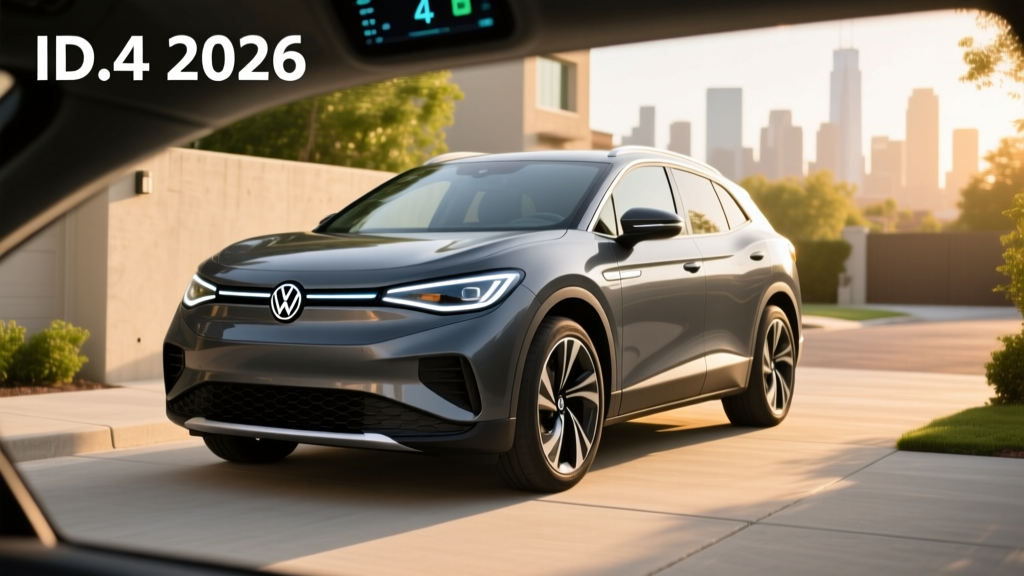
The short answer: The 2026 Volkswagen ID.4 is VW's mainstream electric SUV, offering an EPA-estimated 291 miles of range (RWD Pro S trim), DC fast charging up to 175 kW (10–80% in ~28 minutes), and a starting MSRP around $42,790. It competes directly with the Hyundai Ioniq 5, Tesla Model Y, and Ford Mustang Mach-E. For buyers with reliable home Level 2 charging who drive under 250 miles daily, it delivers lower running costs than a comparable gas SUV like the VW Tiguan — but public-charging dependency and cold-weather range loss are real factors you must weigh before buying.
The 2026 Volkswagen ID.4 at a Glance
Volkswagen's all-electric compact SUV has matured since its 2021 U.S. launch. The current-generation ID.4 rides on the MEB platform and is built at VW's Chattanooga, Tennessee factory — a detail that matters for federal tax credit eligibility. For 2026, the ID.4 lineup includes RWD and AWD configurations across Pro, Pro S, and Pro S Plus trims, with battery options centered on an 82 kWh usable (91 kWh gross) NMC lithium-ion pack.
| Spec | ID.4 Pro S (RWD) | ID.4 AWD Pro S |
|---|---|---|
| EPA Range | 291 miles | 263 miles |
| Battery (usable / gross) | 82 kWh / 91 kWh (NMC) | 82 kWh / 91 kWh (NMC) |
| Horsepower | 282 hp | 335 hp |
| 0–60 mph | ~7.7 sec | ~5.4 sec |
| Peak DC Fast Charge | 175 kW | 175 kW |
| 10–80% DC Fast Charge | ~28 min | ~28 min |
| Level 2 Charge Rate | 11 kW (~37 mi/hr) | 11 kW (~37 mi/hr) |
| MPGe (combined) | 107 MPGe | 96 MPGe |
| Base MSRP | $42,790 | $47,790 |
| Battery Warranty | 8 yr / 100,000 mi | 8 yr / 100,000 mi |
Real-World Range Reality: The EPA 291-mile sticker (RWD) assumes a mix of city and highway driving at moderate temperatures. Expect approximately 240–260 miles on sustained highway trips at 70+ mph. In freezing weather (below 32°F), plan for a 20–30% range reduction, bringing real-world winter range down to roughly 200–230 miles. The AWD variant's lower EPA figure (263 mi) compounds further in cold conditions. Always plan road trips around 80% of the EPA number to stay safe.
How Does the ID.4 Compare to a Gas SUV Like the Tiguan?
Many shoppers cross-shop the ID.4 against VW's own Tiguan or competitors like the Toyota RAV4. The economics differ sharply depending on your mileage, local electricity rates, and how long you plan to keep the vehicle.
| Factor | 2026 VW ID.4 Pro S (RWD) | 2026 VW Tiguan (2.0T AWD) |
|---|---|---|
| Base MSRP | $42,790 | $31,490 |
| Estimated Federal Tax Credit | Up to $7,500 (§30D)* | None |
| Effective Price After Credit | ~$35,290 | $31,490 |
| Energy/Fuel Cost per Mile | ~$0.045 (home charging, $0.15/kWh) | ~$0.14 (gas at $3.50/gal, 26 MPG combined) |
| Annual Fuel/Energy (12,000 mi) | ~$540 | ~$1,680 |
| 5-Year Energy/Fuel Cost | ~$2,700 | ~$8,400 |
| Estimated Maintenance (5 yr) | ~$1,200 | ~$3,200 |
| EPA Efficiency | 107 MPGe | 26 MPG combined |
*Federal tax credit eligibility under IRS §30D depends on buyer income caps ($150K single / $300K joint modified AGI), vehicle MSRP caps ($80,000 for SUVs), battery critical-mineral and component sourcing requirements, and point-of-sale transfer availability. The ID.4's U.S. production helps its sourcing eligibility, but rules change — verify current status at IRS.gov's qualified vehicle list and consult a tax professional.
The ID.4's higher sticker price narrows considerably after the federal credit, and the fuel and maintenance savings compound quickly. Over five years and 60,000 miles, the ID.4 can save roughly $7,700 in energy and maintenance costs compared to the Tiguan, according to fueleconomy.gov estimates. If you keep the vehicle eight years or more, the total cost of ownership often tips in the EV's favor — but only if you can charge affordably at home.
Charging the ID.4: Home, Public, and Road Trips
Understanding charging is the single most important homework assignment for a first-time EV buyer. The ID.4 supports three charging tiers, and your daily experience depends heavily on which ones you can access.
| Level | Power (kW) | Miles Added per Hour | Typical Use Case |
|---|---|---|---|
| Level 1 (120V outlet) | ~1.4 kW | ~4–5 mi/hr | Emergency / overnight trickle |
| Level 2 (240V home/public) | Up to 11 kW | ~37 mi/hr | Daily home charging, workplaces |
| DC Fast Charging | Up to 175 kW (peak) | ~200+ mi in 10 min (peak) | Road trips, highway corridors |
Home charging reality: A full Level 2 home charge from empty to 100% takes roughly 8–9 hours at 11 kW. Most owners plug in nightly and wake up with a full battery, never visiting a gas station. But installing a Level 2 charger (a 240V NEMA 14-50 outlet or hardwired wallbox) requires a dedicated 40–50 amp circuit. If your electrical panel is at capacity or far from your garage, expect installation costs between $500 and $2,500 — or more if a panel upgrade to 200A is needed.
DC fast charging and the curve: The ID.4's 175 kW peak rate is competitive but not class-leading (the Hyundai Ioniq 5 peaks at 240 kW on 800V architecture). More importantly, peak rate is not sustained rate. The ID.4 holds strong charging power from roughly 10% to 50% SoC, then tapers progressively. The 10–80% time of ~28 minutes assumes optimal battery preconditioning — navigate to a charger using the vehicle's built-in routing to activate thermal preconditioning. Without it, cold-soak can push that time past 40 minutes.
Connector note: The ID.4 currently uses the CCS1 connector for DC fast charging. Volkswagen has announced a transition to the NACS (Tesla-style) connector for future models, and adapters are expected for existing CCS vehicles to access Tesla Superchargers. Verify adapter compatibility before relying on the Supercharger network.
Real Ownership Costs: A 5-Year Breakdown
Sticker price is just the entry fee. Here's what owning an ID.4 actually costs versus a comparable gas SUV over five years and 60,000 miles.
| Cost Category | VW ID.4 Pro S (RWD) | VW Tiguan 2.0T AWD |
|---|---|---|
| Purchase Price (after est. credit) | $35,290 | $31,490 |
| Home Charger Install (one-time) | $1,200 | $0 |
| Energy/Fuel (5 yr, 60K mi) | $2,700 | $8,400 |
| Maintenance (5 yr) | $1,200 | $3,200 |
| Insurance (est. 5 yr) | $9,500 | $7,800 |
| Estimated Depreciation (5 yr) | $14,000 | $11,500 |
| 5-Year Total Cost | $63,890 | $62,390 |
| Cost per Mile (all-in) | $1.06 | $1.04 |
Key observations from this breakdown:
- Energy savings are real and large: $5,700 less in fuel over five years at national-average electricity and gas prices. If your utility offers off-peak EV rates (many do — check with your provider), savings grow further.
- Insurance is typically higher for EVs: Expect premiums 15–25% above an equivalent gas SUV, driven by higher repair costs for battery and structural components. Get quotes before purchasing.
- Maintenance is genuinely lower: No oil changes, no transmission fluid, no spark plugs, fewer brake replacements (regenerative braking extends pad life). VW's scheduled maintenance is mostly cabin air filters and tire rotations.
- Depreciation remains a wildcard: EV resale values have been volatile. The ID.4 has seen steeper depreciation than some competitors. If you plan to keep the vehicle 8+ years, this matters less.
First-Time EV Buyer: What You Actually Need to Know
If the ID.4 is your first electric vehicle, these practical realities aren't always obvious from the brochure:
| Common Misconception | Fact |
|---|---|
| "291 miles means I can drive 291 miles" | Real-world highway/cold weather range is 200–260 mi depending on conditions. Plan trips conservatively. |
| "I'll save money immediately" | Upfront cost and home charger install mean break-even often takes 3–5 years unless you drive high annual miles. |
| "Charging takes too long" | Home charging happens while you sleep — zero active time. Road-trip DC stops add 25–35 min every ~180 miles. |
| "The battery will need replacing soon" | VW warranties the battery for 8 years/100,000 miles against dropping below 70% capacity. Industry data shows NMC packs typically retain 85–90% after 100K miles. |
| "I don't need home charging" | Public-only charging is possible but expensive ($0.30–$0.50/kWh vs $0.12–$0.18 at home) and time-consuming. Home access is the biggest predictor of EV satisfaction. |
| "The tax credit is guaranteed" | §30D eligibility depends on your income, the vehicle's battery sourcing, and MSRP caps. Rules change — verify at purchase time. |
Home charging access is non-negotiable for most buyers. If you live in an apartment without charging, rely on street parking, or your landlord won't approve an install — think carefully. Public DC fast charging costs 3–4x more per kWh than home electricity and adds 30+ minutes to your routine several times a week. The ID.4 makes most sense when you can install a 240V Level 2 connection at home or work.
Preconditioning matters more than you think. The ID.4's battery thermal management system works best when the pack is warm. In cold weather, navigate to your next DC fast charger using the built-in nav — the car will warm the battery en route, significantly improving charge speed. Skipping this step in winter can double your charging stop time.
Decision Framework: Is the ID.4 the Right Volkswagen SUV Electric Vehicle for You?
Choose the VW ID.4 if:
- You have (or can install) a Level 2 home charger on a 240V circuit
- Your daily driving is under 200 miles round-trip and you take road trips 4–6 times a year
- You want a mainstream-brand EV with dealer service support in all 50 states
- You qualify for the §30D federal tax credit (check income and sourcing at IRS.gov)
- You value a quiet, comfortable ride over sporty handling dynamics
Consider an alternative if:
- You cannot charge at home and must rely entirely on public infrastructure
- You regularly drive 300+ miles in a single day in cold climates — the Ioniq 5's faster charging or the Model Y's Supercharger access may serve you better
- You need three rows of seating — look at the VW ID.Buzz, Kia EV9, or Hyundai Ioniq 9
- Maximum cargo volume is critical — the ID.4's 30.3 cu ft behind the rear seats is mid-pack; the Model Y offers 30.2 cu ft but a larger frunk
- You want cutting-edge ADAS — VW's Travel Assist is a competent Level 2 system, but Ford BlueCruise and GM Super Cruise offer hands-free highway driving on mapped roads
ADAS Note: The ID.4's Travel Assist and IQ.DRIVE suite are SAE Level 2 driver-assistance systems. This means the car can manage steering, acceleration, and braking on highways, but you must remain fully engaged — hands on or near the wheel, eyes on the road. This is not autonomous or self-driving capability. Level 4 driverless operation (no human needed) exists only in limited robotaxi services like Waymo in select cities.
Competitor Snapshot: How the ID.4 Stacks Up
| Spec | VW ID.4 Pro S RWD | Hyundai Ioniq 5 SEL RWD | Tesla Model Y Long Range AWD | Ford Mustang Mach-E Premium RWD |
|---|---|---|---|---|
| EPA Range | 291 mi | 303 mi | 320 mi | 290 mi |
| Battery (usable) | 82 kWh (NMC) | 77.4 kWh (NMC) | 75 kWh (NMC) | 75.7 kWh (NMC) |
| Peak DC Charge | 175 kW | 240 kW (800V) | 250 kW | 150 kW |
| 10–80% DC Time | ~28 min | ~18 min | ~25 min | ~38 min |
| 0–60 mph | 7.7 sec | 7.2 sec | 4.8 sec | 6.1 sec |
| Base MSRP | $42,790 | $43,650 | $46,630 | $43,995 |
| Cargo (rear seats up) | 30.3 cu ft | 27.2 cu ft | 30.2 cu ft | 29.7 cu ft |
The ID.4's advantage is comfort, build quality, and Volkswagen's dealer network. Its weakness is charging speed — the Ioniq 5's 800V architecture delivers materially faster road-trip stops. The Model Y still leads on range and Supercharger network access, though CCS adapter compatibility is narrowing that gap. The Mach-E has fallen behind on charging speed but offers engaging driving dynamics. Source: fueleconomy.gov and manufacturer specifications.
FAQ: Volkswagen ID.4 Electric SUV
Does the Volkswagen ID.4 qualify for the $7,500 federal tax credit?
Potentially. The ID.4 is assembled in Chattanooga, TN, which helps with domestic sourcing requirements under IRS §30D. However, eligibility depends on your modified adjusted gross income (under $150K single / $300K joint), the vehicle's battery critical-mineral and component sourcing percentages (which can change mid-year), and the $80,000 MSRP cap for SUVs. The credit can be transferred to the dealer at point of sale for an immediate price reduction. Always verify current eligibility on the IRS qualified vehicles list at the time of purchase.
How long does the ID.4 battery last, and what does replacement cost?
Volkswagen warranties the high-voltage battery for 8 years or 100,000 miles against capacity loss below 70%. Real-world data from MEB-platform vehicles shows typical degradation of 8–12% over the first 100,000 miles. A full battery replacement out of warranty is estimated at $12,000–$18,000 including labor, though individual module replacement is possible at lower cost. Most owners will never need a full pack replacement during typical ownership.
Can I tow with the Volkswagen ID.4?
Yes, but modestly. The ID.4 is rated for up to 2,700 pounds (AWD) or 2,200 pounds (RWD) when properly equipped with the factory hitch. Towing significantly reduces range — expect a 30–50% reduction depending on trailer weight and aerodynamics. This is a light-duty tow rating suitable for small utility trailers or bike racks, not campers.
What happens if I can only charge on a standard 120V outlet?
Level 1 charging at ~1.4 kW adds roughly 4–5 miles of range per hour, or about 50–60 miles overnight. This is sufficient if your daily driving is under 40 miles, but it's painfully slow for replenishing after longer trips. Consider a 240V Level 2 installation a near-requirement for practical EV ownership.
Is the ID.4 good in snow and cold weather?
The AWD Pro S variant provides confident traction, and VW includes a heat pump (standard on most trims) that improves cabin heating efficiency and reduces winter range loss. However, all EVs lose range in cold weather — expect 20–30% reduction in sub-freezing conditions. The ID.4's battery preconditioning helps mitigate charging slowdowns, but you should plan winter road trips around 180–200 miles between stops.