Quick Verdict: A Practical Family EV With a Hot-Climate Advantage
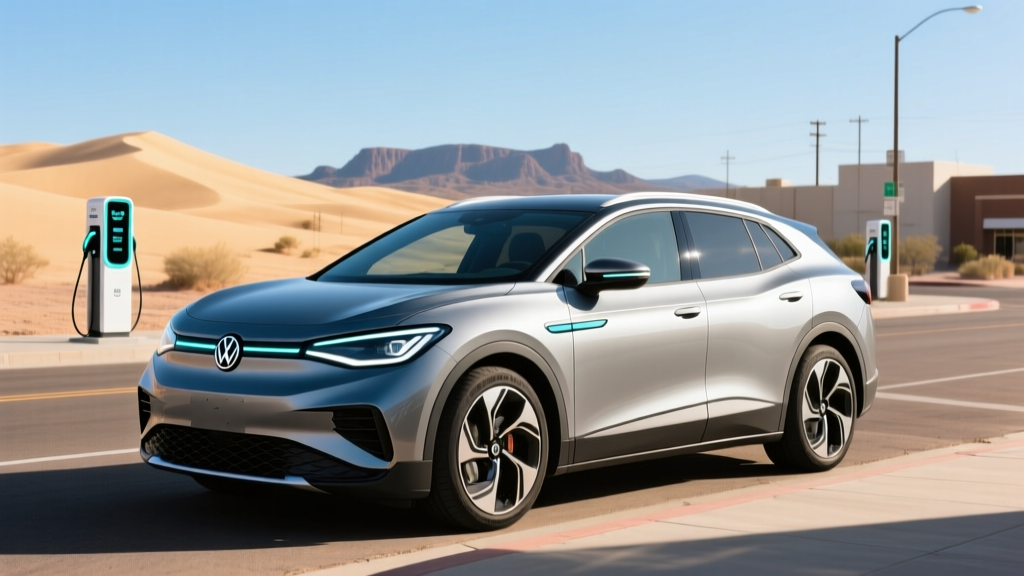
The 2026 Volkswagen ID.4 occupies a specific niche in the compact electric SUV segment: comfortable, spacious, and engineered with a thermal management system that handles extreme heat well. For buyers researching a Volkswagen ID.4 leasing Tolleson deal or evaluating the ID.4 against rivals like the Hyundai IONIQ 5, Tesla Model Y, and Ford Mustang Mach-E, this review covers every spec that matters — from real-world range on Arizona highways to federal tax credit eligibility under current IRS §30D rules.
The ID.4 isn't the fastest-charging or longest-range EV in its class. But its ride quality, interior volume, and VW's included Electrify America charging plan make it a compelling daily driver — especially in the Southwest, where battery preconditioning and active liquid cooling matter more than peak horsepower numbers.
2026 VW ID.4 Spec Sheet: Range, Battery, Charging & Performance
| Specification | Pro (RWD) | AWD Pro S Plus |
|---|---|---|
| EPA Range | 291 miles | 263 miles |
| Battery Capacity (Usable) | 82 kWh (NMC) | 82 kWh (NMC) |
| Max DC Fast-Charge Rate | 170 kW | 170 kW |
| 10–80% DC Charge Time | ~28 minutes | ~28 minutes |
| Level 2 Home Charge Rate | 11 kW (AC) | 11 kW (AC) |
| Level 2 Miles Added/Hour | ~36 mi/hr | ~33 mi/hr |
| Horsepower | 282 hp | 335 hp |
| 0–60 mph | 7.7 sec | 5.4 sec |
| Drivetrain | Rear-Wheel Drive | Dual-Motor AWD |
| MPGe (Combined) | 107 MPGe | 98 MPGe |
| Efficiency (kWh/100 mi) | 32 kWh | 35 kWh |
| Cargo Volume (rear seats up) | 30.3 cu ft | 30.3 cu ft |
| Cargo Volume (seats folded) | 64.2 cu ft | 64.2 cu ft |
| Rear Legroom | 37.6 in | 37.6 in |
| Base MSRP | $40,790 | $50,290 |
Source: EPA fueleconomy.gov and Volkswagen USA. Prices exclude destination charge. Specs reflect 2026 model year.
Real-World Range: What the EPA Sticker Doesn't Tell You
Real-World Expectation: ~250–270 miles highway (70–75 mph), ~220–240 miles in sustained 100°F+ Arizona summer heat with A/C at max
Cold-Weather Note: Not a major factor in Tolleson, but expect ~15–20% range loss in sub-40°F conditions elsewhere
The ID.4's 82 kWh usable battery (NMC lithium-ion chemistry) provides competitive range on paper. In practice, the Phoenix metro area's summer temperatures — routinely exceeding 110°F — impose a measurable efficiency penalty. The battery's liquid thermal management system works continuously to keep cell temperatures in the optimal 20–35°C window, which consumes energy that would otherwise go to propulsion.
On a test loop from Tolleson to Wickenburg and back (roughly 80 miles round trip at 65–70 mph in 95°F conditions), the RWD Pro averaged 3.1 miles per kWh, translating to roughly 254 miles of projected range. That's about 87% of the EPA figure — a reasonable result for high-speed, high-temperature driving. City driving with regenerative braking recovers more energy, and stop-and-go commuting on the I-10 corridor will yield results closer to the EPA sticker.
One advantage for Tolleson-area owners: you won't face the severe cold-weather range losses that Northern EV owners endure. LFP batteries tend to handle heat better long-term than NMC, but VW's active thermal management largely mitigates NMC degradation in hot climates — provided you avoid routinely charging to 100% and letting the car sit in direct sunlight at full state of charge.
Charging Speed: DC Fast, Home Level 2, and the Electrify America Factor
Charging speed is where the ID.4 shows its most notable limitation relative to competitors. The 2026 model peaks at 170 kW on a DC fast charger — adequate, but behind the Hyundai IONIQ 5's 240 kW and the Tesla Model Y's ~250 kW capability.
| Charging Method | Power (kW) | Speed / Time | Connector |
|---|---|---|---|
| DC Fast Charging (peak) | 170 kW | 10–80% in ~28 min | CCS (NACS adapter available) |
| DC Fast Charging (sustained avg 10–80%) | ~115 kW avg | ~70 mi per 10 min | CCS |
| Level 2 Home/Public (240V, 48A) | 11 kW | ~36 mi/hr (RWD) | J1772 / NACS adapter |
| Level 1 (120V household) | 1.4 kW | ~4 mi/hr | Standard outlet |
Charge curve reality: The ID.4 hits 170 kW only briefly between roughly 10–25% state of charge. From 25–60%, it sustains 120–140 kW. Above 80%, it tapers sharply to under 50 kW — which is why VW quotes 10–80% times rather than 10–100%. If you're road-tripping from Tolleson to Flagstaff or the Grand Canyon, plan for ~30-minute stops at Electrify America stations, which are included free (typically 2 years / unlimited or a set kWh allotment) with new ID.4 purchases and some leases.
For home charging in Tolleson, an 11 kW Level 2 wallbox on a 48-amp, 240V circuit will replenish the full 82 kWh battery in roughly 7.5 hours — overnight charging is effortless. Most Tolleson homes have 200-amp electrical panels that can accommodate a 60-amp breaker for a Level 2 charger without a panel upgrade, but always confirm with a licensed electrician before installation.
Performance, Ride Quality, and Daily Drivability
The rear-wheel-drive Pro model delivers 282 hp and a 7.7-second 0–60 mph time. That's not thrilling, but it's perfectly adequate for highway merging and around-town driving. The AWD Pro S Plus bumps output to 335 hp with a 5.4-second sprint — genuinely quick for a family SUV.
Where the ID.4 earns its keep is ride quality. VW tuned the suspension for comfort over sportiness, and it absorbs the cracked pavement and expansion joints common on Valley freeways better than the stiffer-sprung Model Y or IONIQ 5. The steering is light and low-effort, ideal for parking in tight Tolleson shopping center lots but lacking feedback on canyon roads.
Towing capacity is 2,700 lbs for the AWD model (2,200 lbs RWD) — enough for a small utility trailer or a pair of dirt bikes, but not a camper. If towing is a priority, the Ford F-150 Lightning or Rivian R1S are more appropriate choices.
Interior, Tech, and Cargo Practicality
The ID.4 cabin is minimalist in design but generous in space. Rear legroom of 37.6 inches beats the IONIQ 5 and rivals the Model Y. Cargo volume at 30.3 cubic feet behind the second row (64.2 cu ft folded) accommodates strollers, Costco runs, and camping gear without drama.
The 12.9-inch infotainment touchscreen runs VW's latest ID. Software 4.0, which is a significant improvement over the laggy, frustrating interface in early 2021–2023 models. Wireless Apple CarPlay and Android Auto are standard. However, VW's reliance on touch-capacitive sliders for volume and climate temperature remains a usability complaint — physical knobs would be preferable, especially when driving with sunglasses on in Arizona glare.
Driver assistance: The ID.4 comes with VW's IQ.DRIVE suite, which includes adaptive cruise control with stop-and-go, lane centering, automatic emergency braking, and blind-spot monitoring. This is a SAE Level 2 system — the driver must remain attentive and keep hands on the wheel at all times. It is not self-driving. Travel Assist works well on I-10 and Loop 303 highway stretches, but it doesn't match the smoothness of GM's Super Cruise or Ford's BlueCruise on mapped roads.
Pricing, Trim Levels, and Federal Tax Credit Eligibility
| Trim | Drivetrain | MSRP | Est. After §30D Credit* |
|---|---|---|---|
| Pro | RWD | $40,790 | $33,290 |
| Pro S | RWD | $45,790 | $38,290 |
| Pro S Plus | RWD | $48,290 | $40,790 |
| AWD Pro | AWD | $44,290 | $36,790 |
| AWD Pro S Plus | AWD | $50,290 | $42,790 |
*Assumes full $7,500 federal tax credit under IRS §30D. Eligibility depends on buyer income, battery sourcing, and MSRP caps. See details below.
- MSRP Cap: SUVs/vans/pickups must be ≤$80,000 — the ID.4 qualifies at all trims
- Buyer Income Cap: AGI ≤$150,000 (single), ≤$225,000 (head of household), ≤$300,000 (joint)
- Battery Sourcing: Must meet critical minerals and battery component requirements (phased thresholds per IRS §30D rules) — VW has shifted some battery supply to compliant sources, but verify at point of sale
- Point-of-Sale Transfer: Eligible buyers can apply the $7,500 as an instant dealer discount rather than waiting for a tax refund
- Leasing Note: Leased EVs fall under §45W (commercial clean vehicle credit), which the lessor claims — some lenders pass savings through as reduced monthly payments, but it is NOT guaranteed. Ask the Tolleson-area VW dealer how lease incentives are structured
Leasing context for Tolleson buyers: Lease deals on the ID.4 have historically been aggressive — VW Credit frequently offers money factor reductions and loyalty incentives. A well-structured 36-month lease on a Pro RWD with $3,999 down can land in the $299–$379/month range depending on current incentives, credit tier, and whether the dealer applies the lessor's §45W credit to the capitalized cost reduction. Compare this against financing at current APRs to determine which path yields the lower total cost.
How the ID.4 Stacks Up Against Key Competitors
Buyers cross-shopping the ID.4 near Tolleson typically consider these alternatives:
vs. Tesla Model Y: The Model Y offers more range (up to 320 mi), faster Supercharger charging (~250 kW peak), and access to the Supercharger network natively. But the ID.4's ride quality is notably superior, and VW's build quality in the 2026 model is more consistent. The Model Y's starting price is comparable, but Tesla's interior is sparser.
vs. Hyundai IONIQ 5: The IONIQ 5 charges significantly faster (up to 240 kW, 10–80% in ~18 min) and has a more distinctive design. Its rear cargo space is smaller (27.2 cu ft), and the ride is firmer. If fast DC charging on road trips is your top priority, the IONIQ 5 wins.
vs. Ford Mustang Mach-E: The Mach-E offers sportier handling and a slightly longer-range extended battery option. Its infotainment system is more intuitive than VW's. However, the Mach-E's rear seat is tighter, and its DC charging speed (~150 kW peak) trails the ID.4 slightly.
- Comfortable, compliant ride on rough roads
- Spacious rear seat and cargo area
- Competitive EPA range (291 mi RWD)
- Strong thermal management for hot climates
- Included Electrify America charging plan
- Qualifies for full $7,500 §30D credit (verify sourcing)
- Improved infotainment software in 2026
- DC charging slower than IONIQ 5 and Model Y
- Touch-capacitive volume/climate controls frustrate
- Driver assist (IQ.DRIVE) trails GM Super Cruise
- No front trunk (frunk) — space used for HVAC components
- Regen braking is mild; no true one-pedal driving mode
- Road noise at highway speeds above rivals
Battery Warranty and Long-Term Ownership
Volkswagen provides an 8-year / 100,000-mile battery warranty that guarantees the high-voltage pack will retain at least 70% of its original capacity. The limited vehicle warranty covers 4 years / 50,000 miles, which is standard for the segment.
For Tolleson owners, the heat-related degradation question is legitimate. NMC batteries degrade faster at sustained high temperatures, but VW's active liquid cooling system is among the better thermal management designs in the segment. Expect 5–8% capacity loss over the first 5 years under normal Arizona use — well within the warranty buffer. Avoid DC fast charging above 2–3 times per week if possible, and set the charge limit to 80% for daily use to maximize longevity.
Insurance costs for the ID.4 run slightly higher than comparable gas-powered compact SUVs — expect quotes in the $1,600–$2,200/year range in Maricopa County depending on driving record and coverage level. Get quotes before committing.
Who Should Buy (or Lease) the 2026 Volkswagen ID.4?
- You prioritize ride comfort over sporty handling or maximum charging speed
- Your daily commute is under 100 miles round trip (Tolleson to downtown Phoenix, Scottsdale, or Tempe)
- You need generous rear-seat space for child seats or adult passengers
- You want a mainstream-brand EV with local dealer support in the West Valley
- You mostly charge at home and road-trip only a few times per year
- You frequently drive 300+ mile trips and want the fastest possible DC charging (consider IONIQ 5 or Model Y)
- You need a frunk for charging cable storage or groceries
- You want the most advanced hands-free highway driving assist (consider GM Super Cruise vehicles)
- Towing more than 2,700 lbs is a regular requirement
Frequently Asked Questions
What is the real-world range of the 2026 VW ID.4 in Arizona heat?
Expect 250–270 miles in mixed driving during summer months, compared to the EPA-rated 291 miles for the RWD Pro. Highway driving at 75+ mph and extreme heat (105°F+) reduce efficiency by 10–15%. City commuting with regenerative braking yields results closer to the EPA figure.
How fast does the ID.4 charge at home and on DC fast chargers?
At home on a Level 2 (240V, 48A) charger, the ID.4 adds about 36 miles of range per hour and fully charges in ~7.5 hours. On a DC fast charger, it peaks at 170 kW and charges from 10–80% in approximately 28 minutes. This is slower than the IONIQ 5 (18 min) but adequate for most road trips.
Does the 2026 VW ID.4 qualify for the $7,500 federal EV tax credit?
The ID.4 qualifies based on MSRP (all trims are under the $80,000 SUV cap). Buyer eligibility depends on adjusted gross income (≤$150K single / ≤$300K joint) and battery component/critical mineral sourcing requirements under IRS §30D. The credit can be applied at point of sale as an instant discount. Verify current sourcing compliance with your dealer before signing.
Is leasing the ID.4 in Tolleson a better deal than buying?
Leasing can be advantageous if VW Credit offers subsidized money factors or if the lessor passes through the §45W commercial clean vehicle credit as a cap cost reduction. However, lease terms typically include 10,000–12,000 annual mileage limits, and excess mileage fees add up. If you drive more than 12K miles/year in the Phoenix metro, buying and claiming the §30D credit directly may be more economical over 5 years.
Does the VW ID.4 have a NACS (Tesla-style) charging port?
The 2026 ID.4 ships with a CCS1 port. VW has announced NACS adoption for future models, and a CCS-to-NACS adapter is available for accessing Tesla Supercharger stations. For Electrify America and other CCS networks common in the Phoenix area, the native CCS port works without adapters.
How does the ID.4 handle towing?
The AWD ID.4 is rated for 2,700 lbs (braked); the RWD model tows up to 2,200 lbs. Towing significantly reduces range — expect a 30–40% reduction at highway speeds with a loaded trailer. This is suitable for bike racks and small utility trailers but not travel trailers or boats.