The Volkswagen ID.4 at a Glance
The Volkswagen ID.4 remains one of the most accessible electric SUVs on the US market in 2026 — a practical, spacious compact crossover that undercuts rivals like the Hyundai Ioniq 5 and Tesla Model Y on price while delivering competitive range and everyday usability. After a significant refresh for the 2025 model year that brought a revamped interior, upgraded infotainment, and improved charging speeds, the 2026 ID.4 carries forward with minor trim adjustments and continued US production at VW's Chattanooga, Tennessee plant.
This is not the fastest-charging or longest-range EV in its class. But for buyers who prioritize a comfortable ride, intuitive controls, strong cargo space, and a sub-$45,000 entry point before incentives, the ID.4 makes a compelling case. Here's everything you need to know before signing the paperwork.
| Spec | Standard Range (RWD) | Pro / Pro S (RWD) | AWD Pro / Pro S |
|---|---|---|---|
| EPA Range | 206 mi | 275 mi | 263 mi |
| Battery (usable) | 62 kWh (NMC) | 82 kWh (NMC) | 82 kWh (NMC) |
| Horsepower | 201 hp | 282 hp | 335 hp |
| 0–60 mph | ~8.5 sec | ~7.2 sec | ~5.4 sec |
| Max DC Fast Charge | 140 kW | 170 kW | 170 kW |
| 10–80% DC Time | ~29 min | ~28 min | ~28 min |
| Level 2 Charge Rate | 10.9 kW | 10.9 kW | 10.9 kW |
| MPGe (combined) | 104 MPGe | 104 MPGe | 98 MPGe |
| Starting MSRP | $40,790 | $44,540 | $48,540 |
Range and Efficiency: EPA vs. the Real World
The headline number for most shoppers will be the Pro and Pro S RWD trims with the 82 kWh (usable) battery, rated by the EPA at 275 miles. The dual-motor AWD drops that to 263 miles. The Standard Range RWD, with its 62 kWh pack, comes in at 206 miles — adequate for commuting but limiting on road trips.
EPA 275 miles (Pro RWD) is achievable in mixed city/suburban driving at moderate temperatures. Expect ~240–255 miles on highway-heavy trips at 70–75 mph, and ~200–220 miles in cold weather (below 32°F) without consistent preconditioning. The AWD model loses roughly 10–15 additional miles in comparable conditions. Standard Range owners should plan for ~175 miles of real-world highway range.
Efficiency lands at 104 MPGe combined for RWD models (roughly 32 kWh/100mi), which is respectable but trails the Hyundai Ioniq 5's 114 MPGe and the Tesla Model Y's 122 MPGe. The ID.4's slightly boxier shape and heavier curb weight (~4,600 lbs for Pro RWD) explain the gap. On the upside, the ID.4's heat pump — standard on all trims — helps mitigate cold-weather range loss compared to EVs without one.
Charging Speed: Home and DC Fast Charging
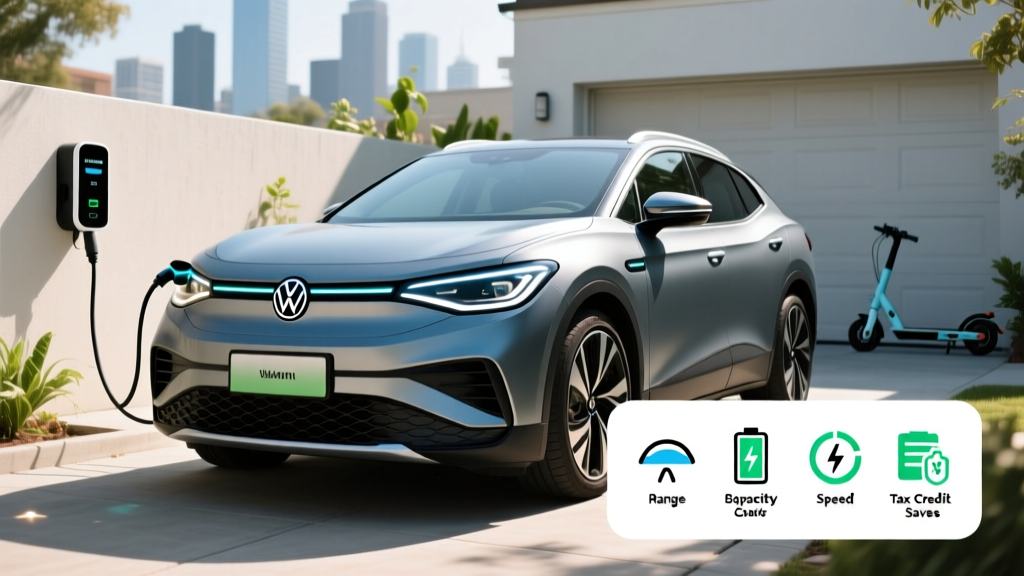
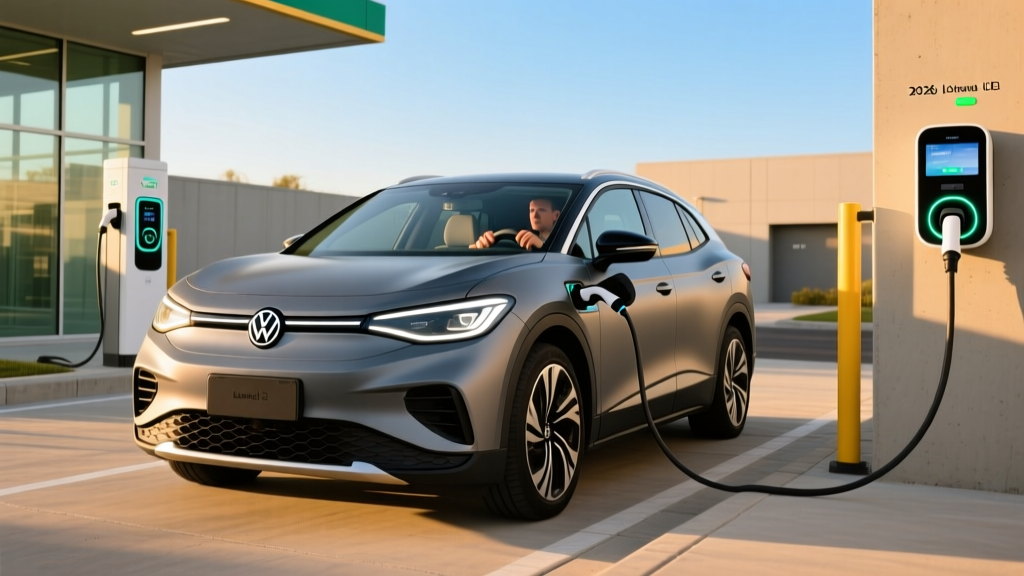
Volkswagen upgraded the ID.4's DC fast-charging capability to 170 kW peak for 82 kWh models starting with the 2025 refresh, up from the original 125 kW. The Standard Range (62 kWh) peaks at 140 kW. While 170 kW doesn't match the 240–350 kW peaks of Hyundai/Kia's E-GMP platform or the Tesla Model Y's ~250 kW, it's adequate for most road-trip scenarios.
| Charging Level | Power | Speed / Time | Notes |
|---|---|---|---|
| Level 1 (120V) | ~1.4 kW | ~4 mi/hr | Emergency/top-up only |
| Level 2 (240V, 48A) | 10.9 kW | ~31 mi/hr; full charge in ~9 hr | Home or workplace |
| DC Fast (82 kWh) | 170 kW peak | 10–80% in ~28 min | Tapers significantly above 80% |
| DC Fast (62 kWh) | 140 kW peak | 10–80% in ~29 min | Smaller pack, lower peak |
Charging curve reality: The ID.4 holds near its peak 170 kW rate between roughly 10–35% State of Charge, then gradually tapers. By 60% SoC you'll see ~100–110 kW, and above 80% it drops to under 50 kW. This is typical for NMC chemistry, but it means a 10–90% session takes closer to 40–42 minutes — plan accordingly on longer trips.
At home on a Level 2 charger (10.9 kW / 48 amps), a full charge from empty takes about 9 hours for the 82 kWh battery. Most owners plugging in overnight at 20–30% remaining will wake up to a full battery every morning. The ID.4 uses the NACS connector starting with the 2025 model year, granting access to Tesla Supercharger stations via VW's partnership — a significant real-world advantage for road-trip charging infrastructure.
Performance and Driving Impressions
The ID.4 was never engineered to chase Tesla Model Y Performance lap times, and that's fine. The AWD model's 335 hp and 5.4-second 0–60 time provide confident highway merging and passing. The RWD Pro's 282 hp and 7.2-second sprint are more than adequate for daily driving.
Ride quality is where the ID.4 earns its keep. The suspension tuning favors comfort over sportiness — it soaks up potholes and expansion joints with a composure that the firmer-riding Ioniq 5 can't match. Steering is light and low-effort, ideal for parking but less engaging on back roads. The turning circle is tight (31.5 ft), making it genuinely easy to maneuver in urban environments.
Regenerative braking offers two modes: a coasting mode (D) that lets the SUV freewheel when you lift off the accelerator, and a stronger regen mode (B) that provides moderate one-pedal-like deceleration — though it won't bring the car to a complete stop like some competitors. VW's philosophy here is to let drivers choose rather than forcing aggressive regen.
Interior, Cargo, and Technology
The 2025 interior refresh carried into 2026 brought meaningful improvements: a redesigned center console with physical volume and climate shortcut controls, a larger 12.9-inch infotainment display, and VW's latest ID.OS software with faster response times and improved voice recognition. Wireless Apple CarPlay and Android Auto are standard across all trims.
Passenger space is generous for the compact SUV segment:
- Front headroom: 41.1 in / legroom: 40.9 in
- Rear headroom: 38.9 in / legroom: 37.6 in
- The rear floor is flat (no transmission tunnel), improving middle-seat comfort
Cargo volume: 30.3 cubic feet behind the rear seats, expanding to 64.2 cu ft with the 60/40 split rear seats folded. There is no front trunk (frunk) — the space under the hood houses electronics and the HVAC system. This is a notable miss compared to the Model Y's 4.1 cu ft frunk and the Ioniq 5's 2.0 cu ft frunk.
Driver assistance includes VW's IQ.DRIVE suite standard on all trims: adaptive cruise control with stop-and-go, lane-keeping assist, front assist with automatic emergency braking, and Travel Assist (a Level 2 combined lane-centering + ACC system). The NHTSA awarded the ID.4 a 5-Star Overall Safety Rating, and the IIHS named it a Top Safety Pick+.
Notable drawbacks: The panoramic glass roof (standard on Pro S and above) has no retractable shade, which can make the cabin warm in summer sun. Some owners report that the capacitive-touch steering wheel controls can be finicky with gloves on. And while the infotainment is vastly improved, it still lags slightly behind Tesla's and Hyundai's interfaces in responsiveness.
Pricing, Trims, and Federal Tax Credit
The 2026 Volkswagen ID.4 is offered in five trims. All prices include destination charge:
| Trim | Drivetrain | MSRP | Est. After §30D Credit* |
|---|---|---|---|
| Standard Range | RWD | $40,790 | ~$33,290 |
| Pro | RWD | $44,540 | ~$37,040 |
| Pro S | RWD | $47,540 | ~$40,040 |
| AWD Pro | AWD | $48,540 | ~$41,040 |
| AWD Pro S | AWD | $51,540 | ~$44,040 |
*Federal tax credit estimates assume buyer eligibility. Actual credit varies.
- Maximum credit: Up to $7,500, split between critical minerals ($3,750) and battery components ($3,750)
- MSRP cap: SUVs must be priced at or below $80,000 — all ID.4 trims qualify
- Buyer income caps: AGI ≤ $150,000 (single), $225,000 (head of household), $300,000 (joint)
- Battery sourcing: Critical minerals and battery components must meet increasing domestic/free-trade-partner thresholds each year. VW's Chattanooga-built ID.4 has historically met partial or full requirements, but exact eligibility varies by production batch
- Point-of-sale transfer: Eligible buyers can apply the credit as an upfront dealer discount rather than waiting for tax filing
Verify current eligibility at IRS.gov §30D and confirm with your dealer before purchase. Rules are subject to change.
How It Compares: ID.4 vs. Key Competitors
The ID.4 competes in a crowded compact electric SUV segment. Here's how it stacks up on the metrics that matter most:
| Spec | VW ID.4 Pro RWD | Hyundai Ioniq 5 SEL RWD | Tesla Model Y Long Range AWD | Ford Mustang Mach-E Select RWD |
|---|---|---|---|---|
| EPA Range | 275 mi | 303 mi | 320 mi | 250 mi |
| Max DC Charge | 170 kW | 240 kW | ~250 kW | 150 kW |
| 10–80% DC | ~28 min | ~18 min | ~22 min | ~34 min |
| 0–60 mph | 7.2 sec | 7.0 sec | 4.8 sec | 6.3 sec |
| Cargo (rear up) | 30.3 cu ft | 27.2 cu ft | 30.2 cu ft | 29.7 cu ft |
| Base MSRP | $44,540 | $46,650 | $46,630 | $42,495 |
| NACS Native | Yes | Yes (2025+) | Yes | Adapter needed |
Where the ID.4 wins: Ride comfort, interior spaciousness (best rear legroom in class), lowest starting price among the group for a long-range RWD model, and a standard heat pump. The NACS connector means native Supercharger access without adapters.
Where it trails: DC charging speed (28 minutes vs. Ioniq 5's 18 minutes is a meaningful gap on road trips), maximum range, and infotainment polish. The Ioniq 5 charges substantially faster; the Model Y goes farther and accelerates harder; the Mach-E offers sportier driving dynamics.
Pros, Cons, and Who Should Buy the ID.4
✓ Pros
- Competitive pricing — starts ~$2,000–$6,000 below key rivals
- Comfortable, compliant ride quality
- Spacious rear seat and class-leading cargo room
- Native NACS / Supercharger access
- Standard heat pump for cold-weather efficiency
- 5-Star NHTSA safety, IIHS Top Safety Pick+
- Strong battery warranty: 8 years / 100,000 miles
✗ Cons
- DC charging slower than Ioniq 5 and Model Y
- No front trunk (frunk)
- Panoramic roof lacks a retractable shade
- Infotainment still a step behind class leaders
- Capacitive-touch steering controls can frustrate
- Standard Range trim's 206-mi range limits road-trip use
- Efficiency (MPGe) trails Hyundai and Tesla
Ideal for: Families and commuters who prioritize comfort, space, and value over maximum range or sporty driving. If your typical day involves school runs, grocery trips, and a 30–50 mile round-trip commute — with occasional 200-mile road trips — the ID.4 Pro RWD is an excellent fit. The AWD model suits those in snow-belt states who need all-weather traction.
Look elsewhere if: You regularly drive 300+ mile routes and want the fastest possible DC charging (consider the Ioniq 5), you need maximum range for minimal stops (Model Y Long Range), or you want sporty handling dynamics (Mach-E GT or Model Y Performance).
Warranty and Long-Term Ownership
Volkswagen backs the ID.4's battery pack with an 8-year / 100,000-mile warranty, guaranteeing a minimum of 70% capacity retention over that period. The powertrain carries the same 8-year/100,000-mile coverage. The basic vehicle warranty is 4 years / 50,000 miles, and VW includes 2 years of scheduled maintenance and 3 years of roadside assistance.
The 82 kWh battery uses NMC (nickel manganese cobalt) chemistry, which offers higher energy density than LFP but is more sensitive to sustained high State of Charge. For long-term health, VW recommends daily charging to 80% and reserving 100% charges for road trips. The battery management system includes active liquid cooling and heating, which helps manage degradation in extreme climates.
According to fueleconomy.gov, the ID.4's estimated annual charging cost is approximately $600–$750 depending on local electricity rates (at $0.15/kWh national average), compared to roughly $1,800–$2,200 in gasoline for a similarly sized gas SUV averaging 26 MPG combined.
Frequently Asked Questions
What is the real-world range of the Volkswagen ID.4?
The EPA rates the ID.4 Pro RWD at 275 miles. In real-world highway driving at 70–75 mph, expect roughly 240–255 miles. In cold weather (below freezing), plan for 200–220 miles unless you consistently precondition the battery while plugged in. The AWD model loses roughly 12 miles from its 263-mile EPA rating under similar conditions.
How fast does the ID.4 charge at home and on DC fast chargers?
On a Level 2 home charger (10.9 kW), the 82 kWh battery charges at roughly 31 miles of range per hour, reaching a full charge in about 9 hours from empty. On DC fast chargers, it peaks at 170 kW and charges from 10–80% in approximately 28 minutes. Expect the full 10–90% session to take 40–42 minutes due to tapering above 80%.
Does the 2026 ID.4 qualify for the $7,500 federal EV tax credit?
All ID.4 trims fall under the $80,000 SUV MSRP cap, so pricing is not a barrier. Eligibility depends on your adjusted gross income (≤$150K single / $300K joint), and whether the specific vehicle's battery meets 2026 critical-mineral and component-sourcing thresholds under IRS §30D. The credit can be transferred at the point of sale as an upfront discount. Confirm with your dealer and tax professional before purchasing.
Is the ID.4 worth buying over the Tesla Model Y or Hyundai Ioniq 5?
It depends on your priorities. The ID.4 wins on ride comfort, rear-seat space, and starting price. The Ioniq 5 charges significantly faster (18 min vs. 28 min, 10–80%). The Model Y offers more range (320 mi) and access to the most reliable Supercharger network natively. If comfort and value are your top criteria, the ID.4 is a strong choice. If road-trip charging speed or maximum range matter more, test-drive the Ioniq 5 and Model Y as well.
Does the ID.4 have a frunk?
No. The Volkswagen ID.4 does not include a front trunk. The space under the hood is occupied by power electronics and HVAC components. If frunk storage is important to you, the Tesla Model Y (4.1 cu ft) and Hyundai Ioniq 5 (2.0 cu ft) both offer one.
What connector does the 2026 ID.4 use?
Starting with the 2025 model year, the US-market ID.4 uses the NACS (North American Charging Standard) connector, the same plug used by Tesla vehicles. This provides native access to Tesla Supercharger stations without an adapter — a major advantage for road-trip charging.