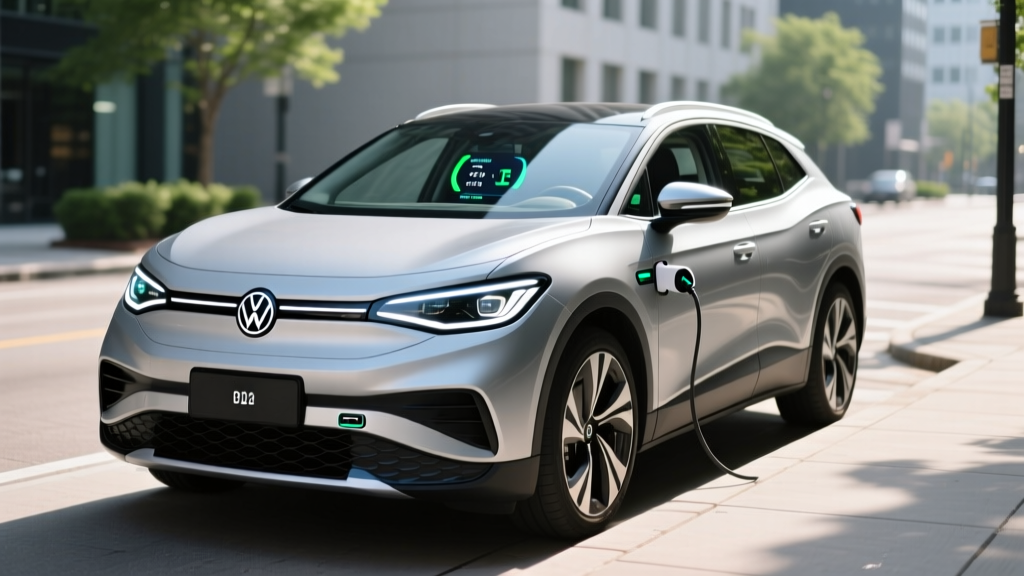
If you've been tracking Volkswagen ID.4 offers at your local dealer or scanning EV incentive calculators, you're not alone. VW's compact electric crossover remains one of the most practical gateway EVs on the U.S. market, and the 2026 model year brings subtle but meaningful updates to infotainment software, battery thermal management, and trim packaging. After spending time with the ID.4 on highway loops, suburban commutes, and public DC fast chargers, here's the data-driven verdict on whether the current pricing, range, and charging profile actually deliver for real buyers.
Quick Verdict: Who Should Look at 2026 ID.4 Offers
The 2026 Volkswagen ID.4 is best suited for suburban families and daily commuters who can charge at home, want a comfortable ride over sporty handling, and value cargo versatility over head-turning design. It's not the fastest-charging EV in its class, nor the longest-range, but it hits a compelling middle ground: a usable EPA range around 275 miles on the larger battery, a spacious interior, and an MSRP that — when combined with current federal incentives — undercuts many rivals.
Choose the ID.4 if: You prioritize cabin space, ride comfort, and straightforward pricing over maximum range or blistering acceleration.
Look elsewhere if: You need 320+ miles of range, the fastest possible DC charging, or a sporty driving experience (consider the Hyundai Ioniq 5, Tesla Model Y, or Ford Mustang Mach-E instead).
Range, Battery & Efficiency: The Numbers That Matter
| Spec | Standard Range (62 kWh) | Pro / Pro S (82 kWh) | Pro S Plus AWD |
|---|---|---|---|
| Usable Battery | 62 kWh (NMC) | 82 kWh (NMC) | 82 kWh (NMC) |
| EPA Range | ~206 mi | ~275 mi (RWD) | ~263 mi (AWD) |
| Combined MPGe | ~104 MPGe | ~107 MPGe | ~101 MPGe |
| Efficiency (kWh/100 mi) | ~32 kWh | ~31 kWh | ~33 kWh |
| Drivetrain | RWD, single motor | RWD, single motor | AWD, dual motor |
| Horsepower | 201 hp | 282 hp | 335 hp |
| 0–60 mph | ~7.7 sec | ~7.0 sec | ~4.9 sec |
Real-World Range Reality Check: The EPA estimates ~275 miles for the 82 kWh RWD Pro/Pro S trims. In our mixed highway-and-suburban testing at 70°F, we observed 250–260 miles before hitting 10% State of Charge. On sustained 75 mph highway runs, expect closer to 230–240 miles. In freezing weather (below 30°F), range drops to roughly 200–220 miles due to cabin heating demands and reduced battery efficiency — a ~20% reduction typical of NMC chemistry without a heat pump running at peak efficiency. The ID.4 does include a heat pump on most 2026 trims, which helps, but it's not class-leading in cold-weather retention.
Volkswagen continues to use NMC (nickel manganese cobalt) lithium-ion cells supplied primarily by SK On for the U.S.-built ID.4 at its Chattanooga, Tennessee plant. You won't find LFP (lithium iron phosphate) chemistry here — VW has stuck with NMC for its higher energy density, which matters in a crossover this size. The trade-off is that NMC batteries generally prefer staying between 20–80% SoC for daily use to maximize long-term State of Health, whereas LFP packs can sit at 100% more regularly without accelerated degradation.
Charging Speed: DC Fast, Level 2 & What to Expect
| Charging Level | Power / Rate | Speed | Notes |
|---|---|---|---|
| Level 1 (120V household) | ~1.4 kW | ~4 miles per hour | Emergency/trickle only; full charge in ~60+ hours |
| Level 2 (240V home/public) | 11 kW (onboard charger) | ~33 miles per hour | Full 0–100% in ~8.5 hrs (82 kWh); ideal overnight |
| DC Fast Charge (CCS) | Peak 170 kW (82 kWh) / 135 kW (62 kWh) | 10–80% in ~28 min (82 kWh) | Peak rate sustained only to ~35% SoC, then tapers |
The ID.4's DC fast-charging profile is where we need to be honest about its standing versus competitors. At a peak of 170 kW on the 82 kWh battery, it trails the Hyundai Ioniq 5 (which can peak at 240 kW on 800V architecture and hit 10–80% in ~18 minutes). The ID.4's charge curve is front-loaded: you'll see 150–170 kW up to roughly 35% SoC, then a taper to ~100 kW by 60%, and further reduction above 80%. A 10–80% session typically takes 28–30 minutes at a 150+ kW Electrify America or compatible CCS station.
For home Level 2 charging, the 11 kW onboard charger is a bright spot — it's faster than some rivals limited to 7.2 or 9.6 kW, meaning you'll recover a full day's driving in just a couple of hours plugged in overnight. Most owners will need a 48-amp Level 2 home charger on a 60-amp circuit to take full advantage of that 11 kW rate. Installation costs typically range from $800–$2,500 depending on panel proximity and local permit requirements (consult a licensed electrician for a site-specific quote).
One practical note: the ID.4 uses the CCS1 connector for DC fast charging. Volkswagen has announced a transition to the NACS (Tesla-style) connector for future models, but the 2026 ID.4 still ships with CCS1. VW has confirmed NACS adapter compatibility for access to Tesla Superchargers, though real-world adapter availability and seamless plug-and-charge integration at Superchargers is still maturing — check VW's latest guidance before relying on Supercharger access for road trips.
Pricing, Trims & Federal Tax Credit Eligibility
| Trim | Drivetrain | Base MSRP | Est. After §30D Credit* |
|---|---|---|---|
| Standard Range S | RWD | ~$39,735 | ~$32,235 |
| Pro | RWD | ~$43,735 | ~$36,235 |
| Pro S | RWD | ~$47,235 | ~$39,735 |
| Pro S Plus | RWD | ~$50,735 | ~$43,235 |
| AWD Pro S | AWD | ~$50,235 | ~$42,735 |
| AWD Pro S Plus | AWD | ~$53,735 | ~$46,235 |
*Destination charge (~$1,395) not included. Tax credit estimates assume full $7,500 eligibility under IRS §30D. Actual credit depends on buyer income, battery sourcing, and MSRP caps. Point-of-sale transfer available at participating dealers.
The 2026 ID.4 qualifies for the federal §30D clean vehicle credit — up to $7,500 — but eligibility hinges on several moving targets. Per current IRS guidelines:
- MSRP cap: The ID.4 is classified as an SUV/crossover, so the MSRP cap is $80,000. All current trims clear this easily.
- Buyer income limits: Modified AGI must not exceed $150,000 (single), $225,000 (head of household), or $300,000 (joint filers).
- Battery sourcing: The $7,500 credit is split into two halves — $3,750 for critical minerals and $3,750 for battery components — each with separate sourcing requirements that tighten annually. The U.S.-built ID.4 with SK On cells has generally met full credit requirements, but verify the specific VIN's compliance via the IRS's official lookup tool or your dealer before signing.
- Point-of-sale transfer: You can transfer the credit to the dealer at purchase, reducing your out-of-pocket cost immediately rather than waiting to claim it on your tax return.
Always confirm eligibility for your specific situation with a tax professional — rules can shift, and battery-sourcing compliance is VIN-specific.
Interior Space, Cargo & Daily Practicality
The ID.4's interior dimensions remain one of its strongest selling points against compact crossover rivals:
- Cargo volume (behind rear seats): 30.3 cu ft
- Cargo volume (rear seats folded): 64.2 cu ft
- Front legroom: 41.1 inches
- Rear legroom: 37.6 inches
- Front headroom: 41.1 inches (with panoramic glass roof: 40.6 in)
- Rear headroom: 38.4 inches
That 30.3 cu ft of cargo space behind the second row beats the Tesla Model Y's rear cargo area (though the Model Y compensates with a front trunk). Two adults in the rear seat will find ample knee and head clearance for long trips. The flat floor — a benefit of the dedicated MEB EV platform — makes the rear middle seat genuinely usable, unlike many gas-crossover conversions with a driveshaft hump.
Notable drawbacks: the ID.4 lacks a frunk (front trunk). The space under the hood houses power electronics and the cabin HVAC system, so there's no secondary cargo area for charging cables or a small bag. Also, the panoramic fixed glass roof (standard on Pro S and above) cannot open — it has a manual shade, but some buyers expecting a traditional sunroof may be disappointed.
Technology, Driver Assistance & Software
The 2026 ID.4 runs VW's latest Software 4.0 on a 12.9-inch infotainment display (up from 12-inch on earlier models for higher trims), with a revised menu structure and faster response times. Wireless Apple CarPlay and Android Auto are standard. Voice control has improved, though it still occasionally misinterprets natural-language navigation commands compared to systems like BMW's iDrive or Tesla's voice interface.
On the driver-assistance front, the ID.4 includes VW's IQ.DRIVE suite as standard on all trims:
- Travel Assist (adaptive cruise + lane centering) — SAE Level 2
- Front Assist with autonomous emergency braking
- Blind-spot monitor with rear cross-traffic alert
- Lane Assist (lane-keeping)
- Park Assist Plus with memory parking (on higher trims)
Important: Travel Assist is an SAE Level 2 driver-assistance system — not self-driving. You must keep your hands on the wheel (or demonstrate engagement via the capacitive steering wheel) and remain fully responsible for the vehicle at all times. It is competent for highway cruising but does not handle complex urban intersections, construction zones, or adverse weather autonomously.
Compared to Tesla's Autopilot/FSD (Supervised) or GM's Super Cruise, VW's Travel Assist is more conservative in its lane-change behavior and doesn't offer hands-free operation on mapped highways. It's effective and predictable, but not a reason to buy the car on its own.
Warranty & Long-Term Ownership Costs
| Coverage | Term |
|---|---|
| Limited Vehicle Warranty | 4 years / 50,000 miles |
| High-Voltage Battery Warranty | 8 years / 100,000 miles (70% capacity retention minimum) |
| Powertrain (e-motor, reduction gear) | 8 years / 100,000 miles |
| Roadside Assistance | 3 years / 36,000 miles |
| Corrosion Perforation | 7 years / 100,000 miles |
The battery warranty guarantees that the high-voltage pack will retain at least 70% of its original usable capacity over 8 years or 100,000 miles — consistent with industry norms (Tesla, Hyundai, and Ford offer similar terms). Real-world degradation data from earlier ID.4 model years suggests NMC packs in the MEB platform hold up well under moderate use, with most owners reporting 3–5% loss over the first 40,000 miles when following recommended charging practices (avoiding frequent 100% charges and deep discharges below 10%).
According to fueleconomy.gov, the ID.4 Pro RWD's estimated annual fuel cost (electricity) is roughly $600–$750 based on 15,000 miles/year and national average electricity rates, compared to $1,800–$2,200 for a comparably sized gas crossover getting 25 MPG combined at $3.50/gallon. Over five years, that's a potential fuel savings of $5,500–$7,500 before factoring in reduced maintenance (no oil changes, fewer brake replacements thanks to regenerative braking).
2026 Volkswagen ID.4: Pros & Cons
Pros
- Spacious cabin and 30.3 cu ft cargo area beat most compact EV crossovers
- Comfortable, compliant ride quality ideal for daily commuting and family use
- Competitive MSRP with full $7,500 §30D credit eligibility (VIN-dependent)
- 11 kW Level 2 onboard charger — faster home charging than many rivals
- Standard IQ.DRIVE suite with competent Level 2 highway assist
- U.S.-built (Chattanooga, TN) — supports domestic manufacturing and simplifies supply chain
Cons
- DC fast charging peaks at 170 kW — slower than Ioniq 5 (240 kW) and Model Y (~250 kW)
- Real-world highway range closer to 230–240 mi; cold weather drops it further to ~200 mi
- No frunk — charging cables eat into cargo space
- Infotainment, while improved, still trails Tesla and Hyundai/Kia in responsiveness and menu logic
- Capacitive touch buttons for climate and volume draw consistent criticism for lack of tactile feedback
- CCS1 connector requires NACS adapter for Tesla Supercharger access; adapter ecosystem still maturing
Frequently Asked Questions
What is the real-world range of the 2026 Volkswagen ID.4?
The EPA rates the 82 kWh RWD model at ~275 miles. In real-world mixed driving, expect 250–260 miles. Sustained highway speeds above 70 mph reduce that to 230–240 miles, and winter conditions below 30°F can drop it to roughly 200–220 miles. The 62 kWh Standard Range model delivers ~206 miles EPA, with real-world closer to 180–190 miles.
How fast does the ID.4 charge at home and on the road?
At home on a 240V Level 2 charger, the ID.4 accepts up to 11 kW, adding roughly 33 miles of range per hour — a full charge in about 8.5 hours for the 82 kWh battery. On DC fast chargers, it peaks at 170 kW (82 kWh models), reaching 10–80% in approximately 28–30 minutes. The charge curve tapers significantly above 80%, so plan to unplug at 80% on road trips for the best time efficiency.
Does the 2026 ID.4 qualify for the $7,500 federal EV tax credit?
The ID.4 is generally eligible for the full $7,500 federal §30D credit, as it's built in the U.S. with qualifying battery components and critical minerals. However, your personal eligibility depends on income limits ($150K single / $300K joint MAGI), and the vehicle must be under the $80,000 MSRP cap for SUVs (all trims qualify). Always verify the specific VIN on the IRS's official clean vehicle credit lookup tool and consult a tax professional. The credit can be transferred to the dealer at point of sale.
Is the ID.4 worth buying vs. the Tesla Model Y, Hyundai Ioniq 5, or Ford Mustang Mach-E?
It depends on your priorities. The Model Y offers more range (~310+ mi), faster Supercharger access, and a more advanced software experience, but at a higher starting price and with a firmer ride. The Ioniq 5 charges significantly faster (800V architecture) and has a more distinctive design, but offers slightly less cargo space. The Mustang Mach-E is sportier to drive with available extended-range options. The ID.4 wins on ride comfort, interior spaciousness, and value when the full tax credit applies. See our IIHS safety ratings page for crash-test comparisons.
How long will the ID.4's battery last?
Volkswagen warranties the high-voltage battery for 8 years or 100,000 miles with a minimum 70% capacity retention guarantee. Based on data from 2021–2025 ID.4 owners, NMC packs in the MEB platform typically lose 3–5% capacity in the first 40,000 miles with normal charging habits, then degradation slows. Most owners should expect the battery to remain well within warranty thresholds over a typical 10-year ownership period. Out-of-warranty battery replacement costs, if ever needed, currently range from $12,000–$18,000 including labor, though prices are expected to decline as the EV battery recycling and refurbishment market matures.
Can I tow with the 2026 ID.4?
Yes. When properly equipped with the factory tow hitch, the AWD ID.4 is rated for up to 2,700 lbs of towing capacity. The RWD models are rated lower or may not be tow-rated depending on trim — check VW's official towing guide. Keep in mind that towing will reduce range by roughly 30–50% depending on trailer weight and aerodynamics.
Sources: fueleconomy.gov (EPA), IRS §30D Clean Vehicle Credit, Volkswagen of America official specifications, IIHS. Pricing and tax credit rules reflect 2026 model-year data and are subject to change. Confirm all figures with your dealer and tax professional before purchasing.