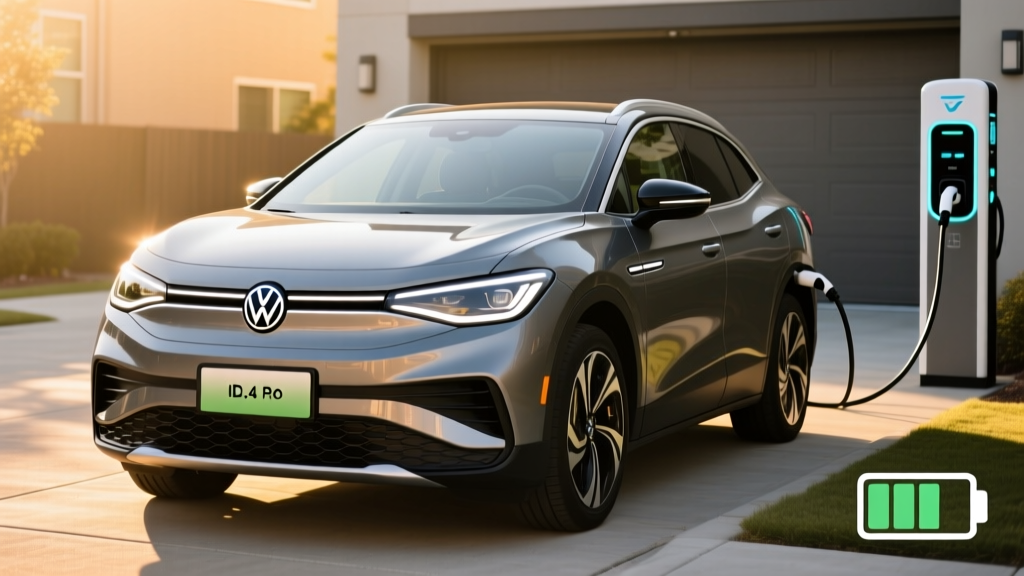
The Volkswagen ID.4 Pro occupies a specific niche in the compact electric SUV segment: a practical, comfort-oriented daily driver that prioritizes cabin space and straightforward usability over blistering performance or cutting-edge infotainment theatrics. For 2026, VW has refined the formula with incremental software and charging improvements, but the core value proposition remains — a roomy, well-built electric crossover priced to compete directly with the Hyundai Ioniq 5, Ford Mustang Mach-E, and Tesla Model Y.
This review breaks down the 2026 Volkswagen ID.4 Pro with the exact numbers that matter: EPA range versus what you'll actually see on the highway, DC fast-charging curves, home charging logistics, federal tax credit eligibility under current IRS §30D rules, and where it fits in a competitive field. If you're researching the ID.4 Pro as your next EV, here's the data-driven analysis you need.
2026 Volkswagen ID.4 Pro: Key Specs at a Glance
| Specification | 2026 VW ID.4 Pro (RWD) | 2026 VW ID.4 Pro S AWD |
|---|---|---|
| EPA Range | 291 miles | 263 miles |
| Battery (usable / gross) | 82 kWh / 91 kWh | 82 kWh / 91 kWh |
| Battery Chemistry | NMC (Nickel Manganese Cobalt) | NMC |
| Drivetrain | Rear-Wheel Drive (single motor) | AWD (dual motor) |
| Horsepower | 282 hp | 335 hp |
| 0–60 mph | 7.7 seconds | 5.4 seconds |
| Max DC Fast Charge | 175 kW | 175 kW |
| 10–80% DC Charge Time | ~28 minutes | ~28 minutes |
| Level 2 Home Charge Rate | 11 kW (~37 mi/hr) | 11 kW (~37 mi/hr) |
| EPA Efficiency (Combined) | 107 MPGe (31 kWh/100 mi) | 98 MPGe (34 kWh/100 mi) |
| Cargo (behind rear seats) | 30.3 cu ft | 30.3 cu ft |
| Cargo (rear seats folded) | 64.2 cu ft | 64.2 cu ft |
| Rear Legroom | 37.6 inches | 37.6 inches |
| Base MSRP | $43,990 | $49,990 |
| Battery/Powertrain Warranty | 8 years / 100,000 miles | 8 years / 100,000 miles |
Real-World Range: What the EPA Number Doesn't Tell You
The EPA rates the 2026 ID.4 Pro (RWD, 82 kWh usable) at 291 miles of range. The AWD Pro S drops to 263 miles due to the added weight and drag of the front motor. These are respectable figures for the segment, but EPA estimates assume a mix of city and highway driving under moderate temperatures — conditions that rarely match a real road trip.
EPA Estimate: 291 miles (RWD Pro)
Highway (70–80 mph, 65°F): Expect ~240–260 miles before needing to charge
Cold Weather (below 32°F, highway): Expect ~200–225 miles — a 20–30% reduction is typical for NMC packs without aggressive preconditioning
City / Suburban (mixed, moderate climate): 280–300+ miles achievable with regenerative braking
The ID.4 Pro uses an NMC (nickel manganese cobalt) lithium-ion battery with 91 kWh gross capacity and approximately 82 kWh usable. VW reserves a buffer at the top and bottom of the pack to reduce degradation — standard practice, but it means you're never truly using every cell. In real-world highway driving at 75 mph, the ID.4's aerodynamic profile (boxier than the Ioniq 5 or Model Y) works against efficiency. Expect consumption around 33–36 kWh/100 mi on the interstate, versus the EPA combined rating of 31 kWh/100 mi.
Cold weather hits all EVs, but the ID.4's thermal management system is adequate rather than class-leading. The available heat pump (standard on Pro S and above trims in 2026) helps preserve cabin heating efficiency, but you should still budget a 20–30% range reduction in sub-freezing conditions, particularly on highway runs. Preconditioning the battery while plugged in at home is essential to mitigate this — it warms the pack before you depart, reducing the energy spent on heating during the first miles.
Charging Speeds: DC Fast Charging and Home Level 2
Charging speed is where the ID.4 Pro shows its age relative to 800V competitors like the Hyundai Ioniq 5 and Kia EV6, which can accept 250–350 kW. The ID.4 Pro runs on a 400V architecture with a 175 kW peak DC fast-charge rate.
| Charging Method | Power / Rate | Time or Miles Added |
|---|---|---|
| Level 1 (120V household outlet) | ~1.4 kW | ~4–5 miles per hour |
| Level 2 (240V, 48A home charger) | 11 kW | ~37 miles per hour; full charge in ~8.5 hours |
| DC Fast Charge (peak) | 175 kW | 10–80% in ~28 minutes |
| DC Fast Charge (sustained avg) | ~110–130 kW | Average over a 10–80% session |
The 10–80% DC fast-charge time of approximately 28 minutes is competitive for a 400V vehicle but falls short of the 18-minute sessions you'll see on 800V platforms. Here's what the charging curve actually looks like: the ID.4 Pro ramps to its 175 kW peak around 20–30% state of charge, holds near peak through roughly 50%, then tapers progressively. By 70% SoC, you're seeing roughly 100–120 kW, and above 80%, the rate drops sharply to protect battery health. This taper is why we recommend planning road-trip stops around 10–80% sessions rather than trying to charge to 100% at a DC fast charger.
For home charging, the ID.4 Pro accepts up to 11 kW on a Level 2 charger (240V, 48 amps). A full overnight charge from near-empty takes roughly 8.5 hours. At the national average electricity rate of ~$0.16/kWh, a full home charge costs approximately $14.70 — versus roughly $45–55 for a gasoline equivalent at current fuel prices. Most owners will plug in nightly and rarely use the full pack, making daily charging cost negligible.
The ID.4 Pro uses the CCS1 connector for DC fast charging and the J1772 connector for Level 2 AC. VW has confirmed that 2026 models will include a NACS (Tesla-style) charging port adapter for Supercharger access, expanding the available DC fast-charging network significantly. This is a meaningful practical advantage over previous model years that relied solely on Electrify America and third-party CCS networks.
Performance and Driving Impressions
The rear-wheel-drive ID.4 Pro delivers 282 horsepower from a single rear-mounted permanent-magnet synchronous motor, reaching 0–60 mph in 7.7 seconds. That's leisurely by EV standards — the Tesla Model Y Long Range hits 60 in roughly 5.0 seconds, and even the Ioniq 5 RWD manages it in about 7.4 seconds. But the ID.4 Pro wasn't engineered for drag-strip bragging rights. It's tuned for ride comfort, low cabin noise, and predictable handling.
The AWD Pro S variant adds a front induction motor for 335 hp combined and a 0–60 time of 5.4 seconds, which feels meaningfully quicker in daily driving, particularly for highway merging and passing. Both versions feature VW's adaptive damping suspension on higher trims, which smooths out rough pavement effectively. The steering is light and numb — a deliberate choice for the commuter-oriented buyer, but it won't excite anyone coming from a sporty ICE crossover.
Regenerative braking in the ID.4 is adjustable via steering-wheel paddles (B-mode for maximum regen). However, unlike Nissan's e-Pedal or GM's one-pedal driving, the ID.4 does not come to a complete stop with regen alone — you'll still need the brake pedal at very low speeds. This frustrates some EV veterans who prefer full one-pedal operation.
Interior, Cargo, and Technology
The ID.4's cabin is where it makes a strong case against competitors. Rear legroom measures 37.6 inches — competitive with the RAV4 and CR-V, and notably more generous than the Model Y's rear seat. Cargo volume behind the rear row is 30.3 cubic feet, expanding to 64.2 cu ft with the 60/40 split rear seats folded. There is no front trunk (frunk) on AWD models; RWD versions include a small storage compartment under the hood, but it's modest.
The 2026 ID.4 Pro features a 12.9-inch touchscreen running VW's latest ID.Software 4.0, which addresses many of the lag and menu-logic complaints from earlier model years. Wireless Apple CarPlay and Android Auto are standard. A 10.25-inch digital instrument cluster sits behind the steering wheel. The physical button situation has improved — VW restored some tactile controls for climate and volume after widespread criticism of the capacitive-touch sliders in 2021–2024 models.
Driver-assistance technology includes VW's IQ.DRIVE suite: adaptive cruise control with stop-and-go, lane-centering assist, front and rear automatic emergency braking, blind-spot monitoring, and rear cross-traffic alert. This is an SAE Level 2 system — meaning the driver must remain fully attentive with hands on the wheel at all times. It is not autonomous driving. The system works reliably on well-marked highways but can struggle with faded lane markings and construction zones.
Pricing, Trims, and Federal Tax Credit Eligibility
| Trim | MSRP | Est. Price After §30D Credit* |
|---|---|---|
| Pro (RWD) | $43,990 | ~$36,490 |
| Pro S (RWD) | $47,490 | ~$39,990 |
| Pro S AWD | $49,990 | ~$42,490 |
| Pro S Plus AWD | $53,490 | ~$45,990 |
*Estimated prices assume full $7,500 federal tax credit eligibility. Actual credit varies based on buyer income, tax liability, battery sourcing compliance, and point-of-sale transfer rules under current IRS §30D regulations.
- MSRP Cap: Vehicle MSRP must not exceed $80,000 for SUVs — the ID.4 qualifies across all trims
- Buyer Income Cap: Modified AGI ≤ $150,000 (single) / $225,000 (head of household) / $300,000 (joint)
- Battery Sourcing: Critical minerals and battery components must meet escalating domestic/free-trade-partner thresholds — VW has adjusted supply chains, but verify current-year compliance at the dealer and on fueleconomy.gov
- Point-of-Sale Transfer: As of 2024+, buyers can transfer the credit to the dealer for an immediate price reduction at purchase — confirm with your dealer before signing
- Assembly: Final assembly must occur in North America — the ID.4 for the US market is assembled in Chattanooga, Tennessee
The ID.4 Pro's US-market production at VW's Chattanooga plant is a significant advantage for §30D eligibility, as it satisfies the North American final-assembly requirement. However, the critical-minerals and battery-component sourcing thresholds have tightened each year since 2023. For 2026, at least 80% of critical minerals must be sourced from the US or free-trade-agreement partners, and 100% of battery components must be manufactured or assembled in North America. VW has made supply-chain adjustments, but you should verify the specific VIN's eligibility on fueleconomy.gov before purchasing — eligibility can shift mid-year.
How It Compares: ID.4 Pro vs. the Competition
The compact electric SUV segment is crowded. Here's how the ID.4 Pro stacks up against three key rivals on the metrics buyers care about most:
| Metric | VW ID.4 Pro (RWD) | Hyundai Ioniq 5 SE (RWD LR) | Tesla Model Y LR (AWD) | Ford Mach-E Select (RWD ER) |
|---|---|---|---|---|
| EPA Range | 291 mi | 303 mi | 320 mi | 320 mi |
| Battery (usable) | 82 kWh | 77.4 kWh | 75 kWh | 91 kWh |
| Peak DC Charge | 175 kW | 250 kW (800V) | 250 kW | 150 kW |
| 10–80% Time | ~28 min | ~18 min | ~25 min | ~36 min |
| 0–60 mph | 7.7 sec | 7.4 sec | 5.0 sec | 6.1 sec |
| Base MSRP | $43,990 | $45,500 | $46,630 | $42,995 |
| Rear Legroom | 37.6 in | 39.4 in | 35.6 in | 37.9 in |
| Cargo (rear up) | 30.3 cu ft | 27.2 cu ft | 30.2 cu ft | 29.7 cu ft |
The ID.4 Pro trades charging speed for interior volume and comfort. If fast DC charging is your top priority (road-trip-heavy lifestyle), the Ioniq 5's 800V architecture is meaningfully faster. If performance matters most, the Model Y is the clear pick. But if you want the most conventional, comfortable, and spacious cabin with strong dealer support and US assembly for tax-credit eligibility, the ID.4 Pro makes a compelling case.
- Spacious cabin with class-competitive rear legroom and cargo
- Comfortable ride quality, low road noise
- US-built (Chattanooga, TN) — strong §30D tax credit eligibility
- Improved infotainment with ID.Software 4.0
- NACS adapter included for Tesla Supercharger access
- Straightforward pricing with no mandatory subscription features
- 175 kW peak DC charge rate trails 800V competitors
- Sluggish 0–60 time for RWD (7.7 sec) vs. segment
- No true one-pedal driving (doesn't come to full stop on regen)
- Infotainment still not as responsive as Tesla or Hyundai
- No frunk on AWD models
- Real-world highway range falls noticeably short of EPA estimate
Who Should Buy the Volkswagen ID.4 Pro?
Choose the ID.4 Pro if: You prioritize cabin comfort, rear-seat space, and a smooth ride over performance; you charge primarily at home; you want a mainstream brand with widespread dealer service; and you need North American assembly for federal tax credit eligibility.
Look elsewhere if: You take frequent long road trips and need the fastest possible DC charging (consider the Ioniq 5 or EV6); you want sporty acceleration (Model Y or Mach-E GT); or you need maximum range above 310 miles.
The ID.4 Pro is best suited for suburban families and commuters who drive 30–60 miles daily, charge at home overnight, and take occasional road trips where a 28-minute charging stop is acceptable. It's a strong choice as a second car or primary family hauler where cargo space and rear-seat comfort outweigh 0–60 bragging rights. Towing capacity is rated at 2,700 lbs (AWD) — enough for a small utility trailer but not a camper. If towing is a priority, look at the Rivian R1S or F-150 Lightning.
Frequently Asked Questions
What is the real-world range of the 2026 Volkswagen ID.4 Pro?
The EPA rates the RWD ID.4 Pro at 291 miles combined. In real-world highway driving at 70–80 mph in moderate temperatures, expect approximately 240–260 miles. In cold weather (below freezing), plan for 200–225 miles. City driving with regenerative braking can approach or slightly exceed the EPA figure.
How fast does the ID.4 Pro charge at home and on DC fast chargers?
On a Level 2 home charger (240V, 48A), the ID.4 Pro charges at up to 11 kW, adding roughly 37 miles of range per hour — a full charge overnight in about 8.5 hours. On DC fast chargers, it peaks at 175 kW and charges from 10–80% in approximately 28 minutes, though sustained average rates are closer to 110–130 kW due to charge-curve taper.
Does the 2026 ID.4 Pro qualify for the $7,500 federal EV tax credit?
The ID.4 Pro is assembled in Chattanooga, Tennessee, and its MSRP is well below the $80,000 SUV cap, so it meets the assembly and price requirements. However, eligibility also depends on your income (≤$150K single / $300K joint), the vehicle's battery-component and critical-minerals sourcing compliance for the current tax year, and your personal tax liability. Verify the specific VIN on fueleconomy.gov and consult a tax professional before relying on the credit.
How much does the ID.4 Pro cost after tax credits?
The base ID.4 Pro (RWD) starts at $43,990. With the full $7,500 §30D credit applied at point of sale, the effective price drops to approximately $36,490. Higher trims (Pro S, Pro S AWD, Pro S Plus) range from roughly $39,990 to $45,990 after the credit, assuming full eligibility. Destination charges, dealer fees, and options can add $1,000–$3,000.
Is the ID.4 Pro worth buying over the Hyundai Ioniq 5 or Tesla Model Y?
It depends on your priorities. The Ioniq 5 charges significantly faster (18 min vs. 28 min, 10–80%) and offers more rear legroom, but has less cargo space. The Model Y delivers far better performance and Supercharger-native access, but has a firmer ride and less conventional cabin layout. The ID.4 Pro wins on ride comfort, dealer familiarity, and straightforward US-built tax-credit eligibility. Test-drive all three to compare seat comfort and visibility — these subjective factors often decide the purchase.
What is the battery warranty on the ID.4 Pro?
VW covers the ID.4's high-voltage battery for 8 years or 100,000 miles (whichever comes first) against defects and capacity loss below 70% of original capacity. The powertrain (motors, reduction gear) carries the same 8-year/100,000-mile coverage. The basic vehicle warranty is 4 years / 50,000 miles.
Does the ID.4 Pro have a heat pump for cold weather?
Yes. For 2026, a heat pump is standard on Pro S trims and above. The base Pro trim may offer it as part of an optional cold-weather package — confirm with your dealer. The heat pump improves cabin heating efficiency, reducing range loss in cold weather by roughly 10–15% compared to resistive heating.
Sources: EPA Fuel Economy — Volkswagen ID.4, IRS §30D Clean Vehicle Credits, NHTSA Vehicle Automation Levels