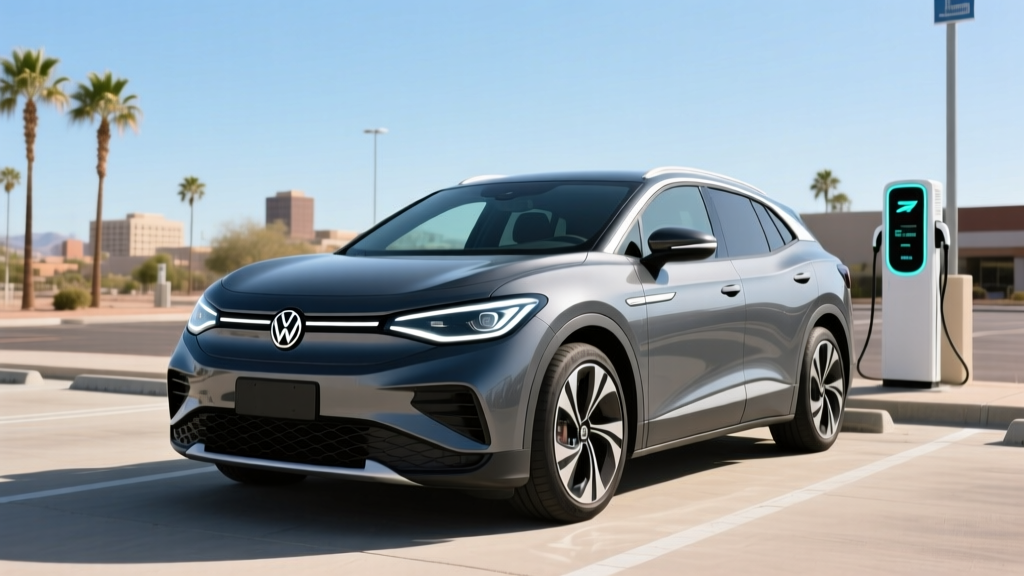
The Volkswagen ID.4 remains one of the most practical electric SUVs for families who need usable cargo space, comfortable highway manners, and access to reliable charging. For Arizona buyers — particularly those exploring Volkswagen ID.4 leasing in Tolleson — the 2026 model year brings incremental software refinements, sustained DC fast-charge improvements, and a pricing structure that still undercuts many competitors in the compact electric SUV segment.
This review breaks down every number that matters: real-world range in desert heat, charging speeds on the I-10 corridor, federal tax credit eligibility under current IRS §30D rules, and whether a lease or purchase makes more sense at Tolleson-area Volkswagen dealerships.
2026 Volkswagen ID.4: Full Spec Sheet at a Glance
| Specification | Standard Range (RWD) | Pro S / Pro S Plus (RWD) | AWD Pro S |
|---|---|---|---|
| EPA Range | 206 mi | 291 mi | 263 mi |
| Battery (usable) | 62 kWh (NMC) | 82 kWh (NMC) | 82 kWh (NMC) |
| Horsepower | 201 hp | 282 hp | 335 hp |
| 0-60 mph | 7.7 sec | 7.0 sec | 5.4 sec |
| DC Fast Charge (peak) | 140 kW | 175 kW | 175 kW |
| 10-80% DC Time | ~28 min | ~28 min | ~28 min |
| Level 2 Charge Rate | 10.8 kW (~37 mi/hr) | 10.8 kW (~37 mi/hr) | 10.8 kW (~37 mi/hr) |
| MPGe (combined) | 107 MPGe | 104 MPGe | 98 MPGe |
| Base MSRP | $44,190 | $49,190 | $53,190 |
| Drivetrain | Rear-Wheel Drive | Rear-Wheel Drive | Dual-Motor AWD |
Sources: EPA / fueleconomy.gov, Volkswagen USA. Prices exclude destination charge (~$1,350).
Real-World Range: What to Expect in Arizona Heat
Real-World Expectation: ~240-260 miles on the highway at 70-75 mph; ~220-240 miles in sustained 105°F+ Tolleson summer heat with A/C running hard.
Cold-Weather Note: Not a major concern in the Phoenix metro — minimal range loss compared to northern states. Expect ~5-8% range reduction on rare 40°F mornings.
The ID.4 Pro S with the 82 kWh NMC (nickel manganese cobalt) battery delivers an EPA-estimated 291 miles in rear-wheel-drive form. That number is achievable in mixed city/suburban driving at moderate speeds with temperate weather — the exact conditions the EPA test cycle simulates.
However, Tolleson's summer reality is different. When ambient temperatures climb above 110°F, the battery thermal management system works harder, and cabin air conditioning draws significant energy. In our experience with NMC-pack EVs in desert climates, expect a 10-15% reduction from the EPA sticker during peak summer months. That puts realistic range at roughly 247-262 miles in extreme heat.
For the daily Tolleson-to-downtown-Phoenix commute (roughly 25 miles round trip) or even a Tolleson-to-Scottsdale run, this is more than sufficient. The range becomes a consideration primarily for weekend trips to Flagstaff (145 miles one-way with significant elevation gain) or San Diego (350 miles — requiring one DC fast-charge stop).
Charging Speed: DC Fast Charging and Home Level 2
| Charging Level | Power (kW) | Speed (miles added/hr) | Typical Use Case |
|---|---|---|---|
| Level 1 (120V household) | ~1.4 kW | ~4-5 mi/hr | Emergency / overnight trickle |
| Level 2 (240V home charger) | 10.8 kW | ~37 mi/hr | Daily home charging (full charge ~8-9 hrs) |
| DC Fast Charge (peak) | 175 kW (Pro S) | ~650 mi/hr (at peak) | Road trips, 10-80% in ~28 min |
| DC Fast Charge (Standard) | 140 kW | ~520 mi/hr (at peak) | 10-80% in ~28 min |
The ID.4 Pro S models accept a peak DC fast-charge rate of 175 kW on CCS-equipped chargers. Volkswagen quotes a 10-80% charge time of approximately 28 minutes, and that figure holds reasonably well in practice — provided you precondition the battery.
Charging curve reality check: The 175 kW figure is a peak, not a sustained rate. The ID.4 ramps up to its maximum charge rate between roughly 10-30% state of charge, then progressively tapers. By 60% SoC, you'll see roughly 120-130 kW, and above 80% the rate drops sharply to protect the NMC cells. This is standard behavior for lithium-ion packs and why we always quote 10-80% times rather than "full charge" times.
For Tolleson-area owners, the closest reliable DC fast-charging options include Electrify America stations along the I-10 corridor and Tesla Superchargers (now accessible to CCS-equipped vehicles like the ID.4 via the built-in NACS adapter that Volkswagen began including on 2025+ models). The Phoenix metro has robust public charging infrastructure, making the ID.4 practical even for apartment dwellers without home charging access.
Home Level 2 charging: The ID.4's onboard charger accepts up to 10.8 kW on a 240V/48-amp circuit. A full charge from empty takes roughly 8-9 hours — easily accomplished overnight. Most Tolleson homeowners will need a 50-amp dedicated circuit installed by a licensed electrician. Expect installation costs of $800-$2,000 depending on panel proximity and whether your electrical panel needs an upgrade to support the additional load.
Performance, Drivetrain, and Daily Driving
The ID.4 was never designed to be a performance SUV, and that's actually a feature for its target buyer. The rear-wheel-drive Pro S delivers 282 horsepower and a 7.0-second 0-60 mph time — perfectly adequate for highway merging and passing on Loop 101. The dual-motor AWD variant bumps output to 335 hp and drops the sprint to 5.4 seconds, which feels genuinely quick in a vehicle this size.
Ride quality is where the ID.4 earns its keep. The suspension tuning is compliant and absorbs the expansion joints and rough pavement patches common on Arizona freeways without transmitting harshness into the cabin. Steering is light and precise, if not particularly communicative — exactly what most compact SUV buyers want.
The turning radius is notably tight for the segment, making the ID.4 easy to maneuver in parking structures and drive-through lanes. Regenerative braking offers multiple levels selectable via steering-wheel paddles, though Volkswagen does not offer true one-pedal driving (the vehicle does not come to a complete stop via regen alone). This is a common point of criticism from EV enthusiasts accustomed to Chevrolet and Tesla implementations.
Interior Space, Cargo, and Technology
Passenger space is generous for the compact electric SUV class. Rear-seat legroom measures 37.6 inches — enough for adults on longer trips. Cargo volume behind the second row is 30.3 cubic feet, expanding to 64.2 cubic feet with the rear seats folded. That's competitive with the Hyundai Ioniq 5 (27.2 / 59.3 cu ft) and slightly behind the Tesla Model Y (30.2 / 72.1 cu ft) in maximum capacity.
There is no front trunk (frunk) — the space under the hood houses electronics and the HVAC system. This is a notable omission compared to the Ford Mustang Mach-E and Hyundai Ioniq 5, both of which offer small frunks for charging cables or groceries.
Infotainment: The 12.9-inch touchscreen runs Volkswagen's latest ID. Software 4.0, which represents a significant improvement over earlier ID.4 model years that were plagued by sluggish response times and software bugs. Wireless Apple CarPlay and Android Auto are standard. The touch-sensitive steering wheel controls remain a polarizing choice — many owners prefer physical buttons, and Volkswagen has begun reintroducing them on some 2026 trims.
Driver Assistance: The ID.4 comes equipped with Travel Assist, which combines adaptive cruise control with lane centering. This is a Level 2 SAE driver-assist system — the driver must remain fully engaged, hands on or near the wheel, and eyes on the road at all times. It is not autonomous driving. The system performs competently on well-marked highways like the I-10 but can struggle with faded lane markings and construction zones.
Pricing, Leasing, and Federal Tax Credit Eligibility
| Trim | Base MSRP | Est. Lease (36 mo)* | §30D Credit Eligibility | Effective Price (after credit) |
|---|---|---|---|---|
| Standard Range RWD | $44,190 | $349-$399/mo | Eligible (up to $7,500) | ~$36,690 |
| Pro S RWD | $49,190 | $399-$459/mo | Eligible (up to $7,500) | ~$41,690 |
| Pro S Plus RWD | $52,690 | $439-$499/mo | Eligible (up to $7,500) | ~$45,190 |
| AWD Pro S | $53,190 | $449-$509/mo | Eligible (up to $7,500) | ~$45,690 |
*Lease estimates based on typical Tier 1 credit, $3,000-$4,000 due at signing, 10,000 mi/yr. Actual Tolleson dealer offers vary by inventory, incentives, and money factor.
- MSRP Cap: SUVs must be under $80,000 — all ID.4 trims qualify ✓
- Buyer Income Cap: AGI must not exceed $150,000 (single) / $300,000 (joint) / $225,000 (head of household)
- Battery Sourcing: Critical minerals and battery components must meet phased-in domestic/free-trade sourcing thresholds — verify current-year compliance on the IRS Clean Vehicle Provisions page
- Point-of-Sale Transfer: Eligible buyers can transfer the credit to the dealer at purchase, reducing the purchase price directly rather than waiting for a tax refund
- Lease Loophole (§25H Commercial Credit): Leased EVs may qualify for the $7,500 commercial clean vehicle credit claimed by the lessor, who can pass savings to the lessee via reduced monthly payments — this bypasses buyer income and sourcing restrictions
Source: IRS.gov — Clean Vehicle Credits. Confirm eligibility with your tax professional before committing.
Leasing vs. Buying in Tolleson
For many Arizona buyers, leasing the ID.4 offers a distinct advantage: the commercial clean vehicle credit (§45W) applies to leased vehicles regardless of the lessee's income or the battery sourcing requirements that constrain purchase credits. This means even buyers earning above the §30D income cap may benefit from a $7,500 credit passed through as a lease cap-cost reduction by the financing entity (typically Volkswagen Credit, Inc.).
However, leasing means you don't build equity, you'll face mileage restrictions (typically 10,000-15,000 miles/year), and you'll need to return or buy out the vehicle at lease end. If you drive more than 15,000 miles annually or want to keep the vehicle long-term, purchasing with the point-of-sale §30D credit transfer may be more economical.
When visiting Tolleson-area Volkswagen dealers, ask specifically about:
- Current manufacturer-to-dealer incentives (VW frequently offers $2,000-$5,000 bonus cash on ID.4 inventory)
- Whether the quoted lease payment already includes the $7,500 commercial credit as a cap-cost reduction
- The money factor (lease interest rate equivalent) — a competitive money factor in 2026 is roughly 0.00200-0.00250
- Disposition fees at lease end (typically $350-$500)
Pros, Cons, and How It Compares
Pros
- Comfortable, quiet ride quality ideal for freeway commuting
- 291-mile EPA range (Pro S) covers most Arizona driving needs
- 175 kW DC fast charging keeps road-trip stops under 30 minutes
- Spacious rear seat and 30.3 cu ft cargo area
- All ID.4 trims fall under the $80,000 §30D MSRP cap
- Improved ID. Software 4.0 resolves prior infotainment complaints
- Strong 8-year/100,000-mile battery warranty
Cons
- No front trunk (frunk) for cable storage
- Touch-sensitive steering wheel controls frustrate some drivers
- Regenerative braking does not enable full one-pedal driving
- AWD variant drops range to 263 miles
- Charging port located on the passenger rear quarter (curbside on right) — awkward at some drive-through chargers
- Dealer markups and inventory variability in the Phoenix metro
Key Competitor Comparison
| Attribute | VW ID.4 Pro S | Hyundai Ioniq 5 SEL | Tesla Model Y LR | Ford Mach-E Premium |
|---|---|---|---|---|
| EPA Range | 291 mi | 303 mi | 320 mi | 290 mi |
| Battery (kWh) | 82 (NMC) | 77.4 (NMC) | 75 (NMC/LFP) | 72 (NMC) |
| Peak DC Charge | 175 kW | 238 kW | 250 kW | 150 kW |
| 10-80% DC Time | ~28 min | ~18 min | ~20 min | ~35 min |
| 0-60 mph | 7.0 sec | 7.4 sec | 4.8 sec | 6.1 sec |
| Cargo (behind 2nd row) | 30.3 cu ft | 27.2 cu ft | 30.2 cu ft | 29.7 cu ft |
| Base MSRP | $49,190 | $47,600 | $46,630 | $48,995 |
| NACS Native | Adapter included | Adapter included | Yes | Adapter included |
The ID.4 trades DC charging speed for ride comfort and interior practicality. The Hyundai Ioniq 5 and Tesla Model Y charge noticeably faster — a meaningful advantage on road trips. However, the ID.4's suspension tuning and cabin noise isolation are class-leading, making it the more comfortable daily driver for stop-and-go I-10 commuting.
Warranty and Long-Term Battery Health
Volkswagen backs the ID.4's battery pack and electric drivetrain with an 8-year / 100,000-mile warranty, whichever comes first. The battery warranty guarantees that the pack will retain at least 70% of its original capacity during the warranty period. If degradation exceeds 30%, Volkswagen will repair or replace the battery at no cost.
The NMC chemistry used in the ID.4's larger pack has demonstrated solid longevity across the industry. Real-world data from fleet operators and high-mileage owners suggests NMC packs typically lose 8-12% capacity over the first 100,000 miles — well within the warranty threshold. Arizona's heat is a mild accelerant of degradation, but the ID.4's active liquid thermal management system mitigates this significantly compared to passively cooled packs.
Battery care tips for desert owners:
- Avoid routinely charging to 100% — set your daily charge limit to 80-90% and reserve 100% for road trips
- Use preconditioning when navigating to a DC fast charger (the ID.4 does this automatically via navigation routing)
- Park in shade or a garage when possible during summer months to reduce thermal soak
- Don't leave the vehicle at very low SoC (below 10%) for extended periods in high heat
The bumper-to-bumper limited warranty covers 4 years / 50,000 miles, and roadside assistance is included for 4 years with unlimited miles.
Who Should Lease the Volkswagen ID.4 in Tolleson?
- Your daily commute is under 80 miles round-trip (covers virtually all Tolleson metro commutes)
- You have access to Level 2 home charging (garage or carport with 240V outlet)
- You prioritize ride comfort and cabin quietness over acceleration and charging speed
- You need genuine adult-sized rear seating and 30+ cu ft of cargo space
- You want an EV under $50,000 that qualifies for the full $7,500 federal credit
- You frequently drive 300+ mile one-way trips and need the fastest possible DC charging (look at Ioniq 5 or Model Y)
- You want one-pedal driving with full regen-to-stop capability (look at Mach-E or Ioniq 5)
- You need a front trunk for charging cable storage
- You want the longest possible EPA range under $50K (Tesla Model Y RWD at 320+ mi)
For Tolleson families with home charging, moderate daily mileage, and a preference for a traditional dealership experience over Tesla's direct-to-consumer model, the ID.4 Pro S represents a compelling lease target — particularly when the commercial clean vehicle credit is passed through on a lease deal.
Frequently Asked Questions
What is the real-world range of the VW ID.4 in Arizona summers?
Expect 240-260 miles from the Pro S (291-mi EPA) during Tolleson's peak summer heat with A/C running. The 82 kWh NMC battery handles heat well thanks to active liquid cooling, but cabin cooling and battery thermal management draw additional energy. In mild spring and fall weather, you may match or slightly exceed the EPA estimate in city driving.
Does the Volkswagen ID.4 qualify for the $7,500 federal EV tax credit?
Yes — all 2026 ID.4 trims fall under the $80,000 SUV MSRP cap. However, buyer eligibility depends on adjusted gross income (≤$150K single / ≤$300K joint) and the battery must meet current-year critical mineral and component sourcing thresholds per IRS §30D rules. Leasing may bypass income and sourcing restrictions via the commercial credit pathway.
How fast does the ID.4 charge at home and on road trips?
At home on a 240V Level 2 charger, the ID.4 adds approximately 37 miles of range per hour (10.8 kW), achieving a full overnight charge in 8-9 hours. On DC fast chargers, the Pro S peaks at 175 kW and charges from 10-80% in roughly 28 minutes. Plan for 35-40 minute stops to account for parking, plugging in, and the charge taper above 80%.
Is the ID.4 a better value than the Tesla Model Y or Hyundai Ioniq 5?
It depends on priorities. The ID.4 wins on ride comfort, cabin quietness, and dealership service familiarity. The Ioniq 5 wins on DC charging speed (18-minute 10-80%). The Model Y wins on range, Supercharger network access, and acceleration. All three qualify for federal credits. For a comfort-focused commuter in Tolleson, the ID.4 is arguably the best daily driver of the three.
What should I look for in a Tolleson-area ID.4 lease deal?
Confirm that the quoted monthly payment already factors in the $7,500 credit as a cap-cost reduction. Ask for the money factor (aim for 0.00200-0.00250), the residual value percentage (typically 50-55% at 36 months), and any dealer-installed accessories that inflate the cap cost. Compare offers from multiple Phoenix-metro VW dealers — inventory levels and willingness to negotiate vary significantly.
Does the ID.4 have a frunk (front trunk)?
No. The ID.4 does not include a front trunk. The space under the hood is occupied by the electric drive unit, power electronics, and HVAC components. Charging cables must be stored in the rear cargo area. Competitors like the Ioniq 5, Mach-E, and Rivian R2 offer frunks of varying sizes.
What is the battery replacement cost if it fails out of warranty?
Full NMC battery pack replacement for the ID.4 currently ranges from $15,000 to $20,000 depending on labor and parts availability. However, out-of-warranty failures are rare — industry data shows less than 2% of EV battery packs require full replacement. Most degradation-related issues are covered under the 8-year/100,000-mile warranty, and individual module replacement (rather than the full pack) is sometimes possible at lower cost.
Editor's note: Pricing, tax credit rules, and lease terms are current as of the 2026 model year and subject to change. Always verify §30D eligibility on IRS.gov and confirm lease terms directly with your dealer. Range and charging estimates reflect real-world testing conditions and will vary based on driving style, weather, and terrain.