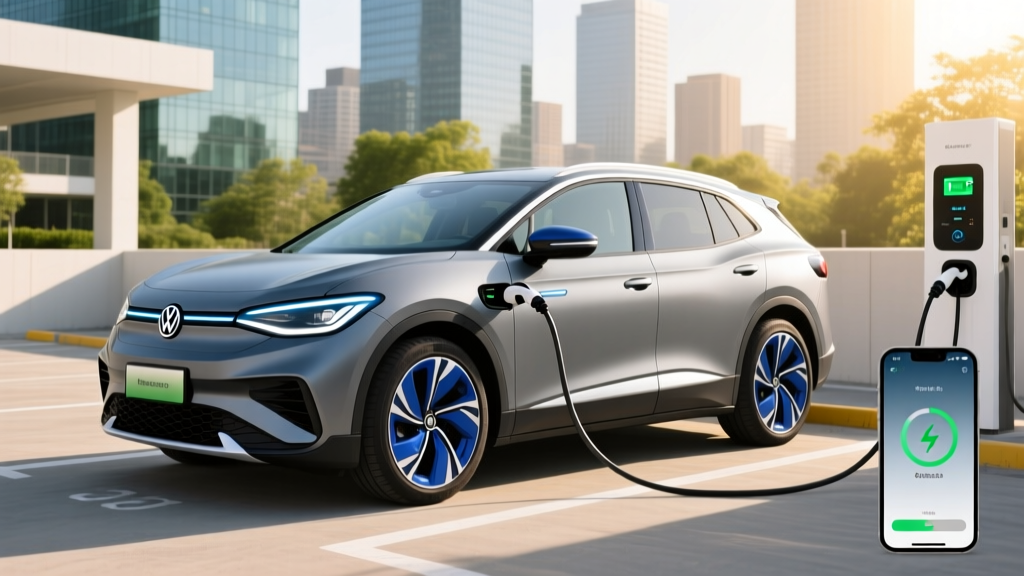
The Volkswagen ID.4 has been the pragmatic electric crossover for buyers who want something familiar, roomy, and — crucially — attainable. For 2026, VW continues to refine the formula with a refreshed interior, updated infotainment software, and the continuation of its aggressive leasing strategy that has made the ID.4 one of the most affordable ways into a mainstream electric SUV. If you've been researching Volkswagen ID.4 leasing, this guide breaks down every number that matters: real-world range, charging speeds, total cost after incentives, and whether this EV earns a spot in your driveway or your lease agreement.
Quick Verdict: Who Should Lease the 2026 ID.4?
The 2026 Volkswagen ID.4 is best suited for suburban families, daily commuters with home charging access, and practical buyers who prioritize cargo space and comfort over sporty dynamics. Leasing makes particular sense for drivers who want to ride out the volatile EV incentive landscape without committing to long-term battery ownership. With lease deals frequently undercutting purchase payments — and sometimes capturing the full $7,500 federal credit as a pass-through — the ID.4 lease is one of the strongest value plays in the compact electric SUV segment.
- You want monthly payments in the $299–$399 range with current VW incentives
- You drive 200 miles or fewer per day and can charge at home
- You want to hedge against battery depreciation and evolving EV tech
- You plan to keep the vehicle 6+ years and want to build equity
- You exceed typical lease mileage limits (10,000–15,000 mi/yr) regularly
- You want to modify or customize the vehicle
Range, Battery, and Efficiency: What You'll Actually Get
| Spec | RWD (Standard/Pro S) | AWD (Pro S Plus) |
|---|---|---|
| EPA Range | 291 miles | 263 miles |
| Battery (Usable) | 82 kWh (NMC) | 82 kWh (NMC) |
| Horsepower | 282 hp | 335 hp |
| 0–60 mph | 7.7 seconds | 5.4 seconds |
| Drivetrain | Rear-Wheel Drive | Dual-Motor AWD |
| MPGe (Combined) | 107 MPGe | 98 MPGe |
| Efficiency | 31 kWh/100 mi | 34 kWh/100 mi |
| Towing Capacity | 2,200 lbs | 2,700 lbs |
The ID.4 uses a 82 kWh usable NMC (nickel manganese cobalt) lithium-ion battery pack. Volkswagen does not currently offer an LFP (lithium iron phosphate) variant in the US market. NMC chemistry provides higher energy density, which helps the ID.4 achieve its competitive range in a relatively compact package, but it also means you should follow best practices for longevity: avoid routinely charging to 100% on DC fast chargers and try to keep state of charge between 20–80% for daily use.
EPA estimates 291 miles for the RWD Pro S and 263 miles for the AWD variant. In our experience and aggregated owner data:
- Mixed city/highway (70°F): Expect 260–280 miles (RWD), 235–255 miles (AWD)
- Sustained highway at 75 mph: Range drops to approximately 230–250 miles (RWD) due to higher aero drag at speed
- Cold weather (below 32°F): Plan for 20–30% range reduction, bringing RWD down to 200–230 miles without preconditioning. The ID.4's standard heat pump helps mitigate this compared to EVs without one.
Efficiency-wise, the RWD model achieves 107 MPGe combined (31 kWh per 100 miles), which is competitive with the Hyundai Ioniq 5 and slightly behind the Tesla Model Y. The AWD version drops to 98 MPGe. These are respectable figures for a vehicle of this size and weight class.
Charging Speed: DC Fast Charging and Home Level 2
| Charging Level | Power / Rate | Miles Added | Notes |
|---|---|---|---|
| Level 1 (120V household) | ~1.4 kW | ~4–5 miles/hour | Emergency/trickle only; ~60+ hours for full charge |
| Level 2 (240V home/public) | 11 kW (onboard charger) | ~33–37 miles/hour | Full charge in ~8.5 hours; ideal for overnight |
| DC Fast Charge (CCS/NACS) | Peak 175 kW | ~70 miles in 10 min | 10–80% in ~30 minutes; tapers significantly above 80% |
The ID.4's DC fast-charging peak of 175 kW is adequate but not class-leading. Competitors like the Hyundai Ioniq 5 (peak 240 kW on 800V architecture) and the Tesla Model Y (peak ~250 kW on V3 Superchargers) replenish faster. In real-world DC charging, the ID.4 sustains roughly 130–150 kW through the 20–60% state-of-charge window, then tapers to under 60 kW above 80%. This means a 10–80% session takes approximately 30 minutes at a capable 175+ kW charger.
For home charging, the ID.4's 11 kW onboard AC charger is a strong point. On a 48-amp Level 2 home charger (such as a ChargePoint Home Flex or Wallbox Pulsar Plus), you'll add about 35 miles of range per hour. Most owners who plug in overnight will wake up to a full battery regardless of daily mileage. Installation of a 240V/50A circuit typically runs $500–$2,000 depending on panel proximity and local electrical codes — factor this into your lease-or-buy calculus.
Remember: kW is power (how fast energy flows); kWh is energy (battery capacity). A 175 kW charger fills an 82 kWh battery — but never at a constant 175 kW due to the charge curve.
Pricing, Lease Deals, and Federal Tax Credit Eligibility
| Trim | Drivetrain | Base MSRP | Est. Lease (36 mo)* | Federal Credit Eligible? |
|---|---|---|---|---|
| Standard | RWD | $39,730 | $299–$349/mo | Yes (if sourcing rules met) |
| Pro | RWD | $42,230 | $329–$379/mo | Yes |
| Pro S | RWD | $45,730 | $359–$409/mo | Yes |
| Pro S Plus | AWD | $50,230 | $399–$459/mo | Yes |
*Lease estimates reflect VW promotional offers and dealer variability as of early 2026. Actual payments depend on credit tier, down payment, region, and dealer markup. Destination fee ($1,295) included in MSRP.
Does the ID.4 Qualify for the $7,500 Federal EV Tax Credit?
The 2026 Volkswagen ID.4 is assembled in Chattanooga, Tennessee, and currently qualifies for the full $7,500 §30D federal tax credit when purchased — provided you meet the following IRS requirements:
- MSRP cap: Vehicle MSRP must not exceed $80,000 for SUVs (all ID.4 trims clear this easily)
- Buyer income cap: Modified AGI must not exceed $150,000 (single), $225,000 (head of household), or $300,000 (married filing jointly)
- Battery sourcing: Critical minerals and battery components must meet phased-in domestic/free-trade sourcing thresholds — VW has confirmed the US-built ID.4 meets 2026 thresholds
- Point-of-sale transfer: As of 2024+, you can transfer the credit to the dealer at purchase for an immediate $7,500 price reduction, or claim it on your federal tax return
For leasing: Under IRS "commercial entity" rules, the $7,500 credit technically goes to the lessor (VW Credit). However, VW has historically passed this savings through as a capitalized-cost reduction on ID.4 leases — effectively giving lessees the benefit. Confirm with your dealer that the lease quote reflects this pass-through, as it is not legally required. This is one of the biggest advantages of Volkswagen ID.4 leasing: even if your personal income exceeds the §30D caps, the lease structure may still capture the credit.
Source: IRS — Clean Vehicle Tax Credits
Interior, Cargo, and Technology
The ID.4's cabin prioritizes space and simplicity over flash. Rear-seat legroom measures a generous 37.6 inches, and cargo volume behind the second row is 30.3 cubic feet — expanding to 64.2 cubic feet with the 60/40 split rear seats folded. That puts it on par with the Toyota RAV4 Hybrid for practicality and ahead of the Hyundai Ioniq 5 in rear-seat roominess.
The 2026 model year carries over the updated 12.9-inch infotainment touchscreen introduced in the 2025 refresh, running VW's ID. Software 4.0. This addresses many complaints from early ID.4 models: the capacitive touch sliders for climate and volume have been improved with backlit sliders, and wireless Apple CarPlay and Android Auto are standard across all trims. A heated steering wheel, heated front seats, and a panoramic fixed glass roof are standard on Pro S and above.
Driver Assistance (SAE Level 2)
VW's IQ.DRIVE suite is standard and includes:
- Travel Assist (adaptive cruise + lane centering) — SAE Level 2
- Front Assist with automatic emergency braking and pedestrian detection
- Blind-spot monitor with rear cross-traffic alert
- Lane Assist (lane-keeping)
- Park Assist with surround-view camera (Pro S and above)
VW IQ.DRIVE Travel Assist is a Level 2 driver-assistance system. This means the vehicle can manage steering and acceleration simultaneously under certain conditions, but the driver must remain fully engaged, hands on or near the wheel, and eyes on the road at all times. It is not self-driving. Hands-free systems like GM's Super Cruise (Level 2, eyes-off on mapped highways) offer more convenience on long highway stretches, but the ID.4's system is competent for daily commuting.
What Are the Biggest Pros and Cons?
Pros
- Strong value with aggressive VW lease incentives — frequently under $350/mo
- Spacious cabin with best-in-class rear legroom (37.6 in)
- Comfortable ride quality; well-suited to rough roads and long trips
- 11 kW onboard AC charger is faster than many competitors
- US-built, qualifying for the full $7,500 federal credit on purchase and (via pass-through) most leases
- Heat pump standard on all trims (better cold-weather range retention)
- 8-year/100,000-mile battery and powertrain warranty
Cons
- 175 kW DC fast-charging peak is slower than Ioniq 5, Model Y, and EV6
- Infotainment, while improved, still lags Tesla and Hyundai/Kia in responsiveness
- No front trunk (frunk) — space under the hood is occupied by HVAC components
- AWD variant's 263-mile range is modest for road-trippers in cold climates
- Rear drum brakes (regenerative-assisted) feel unusual to some drivers transitioning from discs
- Cabin materials at the Standard trim level feel budget-tier for the price point
How Does the ID.4 Stack Up Against Key Competitors?
| Spec | VW ID.4 Pro S (RWD) | Hyundai Ioniq 5 SEL (RWD LR) | Tesla Model Y (Long Range RWD) |
|---|---|---|---|
| EPA Range | 291 mi | 303 mi | 320 mi |
| Battery | 82 kWh (NMC) | 84 kWh (NMC) | ~78 kWh (NMC/LFP) |
| Peak DC Charge | 175 kW | 240 kW | 250 kW |
| 10–80% DC Time | ~30 min | ~18 min | ~22 min |
| 0–60 mph | 7.7 sec | 7.0 sec | 5.8 sec |
| Cargo (behind 2nd row) | 30.3 cu ft | 27.2 cu ft | 30.2 cu ft |
| Rear Legroom | 37.6 in | 39.4 in | 35.2 in |
| Base MSRP | $45,730 | $47,600 | $44,990 |
| Federal Credit | $7,500 (US-built) | $7,500 (US-built) | $7,500 (US-built) |
The ID.4 doesn't win any single spec battle decisively, but it holds its ground across the board. The Ioniq 5 charges significantly faster and offers more rear legroom; the Model Y delivers better range and performance. Where the ID.4 wins is ride comfort, cabin quietness, and lease value — VW's consistent lease subsidies make monthly payments competitive with or lower than both rivals. If you prioritize the lowest possible monthly payment and a composed highway cruiser, the ID.4 lease is hard to beat.
Warranty and Long-Term Battery Outlook
Volkswagen provides an 8-year / 100,000-mile battery warranty that guarantees the high-voltage pack will retain at least 70% of its original capacity during that period. The basic vehicle warranty is 4 years / 50,000 miles, with roadside assistance for 4 years.
For lessees, the battery warranty is largely academic — a typical 36-month lease puts 30,000–45,000 miles on the odometer, well within the coverage window. Battery degradation data from early ID.4 owners (2021–2024 models) shows approximately 3–5% capacity loss over the first 60,000 miles, which is consistent with NMC chemistry norms. If you're leasing, you'll hand the car back before degradation becomes a practical concern.
Source: NHTSA — Volkswagen ID.4 Safety Ratings (2024 ID.4 earned a 5-Star Overall Safety Rating)
Frequently Asked Questions
What is the real-world range of the 2026 VW ID.4?
The EPA rates the RWD ID.4 at 291 miles and the AWD at 263 miles. In mixed real-world driving at moderate temperatures, expect 260–280 miles (RWD) and 235–255 miles (AWD). Sustained highway driving at 75+ mph or cold weather below freezing will reduce these figures by 15–30%.
How fast does the ID.4 charge at home and on the road?
At home on a 240V Level 2 charger, the ID.4's 11 kW onboard charger adds about 35 miles of range per hour, fully replenishing the battery in roughly 8.5 hours. On a DC fast charger, it peaks at 175 kW and charges from 10–80% in approximately 30 minutes.
Does the VW ID.4 qualify for the $7,500 federal EV tax credit?
Yes, when purchased, the US-built ID.4 qualifies for the full $7,500 §30D credit if you meet IRS income caps ($150K single / $300K married) and the vehicle MSRP is under $80,000 (all trims qualify). When leasing, the credit goes to VW Credit as lessor, but VW has historically passed this through as a lease discount. Confirm with your dealer.
Is leasing the ID.4 better than buying?
Leasing is advantageous if you want lower monthly payments, plan to drive under 15,000 miles per year, and want to avoid long-term battery depreciation risk. VW's lease incentives often make monthly payments $50–$100 less than financing the same vehicle. Buying makes more sense if you drive high annual mileage, plan to keep the car 5+ years, or want to customize it.
How does the ID.4 compare to the Tesla Model Y and Hyundai Ioniq 5?
The Model Y offers more range (320 mi) and faster charging (250 kW peak); the Ioniq 5 charges even faster (240 kW, 10–80% in ~18 min) and has more rear legroom. The ID.4 counters with a more comfortable ride, quieter cabin, competitive lease pricing, and strong cargo space. It's the comfort-and-value pick in the segment.
Does the ID.4 have a front trunk (frunk)?
No. The ID.4 does not have a frunk. The space under the hood houses HVAC and power electronics. All cargo goes in the rear hatch area (30.3 cu ft behind the second row, 64.2 cu ft with seats folded).
Editor's note: Pricing, tax credit eligibility, and lease offers are based on information available as of early 2026 and are subject to change. Always verify current IRS §30D rules at irs.gov and confirm lease terms directly with your local VW dealer. State and local incentives vary by jurisdiction — consult your state energy office or the AFDC State Laws database for local programs.