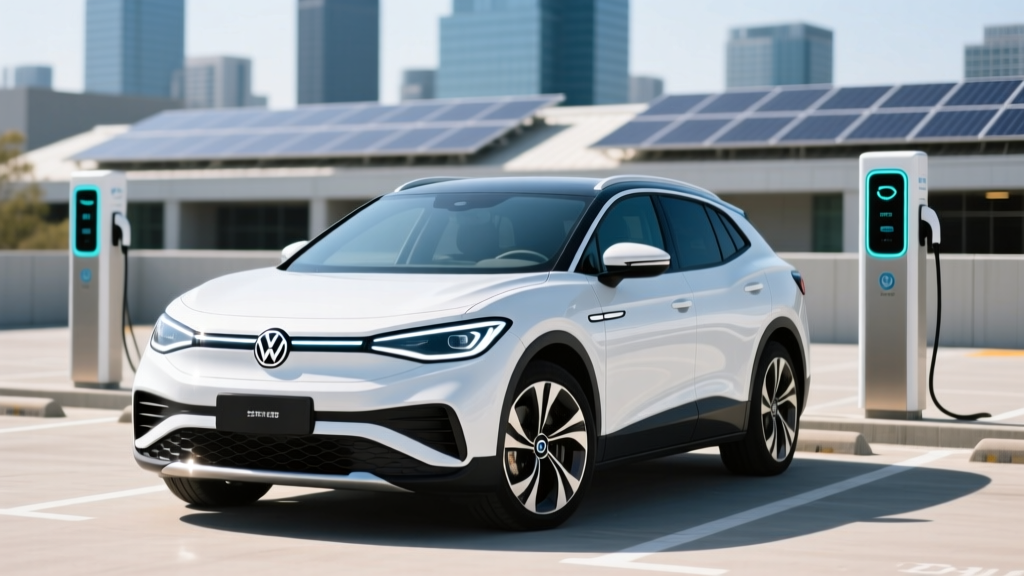
2026 Volkswagen ID.4: The Practical EV Lease Contender
The Volkswagen ID.4 has carved out a specific niche in the American EV market: a compact electric crossover that prioritizes comfort, space, and mainstream appeal over performance theatrics. For 2026, the ID.4 continues to offer competitive range, improved software, and access to one of the most robust lease incentive structures in the segment. If you're researching ID.4 leases, you're likely weighing this against the Tesla Model Y, Hyundai Ioniq 5, or Ford Mustang Mach-E — and the numbers tell a nuanced story.
This review breaks down the 2026 ID.4's real-world range, charging performance, pricing after tax credits, and whether leasing makes more financial sense than buying outright.
Spec Snapshot: 2026 Volkswagen ID.4
| Specification | Standard Range (RWD) | Pro S / Pro S Plus (RWD) | AWD Pro S |
|---|---|---|---|
| EPA Range | 206 miles | 291 miles | 263 miles |
| Battery Capacity | 62 kWh (usable) | 82 kWh (usable) | 82 kWh (usable) |
| Battery Chemistry | NMC (Nickel Manganese Cobalt) | NMC | NMC |
| Horsepower | 201 hp | 282 hp | 335 hp |
| 0-60 mph | ~8.5 sec | ~7.2 sec | ~5.4 sec |
| Max DC Fast Charge | 135 kW | 170 kW | 170 kW |
| 10-80% DC Time | ~30 min | ~28 min | ~28 min |
| Level 2 Home Charging | 10.8 kW (~33 mi/hr) | 11.5 kW (~37 mi/hr) | 11.5 kW (~37 mi/hr) |
| MPGe (Combined) | 107 MPGe | 104 MPGe | 98 MPGe |
| Base MSRP | $40,790 | $47,290 | $51,290 |
Real-World Range: What to Actually Expect
The ID.4's efficiency is adequate but not class-leading. At 104 MPGe combined for the Pro S, it trails the Hyundai Ioniq 5 (114 MPGe) and Tesla Model Y (122 MPGe). The aerodynamic profile is more traditional SUV than teardrop, and the 82 kWh battery is heavy. For daily commuting under 60 miles round-trip, range is a non-issue. For road trips, you'll be stopping every 200-220 miles in temperate weather, which aligns with typical DC fast-charger spacing on major interstates.
The Standard Range trim's 206-mile EPA rating is genuinely limiting for anything beyond local driving. If your lease budget allows, the 82 kWh battery is the pragmatic choice.
Charging Performance: Adequate, Not Exceptional
| Charging Level | Power / Rate | Time / Miles Added | Use Case |
|---|---|---|---|
| Level 1 (120V) | 1.4 kW | ~4 miles per hour | Emergency / overnight trickle |
| Level 2 (240V, 48A) | 11.5 kW | ~37 miles per hour; 0-100% in ~8.5 hrs | Home daily charging |
| DC Fast Charge | Peak 170 kW (Pro S) | 10-80% in ~28 min; 80-100% tapers sharply | Road trips, public stations |
The 170 kW peak charge rate on Pro S trims is respectable but not cutting-edge. The Hyundai Ioniq 5 peaks at 240 kW (800V architecture), and the Tesla Model Y at 250 kW. More importantly, the ID.4's charge curve is relatively flat from 20-60% State of Charge, then tapers progressively above 80%. On a 300-mile road trip, expect two 25-30 minute charging stops at Electrify America, Tesla Supercharger (with adapter), or compatible CCS networks.
Home charging reality: A full Level 2 installation (48-amp hardwired charger, 60-amp circuit) typically costs $800-$1,500 for equipment and electrician labor, assuming your panel has capacity. The ID.4's 11.5 kW onboard charger means you'll add roughly 37 miles of range per hour — adequate for overnight replenishment.
Interior, Cargo & Technology
The ID.4's cabin prioritizes space and simplicity over luxury. Rear legroom measures 37.6 inches, which is generous for the segment and comfortably fits adults on longer trips. Cargo volume is 30.3 cubic feet behind the rear seats, expanding to 64.2 cubic feet with seats folded — competitive with the Model Y (30.2 / 72.1 cu ft) and slightly more than the Ioniq 5 (27.2 / 59.3 cu ft).
The 12.9-inch infotainment screen (on Pro S and above) runs VW's ID. Software 4.0, which has improved significantly since the ID.4's 2021 launch. Wireless Apple CarPlay and Android Auto are standard. However, the capacitive touch sliders for volume and climate remain a frustration — imprecise and unlit at night.
Driver assistance: Travel Assist combines adaptive cruise control and lane centering (SAE Level 2). It's competent for highway cruising but requires hands-on-wheel supervision. This is not autonomous driving; it's a driver aid comparable to Toyota Safety Sense or Honda Sensing, though slightly less refined in lane-keeping smoothness.
Pricing, Lease Deals & Federal Tax Credit
| Trim | Base MSRP | Estimated Lease (36 mo / 12k mi) | Federal Tax Credit (§30D) | Effective Cost Note |
|---|---|---|---|---|
| Standard Range | $40,790 | $299-$399/mo (varies by region, incentives) | Up to $7,500 if eligible | Lease may include lessor credit applied as cap reduction |
| Pro S RWD | $47,290 | $399-$529/mo | Up to $7,500 if eligible | Most popular trim; best range-to-price ratio |
| AWD Pro S | $51,290 | $459-$599/mo | Up to $7,500 if eligible | AWD reduces range; consider only if needed for snow/traction |
Federal tax credit eligibility (§30D): The ID.4 qualifies for up to $7,500 under current IRS rules, but eligibility depends on three factors:
- MSRP cap: The ID.4 (as an SUV) must have an MSRP under $80,000. All 2026 trims comply.
- Buyer income cap: Adjusted gross income must not exceed $150,000 (single), $225,000 (head of household), or $300,000 (joint filers).
- Battery sourcing: Critical minerals and battery components must meet phased-in percentages from US/free-trade-agreement sources. Volkswagen has confirmed 2026 ID.4 models meet current thresholds for the full $7,500.
Lease vs buy: When you lease, the tax credit technically goes to the lessor (Volkswagen Credit). However, VW often passes this through as a "lease cash" incentive, effectively reducing your monthly payment. Confirm with your dealer whether the $7,500 is reflected in the lease quote. Point-of-sale transfer (available for purchases) does not apply to leases in the same way.
For buyers, the point-of-sale transfer allows you to apply the $7,500 directly at purchase, reducing the financed amount. This is often more straightforward than claiming the credit on your tax return. See IRS §30D guidance for current rules.
Pros & Cons
- Spacious rear seat and cargo area
- Comfortable ride quality, quiet cabin
- Competitive lease incentives
- Full $7,500 tax credit eligibility (2026)
- Improved infotainment software (ID. 4.0)
- 3-year/36,000-mi bumper-to-bumper + 8-yr/100,000-mi battery warranty
- Charging speed lags Ioniq 5, Model Y
- Efficiency below segment average (104 MPGe vs 114-122)
- Capacitive touch controls frustrating
- Standard Range trim's 206 miles is limiting
- AWD significantly reduces range (263 vs 291 mi)
- Real-world highway range ~240-260 mi (Pro S)
Who Should Lease the 2026 ID.4?
The ID.4 is best suited for:
- Commuters with home charging: If your round-trip commute is under 80 miles and you can charge overnight, the ID.4's comfort and space make it an excellent daily driver.
- Families needing cargo space: 30.3 cu ft behind the rear seats handles strollers, groceries, and weekend trip luggage without folding seats.
- Lease-focused buyers: VW's aggressive lease incentives and the pass-through of the $7,500 tax credit make monthly payments competitive with gas crossovers.
The ID.4 is less ideal for:
- Frequent road trippers: 170 kW charging and 240-mile real-world range mean more stops and longer dwell times than an Ioniq 5 or Model Y.
- Performance-oriented drivers: Even the AWD's 5.4-second 0-60 is leisurely compared to the Model Y Long Range (4.8 sec) or Ioniq 5 N (3.3 sec).
- Cold-climate drivers without garage parking: Expect 30-40% range loss in sub-freezing temperatures, dropping the Pro S to ~180 miles usable.
Competitor Comparison
| Vehicle | EPA Range | Max DC Charge | MPGe | Base MSRP | Cargo (cu ft) |
|---|---|---|---|---|---|
| 2026 VW ID.4 Pro S | 291 mi | 170 kW | 104 | $47,290 | 30.3 |
| 2026 Hyundai Ioniq 5 SEL | 303 mi | 240 kW | 114 | $46,700 | 27.2 |
| 2026 Tesla Model Y LR | 320 mi | 250 kW | 122 | $47,990 | 30.2 |
| 2026 Ford Mach-E Premium | 305 mi | 150 kW | 101 | $48,995 | 29.7 |
The Ioniq 5 and Model Y are objectively better EVs in terms of efficiency, charging speed, and technology. The ID.4's advantages are ride comfort, rear-seat space, and VW's lease incentive structure. If you prioritize driving dynamics and road-trip charging, the Ioniq 5 is the stronger choice. If you value a traditional dealership experience and competitive lease terms, the ID.4 remains viable.
Frequently Asked Questions
What is the real-world range of the 2026 VW ID.4?
The Pro S RWD has a 291-mile EPA rating, but expect 240-260 miles in highway driving at 70 mph, and 180-210 miles in freezing temperatures. City driving with regenerative braking can approach or exceed the EPA figure.
How fast does the ID.4 charge at home and on DC fast chargers?
On a Level 2 home charger (11.5 kW), the ID.4 adds ~37 miles per hour, fully charging in ~8.5 hours. On DC fast chargers, the Pro S peaks at 170 kW, reaching 10-80% in ~28 minutes, with significant tapering above 80%.
Does the 2026 ID.4 qualify for the $7,500 federal tax credit?
Yes, the 2026 ID.4 qualifies for the full $7,500 under §30D, assuming you meet income caps ($150k single / $300k joint) and the vehicle's MSRP is under $80,000 (all trims comply). Battery sourcing requirements are met. For leases, confirm the credit is passed through as a lease incentive.
Is it better to lease or buy the ID.4?
Leasing often makes sense for the ID.4 due to VW's aggressive lease cash incentives and EV depreciation concerns. However, if you plan to keep the vehicle 5+ years and qualify for the tax credit, buying with point-of-sale transfer may be more economical. Run the numbers with your dealer.
How does the ID.4 compare to the Tesla Model Y and Hyundai Ioniq 5?
The Model Y and Ioniq 5 are more efficient, charge faster, and offer better real-world range. The ID.4 counters with a quieter ride, more rear legroom, and competitive lease pricing. If charging speed and efficiency are priorities, the Ioniq 5 is the segment benchmark.
What is the ID.4's battery warranty?
Volkswagen provides an 8-year/100,000-mile battery warranty covering defects and capacity loss below 70% of original capacity. The powertrain warranty is also 8 years/100,000 miles, and bumper-to-bumper coverage is 3 years/36,000 miles.
Sources: EPA fuel economy data from fueleconomy.gov, IRS clean vehicle credit rules from irs.gov, manufacturer specifications from Volkswagen of America.