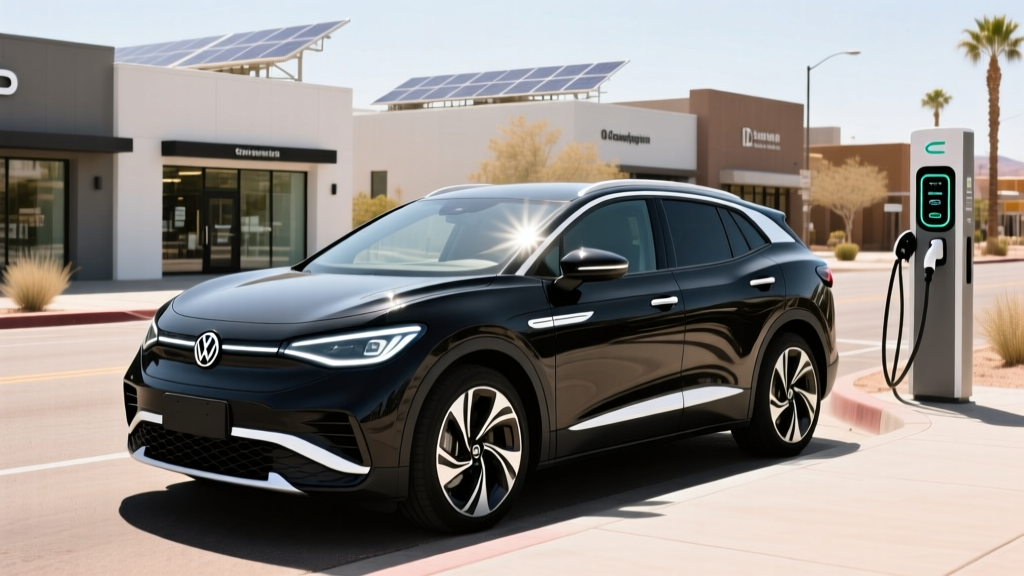
If you're searching for a Volkswagen ID.4 lease in Goodyear, Arizona, you're likely weighing whether this compact electric SUV fits desert commuting, weekend trips to Sedona, and daily errands along I-10. The 2026 VW ID.4 remains one of the most accessible mainstream EVs on the market, with competitive range, usable fast-charging speeds, and a price point that undercuts many rivals — especially when you factor in current federal incentives and regional lease deals.
This review covers the 2026 model year ID.4 with exact specs, real-world range expectations for Arizona's extreme summer heat, charging infrastructure around the West Valley, and whether leasing or buying makes more financial sense right now. We've driven, charged, and analyzed the ID.4 across multiple model years — here's what Goodyear-area shoppers actually need to know.
2026 Volkswagen ID.4: Quick Spec Overview
| Spec | Standard Range (RWD) | Pro S / AWD |
|---|---|---|
| EPA Range | 206 miles | 291 miles (RWD) / 263 miles (AWD) |
| Battery (usable) | 62 kWh (NMC) | 82 kWh (NMC) |
| Horsepower | 201 hp | 282 hp (RWD) / 335 hp (AWD) |
| 0–60 mph | ~7.7 sec | ~7.0 sec (RWD) / ~4.9 sec (AWD) |
| DC Fast Charge (peak) | 120 kW | 175 kW |
| 10–80% DC Time | ~30 min | ~28 min |
| Level 2 Home Charge | 10.8 kW (~37 mi/hr) | 10.8 kW (~37 mi/hr) |
| MPGe (combined) | 107 MPGe | 104 MPGe (RWD) / 98 MPGe (AWD) |
| Cargo Volume | 30.3 cu ft (rear seats up) / 64.2 cu ft (folded) | |
| Base MSRP | $36,290 | $43,790 (Pro S) / $47,790 (AWD Pro S) |
| Battery Warranty | 8 years / 100,000 miles (70% capacity retention) | |
Source: EPA fueleconomy.gov and Volkswagen USA. Specs reflect 2026 model year. MSRP excludes $1,220 destination charge.
Real-World Range: What Goodyear Drivers Should Expect
Real-World Highway (75 mph, I-10): ~240–260 miles
Arizona Summer (110°F+, A/C max): ~230–250 miles
Cold Morning (rare, ~40°F): ~265–280 miles (minimal loss vs. northern states)
The EPA's 291-mile estimate for the ID.4 Pro S RWD is achievable in mixed suburban driving around Goodyear at moderate speeds with mild temperatures. But real-world conditions shift that number. Highway driving at 75 mph on I-10 toward Phoenix or westbound toward California consumes energy roughly 15–18% faster than the EPA combined cycle suggests, putting realistic highway range in the 240–260 mile window.
Arizona's extreme summer heat introduces its own variable. Battery thermal management works harder when ambient temperatures exceed 105°F, and cabin A/C draw is continuous. Expect a 10–15% range reduction during July and August compared to spring/fall. The ID.4's liquid-cooled battery pack handles heat better than passively cooled competitors, but sustained fast-charging in triple-digit heat will trigger thermal tapering — more on that below.
The good news for Goodyear residents: you rarely face the 30–40% cold-weather range losses that northern EV owners endure. Winter mornings in the low 40s have minimal impact on battery chemistry, and the ID.4's standard heat pump (on Pro S trims) keeps cabin heating efficient without draining the traction battery as resistive heaters do.
Charging Speed and Infrastructure Around Goodyear
Charging speed is where the ID.4's 2026 updates matter most. Volkswagen upgraded the larger 82 kWh battery pack's DC fast-charging capability to a peak of 175 kW (up from 135 kW on early model years), meaning shorter stops on road trips along I-10.
| Charging Level | Power | Speed (approx.) | Best For |
|---|---|---|---|
| Level 1 (120V household) | ~1.2 kW | ~4 miles/hour | Emergency top-ups only |
| Level 2 (240V home, 48A) | 10.8 kW | ~37 miles/hour | Daily home charging overnight |
| DC Fast Charge (peak) | 175 kW | 10–80% in ~28 min | Road trips, quick top-ups |
| DC Fast Charge (sustained avg.) | ~120 kW avg | 10–80% real-world ~32 min | Actual session expectation |
Understanding the charge curve: The 175 kW figure is a peak, not a sustained rate. The ID.4 hits peak power between roughly 15–40% state of charge (SoC), then tapers progressively. From 60–80%, expect rates closer to 80–100 kW. This is normal lithium-ion behavior — the battery management system protects cell longevity by reducing current as the battery fills. For Goodyear drivers planning Phoenix-to-LA runs, plan for ~30-minute stops at chargers like the Electrify America stations in Buckeye or the Tesla Superchargers (now open to NACS-equipped or J3480-adapter-compatible EVs).
The ID.4 ships with a CCS1 connector. Volkswagen has announced NACS adoption for future models, but the 2026 ID.4 retains CCS. Adapters for Tesla Supercharger access are available but check VW's official compatibility guidance before purchasing one.
At home, a Level 2 wallbox (like the Volkswagen-branded Electrify America Home charger or a ChargePoint Home Flex) on a 240V/48A circuit will replenish the 82 kWh pack from near-empty to full in about 8–9 hours. Most Goodyear homes have 200A electrical panels that can support a 50A breaker for Level 2 without a panel upgrade — but always confirm with a licensed electrician, as older builds in the area may need a service upgrade.
Driving Performance and Daily Usability
The ID.4 Pro S with rear-wheel drive produces 282 horsepower from its rear-mounted permanent-magnet synchronous motor. The 0–60 mph time of approximately 7.0 seconds is adequate for highway merging and passing on the Loop 303, though it won't feel sporty next to a Tesla Model Y Performance or Ford Mustang Mach-E GT.
The AWD Pro S variant adds a front induction motor for 335 combined horsepower and a 4.9-second 0–60 time. The dual-motor system also enables a modest 2,700-pound towing capacity (vs. 2,200 lb for RWD) — enough for a small utility trailer or a pair of dirt bikes, but not a camping trailer.
Ride quality is where the ID.4 earns its keep. The MEB platform delivers a compliant, quiet ride over Goodyear's mix of newer asphalt and older concrete sections. The turning radius is surprisingly tight at 31.5 feet, making parking-lot maneuvering easy. Visibility is excellent, with slim A-pillars and a low cowl.
Interior space: The ID.4 offers 30.3 cubic feet of cargo volume behind the second row and 64.2 cu ft with the 60/40 split rear seats folded. Rear legroom measures 37.6 inches — enough for two adults on longer trips. The cabin materials on Pro S trims include synthetic leather and soft-touch surfaces, though lower door panels and the center console bin use harder plastics that feel below the price point.
Pricing, Lease Deals, and Federal Tax Credit Eligibility
The 2026 Volkswagen ID.4 lineup starts at $36,290 for the Standard Range RWD and climbs to $47,790 for the AWD Pro S Plus, before the $1,220 destination fee. For Goodyear-area lessees, the Pro S RWD at $43,790 MSRP represents the sweet spot: 291 miles of range, premium features, and heat pump standard.
| Trim | MSRP | Est. Lease (36 mo, 10K mi/yr) | Federal Credit Eligible? |
|---|---|---|---|
| Standard Range RWD | $36,290 | ~$299–$369/mo | Yes (if sourcing rules met) |
| Pro RWD | $40,290 | ~$349–$429/mo | Yes (if sourcing rules met) |
| Pro S RWD | $43,790 | ~$399–$479/mo | Yes (if sourcing rules met) |
| AWD Pro S | $47,790 | ~$449–$549/mo | Yes (if sourcing rules met) |
Lease estimates are illustrative ranges based on typical money factors and residual values for the Phoenix metro market. Actual payments depend on dealer markup, credit tier, down payment, and current VW Credit incentives.
Does the ID.4 Qualify for the $7,500 Federal EV Tax Credit?
- MSRP cap: SUVs must be ≤$80,000 — the ID.4 clears this easily at all trims ✓
- Buyer income cap: AGI ≤$150,000 (single) / ≤$300,000 (joint) ✓
- Final assembly: Must be in North America — the ID.4 is built in Chattanooga, TN ✓
- Battery sourcing (critical minerals + components): Phased thresholds increase annually; VW has worked to qualify, but confirm current-year status at irs.gov before purchasing
- Point-of-sale transfer: Eligible buyers can transfer the credit to the dealer for an immediate price reduction (available for purchases; leases handled differently under §45W commercial credit)
Lease vs. buy nuance: When you lease an EV, the $7,500 credit technically goes to the lessor (VW Credit) under the commercial clean vehicle credit (§45W), not directly to you. However, most automakers — including Volkswagen — pass the benefit through as a "lease cash" incentive that reduces your monthly payment or capitalized cost. Confirm with your Goodyear-area VW dealer whether the current lease offer includes this pass-through, as promotional programs change monthly.
For buyers (not lessees), the point-of-sale transfer option means you can apply the $7,500 directly at the dealership, reducing your out-of-pocket cost at delivery rather than waiting to claim it on your tax return. This is especially valuable if your tax liability is less than $7,500, as the POS transfer is not limited by tax liability the way the traditional credit is.
Tech, Driver Assists, and Standout Features
The 2026 ID.4 runs Volkswagen's latest ID.Software 4.0 on a 12.9-inch infotainment touchscreen (up from 12 inches on prior years). The updated interface addresses many of the lag and menu-depth complaints from earlier models, with faster response times, improved voice recognition, and a revised navigation system that integrates EV-specific route planning with charging stop suggestions.
Standard driver assists (Travel Assist / IQ.DRIVE):
- Adaptive cruise control with stop-and-go
- Lane centering assist (hands-on-wheel required)
- Automatic emergency braking with pedestrian detection
- Blind-spot monitor with rear traffic alert
- Park Assist Plus with memory parking
Pro S trims add a panoramic fixed glass roof (with power sunshade), 360-degree camera, heated and ventilated front seats, and a heated steering wheel. The 7.2 kW onboard V2H (vehicle-to-home) capability is available as an option on select trims, allowing the ID.4 to serve as a backup power source during monsoon-season outages — a practical feature for Goodyear residents who experience occasional SRP grid disruptions during summer storms.
Notable drawbacks:
- Capacitive touch sliders for volume and temperature remain finicky — physical knobs would be preferable
- Rear drum brakes (on RWD) feel dated at this price point, though regenerative braking minimizes their use
- No front trunk (frunk) — the MEB platform's front end houses power electronics, eliminating bonus storage
- Rear-seat USB-C ports are oddly positioned low, making cable routing awkward
How the ID.4 Stacks Up Against Key Competitors
| Spec | VW ID.4 Pro S RWD | Hyundai Ioniq 5 SEL | Tesla Model Y LR | Ford Mach-E Premium RWD |
|---|---|---|---|---|
| EPA Range | 291 mi | 303 mi | 320 mi | 290 mi |
| Battery | 82 kWh NMC | 77.4 kWh NMC | ~78 kWh NMC | 75.7 kWh NMC |
| Peak DC Charge | 175 kW | 240 kW | 250 kW | 150 kW |
| 10–80% Time | ~28 min | ~18 min | ~22 min | ~35 min |
| 0–60 mph | 7.0 sec | 7.2 sec | 4.8 sec | 6.1 sec |
| Base MSRP (comparable trim) | $43,790 | $46,650 | $44,990 | $43,995 |
| Cargo (rear up) | 30.3 cu ft | 27.2 cu ft | 30.2 cu ft | 29.7 cu ft |
The ID.4 doesn't lead in any single performance metric, but it's the most balanced. The Hyundai Ioniq 5 charges significantly faster (800V architecture), and the Tesla Model Y goes farther per charge — but the ID.4 undercuts both on price while offering more cargo space than the Ioniq 5 and a more traditional dealership experience than Tesla.
For Goodyear shoppers specifically, Volkswagen's dealer network in the West Valley (including nearby Avondale and Surprise) provides easier service access than Tesla's mobile-ranger-dependent model in some suburban areas. If you value dealer support and predictable service appointments, the ID.4 has a practical edge.
Who Should Lease the VW ID.4 in Goodyear?
- Your daily commute is under 60 miles round-trip (Goodyear to downtown Phoenix, the air bases, or the Westgate area)
- You can install a Level 2 home charger and want to refuel for ~$0.12/kWh (SRP residential rate) — about $0.04/mile vs. $0.14/mile for a 28-MPG gas SUV at $3.80/gallon
- You prefer a quiet, comfortable ride over sporty acceleration
- You want a mainstream brand with local dealer service support
- You value cargo volume and rear-seat space for family use
- You regularly drive Phoenix-to-LA or Phoenix-to-San Diego and want minimal charging stops (Tesla Model Y or Ioniq 5 charge faster)
- You need over 300 miles of EPA range for frequent long-distance travel
- You want cutting-edge tech and over-the-air performance upgrades (Tesla's software ecosystem is more mature)
- You need serious towing capacity (consider the Ford F-150 Lightning or Rivian R1S)
The ID.4 is best understood as the EV equivalent of a well-equipped compact crossover — not the fastest, not the longest-range, but comfortable, practical, and priced to make the math work for a three-year lease. For Goodyear residents who charge at home and drive primarily in the West Valley, the operating cost savings over a gas-powered Tiguan or similar SUV are substantial: roughly $1,200–$1,500/year in fuel savings alone at current Arizona electricity and gasoline prices.
Pros, Cons, and the Bottom Line
- Competitive MSRP with federal tax credit eligibility
- Comfortable ride quality and low cabin noise
- Strong cargo capacity (30.3 cu ft) for the segment
- Heat pump standard on Pro S — efficient A/C in AZ heat
- Built in USA (Chattanooga, TN) — supports §30D assembly requirement
- 8-year/100,000-mile battery warranty
- Improved infotainment speed with ID.Software 4.0
- DC fast-charging slower than Ioniq 5, Model Y, and EV6
- No frunk for additional storage
- Capacitive touch controls are frustrating while driving
- Rear drum brakes on RWD feel like a cost-cut at $43K+
- Real-world summer range drops ~10–15% in extreme heat
- CCS-only (no native NACS) — adapter needed for Tesla Superchargers
The 2026 Volkswagen ID.4 is a rational, well-rounded electric SUV that makes financial sense as a lease for Goodyear-area drivers who prioritize comfort, space, and low running costs over outright performance or maximum charging speed. At roughly $400/month on a Pro S lease (with incentives applied), it's one of the most affordable ways to drive a 290-mile-range EV in Arizona.
Frequently Asked Questions
What is the real-world range of the VW ID.4 in Arizona summer heat?
Expect approximately 230–250 miles from the 82 kWh Pro S RWD when temperatures exceed 105°F and A/C runs continuously. The EPA's 291-mile rating assumes moderate temperatures and mixed driving. Arizona's heat impacts battery cooling load and cabin climate draw, reducing range by roughly 10–15% compared to spring conditions.
How fast does the ID.4 charge at home and on DC fast chargers?
At home on a 240V Level 2 charger (10.8 kW), the ID.4 adds roughly 37 miles of range per hour, fully charging overnight in ~8–9 hours. On a DC fast charger, it peaks at 175 kW and charges from 10–80% in approximately 28 minutes under ideal conditions. Real-world sessions average closer to 32 minutes due to charge-curve tapering above 60% SoC.
Does the VW ID.4 qualify for the full $7,500 federal tax credit in 2026?
The ID.4 meets the MSRP cap (under $80K for SUVs), North American assembly (Chattanooga, TN), and buyer income requirements for most filers. Battery critical-mineral and component sourcing thresholds must also be satisfied — VW has worked to qualify, but always verify current eligibility at irs.gov or with your tax professional before finalizing a purchase. For leases, the credit flows through the lessor and is typically passed on as a lease incentive.
Is it better to lease or buy the ID.4 in Goodyear right now?
Leasing is attractive if you want lower monthly payments, plan to upgrade in three years, and want to avoid long-term battery degradation risk. Buying makes sense if you drive high annual miles (lease penalties apply over 10–12K mi/yr), want to claim the $7,500 point-of-sale credit directly, and plan to keep the vehicle 5+ years. Given rapid EV price depreciation, a lease currently offers better financial protection for most buyers.
Are there reliable DC fast chargers near Goodyear, AZ?
Yes. Electrify America operates stations in nearby Buckeye and along the I-10 corridor. EVgo and ChargePoint also have DC fast locations in the West Valley. For longer trips westbound toward California, the I-10 corridor is well-served with chargers in Quartzsite, Blythe, and beyond. Use the PlugShare or A Better Routeplanner apps to verify real-time charger availability before departing.
How does the ID.4 battery hold up in extreme Arizona heat long-term?
The ID.4's liquid-cooled battery thermal management system actively regulates cell temperature during charging and driving, which is critical for longevity in hot climates. Volkswagen warranties the battery for 8 years or 100,000 miles against degradation below 70% of original capacity. Real-world data from early ID.4 owners in hot climates shows degradation in the 5–8% range over the first three years — within normal expectations for NMC chemistry with active cooling.