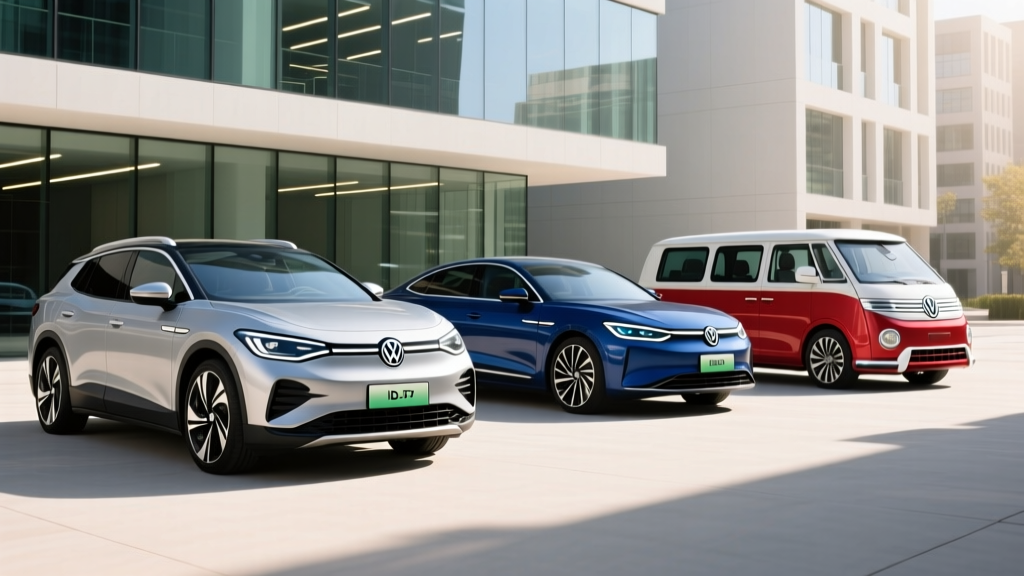
Quick Answer: Volkswagen currently sells three electric vehicles in the US: the ID.4 compact SUV (EPA range up to 291 miles, starting ~$40,790), the ID.7 sedan (EPA range up to ~340 miles, starting ~$46,290), and the ID.Buzz electric van (EPA range up to ~234 miles, starting ~$59,995). All three use an 82 kWh (usable) NMC battery on higher trims, support DC fast charging up to 175–200 kW, and qualify for varying levels of the federal §30D tax credit depending on battery sourcing. For most buyers, the ID.4 Pro S offers the best value; the ID.7 suits high-mileage commuters; the ID.Buzz is a niche family hauler with no direct EV rival.
Volkswagen's 2026 EV Lineup at a Glance
Volkswagen's electric strategy in the US rests on three production models built on the MEB platform. Each targets a distinct buyer profile, and the differences in range, charging, and packaging matter more than the shared underpinnings suggest. Below is the essential spec comparison you need before visiting a dealer.
| Spec | 2026 ID.4 Pro S (RWD) | 2026 ID.7 Pro S | 2026 ID.Buzz Pro S (RWD) |
|---|---|---|---|
| Body Style | Compact SUV | Midsize Sedan | 3-Row Minivan |
| EPA Range | 291 mi | ~340 mi | 234 mi |
| Battery (usable) | 82 kWh, NMC | 82 kWh, NMC | 86 kWh, NMC |
| Drivetrain | RWD (AWD avail.) | RWD (AWD avail.) | RWD (AWD avail.) |
| Horsepower | 282 hp (RWD) | 282 hp (RWD) | 282 hp (RWD) |
| 0–60 mph | ~7.7 sec | ~6.5 sec | ~7.9 sec |
| Peak DC Fast Charge | 175 kW | 200 kW | 175 kW |
| 10–80% DCFC Time | ~28 min | ~26 min | ~30 min |
| Level 2 (AC) Rate | 11 kW | 11 kW | 11 kW |
| MPGe (combined) | 107 MPGe | ~115 MPGe | ~88 MPGe |
| Base MSRP | $40,790 | $46,290 | $59,995 |
| Battery Warranty | 8 yr / 100,000 mi | 8 yr / 100,000 mi | 8 yr / 100,000 mi |
Sources: fueleconomy.gov, VW ID.4 specs, VW ID.Buzz specs. ID.7 figures are preliminary based on VW's US announcement.
Real-World Range: What the EPA Sticker Doesn't Tell You
EPA range estimates assume a mix of city and highway driving at moderate temperatures. In practice, your mileage will vary — sometimes significantly — based on three factors that every VW EV buyer should understand.
Real-World Range Expectations (ID.4 Pro S, 291 mi EPA):
- Highway-only at 75 mph, 70°F: ~240–255 miles
- City-heavy commute, 60°F: ~275–295 miles
- Highway at 75 mph, 20°F (no preconditioning): ~185–210 miles
- Highway at 75 mph, 20°F (preconditioned cabin + battery): ~215–235 miles
The ID.7, with its lower drag coefficient (~0.23 Cd vs the ID.4's ~0.28 Cd), holds range better at highway speeds — expect roughly 290–305 highway miles in fair weather. The ID.Buzz, tall and boxy, suffers the most: highway driving at 75 mph can drop real range to ~175–195 miles even in mild conditions. If your typical drive includes long interstate stretches, the ID.Buzz requires more frequent charging stops than the other two.
Preconditioning matters. VW's MEB platform includes a heat pump on most trims (standard on Pro S and above in 2026). When you set a departure time while plugged in, the car warms the battery to its optimal operating temperature before you leave. This preserves range and enables faster DC charging upon arrival at a station. Without preconditioning in freezing weather, expect a 30–40% range penalty and significantly slower charge speeds.
Charging Speeds and Infrastructure: NACS, CCS, and What VW Owners Actually Use
Volkswagen's US EVs shipped with CCS1 connectors through 2024. Starting with the 2025 model year, VW began transitioning to the NACS (Tesla-style) charge port on new vehicles, and by 2026, all new ID.4, ID.7, and ID.Buzz models come equipped with NACS natively. This gives VW owners direct access to the Tesla Supercharger network — over 25,000 stalls in North America — without an adapter.
| Charging Level | Power (kW) | Miles Added per Hour | Typical Use Case |
|---|---|---|---|
| Level 1 (120V outlet) | ~1.4 kW | ~4–5 mi/hr | Emergency/top-up overnight |
| Level 2 (240V home) | 11 kW | ~35–40 mi/hr | Daily home charging (full overnight) |
| DC Fast (peak) | 175–200 kW | ~600+ mi/hr (at peak) | Road trips, 10–80% in ~26–30 min |
The charge curve is where VW's MEB platform shows its age. The ID.4 peaks at 175 kW but sustains that rate only between roughly 10–30% state of charge. By 50%, power drops to ~120 kW; by 80%, it tapers to ~50 kW. The ID.7's slightly upgraded thermal management allows a 200 kW peak with a marginally better sustained curve, but neither VW matches the flatter charge curves of Hyundai/Kia's E-GMP platform (which sustains 200+ kW longer). On a road trip, plan for 10–80% stops of about 28 minutes in the ID.4 and 26 in the ID.7.
For home charging, a Level 2 wallbox at 11 kW (48 amps on a 60-amp circuit) replenishes the 82 kWh battery from empty in roughly 8.5 hours. Most owners who plug in nightly never use more than 20–30 kWh, refilling in 2–3 hours.
Cost Breakdown: EV vs Gas — Is a VW Electric Car Cheaper to Own?
The sticker price of an electric VW is higher than a comparable gas Tiguan or Atlas, but total cost of ownership tells a different story for most drivers. Here's a five-year comparison using the ID.4 Pro S against the gas Tiguan SE — both popular compact SUVs in VW's showroom.
| Cost Category (5 Years / 75,000 Miles) | ID.4 Pro S (EV) | Tiguan SE (Gas) |
|---|---|---|
| Purchase Price (MSRP) | $40,790 | $33,490 |
| Federal Tax Credit (§30D)* | –$3,750 to –$7,500 | $0 |
| Effective Purchase Price | $33,290–$37,040 | $33,490 |
| Fuel / Electricity (75k mi) | $2,600–$4,200 | $8,900–$10,500 |
| Maintenance (5 yr) | ~$1,200 | ~$3,500 |
| Insurance (5 yr avg.) | ~$9,500 | ~$8,200 |
| Estimated Depreciation | ~$18,000 | ~$14,500 |
| Total 5-Year Cost | ~$57,000–$63,000 | ~$61,500–$67,000 |
*Federal §30D credit eligibility depends on battery critical-mineral sourcing, buyer income caps ($150k single / $300k joint), and MSRP caps ($55k SUVs, $50k sedans). The ID.4 Pro S qualifies for partial or full credit depending on the model year's sourcing compliance — check IRS §30D guidance before purchasing. Point-of-sale transfer is available at participating dealers.
The key variables in this comparison:
- Electricity cost: Home charging at $0.14/kWh (national average) yields ~$2,600 over 75k miles. If you rely on public DC fast charging at $0.40–$0.50/kWh, costs climb to $4,000–$4,500.
- Gas cost: At $3.40/gallon and 26 MPG combined, the Tiguan costs ~$9,800 in fuel.
- Maintenance: EVs skip oil changes, spark plugs, and transmission fluid. Brake wear is minimal thanks to regenerative braking. Expect tire rotations, cabin air filters, and wiper fluid — roughly $240/year.
- Insurance: EV premiums run 10–18% higher on average due to repair costs. Get quotes before buying.
Federal Tax Credit: What VW EVs Qualify for in 2026
The §30D clean vehicle credit remains a moving target. Here's the 2026 eligibility checklist for Volkswagen's EV lineup:
- MSRP cap: $55,000 for SUVs/vans (ID.4, ID.Buzz), $50,000 for sedans (ID.7). All three VW models fall under these caps at base MSRP.
- Buyer income cap: Adjusted gross income ≤$150,000 (single), ≤$225,000 (head of household), ≤$300,000 (joint).
- Battery sourcing: At least 60% of battery critical minerals must be sourced from the US or a free-trade-agreement country, and battery components must meet phased-in domestic-content thresholds. VW has been gradually shifting supply chains — credit amounts ($3,750 for minerals only, $7,500 for minerals + components) vary by build date.
- Point-of-sale transfer: Available at enrolled dealers, reducing your out-of-pocket cost at purchase rather than waiting for a tax refund.
- Final assembly: Vehicle must undergo final assembly in North America. The ID.4 is built in Chattanooga, Tennessee. The ID.7 and ID.Buzz are assembled in Germany — which may disqualify them from §30D for new purchases, though leased vehicles may qualify under §45W commercial credit passed through by the lessor.
Critical note: Because the ID.7 and ID.Buzz are assembled outside North America, they likely do not qualify for the §30D new-vehicle credit if purchased. However, leasing these models may unlock the $7,500 commercial credit, which the leasing company can pass to you as a capitalized-cost reduction. Always confirm with your dealer and a tax professional before relying on credit eligibility.
Common Misconceptions About Volkswagen EVs
| Myth | Fact |
|---|---|
| "VW EVs have terrible software and it never gets fixed." | VW's ID.Software 4.0 (rolling out across 2025–2026 models) significantly improves infotainment responsiveness, adds wireless CarPlay/Android Auto as default, and fixes the slider-volume complaint with physical steering-wheel controls. Older 2021–2023 models received OTA updates but remain behind. |
| "The battery will need replacing in 5 years." | VW warranties the HV battery for 8 years / 100,000 miles against degradation below 70% capacity. Real-world data from European ID.3 and ID.4 fleets shows ~5–8% degradation at 60,000 miles. Full battery replacement costs $15,000–$22,000 out of warranty — but is rare within the first decade. |
| "You can't road-trip an electric VW." | With NACS access to Superchargers and a growing Electrify America network (which VW helped fund), road-tripping is viable. A 500-mile trip in the ID.4 requires one 25–30-minute charge stop. The ID.7's longer range can stretch some 400-mile routes with no stop. |
| "Charging at home is too expensive to install." | A basic Level 2 install on an existing 240V circuit (e.g., near a dryer outlet) can cost $500–$1,200. A new 60-amp circuit with panel proximity runs $1,500–$3,000. If your panel needs upgrading to 200 amps, add $2,000–$4,000. Most homes with a 200A panel need no upgrade. |
Which Electric Volkswagen Is Right for You? A Decision Framework
Choose the ID.4 if:
- You want the most affordable entry into VW's EV lineup
- Your daily commute is under 80 miles round-trip
- You need SUV cargo space (30.3 cu ft behind rear seats, 64.2 cu ft folded)
- You want a US-built vehicle with the strongest §30D credit eligibility
Choose the ID.7 if:
- Your commute exceeds 100 miles daily and maximum range is a priority
- You prefer a sedan's driving dynamics and lower highway energy consumption
- You value the latest VW tech (AR-HUD, updated ID.Software 4.0, Travel Assist with lane-change)
- You're open to leasing to access the commercial tax credit
Choose the ID.Buzz if:
- You need three-row seating for 6–7 passengers
- You want a distinctive vehicle with no direct EV competitor (Chrysler Pacifica Hybrid is the closest, but it's a PHEV)
- Your driving is mostly local/suburban — the 234-mile EPA range limits road-trip practicality
- Budget is flexible (starting near $60K, loaded models approach $70K)
Choose a hybrid (or wait) if:
- You lack home or workplace charging access — public-only charging erodes cost savings and adds daily friction
- You regularly tow (the ID.4 maxes out at 2,700 lbs; the ID.Buzz at ~3,500 lbs — a gas/hybrid Atlas or Tiguan tows more)
- You live in extreme cold (below 0°F regularly) and cannot garage the vehicle — battery preconditioning mitigates but doesn't eliminate range loss
What First-Time EV Buyers Should Know Before Signing
If this is your first electric vehicle, a few ownership realities deserve attention before you drive off the lot:
Home charging is the backbone. Over 80% of EV charging happens at home. If you live in an apartment without charging access or park on the street, an EV is still possible but significantly less convenient. Confirm your charging situation before committing. A Level 2 home charger (like a ChargePoint Home Flex or Emporia V2) on a 48-amp circuit delivers ~11 kW to your VW — enough for a full overnight charge.
The 12V battery is still a thing. Like all modern EVs, VW's ID models have a conventional 12V auxiliary battery that powers electronics, door locks, and the contactors that connect the high-voltage pack. If the 12V dies, the car won't start even if the main battery is full. VW has had some 12V-related software recalls — ensure all recall updates are applied.
Tires wear faster. EVs are heavy (the ID.4 weighs ~4,700 lbs) and deliver instant torque. Expect tire replacement every 30,000–40,000 miles rather than the 50,000+ miles typical on a gas car. Budget ~$800–$1,200 for a set of EV-rated all-season tires.
Dealer experience varies. VW's EV sales model still relies on franchised dealers. Not all are equally knowledgeable about charging setup, tax credits, or EV maintenance. Test the dealer's expertise before buying — ask them about §30D point-of-sale transfer and NACS compatibility.
Do electric Volkswagen cars qualify for the $7,500 federal tax credit?
It depends on the model and how you acquire it. The ID.4, assembled in Chattanooga, TN, may qualify for a partial or full §30D credit ($3,750–$7,500) depending on battery-sourcing compliance for the specific build date. The ID.7 and ID.Buzz, built in Germany, generally do not qualify for §30D on purchase but may unlock $7,500 through a lease (via the §45W commercial credit). Always verify current eligibility on fueleconomy.gov and with a tax professional.
How long does it take to charge a VW ID.4 at home?
On a Level 2 charger at 11 kW (48 amps, 240V), a full charge from near-empty takes about 8.5 hours. In typical daily use — plugging in at 50% state of charge — you'll add the needed 40–50% in roughly 4 hours overnight.
Are VW EVs reliable compared to Tesla or Hyundai?
VW's MEB platform has improved since the ID.4's 2021 launch, but J.D. Power and Consumer Reports data still place VW's EV reliability slightly below Hyundai/Kia and Tesla in the first 2–3 years. Most complaints center on infotainment software rather than powertrain or battery. The 8-year/100,000-mile battery and powertrain warranty provides long-term protection.
Can I tow with a Volkswagen electric vehicle?
Yes, within limits. The ID.4 is rated for up to 2,700 lbs (braked trailer). The ID.Buzz is rated for approximately 3,500 lbs. Towing reduces range by 30–50% depending on trailer weight and aerodynamics — plan accordingly for road trips with a trailer.
What happens if the high-voltage battery degrades?
VW guarantees at least 70% capacity retention over 8 years or 100,000 miles. If the battery falls below this threshold under warranty, VW will repair or replace it at no cost. Real-world degradation for NMC chemistry in the MEB platform averages 5–8% over the first 60,000 miles, suggesting most batteries will remain well above the warranty threshold for a decade or more.