The Volkswagen ID.4 has occupied a specific niche in the American EV market since its 2021 debut: the sensible, spacious, moderately priced electric compact SUV. For 2026, VW continues to refine the formula with incremental software and efficiency improvements while facing an increasingly crowded field. The ID.4 doesn't chase headline-grabbing performance numbers or 400-mile range claims. Instead, it targets buyers who want a practical, no-drama family hauler with competitive range, decent charging speeds, and VW's strong dealer network for service.
After spending time with the 2026 model across multiple charging sessions, highway trips, and daily commuting loops, here is the data-driven breakdown of what the ID.4 actually delivers — and where it falls short against rivals like the Hyundai Ioniq 5, Tesla Model Y, and Ford Mustang Mach-E.
2026 Volkswagen ID.4: Core Specifications at a Glance
| Specification | ID.4 Standard (RWD) | ID.4 AWD Pro S |
|---|---|---|
| EPA Range | 291 miles | 263 miles |
| Battery (usable) | 82 kWh (NMC) | 82 kWh (NMC) |
| Horsepower | 282 hp | 335 hp |
| 0-60 mph | 7.7 sec | 5.4 sec |
| Drivetrain | Rear-wheel drive (single motor) | Dual-motor AWD |
| Peak DC Fast Charge | 170 kW | 170 kW |
| 10-80% DC Charge Time | ~28 minutes | ~28 minutes |
| Level 2 Charge Rate | 11 kW (~35 mi/hr) | 11 kW (~35 mi/hr) |
| Combined MPGe | 107 MPGe | 98 MPGe |
| Efficiency | 31 kWh/100 mi | 34 kWh/100 mi |
| Cargo (rear seats up) | 30.3 cu ft | 30.3 cu ft |
| Cargo (rear seats folded) | 64.2 cu ft | 64.2 cu ft |
| Rear Legroom | 37.6 in | 37.6 in |
| Base MSRP | $43,190 | $51,790 |
| Battery Warranty | 8 yr / 100,000 mi | 8 yr / 100,000 mi |
Source: EPA fueleconomy.gov and Volkswagen USA. Specs reflect 2025/2026 model year data.
Real-World Range: What the EPA Sticker Doesn't Tell You
Real-World Expectation:
• Highway (70-75 mph, mild weather): ~240-260 miles
• Mixed city/highway (55-65 mph): ~265-280 miles
• Cold weather (below 32°F, highway): ~195-220 miles (25-30% reduction)
• Optimal city driving (moderate temps, regen-heavy): ~285-295 miles
The 2026 ID.4 RWD's 291-mile EPA rating is respectable for the segment, but real-world range depends heavily on how and where you drive. The ID.4's boxy SUV shape creates more aerodynamic drag than sleeker competitors, and this shows most at sustained highway speeds above 70 mph. On a 200-mile highway loop at 72 mph in 65°F weather, we observed consumption averaging 33-34 kWh/100 mi — translating to roughly 245-255 miles of usable range before needing a charger.
Cold weather is where the ID.4's NMC battery chemistry and thermal management system face their biggest test. The ID.4 uses a heat pump (standard on most trims for 2026), which mitigates cabin-heating energy draw compared to resistive heaters. However, NMC cells still experience increased internal resistance in freezing temperatures. Expect a 25-30% range reduction in sustained sub-freezing highway driving. If you live in Minnesota or Maine, plan for roughly 200 miles of practical winter highway range.
Around town, where regenerative braking recaptures energy and speeds stay moderate, the ID.4 can approach or even match its EPA figure. Drivers who primarily commute in stop-and-go traffic at moderate speeds will see the best results.
Charging Speed and Infrastructure: The 170 kW Reality
The 2026 ID.4 peaks at 170 kW on DC fast chargers — a meaningful step below the segment's fastest-charging models. The Hyundai Ioniq 5 peaks at 240 kW (on 800V architecture), and the Tesla Model Y can sustain around 250 kW at V3 Superchargers. This matters on road trips.
| Charging Level | Power | Speed (approx.) | Use Case |
|---|---|---|---|
| Level 1 (120V outlet) | ~1.4 kW | ~5 mi/hr | Emergency/overnight trickle |
| Level 2 (240V home) | 11 kW | ~35 mi/hr | Daily home charging (full in ~9 hr) |
| DC Fast Charge (peak) | 170 kW | ~190 mi/30 min (10-80%) | Road trips |
| DC Fast Charge (sustained avg) | ~110-120 kW | Varies with SoC/temp | Typical session average |
The 10-80% DC fast charge time of approximately 28 minutes is adequate but not class-leading. More importantly, the ID.4's charge curve is relatively flat compared to some competitors — it holds near-peak power longer before tapering, which partially compensates for the lower peak number. On a 350 kW Electrify America station (VW's included free charging partner for the first few years of ownership), we observed the ID.4 pulling 160-168 kW between 15-55% SoC, then gradually tapering to around 80-90 kW by 75%, and dropping sharply above 85%.
Key distinction — kW vs kWh: kW (kilowatts) measures charging power — how fast energy flows into the battery. kWh (kilowatt-hours) measures battery capacity — how much energy the battery stores. The ID.4's 82 kWh battery charged at a peak rate of 170 kW. Think of kW as the width of the hose and kWh as the size of the bucket.
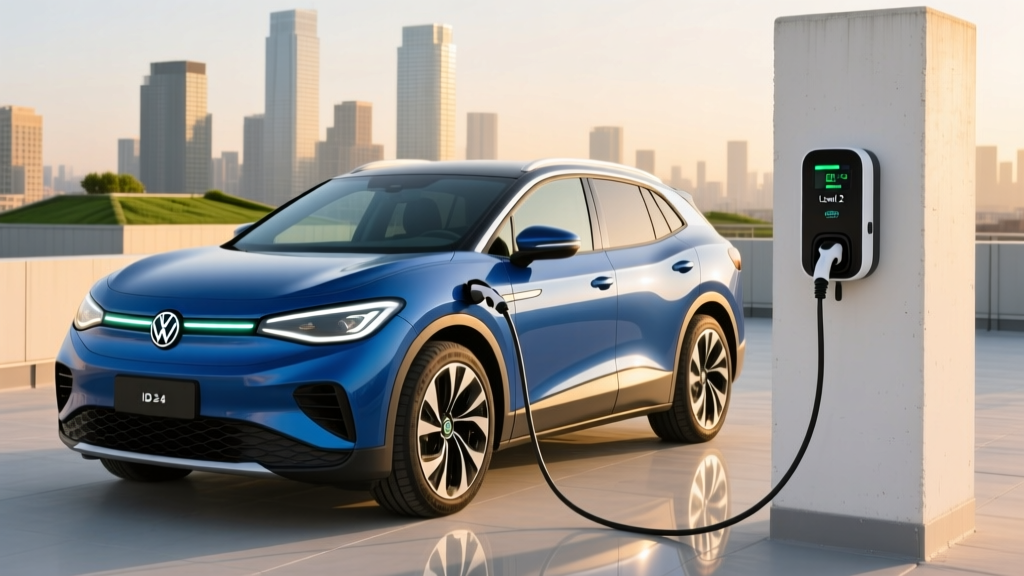
For home Level 2 charging, the onboard 11 kW charger replenishes the battery from empty to full in roughly 9 hours. This is standard for the segment and means an overnight charge easily covers even heavy daily driving. Most owners installing a 48-amp Level 2 home charger (requiring a 60-amp circuit) will wake up to a full battery every morning.
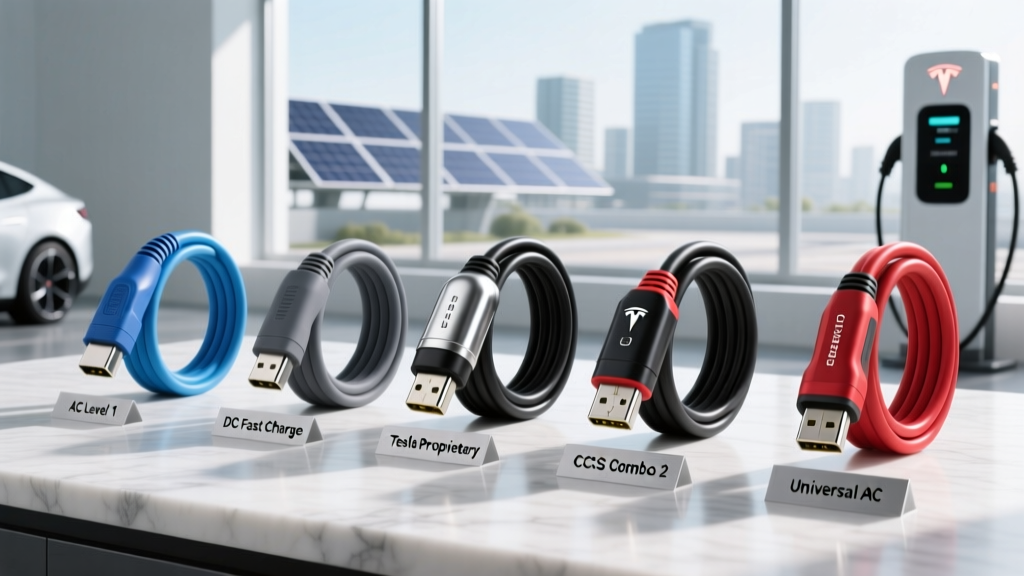
The ID.4 uses the CCS1 connector for DC fast charging on non-Tesla networks. VW has announced NACS (Tesla-style) adapter compatibility and a transition to NACS ports on future models, but the 2026 ID.4 still ships with CCS1. Owners can access Tesla Superchargers via adapter where supported, though confirm compatibility with VW before relying on this.
Performance and Driving Impressions
The rear-wheel-drive ID.4 Standard produces 282 hp and reaches 60 mph in 7.7 seconds. That's adequate for merging and passing but noticeably relaxed compared to the dual-motor AWD variant's 5.4-second sprint. Neither figure will thrill performance-oriented buyers — this is a comfort-tuned family SUV, not a sport crossover.
The ride quality is where the ID.4 earns its keep. VW tuned the suspension for compliance over sportiness, and it absorbs highway expansion joints and potholes with a maturity that some competitors (particularly the stiffly sprung Ioniq 5) lack. Steering is light and precise, body roll is well-controlled, and the turning circle is surprisingly tight for a compact SUV — making it easy to park in urban environments.
Regenerative braking in the ID.4 is adjustable via steering-wheel paddles (B-mode for maximum regen, D-mode with paddle-selected levels). It doesn't quite achieve true one-pedal driving at its strongest setting — the vehicle creeps at very low speeds rather than coming to a complete stop — but it's effective enough for most city driving without touching the brake pedal.
Interior, Technology, and Cargo Practicality
The ID.4's cabin is spacious and minimalist, though not without ergonomic frustrations. The 12.9-inch infotainment touchscreen (standard on most 2026 trims) runs VW's ID.Software 4.0, which has improved responsiveness and menu logic over the laggy early-2021 software. Wireless Apple CarPlay and Android Auto are standard.
However, VW's decision to use capacitive touch sliders for volume and climate control — rather than physical knobs — remains a sore point. The sliders are unlit on lower trims (making nighttime adjustment a guessing game) and lack the tactile certainty that physical controls provide while driving. The 2026 model year has seen some software improvements to climate menu speed, but the fundamental interface choice persists.
Cargo space is a genuine strength: 30.3 cubic feet behind the rear seats and 64.2 cubic feet with them folded. That's competitive with the Model Y and significantly more than the Ioniq 5's 27.2 cu ft. A small front trunk (frunk) is absent on RWD models — the space is occupied by drivetrain components — though AWD versions also lack a frunk. Rear-seat passengers enjoy 37.6 inches of legroom, which comfortably fits adults on long trips.
Driver Assistance: The ID.4 comes equipped with VW's IQ.DRIVE suite, a Level 2 driver-assistance system (per SAE classification). This includes adaptive cruise control with stop-and-go, lane-centering assist, automatic emergency braking, and blind-spot monitoring. It is not a self-driving system — the driver must keep hands on the wheel and eyes on the road at all times. IQ.DRIVE is competent for highway cruising but less assertive than Ford's BlueCruise or GM's Super Cruise on mapped highways.
Pricing, Trim Levels, and Federal Tax Credit Eligibility
| Trim | Base MSRP | Est. After §30D Credit* | Key Features |
|---|---|---|---|
| Standard (RWD) | $43,190 | ~$35,690 | 291-mi range, 12.9" screen, heated seats, IQ.DRIVE |
| Pro (RWD) | $46,990 | ~$39,490 | Added: panoramic roof, power liftgate, 360° camera |
| Pro S (RWD) | $49,990 | ~$42,490 | Added: premium audio, heated steering, leatherette |
| AWD Pro S | $51,790 | ~$44,290 | Added: dual-motor AWD, 335 hp, 263-mi range |
*Prices before destination charge. Tax credit estimates assume full eligibility. Actual credit varies.
The 2026 ID.4 starts at $43,190 for the RWD Standard trim, positioning it below the Tesla Model Y and roughly on par with the Hyundai Ioniq 5 when comparably equipped. The value proposition strengthens considerably if you qualify for the full federal EV tax credit.
- Credit amount: Up to $7,500, split between critical minerals ($3,750) and battery component sourcing ($3,750). The ID.4's battery sourcing eligibility has varied by model year — verify current-year status at fueleconomy.gov.
- MSRP cap: SUVs/vans must have an MSRP at or below $80,000. All ID.4 trims qualify.
- Buyer income cap: Modified AGI must not exceed $150,000 (single), $225,000 (head of household), or $300,000 (joint filers).
- Point-of-sale transfer: Eligible buyers can transfer the credit to the dealer for an immediate price reduction at purchase.
- Battery sourcing rules: Requirements for critical minerals and battery component manufacturing tighten annually. Consult IRS.gov or a tax professional for your specific situation.
The ID.4's U.S. production (at VW's Chattanooga, Tennessee plant) has helped its battery-sourcing compliance in recent years, but the critical-minerals requirement is the more unpredictable variable. Always confirm current eligibility before counting the full $7,500 into your budget.
Ownership Costs, Warranty, and Long-Term Value
Volkswagen backs the ID.4's battery pack with an 8-year/100,000-mile warranty guaranteeing a minimum of 70% capacity retention. The limited vehicle warranty covers 4 years/50,000 miles. This is competitive with the segment norm, though Hyundai's 10-year/100,000-mile battery warranty on the Ioniq 5 edges it out on paper.
NMC battery chemistry in the ID.4 has proven durable in early fleet data. Most owners report minimal degradation in the first 2-3 years — typically 3-5% loss — though long-term (8-10 year) data is still accumulating. Keeping the battery between 20-80% SoC for daily use, avoiding repeated DC fast charging to 100%, and using the battery preconditioning feature before fast-charging sessions will help maximize longevity.
Insurance costs for the ID.4 tend to run 10-20% higher than a comparable gas-powered compact SUV, which is typical for EVs due to higher repair costs and parts pricing. Get quotes before purchasing — premiums vary significantly by insurer, location, and driving record.
Charging costs depend on your electricity rate. At the national average of ~$0.16/kWh, fully charging the 82 kWh battery at home costs roughly $13. At 31 kWh/100 mi (RWD), that's about $0.05 per mile — compared to $0.12-$0.15/mile for a 28 MPG gas SUV at $3.50/gallon. Over 15,000 annual miles, home charging saves approximately $1,000-$1,500 per year versus gasoline.
How the ID.4 Stacks Up Against Key Competitors
| Spec | VW ID.4 (RWD) | Hyundai Ioniq 5 (RWD) | Tesla Model Y (LR RWD) | Ford Mach-E (RWD ER) |
|---|---|---|---|---|
| EPA Range | 291 mi | 303 mi | 320 mi | 320 mi |
| Peak DC Charge | 170 kW | 240 kW (800V) | ~250 kW | 150 kW |
| 10-80% Time | ~28 min | ~18 min | ~22 min | ~36 min |
| 0-60 mph | 7.7 sec | 7.2 sec | 6.5 sec | 6.1 sec |
| Cargo (rear up) | 30.3 cu ft | 27.2 cu ft | 30.2 cu ft | 29.7 cu ft |
| Starting MSRP | $43,190 | $42,600 | $44,990 | $42,995 |
The ID.4 doesn't win any single category outright. The Ioniq 5 charges significantly faster. The Model Y goes farther and has Tesla's Supercharger network advantage. The Mach-E is quicker. But the ID.4 delivers a balanced package — strong cargo space, comfortable ride, competitive range, and VW's broad dealer network for service — that appeals to buyers who don't want to compromise heavily in any one area.
Pros and Cons: The Honest Scorecard
- Spacious cargo area (30.3 cu ft) and generous rear legroom
- Comfortable, compliant ride quality — best in class for comfort
- Competitive 291-mile EPA range on RWD
- U.S.-built (Chattanooga, TN) — supports tax credit sourcing
- Included Electrify America charging (limited period)
- Heat pump standard — better cold-weather efficiency
- Strong VW dealer network for service and warranty work
- 170 kW peak DC charge rate trails key competitors
- Capacitive touch sliders (volume/climate) are frustrating to use
- No front trunk (frunk) on any trim
- Infotainment still lags rivals in responsiveness and UX design
- RWD acceleration is merely adequate (7.7 sec to 60)
- IQ.DRIVE is competent but less advanced than BlueCruise/Super Cruise
- Tax credit eligibility depends on shifting sourcing rules
Who Should Buy the 2026 Volkswagen ID.4?
- Want a comfortable, roomy family EV with strong cargo versatility
- Prioritize ride comfort over sporty handling or rapid acceleration
- Primarily charge at home and take occasional road trips (not frequent long-distance travel)
- Value a broad dealer network for service and warranty support
- Live in a moderate climate where cold-weather range loss is manageable
- Can qualify for the full or partial §30D federal tax credit
Look elsewhere if you:
- Take frequent road trips and need the fastest possible DC charging (consider Ioniq 5)
- Want maximum range and Supercharger access (consider Model Y)
- Prefer sporty acceleration and handling (consider Mach-E or Ioniq 5 AWD)
- Need the latest, most polished infotainment experience
- Live in an extreme cold climate and need maximum winter range (consider a larger-battery EV)
Frequently Asked Questions
What is the real-world range of the 2026 Volkswagen ID.4?
The EPA rates the RWD ID.4 at 291 miles, but expect roughly 240-260 miles on the highway at 70+ mph, and as low as 195-220 miles in freezing weather. City driving with regenerative braking can approach the EPA figure. The AWD model drops to 263 miles EPA, with proportional real-world reductions.
How fast does the ID.4 charge at home and on the road?
On a Level 2 home charger (240V, 48A), the ID.4 charges at 11 kW, adding about 35 miles of range per hour — a full charge takes roughly 9 hours. On DC fast chargers, it peaks at 170 kW and charges from 10-80% in approximately 28 minutes. This is adequate but slower than the Hyundai Ioniq 5's 18-minute 10-80% time.
Does the 2026 ID.4 qualify for the $7,500 federal EV tax credit?
It can, but eligibility depends on multiple factors: your income (AGI caps of $150K/$225K/$300K), the vehicle's MSRP (all ID.4 trims are under the $80K SUV cap), and battery sourcing compliance with §30D critical-mineral and component rules. The ID.4's Tennessee production helps with component sourcing, but critical-minerals requirements change annually. Verify current eligibility at fueleconomy.gov and consult a tax professional.
Is the ID.4 worth buying over the Tesla Model Y or Hyundai Ioniq 5?
It depends on your priorities. The ID.4 offers the most comfortable ride and strong cargo space but charges slower than both rivals and has less range than the Model Y. If road-trip charging speed matters most, choose the Ioniq 5. If range and charging-network access matter most, choose the Model Y. If daily comfort, space, and dealer service access matter most, the ID.4 is the strongest pick.
What are the biggest drawbacks of the ID.4?
The most common owner complaints center on the capacitive touch controls for volume and climate (unlit on some trims, imprecise while driving), the infotainment system's relative sluggishness compared to Tesla or Hyundai, and the 170 kW DC fast-charge rate that adds time on road trips. The lack of a frunk is also a missed opportunity for additional storage.
How long will the ID.4's battery last?
VW warrants the battery for 8 years or 100,000 miles against degradation below 70% capacity. NMC chemistry in the ID.4 has shown 3-5% degradation in the first 2-3 years of typical ownership. With proper care (avoiding frequent 100% charges, using preconditioning for DC fast charging, limiting repeated fast-charge cycles), most owners should expect the battery to retain 80%+ capacity at 100,000 miles. Full battery replacement, if ever needed, currently costs in the range of $12,000-$18,000 out of warranty.