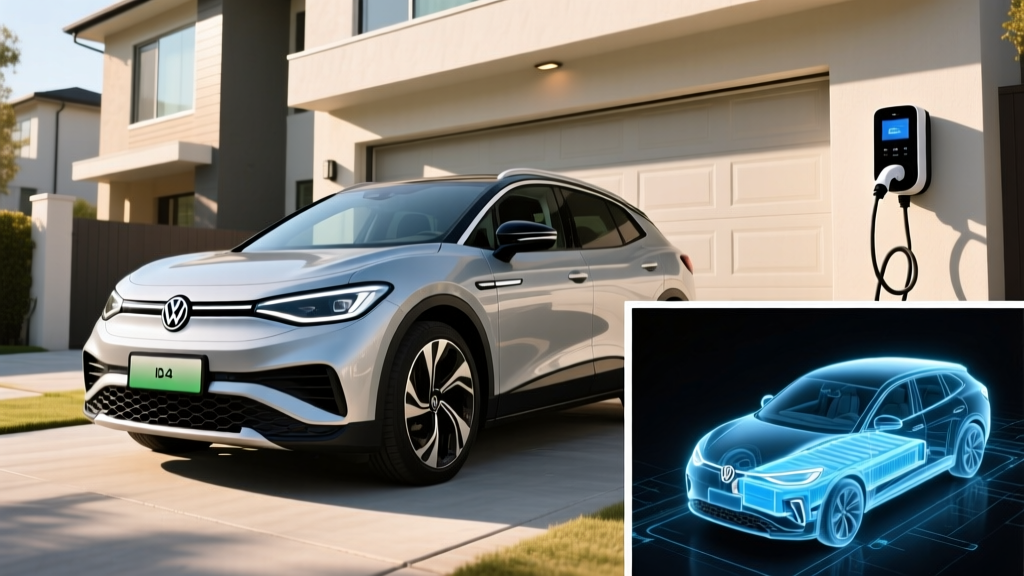
The Volkswagen ID.4 has occupied a specific niche since its U.S. debut: the sensible, no-drama electric compact SUV for buyers who want something that drives like a familiar crossover but runs on electrons. For 2026, VW continues to refine the formula with incremental software and packaging updates while keeping the ID.4's core appeal intact — approachable pricing, competitive range, and one of the best battery warranties in the segment. If you're researching the Volkswagen ID.4 electric SUV as your next vehicle, this review covers every number that matters.
Quick Verdict: Who the 2026 ID.4 Is For
The ID.4 is the right call for suburban families and commuters who want a practical electric SUV without paying Tesla or luxury-brand premiums. It excels at daily driving, offers decent cargo space, and charges quickly enough for road trips — though its infotainment software and interior materials still trail Korean competitors. If you prioritize driving engagement or cutting-edge tech interfaces, look at the Hyundai Ioniq 5 or Kia EV6. If you want a proven, comfortable, well-priced electric family hauler, the ID.4 earns a serious test drive.
Range, Efficiency, and Real-World Expectations
| Trim / Drivetrain | Battery (Usable kWh) | EPA Range (mi) | Combined MPGe | kWh/100 mi |
|---|---|---|---|---|
| Standard Range RWD | 62 kWh (NMC) | 206 | 104 MPGe | 32 |
| Pro / Pro S RWD | 77 kWh (NMC) | 275 | 107 MPGe | 31 |
| Pro / Pro S AWD | 77 kWh (NMC) | 263 | 101 MPGe | 33 |
The ID.4 uses NMC (nickel manganese cobalt) lithium-ion battery chemistry across all trims. NMC offers higher energy density than LFP (lithium iron phosphate), which keeps the pack compact, but it requires more careful charge management. VW recommends daily charging to 80% for NMC longevity, reserving 100% fills for road trips — a standard practice that meaningfully extends battery life over a decade of ownership.
According to fueleconomy.gov, the RWD Pro's 107 MPGe combined rating places it mid-pack among electric compact SUVs — competitive with the Ford Mustang Mach-E RWD (105 MPGe) but behind the Hyundai Ioniq 5 RWD (117 MPGe) in efficiency.
Charging Speed: DC Fast, Level 2, and Level 1
| Charge Level | Power | Connector | Speed / Time |
|---|---|---|---|
| Level 1 (120V household) | ~1.4 kW | J1772 / NACS | ~3–4 mi/hr (24+ hrs for full charge) |
| Level 2 (240V home/public) | 11 kW (onboard max) | J1772 / NACS | ~30 mi/hr; 0–100% in ~8.5 hrs (77 kWh) |
| DC Fast Charge | 170 kW peak (77 kWh pack) | CCS1 / NACS | 10–80% in ~30 min; tapers significantly above 80% |
| DC Fast Charge (Std Range) | 135 kW peak (62 kWh pack) | CCS1 / NACS | 10–80% in ~32 min |
The 77 kWh pack's 170 kW peak DC fast-charge rate is adequate but no longer class-leading. The Hyundai Ioniq 5 peaks at 240 kW, and the Tesla Model Y at roughly 250 kW on V3 Superchargers. In practice, the ID.4 sustains close to its peak rate between 10–50% state of charge, then tapers progressively. A typical 10–80% session takes about 30 minutes on a 175+ kW station — enough for a meal break on a road trip, but you'll notice the gap on back-to-back highway legs.
For 2026, VW continues to offer the ID.4 with the NACS (North American Charging Standard) port, giving owners native access to Tesla's Supercharger network without an adapter — a significant practical advantage over CCS-only competitors. This is arguably the ID.4's single strongest charging-infrastructure play.
At home on a Level 2 wallbox, the 11 kW onboard charger fills the 77 kWh pack in roughly 8.5 hours from empty. Most owners charging overnight from 20–80% daily will see a full top-up in about 5 hours — easily handled by a standard 48-amp home charger installation.
Performance and Drivetrain
| Configuration | Horsepower | Torque (lb-ft) | 0–60 mph | Drivetrain |
|---|---|---|---|---|
| RWD (all trims) | 282 hp | 339 | ~7.3 sec | Rear-wheel drive |
| AWD (Pro / Pro S) | 335 hp | 402 | ~5.4 sec | Dual-motor AWD |
The rear-wheel-drive ID.4 delivers adequate acceleration for merging and passing, with a linear torque curve that feels peppy around town. The dual-motor AWD variant's 5.4-second 0–60 time is genuinely quick for a family SUV and provides confident traction in rain and snow. Neither configuration is a performance benchmark — the Ford Mustang Mach-E GT hits 60 in ~3.5 seconds — but the ID.4 prioritizes ride comfort and low-effort driving over sporty dynamics.
Regenerative braking in the ID.4 operates through steering-wheel paddles with multiple levels (B-mode for maximum regen). It doesn't offer true one-pedal driving that brings the car to a full stop without brake-pedal input, which some EV converts find disappointing. You'll still use the friction brakes at intersections.
Pricing, Trims, and Federal Tax Credit Eligibility
| Trim | MSRP (est.) | §30D Credit Eligible? | Effective Price (est.) |
|---|---|---|---|
| Standard Range RWD | ~$38,995 | Yes (up to $7,500)* | ~$31,495 |
| Pro RWD | ~$43,995 | Yes (up to $7,500)* | ~$36,495 |
| Pro S RWD | ~$48,495 | Yes (up to $7,500)* | ~$40,995 |
| Pro S Plus AWD | ~$54,495 | Yes (up to $7,500)* | ~$46,995 |
*Federal tax credit eligibility under IRS §30D is subject to multiple requirements. Always verify current rules at irs.gov before purchasing.
- MSRP cap: SUVs must be ≤ $80,000 — all ID.4 trims qualify
- Buyer income cap: AGI ≤ $150,000 (single) / $300,000 (joint) / $225,000 (head of household)
- Battery sourcing: Critical minerals and battery components must meet phased-in domestic/free-trade-partner thresholds — VW has worked to qualify U.S.-built ID.4 models, but verify VIN-specific eligibility with your dealer
- Point-of-sale transfer: Eligible buyers can transfer the credit to the dealer for an immediate price reduction at purchase (requires dealer registration with IRS)
- Vehicle assembly: Must be assembled in North America — the U.S.-market ID.4 is built in Chattanooga, TN
The Chattanooga-built ID.4's domestic assembly is a strong advantage for tax-credit qualification. However, the critical-minerals and battery-component sourcing thresholds tighten each year under the Inflation Reduction Act. Always confirm your specific vehicle's VIN eligibility through the IRS's official tool or with a qualified tax professional before counting on the full $7,500.
Interior, Cargo, and Daily Practicality
The ID.4's cabin prioritizes space and simplicity over flash. Key dimensions:
- Cargo volume (behind rear seats): 30.3 cu ft
- Cargo volume (rear seats folded): 64.2 cu ft
- Rear legroom: 37.6 inches
- Front headroom: 41.1 inches
- Towing capacity: 2,700 lbs (AWD, with factory tow package) / 2,200 lbs (RWD)
The 30.3 cu ft cargo area behind the second row is competitive with the Toyota RAV4 Hybrid (37.5 cu ft) and slightly behind the Hyundai Ioniq 5 (27.2 cu ft cargo but with a larger frunk). The ID.4's frunk (front trunk) is disappointingly small — essentially a shallow cubby for charging cables — which is a missed opportunity given the space available with no engine up front.
The 12.9-inch infotainment touchscreen (Pro S and above) runs VW's latest ID. Software. Response times have improved over earlier model years, but the touch-capacitive slider controls for volume and climate remain a common complaint — they're unlit and imprecise compared to physical knobs. Wireless Apple CarPlay and Android Auto are standard, which mitigates the native interface for many users.
Driver Assistance and Safety Technology
Standard IQ.DRIVE features include:
- Adaptive cruise control with stop-and-go
- Lane-keeping assist and lane-centering
- Automatic emergency braking with pedestrian detection
- Blind-spot monitoring with rear cross-traffic alert
- Travel Assist (combined lane-centering + adaptive cruise for highway use)
Travel Assist works well on divided highways and reduces fatigue on long trips. It doesn't offer hands-free driving like GM's Super Cruise or Ford's BlueCruise on mapped roads. The ID.4 received a TOP SAFETY PICK+ rating from IIHS and a 5-star overall rating from NHTSA — strong results for a family vehicle. See full ratings at iihs.org and nhtsa.gov.
Warranty and Long-Term Battery Outlook
| Component | Coverage |
|---|---|
| Basic / Bumper-to-Bumper | 4 years / 50,000 miles |
| Powertrain | 4 years / 50,000 miles |
| Battery Pack | 8 years / 100,000 miles (retains ≥70% capacity) |
| Roadside Assistance | 3 years / 36,000 miles |
VW's 8-year/100,000-mile battery warranty guarantees that the high-voltage pack will retain at least 70% of its original capacity. This is standard for the industry (matched by Hyundai, Kia, Ford, and Tesla). Real-world data from European ID.4 fleets suggests NMC packs in VW's MEB platform degrade roughly 2–3% per year under normal use, meaning most owners should see 85–90% state of health after 5 years — well within warranty thresholds.
Out-of-warranty battery replacement costs are estimated at $15,000–$20,000 for the 77 kWh pack based on current MEB-platform pricing. This is a worst-case scenario and rarely needed within the vehicle's typical 10–15 year lifespan, but it's a number every EV buyer should know.
ID.4 vs. Key Competitors
| Spec | VW ID.4 Pro RWD | Hyundai Ioniq 5 SEL RWD | Tesla Model Y LR AWD | Ford Mach-E Premium RWD |
|---|---|---|---|---|
| EPA Range | 275 mi | 303 mi | 320 mi | 290 mi |
| Battery (kWh) | 77 (NMC) | 77.4 (NMC) | ~75 (NMC) | 75.7 (NMC) |
| Peak DC Charge | 170 kW | 240 kW | ~250 kW | 150 kW |
| 10–80% Time | ~30 min | ~18 min | ~22 min | ~38 min |
| 0–60 mph | 7.3 sec | 7.0 sec | 4.8 sec | 6.1 sec |
| Cargo (rear seats up) | 30.3 cu ft | 27.2 cu ft | 30.2 cu ft | 29.7 cu ft |
| Base MSRP (est.) | ~$43,995 | ~$46,500 | ~$46,990 | ~$44,995 |
| NACS Native | Yes | 2025+ models | Yes (proprietary) | Adapter required |
The ID.4's strongest competitive position is its combination of price, cargo space, and NACS Supercharger access. The Ioniq 5 charges faster and goes farther on a charge, but costs more at comparable trims. The Model Y offers the best range and Supercharger ecosystem but carries a Tesla tax in insurance and service-center access. The Mach-E is sportier but slower to charge. If you value a lower entry price and don't mind a 30-minute fast-charge stop, the ID.4 holds its own.
- Competitive pricing, especially after §30D credit
- NACS port = native Supercharger access
- Spacious cargo area and rear seat
- Strong safety ratings (IIHS TSP+, NHTSA 5-star)
- Comfortable ride quality, quiet cabin
- 8-yr/100,000-mi battery warranty
- U.S.-built (Chattanooga, TN) — supports tax credit eligibility
- 170 kW peak DC charge trails Ioniq 5 / Model Y
- Touch-capacitive climate/volume sliders frustrate many owners
- Small frunk — wasted front-trunk potential
- No true one-pedal driving mode
- Infotainment UI still lags competitors in responsiveness
- AWD towing limited to 2,700 lbs
- Real-world highway range drops noticeably vs. EPA
Frequently Asked Questions
What is the real-world range of the Volkswagen ID.4 electric SUV?
The EPA rates the ID.4 Pro RWD at 275 miles. In real-world mixed driving, expect 250–265 miles in mild weather. Sustained highway driving at 70–80 mph reduces that to roughly 230–250 miles, and freezing temperatures can drop range to 190–220 miles. The AWD version's EPA rating is 263 miles with proportionally lower real-world figures.
How fast does the ID.4 charge at home and on DC fast chargers?
On a DC fast charger, the 77 kWh pack peaks at 170 kW, reaching 10–80% in approximately 30 minutes. At home on a Level 2 (240V) charger, the 11 kW onboard charger adds roughly 30 miles of range per hour, filling the pack from empty in about 8.5 hours. Level 1 (120V) trickle charging adds only 3–4 miles per hour and is best used as emergency backup.
How much does the 2026 ID.4 cost after the federal tax credit?
The Standard Range RWD starts around $38,995 and could drop to approximately $31,495 with the full $7,500 §30D credit. The popular Pro RWD at ~$43,995 could fall to ~$36,495. Eligibility depends on your income, the vehicle's battery-sourcing compliance, and MSRP caps. Always verify through the IRS or a tax professional before purchasing.
Does the Volkswagen ID.4 qualify for the federal EV tax credit?
The U.S.-built ID.4 meets the North American assembly requirement and falls under the $80,000 SUV MSRP cap. Whether you receive the full $7,500, a partial credit, or nothing depends on your adjusted gross income, the specific vehicle's battery-critical-mineral sourcing compliance, and current-year IRS thresholds. Check the IRS's VIN-specific eligibility tool and consult a tax professional.
Is the ID.4 worth buying vs. the Hyundai Ioniq 5 or Tesla Model Y?
The ID.4 is worth buying if you prioritize lower cost, a comfortable ride, generous cargo space, and native Supercharger access via NACS. The Ioniq 5 is better if fast charging and maximum range are your top priorities. The Model Y wins on range, performance, and charging speed but costs more and carries Tesla-specific insurance and service considerations. Test-drive all three before deciding.
How long will the ID.4 battery last?
VW warranties the battery for 8 years or 100,000 miles with a 70% capacity-retention guarantee. Based on current MEB-platform data, NMC packs in the ID.4 degrade approximately 2–3% per year under normal charging habits (daily 80% max, occasional 100% for trips). Most owners should see 85–90% battery health at the 5-year mark. Out-of-warranty replacement is estimated at $15,000–$20,000.
Can the ID.4 tow a trailer?
Yes. The AWD ID.4 with the factory tow package is rated for up to 2,700 pounds — enough for a small utility trailer, bike rack, or lightweight pop-up camper. The RWD version tows up to 2,200 pounds. Note that towing significantly reduces range, often by 30–50% depending on trailer weight and aerodynamics.
Bottom Line: A Sensible Electric SUV That Gets the Job Done
The 2026 Volkswagen ID.4 electric SUV isn't the fastest-charging, longest-range, or most tech-forward vehicle in its segment — and it doesn't try to be. What it delivers is a comfortable, practical, well-priced electric family vehicle with genuine road-trip capability via the NACS/Supercharger network, strong safety credentials, and a battery warranty that should ease long-term ownership anxiety. For buyers who want an EV that simply works without a learning curve or a premium price tag, the ID.4 remains one of the most rational choices on the market.