Quick Verdict: The ID.4 Black Sits in the EV Sweet Spot
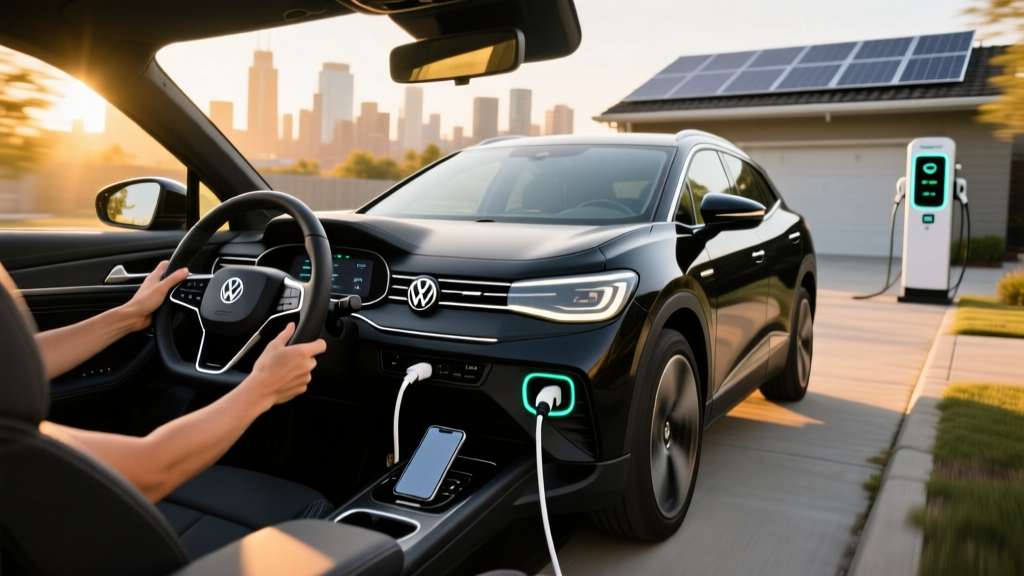
The 2026 Volkswagen ID.4 Black occupies a narrow but appealing lane in the compact electric SUV segment: it undercuts the Tesla Model Y and Ford Mustang Mach-E on price while delivering competitive range, solid DC fast-charging speeds, and a cabin that prioritizes space and comfort over flash. The Black appearance package — standard on the Pro S trim — adds blacked-out 20-inch wheels, gloss-black roof and mirror caps, and darkened badging, giving the ID.4 a more aggressive stance without touching the powertrain.
With an EPA-estimated 291 miles of range (RWD Pro S), a usable 82 kWh NMC battery, and peak DC charging at 170 kW, the ID.4 Black is a pragmatic family EV that handles daily commuting and moderate road trips without drama. Its weaknesses — middling infotainment responsiveness and a charge curve that tapers hard above 80% — are real but manageable if you understand them going in.
| Spec | Value |
|---|---|
| EPA Range | 291 miles (RWD) / 263 miles (AWD) |
| Battery (Usable) | 82 kWh, NMC (Nickel Manganese Cobalt) |
| Max DC Fast Charge | 170 kW (peak) |
| 10–80% DC Charge Time | ~30 minutes (preconditioned) |
| Level 2 Home Charge Rate | 11 kW (~36 mi/hr) |
| 0–60 mph | 7.7 sec (RWD) / 5.4 sec (AWD Pro S Plus) |
| Horsepower | 282 hp (RWD) / 335 hp (AWD) |
| Drivetrain | Rear-wheel drive (AWD optional) |
| MPGe (Combined) | 104 MPGe (RWD) |
| Efficiency | 32 kWh/100 mi |
| Cargo Volume | 30.3 cu ft (rear seats up) / 64.2 cu ft (folded) |
| Rear Legroom | 37.6 inches |
| Battery Warranty | 8 years / 100,000 miles (70% capacity retention) |
| Base MSRP (Pro S RWD) | $43,990 |
| AWD Pro S MSRP | $47,790 |
Range and Efficiency: EPA vs. the Real World
Real-World Expectation: 240–265 miles on mixed highway driving at 70–75 mph; 200–220 miles in sustained cold weather (below 30°F) with cabin heat. City and suburban driving with regen braking can match or slightly exceed the EPA number.
The ID.4's 82 kWh usable battery (gross capacity is approximately 86 kWh, with a ~4 kWh buffer to protect longevity) uses NMC chemistry supplied by SK On. NMC offers higher energy density than LFP, which is why VW can package 291 EPA miles into a vehicle with a relatively compact floor pack. The trade-off is that NMC batteries degrade slightly faster than LFP over many charge cycles, though VW's thermal management system and the built-in buffer mitigate this meaningfully.
In real-world highway testing, the ID.4 RWD typically delivers between 3.0 and 3.3 miles per kWh at 70 mph on flat terrain. That translates to roughly 250–270 miles before you'd want to stop. In cold weather — say, a January drive through the Midwest at 20°F — expect that to drop to around 2.4–2.7 mi/kWh, or 200–220 miles. The ID.4's available heat pump (standard on Pro S and above in the US market) helps reduce winter HVAC energy draw, but physics still wins: cold batteries and cabin heating eat range.
If your commute is mostly city and suburban driving under 50 mph with frequent regen braking opportunities, you'll see numbers closer to or even above the EPA estimate. According to fueleconomy.gov, the ID.4 RWD achieves 104 MPGe combined (109 city / 98 highway).
Charging Speed: DC Fast, Level 2, and the Curve Reality
| Charge Level | Power / Voltage | Miles Added per Hour | Notes |
|---|---|---|---|
| Level 1 (120V household) | ~1.4 kW | ~4–5 mi/hr | Emergency/trickle only; 80+ hours for full charge |
| Level 2 (240V home) | 11 kW (48A) | ~36 mi/hr | Full charge in ~8–9 hours; ideal for overnight |
| DC Fast Charge | 170 kW peak (CCS/NACS) | ~230 mi/hr (peak) | 10–80% in ~30 min; tapers significantly above 80% |
The ID.4's 170 kW peak DC charge rate is respectable but not class-leading — the Hyundai Ioniq 5 peaks at 240 kW, and the Tesla Model Y can sustain high rates thanks to the Supercharger network. The important nuance is the charge curve. The ID.4 holds close to its peak rate from roughly 10% to about 50% state of charge, then begins a gradual taper. Above 80%, charging slows dramatically — from 170 kW down to under 50 kW. This is standard behavior for NMC batteries to protect cell health, but it means charging from 80–100% at a DC fast charger can take almost as long as the 10–80% portion.
Practical advice: on road trips, plan stops to charge from 10–80% and drive on. Don't sit at a charger waiting for 100% unless you're at your destination overnight.
For 2026, VW has equipped US-market ID.4 models with the NACS (North American Charging Standard) port, replacing the CCS1 connector used on 2021–2024 models. This gives ID.4 owners native access to Tesla Superchargers without an adapter — a significant practical advantage. Older CCS-equipped ID.4s can use a VW-provided CCS-to-NACS adapter.
At home, the ID.4's 11 kW onboard charger means a 48-amp Level 2 wall connector will fully replenish the battery in about 8–9 hours. Most owners who plug in nightly will never need DC fast charging for daily use. A typical Level 2 home installation (charger + electrician + permit) runs $1,200–$2,500 depending on panel capacity and run length.
Performance and Driving Dynamics
The rear-wheel-drive ID.4 Black (Pro S) sends 282 horsepower to the rear wheels via a single-speed reduction gearbox. The 0–60 mph time of 7.7 seconds is adequate for merging and passing but won't thrill anyone coming from a performance EV. The steering is light and precise, the ride quality is composed over rough pavement, and the turning radius is surprisingly tight for a compact SUV — making it easy around parking structures and urban streets.
Step up to the AWD Pro S Plus and you get a dual-motor setup producing 335 hp and a 5.4-second 0–60 time. The AWD system also improves traction in snow and rain, and the additional front motor enables stronger regen braking. For buyers in northern climates, the $3,800 AWD premium is worth considering for both the traction benefit and the extra performance headroom.
Regenerative braking in the ID.4 is adjustable via steering-wheel paddles (on higher trims) or through the infotainment menu, offering multiple levels up to near-one-pedal driving. However, unlike some competitors, the ID.4 does not come to a complete stop in its strongest regen mode — you still need the brake pedal for the final few mph. This is a deliberate VW engineering choice to comply with certain regulatory interpretations, but it frustrates drivers accustomed to full one-pedal operation.
Interior, Cargo, and Technology
The ID.4's cabin is where VW's packaging expertise shows. With 30.3 cubic feet of cargo space behind the rear seats and 64.2 cu ft with the 60/40 split rear seats folded, it competes favorably with the Model Y (30.2 / 72.0 cu ft) and handily beats the Mach-E (29.7 / 59.7 cu ft). Rear-seat legroom at 37.6 inches is generous, and the flat floor (no transmission tunnel) makes the middle seat genuinely usable for a third passenger.
The 12.9-inch infotainment touchscreen (upgraded from the 12-inch unit on earlier models) runs VW's ID.Software 4.0, which is a meaningful improvement over the laggy, buggy ID.Software 2.x that plagued 2021–2022 models. Response times are faster, the menu structure is more logical, and wireless Apple CarPlay and Android Auto are standard. However, VW's continued reliance on capacitive-touch sliders for volume and climate control — rather than physical buttons — remains a common complaint among owners. The haptic feedback is imprecise, and it's easy to accidentally adjust temperature when reaching for volume.
The Black package adds specific interior touches: black headliner, stainless steel pedals, and "Black" badging on the door sills. It does not change seating material — Pro S trims come with V-Tex leatherette, which is durable and easy to clean but not premium-feeling.
On the driver-assistance front, the ID.4 comes standard with VW's IQ.DRIVE suite, which includes:
- Travel Assist (adaptive cruise + lane centering) — SAE Level 2, requiring hands on the wheel
- Front Assist (automatic emergency braking with pedestrian detection)
- Blind-spot monitor with rear cross-traffic alert
- Lane Assist (lane-keeping assistance)
- Park Assist Plus (semi-automated parking)
Travel Assist works well on highways and is competitive with Toyota Safety Sense and Honda Sensing, though it falls short of GM's Super Cruise or Ford's BlueCruise in terms of hands-free capability. The ID.4 does not offer any hands-free driving mode — you must maintain contact with the steering wheel at all times.
Pricing, Trims, and Federal Tax Credit Eligibility
| Trim | MSRP | Drivetrain | Est. §30D Credit* | Effective Price* |
|---|---|---|---|---|
| Pro (base) | $39,735 | RWD | Up to $7,500 | ~$32,235 |
| Pro S (Black package eligible) | $43,990 | RWD | Up to $7,500 | ~$36,490 |
| Pro S AWD | $47,790 | AWD | Up to $7,500 | ~$40,290 |
| Pro S Plus AWD | $52,790 | AWD | Up to $7,500 | ~$45,290 |
*Tax credit amounts depend on individual eligibility. The federal §30D credit is subject to buyer income caps ($150K single / $300K joint AGI), vehicle MSRP caps ($80,000 for SUVs), and battery critical-mineral and component sourcing requirements that change annually. As of 2026, the ID.4 (assembled in Chattanooga, TN) qualifies for at least partial credit; confirm current-year eligibility at IRS.gov or via the point-of-sale transfer option at the dealer. This is not tax advice — consult a tax professional.
The Black appearance package is a $0-cost option on the Pro S trim for 2026, meaning you get the blacked-out aesthetic without a price premium over the standard Pro S. This makes the ID.4 Black Pro S at $43,990 one of the more attractively priced compact EV SUVs with 280+ miles of range.
The point-of-sale transfer option (available since 2024) allows buyers to apply the federal credit as an instant rebate at the dealership rather than waiting to claim it on their tax return. This effectively reduces your out-of-pocket cost or down payment on the day of purchase.
Warranty and Long-Term Ownership
VW backs the ID.4's battery pack with an 8-year / 100,000-mile warranty guaranteeing at least 70% capacity retention. This is the industry-standard threshold — matching Tesla, Hyundai, and Ford. If your battery drops below 70% of its original usable capacity within the warranty period, VW will repair or replace it at no cost.
The broader vehicle warranty is 4 years / 50,000 miles bumper-to-bumper, which is average for the segment. VW also includes 2 years of scheduled maintenance and 3 years of roadside assistance.
For long-term ownership, the NMC battery chemistry means you should expect roughly 10–15% degradation over 150,000 miles based on industry data from similar packs (SK On supplies batteries for the Hyundai Ioniq 5 and Kia EV6 as well). Keeping your daily charge limit at 80% and avoiding frequent DC fast charging will extend battery life. VW's infotainment allows you to set a custom charge limit, which we strongly recommend.
How the ID.4 Black Stacks Up Against Competitors
The ID.4 Black competes directly with three vehicles in the $40K–$50K compact EV SUV space:
- Tesla Model Y Long Range ($44,990): 320 miles EPA, 250 kW peak charging, vastly superior Supercharger network, but firmer ride, no Apple CarPlay, and a polarizing minimalist interior. The Model Y wins on range and charging infrastructure; the ID.4 wins on ride comfort and traditional cabin ergonomics.
- Hyundai Ioniq 5 SE ($42,600): 303 miles EPA, 240 kW peak charging (faster 10–80% at ~18 min), striking design, but slightly less cargo space (27.2 cu ft rear) and a stiffer ride. The Ioniq 5 is the charging-speed winner; the ID.4 offers more practical cargo volume.
- Ford Mustang Mach-E Premium ($42,995): 290 miles EPA, 150 kW peak charging (slower), sportier driving dynamics, but less rear-seat room and a smaller frunk. The Mach-E is the driver's choice; the ID.4 is the family hauler.
Pros
- Competitive 291-mi EPA range at a sub-$44K price point
- Spacious cargo area (30.3 cu ft) and flat rear floor
- NACS port for native Tesla Supercharger access (2026 models)
- Comfortable, compliant ride quality over rough roads
- Black package at no extra cost on Pro S trim
- Federal tax credit eligible, reducing effective price to ~$36K
- IQ.DRIVE safety suite standard across all trims
Cons
- 170 kW peak DC charge rate is slower than Ioniq 5 and Model Y
- Capacitive-touch sliders for volume/climate are frustrating
- No full one-pedal driving (doesn't hold at complete stop)
- Infotainment, while improved, still lags behind Tesla and Hyundai
- No hands-free driving mode (Level 2 only)
- Rear drum brakes (unusual at this price point, though functional)
Who Should Buy the ID.4 Black?
Choose the ID.4 Black if: You want a practical, comfortable compact EV SUV for family commuting and moderate road trips. You value cargo space and ride comfort over sporty handling. You can charge at home nightly and want a vehicle that qualifies for the full federal tax credit, bringing the effective price under $37K.
Look elsewhere if: You need the fastest possible DC charging for frequent long-distance travel (consider the Ioniq 5 or Model Y). You want hands-free highway driving (look at the Mach-E with BlueCruise or a GM EV with Super Cruise). You prioritize cutting-edge infotainment and over-the-air feature updates (Tesla remains the benchmark here).
Frequently Asked Questions
What is the real-world range of the 2026 VW ID.4 Black?
The EPA estimates 291 miles for the RWD Pro S. In real-world mixed highway driving at 70–75 mph, expect 240–265 miles. In cold weather below 30°F, that drops to roughly 200–220 miles. City driving with regenerative braking can match or slightly exceed the EPA figure.
How fast does the ID.4 charge at home and on DC fast chargers?
At home on a Level 2 (240V, 48A) charger, the ID.4 adds about 36 miles of range per hour, fully charging in 8–9 hours. On a DC fast charger, it peaks at 170 kW and charges from 10–80% in approximately 30 minutes when the battery is preconditioned. Above 80%, charging slows significantly — plan to charge to 80% and drive on.
How much does the ID.4 Black cost after federal tax credits?
The Pro S with the Black package has an MSRP of $43,990. If you qualify for the full $7,500 federal §30D credit (subject to income caps, MSRP caps, and battery-sourcing requirements), the effective price drops to approximately $36,490. Eligibility varies — confirm at IRS.gov and consider the point-of-sale transfer option at the dealer.
Does the 2026 ID.4 qualify for the federal EV tax credit?
Yes, the 2026 ID.4 (assembled in Chattanooga, TN) qualifies for at least partial federal credit under current §30D rules. The exact amount depends on battery critical-mineral and component sourcing percentages, which shift annually. Buyer income must not exceed $150K (single) or $300K (joint). The ID.4's MSRP is well under the $80K SUV cap. Always verify current eligibility before purchase.
Is the ID.4 Black worth buying over the Tesla Model Y or Ioniq 5?
It depends on your priorities. The ID.4 offers the best ride comfort, competitive cargo space, and a strong value proposition after tax credits. The Model Y wins on range (320 mi) and charging infrastructure. The Ioniq 5 wins on DC charging speed (18-minute 10–80%). If comfort, space, and value matter most, the ID.4 Black is a strong pick. If charging speed or range is paramount, test-drive the Ioniq 5 and Model Y first.
What battery chemistry does the ID.4 use, and how long will it last?
The ID.4 uses an NMC (Nickel Manganese Cobalt) lithium-ion battery with 82 kWh of usable capacity. NMC offers higher energy density than LFP but slightly faster degradation over time. Industry data suggests 10–15% capacity loss over 150,000 miles with normal use. VW warrants the battery for 8 years / 100,000 miles at 70% minimum capacity retention.