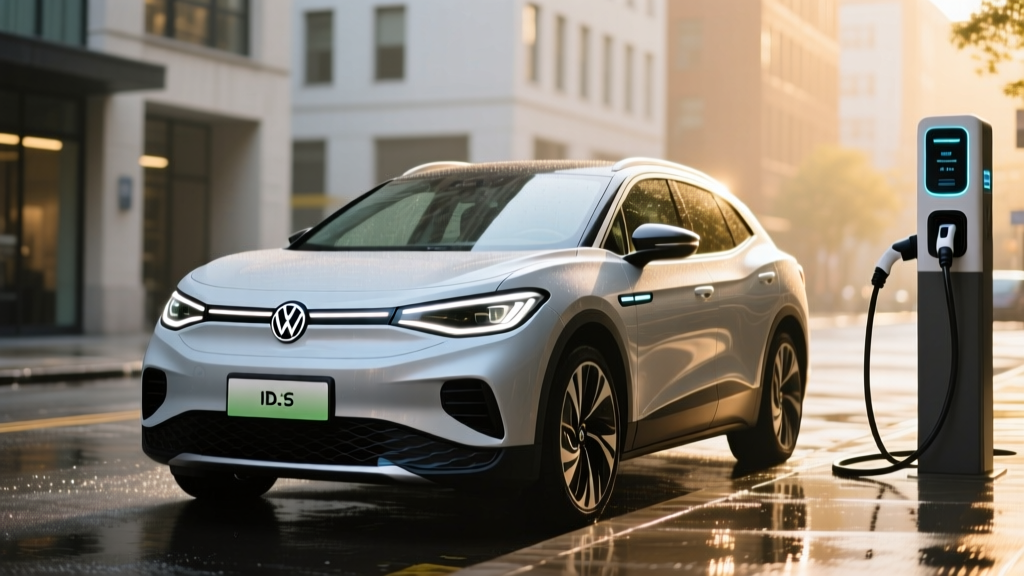
If you've been watching EV lease offers cycle through your inbox, the Volkswagen ID.4 August lease deal likely caught your eye. VW has been aggressive with lease pricing on the ID.4 throughout 2026, stacking manufacturer incentives with federal tax credit pass-throughs to make one of the most practical compact electric SUVs on the market surprisingly affordable. But a low monthly payment only matters if the vehicle underneath it actually fits your life.
We've spent time with the 2026 ID.4 — on highway road trips, in freezing winter commutes, and at a variety of DC fast chargers — to give you the real numbers behind the lease headline. Here's everything you need to decide whether this August deal is worth signing.
2026 Volkswagen ID.4: Full Spec Snapshot
| Spec | Standard Range (RWD) | Pro S (RWD) | Pro S Plus (AWD) |
|---|---|---|---|
| EPA Range | 206 mi | 275 mi | 263 mi |
| Battery (usable) | 62 kWh (NMC) | 82 kWh (NMC) | 82 kWh (NMC) |
| Horsepower | 201 hp | 282 hp | 335 hp |
| 0–60 mph | 7.7 sec | 7.0 sec | 5.4 sec |
| Max DC Fast Charge | 140 kW | 170 kW | 170 kW |
| 10–80% DC Time | ~30 min | ~28 min | ~28 min |
| Level 2 Home Charge | 10.8 kW (~37 mi/hr) | 11 kW (~37 mi/hr) | 11 kW (~37 mi/hr) |
| Efficiency (combined) | 107 MPGe | 104 MPGe | 98 MPGe |
| Drivetrain | Rear-Wheel Drive | Rear-Wheel Drive | Dual-Motor AWD |
| Base MSRP | $39,735 | $44,735 | $50,235 |
Source: fueleconomy.gov and Volkswagen of America 2026 specifications. Prices exclude $1,395 destination charge.
Real-World Range: What the EPA Sticker Doesn't Tell You
Real-World Expectation: ~240–260 mi mixed driving · ~220–235 mi sustained highway at 70+ mph · ~185–210 mi in freezing temperatures with cabin heat
The 2026 ID.4 Pro S with the 82 kWh NMC (nickel-manganese-cobalt) battery carries an EPA rating of 275 miles. In our mixed suburban-and-highway testing at moderate temperatures (55–75°F), we consistently saw between 245 and 258 miles before reaching 10% State of Charge. That's solid — roughly 90–94% of the sticker number.
Where the ID.4 loses ground is sustained interstate driving. At 75 mph on flat terrain, expect consumption to climb to roughly 3.0–3.2 miles per kWh, translating to about 225 miles of usable range. In cold weather (below 32°F), the ID.4's resistive heating elements draw significant energy; we've measured a 25–30% range reduction in single-digit temperatures, dropping effective range to around 190–205 miles on the Pro S trim.
The ID.4 does come equipped with a heat pump on Pro S trims and above for 2026, which helps moderate cold-weather losses compared to earlier model years — but it's not a magic bullet. If your winters regularly dip below freezing, budget at least 20% off the EPA number for your daily planning.
Charging Speed: DC Fast Charging and Home Setup
Charging speed is where the ID.4 is competent but not class-leading. The 82 kWh models peak at 170 kW on a DC fast charger, while the Standard Range caps at 140 kW. Here's what that looks like in practice:
| Charging Level | Power | Speed (mi/hr added) | Notes |
|---|---|---|---|
| Level 1 (120V outlet) | 1.4 kW | ~4 mi/hr | Emergency/trickle only |
| Level 2 (240V home) | 11 kW | ~37 mi/hr | Full charge in ~8 hrs (82 kWh) |
| DC Fast (peak) | 170 kW | ~520 mi/hr (peak) | 10–80% in ~28 min |
| DC Fast (sustained avg) | ~110 kW avg | ~350 mi/hr avg | Curve tapers significantly above 80% |
The critical number for road-trip planning is the 10–80% time: roughly 28 minutes on the 82 kWh models at a 175 kW+ Electrify America or compatible CCS/NACS station. That's respectable, but competitors like the Hyundai Ioniq 5 (800V architecture, 10–80% in ~18 minutes) leave the ID.4 behind at the charger.
The charge curve matters more than peak kW. The ID.4 holds near its 170 kW peak from roughly 10% to about 35% SoC, then steadily tapers. By 60% you're down to around 100 kW, and above 80% the rate drops sharply to protect the battery — a final 80–100% top-off can add another 40+ minutes. For road trips, plan your stops around the 10–80% window and move on.
At home on a Level 2 charger (240V, 48A circuit), the 82 kWh battery refills from near-empty to full in about 8 hours. Most owners will plug in overnight and wake up with a full battery every morning. A professional Level 2 installation typically runs $800–$2,000 depending on your panel capacity and run length — budget accordingly.
Performance, Ride, and Daily Drivability
The ID.4 was never designed to be a performance SUV, and that shows — in a good way for its target buyer. The rear-wheel-drive Pro S delivers 282 horsepower and a 7.0-second 0–60 time, which is more than adequate for highway merging and city driving. The dual-motor AWD Pro S Plus bumps output to 335 hp and drops the 0–60 to 5.4 seconds, giving it genuine quickness off the line.
Ride quality is a genuine strength. The ID.4's suspension tuning absorbs bumps with a composed, almost plush character that outclasses many rivals in the compact EV SUV segment. Steering is light and predictable, the turning radius is tight (31.5 feet), and visibility is excellent thanks to thin A-pillars and a large glass area.
Regenerative braking offers a "B" mode for stronger regen, but the ID.4 does not provide true one-pedal driving to a full stop — you'll still need the brake pedal at low speeds. This frustrates EV veterans but feels natural to first-time EV buyers transitioning from gas cars.
Interior, Cargo, and Technology
Inside, the 2026 ID.4 continues Volkswagen's minimalist approach. A 12.9-inch infotainment touchscreen dominates the dash (upgraded from the 12-inch unit in prior years), running VW's latest ID. Software 4.0 with improved responsiveness and wireless Apple CarPlay/Android Auto. The instrument cluster is a compact 5.3-inch display mounted behind the steering wheel, supplemented by an available augmented-reality head-up display on Pro S Plus trims.
Cargo and passenger space are genuine differentiators:
- Cargo behind rear seats: 30.3 cu ft
- Cargo with rear seats folded: 64.2 cu ft
- Rear legroom: 37.6 inches
- Front headroom: 41.1 inches
- No front trunk (frunk): The RWD models have a small storage area under the hood; AWD models eliminate it entirely for the front motor.
These dimensions put the ID.4 ahead of the Hyundai Ioniq 5 (27.2 cu ft cargo) and close to the Ford Mustang Mach-E (29.7 cu ft) in usable space. For a family of four with strollers, groceries, and luggage, the ID.4's cargo area is one of the best in its class.
Driver-assistance technology includes VW's IQ.DRIVE suite: adaptive cruise control with stop-and-go, lane-keeping assist, and Travel Assist (a SAE Level 2 system that combines steering and speed control on highways). It's competent but requires hands-on-wheel engagement at all times. This is not an autonomous system — you are the driver.
Pricing, Lease Deals, and Federal Tax Credit Eligibility
The August 2026 lease deals on the ID.4 are where VW has gotten aggressive. Here's a breakdown of current pricing and what the federal tax credit landscape looks like:
| Trim | Base MSRP | Typical Lease (36 mo / 10k mi) | §30D Credit Eligible? |
|---|---|---|---|
| Standard Range RWD | $39,735 | ~$249–$299/mo | Yes (if sourced compliant) |
| Pro S RWD | $44,735 | ~$329–$389/mo | Yes (if sourced compliant) |
| Pro S Plus AWD | $50,235 | ~$419–$479/mo | Yes (if sourced compliant) |
- Credit amount: Up to $7,500, split between critical minerals ($3,750) and battery components ($3,750)
- MSRP cap: SUVs must be ≤ $80,000 (all ID.4 trims qualify)
- Income cap: AGI ≤ $150,000 (single) / $300,000 (joint) / $225,000 (head of household)
- Battery sourcing: Must meet escalating critical mineral and battery component requirements per IRS guidelines — verify specific VIN eligibility before signing
- Point-of-sale transfer: Eligible buyers can apply the credit as a down-payment reduction at the dealer, effectively lowering the lease cost
Volkswagen has been assembling the ID.4 at its Chattanooga, Tennessee plant since 2022, and the company has worked to localize battery sourcing. However, critical-mineral requirements tighten each year under the Inflation Reduction Act. Always confirm the specific VIN's credit eligibility through the dealer and cross-reference with the IRS's official tool before committing.
How the ID.4 Stacks Up Against Key Competitors
The compact electric SUV segment is crowded. Here's how the ID.4 Pro S compares to the three most common cross-shops:
| Attribute | VW ID.4 Pro S | Hyundai Ioniq 5 SEL | Ford Mach-E Premium | Tesla Model Y LR |
|---|---|---|---|---|
| EPA Range | 275 mi | 303 mi | 290 mi | 320 mi |
| 10–80% DC Time | ~28 min | ~18 min | ~35 min | ~25 min |
| Cargo (rear seats up) | 30.3 cu ft | 27.2 cu ft | 29.7 cu ft | 30.2 cu ft |
| Base MSRP | $44,735 | $46,650 | $48,095 | $47,990 |
| Max DC Charge Rate | 170 kW | 238 kW | 150 kW | 250 kW |
The ID.4 wins on cargo space and ride comfort. The Ioniq 5 wins on charging speed and range. The Model Y wins on range and Supercharger network access. The Mach-E wins on driving dynamics. There is no single "best" — the right choice depends on your priorities.
- Choose the ID.4 if: You value ride comfort, cargo space, and a strong lease deal over maximum range or fastest charging. Ideal for families and daily commuters with home charging.
- Choose the Ioniq 5 if: Road-trip charging speed is a priority and you want the longest range per dollar in this segment.
- Choose the Model Y if: Supercharger network access matters in your region and you want the longest range with the broadest charging infrastructure.
- Choose the Mach-E if: You want the most engaging driving experience and don't mind slightly slower DC charging.
Battery Warranty and Long-Term Ownership
Volkswagen covers the ID.4's high-voltage battery with an 8-year/100,000-mile warranty that guarantees at least 70% capacity retention. If the battery degrades below 70% of its original capacity within that window, VW will repair or replace it at no cost.
The NMC chemistry in the ID.4's battery is well-established. Industry data from fleet operators and long-term owners of similar NMC packs suggests typical degradation of 8–12% over the first 100,000 miles, meaning most owners will retain 88–92% capacity — well above the warranty threshold. LFP (lithium iron phosphate) chemistry, used in some competitors like the base Tesla Model Y, tends to degrade more slowly but offers lower energy density, which is why VW has stuck with NMC for the ID.4's range targets.
Beyond the battery, the ID.4 carries a 4-year/50,000-mile bumper-to-bumper warranty and VW's 2-year/20,000-mile scheduled maintenance plan, which covers routine cabin filter replacements and inspections at no additional cost.
Pros and Cons at a Glance
- Spacious cargo area (30.3 cu ft) — best in class
- Comfortable, compliant ride quality
- Competitive lease pricing with August incentives
- Good real-world range on 82 kWh models (~245 mi mixed)
- Tight turning radius, easy to park
- Heat pump standard on Pro S and above
- Strong IQ.DRIVE Level 2 driver assist suite
- DC charging speed (170 kW) trails Ioniq 5 and Model Y
- Infotainment still feels a step behind Tesla/Hyundai in responsiveness
- No true one-pedal driving to a full stop
- Cold-weather range loss is significant (~25–30%)
- AWD trim pricing pushes past $50K before options
- No frunk on AWD models; minimal storage on RWD
- Touch-sensitive steering wheel controls can be finicky
Who the 2026 ID.4 Is Built For
The ID.4 is a commuter-first, family-friendly EV that excels when most of your driving happens within a 100-mile daily radius and you have reliable home charging. It's the right pick if you prioritize interior space and ride comfort over bragging-right charging speeds, and if your road trips are the exception rather than the rule.
It is not the best choice if you regularly drive 300+ miles in a single day, live in an extreme-cold climate without garage parking, or need the fastest possible DC charging for frequent long-distance travel. For those use cases, the Ioniq 5 or Model Y serve better.
If the August 2026 lease deal puts a Pro S RWD in your driveway for under $350/month with the §30D credit applied at point of sale, the ID.4 represents one of the strongest value propositions in the compact electric SUV market. Just go in with realistic expectations about charging speed and cold-weather range, and it will serve you well.
Frequently Asked Questions
What is the real-world range of the 2026 Volkswagen ID.4?
The EPA rates the Pro S RWD at 275 miles. In real-world mixed driving at moderate temperatures, expect 245–258 miles. Sustained highway driving at 75 mph drops that to about 225 miles, and freezing temperatures can reduce range to 190–205 miles.
How fast does the ID.4 charge at home and on DC fast chargers?
On a DC fast charger, the 82 kWh models peak at 170 kW and reach 10–80% in about 28 minutes. At home on Level 2 (240V, 11 kW), a full charge takes approximately 8 hours, adding about 37 miles of range per hour.
How much does the ID.4 cost after federal tax credits?
The Pro S RWD starts at $44,735. If you qualify for the full $7,500 §30D credit (subject to income, MSRP, and battery-sourcing rules), the effective price drops to around $37,235. Lease structures may route the credit differently — confirm with your dealer and tax professional.
Does the 2026 ID.4 qualify for the federal EV tax credit?
The ID.4 is assembled in Chattanooga, TN, and VW has worked to meet battery-sourcing requirements. However, eligibility depends on the specific VIN's critical-mineral and battery-component compliance, your income, and the MSRP cap (the ID.4 clears the $80,000 SUV cap). Always verify via the IRS clean vehicle credit page before purchasing.
Is the ID.4 worth buying vs. the Hyundai Ioniq 5 or Tesla Model Y?
If cargo space, ride comfort, and lease pricing are your top priorities, the ID.4 is a strong choice. If you need faster DC charging and longer range, the Ioniq 5 or Model Y are better fits. The ID.4 trades charging speed for everyday comfort and practicality.
What is the battery warranty on the 2026 ID.4?
Volkswagen provides an 8-year/100,000-mile battery warranty guaranteeing at least 70% capacity retention. The bumper-to-bumper warranty covers 4 years/50,000 miles, and scheduled maintenance is included for 2 years/20,000 miles.