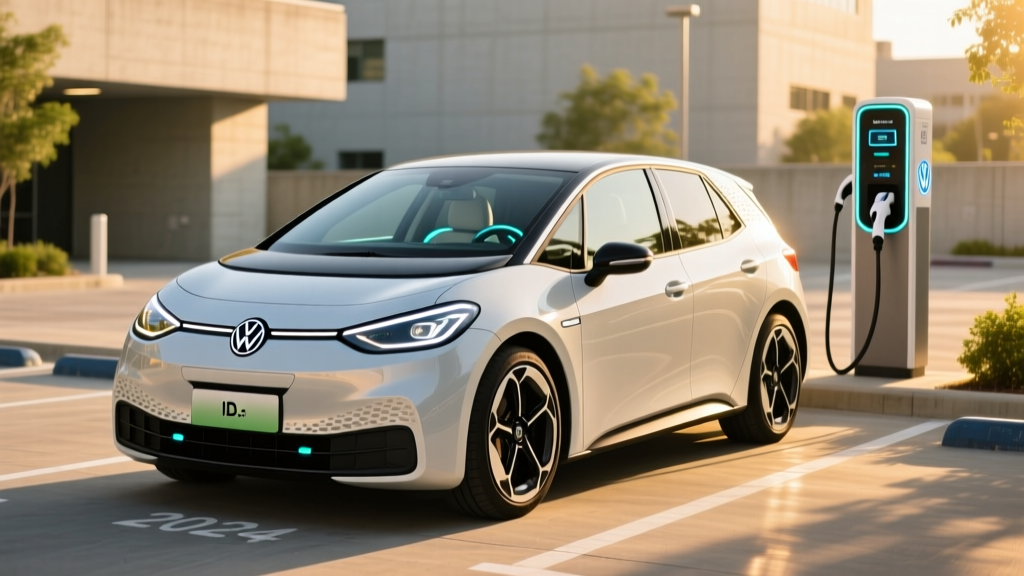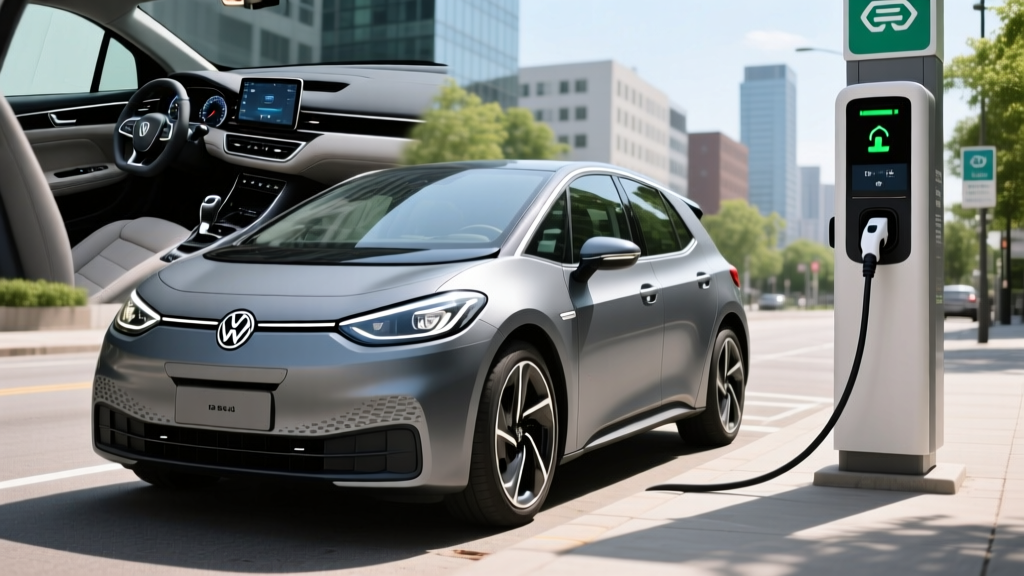
The Volkswagen ID.3 has been one of Europe's best-selling electric hatchbacks since its launch, but for US-based EV shoppers, it remains a vehicle shrouded in questions. Will it arrive stateside? How does it stack up against the Chevrolet Bolt EV, Nissan Leaf, and Hyundai Kona Electric? This comprehensive review covers everything known about the ID.3's specs, real-world efficiency, charging performance, and ownership economics — whether you're tracking it for a potential US debut or comparing it against available alternatives.
Note: As of early 2026, Volkswagen has not officially confirmed the ID.3 for the US market. This review uses European-spec data and WLTP figures, converted and adjusted to provide EPA-equivalent estimates where possible. If and when a US-spec ID.3 launches, final EPA ratings, pricing, and tax credit eligibility may differ.
Volkswagen ID.3 at a Glance: Key Specs
| Specification | Value |
|---|---|
| Battery Capacity (usable) | 77 kWh (NMC chemistry) |
| WLTP Range | ~348 miles (560 km) |
| EPA-Equivalent Range (est.) | ~285–305 miles |
| Motor Output | 228 hp (170 kW), RWD |
| 0–62 mph (0–100 km/h) | 7.1 seconds |
| Max DC Fast Charge Rate | 135 kW (peak) |
| 10–80% DC Charge Time | ~30 minutes (est.) |
| Level 2 AC Charge Rate | 11 kW (onboard charger) |
| Efficiency (WLTP) | ~3.6 mi/kWh (~16 kWh/100 km) |
| Drivetrain | Rear-wheel drive, single motor |
| Length / Width / Height | 167.8 / 71.2 / 62.1 in |
| Cargo Volume (rear seats up) | 13.6 cu ft (385 L) |
| Battery Warranty (EU) | 8 years / 100,000 mi (160,000 km), 70% SoH |
| EU Starting Price (Pro S) | ~€43,000 (~$46,500 USD) |
Range and Efficiency: What to Expect in the Real World
The ID.3 Pro S uses a 77 kWh usable lithium-ion battery pack with NMC (nickel manganese cobalt) chemistry. Volkswagen quotes a WLTP range of approximately 348 miles (560 km) for the top-spec Pro S model. However, WLTP testing tends to be more generous than the US EPA cycle.
WLTP Sticker: ~348 miles
EPA-Equivalent Estimate: ~285–305 miles
Highway (70 mph sustained): ~240–260 miles
Cold Weather (below 32°F / 0°C): ~210–240 miles (20–30% reduction)
Why the gap? The EPA test cycle includes more aggressive acceleration, higher sustained speeds, and less favorable climate-control assumptions than WLTP. On a 70-mph highway run, expect range to drop roughly 15–20% below the EPA-equivalent figure due to aerodynamic drag. In freezing temperatures, the ID.3's battery must divert energy to thermal management, and cabin heating further reduces range — a universal EV reality, though the ID.3's optional heat pump (standard on Pro S) mitigates some loss.
Efficiency hovers around 3.6 miles per kWh under mixed WLTP conditions, translating to roughly 27–28 kWh per 100 miles in real-world driving. This is competitive with the Hyundai Kona Electric (3.8 mi/kWh) and slightly behind the Tesla Model 3 RWD (~4.0 mi/kWh), but entirely respectable for a compact hatchback.
Charging Performance: DC Fast and Home Level 2
Charging speed is where the ID.3 shows its age relative to newer platforms. The Pro S peaks at 135 kW on a DC fast charger — adequate for highway stops, but noticeably slower than the Hyundai Ioniq 5 (peak 240 kW) or Tesla Model 3 (peak 250 kW on V3 Superchargers).
| Charge Level | Power / Rate | Time or Miles Added |
|---|---|---|
| Level 1 (120V household) | ~1.4 kW | ~4–5 miles per hour |
| Level 2 (240V home/public) | 11 kW (max onboard) | ~32–36 miles per hour; full charge in ~7.5 hours |
| DC Fast Charge (CCS2) | 135 kW peak | 10–80% in ~30 minutes; ~170 miles added in 20 min |
The 10–80% charge time of approximately 30 minutes is acceptable for a road-trip comfort stop, but it falls short of the sub-20-minute benchmarks set by 800-volt architectures. The ID.3 uses a 400-volt electrical system, which limits peak charge rate. Above 80% state of charge (SoC), the charge curve tapers significantly — expect 80–100% to take an additional 25–30 minutes. For daily use, most owners will charge at home on Level 2 overnight, which fully replenishes the 77 kWh battery in about 7.5 hours.
One practical note: European-spec ID.3 models use the CCS2 connector. Any US-spec version would use CCS1 (or potentially NACS, depending on Volkswagen's future connector strategy). Preconditioning — warming the battery before arriving at a DC charger — is supported via the navigation system and is essential for achieving peak charge rates in cooler weather.
Performance and Driving Dynamics
The ID.3 Pro S is a rear-wheel-drive, single-motor setup producing 228 horsepower (170 kW) and 229 lb-ft of torque. The 0–62 mph (0–100 km/h) sprint takes 7.1 seconds — making it brisk off the line but not a performance car. The lower trims (Pro and Pure) offer 201 hp and 148 hp respectively, with correspondingly slower acceleration.
Driving dynamics are where the ID.3 earns praise. The rear-mounted motor and low center of gravity give it balanced handling unusual for a compact hatchback. The turning circle is tight (33.5 feet), making it nimble in urban environments. Regenerative braking offers multiple levels via steering-wheel paddles, though it does not enable full one-pedal driving in all conditions — a point of criticism compared to the Nissan Leaf or Chevrolet Bolt's stronger regen implementations.
The ID.3 is not available with all-wheel drive or a dual-motor configuration. For buyers in snow-belt regions, winter tires are the recommended solution rather than AWD.
Interior, Tech, and Practicality
The ID.3's cabin is minimalist, with a compact digital instrument cluster mounted behind the steering wheel and a central 12-inch (Pro S) touchscreen handling infotainment, climate, and vehicle settings. The shifter is a column-mounted toggle, freeing up console space.
Passenger and Cargo Space:
- Front headroom: ~40.2 in | Rear headroom: ~38.5 in
- Front legroom: ~41.0 in | Rear legroom: ~35.8 in
- Cargo behind rear seats: 13.6 cu ft (385 L)
- Cargo with rear seats folded: ~44.7 cu ft (1,267 L)
Rear legroom is adequate for adults on shorter trips but tighter than a Tesla Model 3 or Hyundai Ioniq 5. Cargo space is competitive with the Chevrolet Bolt EV (16.3 cu ft) but trails the Kona Electric (19.2 cu ft). There is no front trunk (frunk).
Driver Assistance (ADAS): The ID.3 offers Volkswagen's Travel Assist, which bundles adaptive cruise control and lane-centering. This is an SAE Level 2 system — meaning the driver must remain fully engaged, with hands on the wheel and eyes on the road. It is not autonomous driving. IQ.DRIVE with Park Assist is available on higher trims. These systems are competent but do not match the sophistication of Ford's BlueCruise or GM's Super Cruise for hands-free highway operation.
Notable Drawbacks:
- Infotainment software has drawn criticism for sluggishness and unintuitive menus, though VW's latest 4.0 software update has improved responsiveness.
- No physical climate controls — temperature and fan speed are managed through touch-sensitive sliders on the screen, which many reviewers find frustrating.
- Rear drum brakes (instead of discs) — chosen to reduce rolling resistance and particulate emissions, but perceived as a cost-cutting measure.
Pricing, Trims, and Federal Tax Credit Eligibility
Since the ID.3 is not currently sold in the United States, there is no official US MSRP. European pricing for the 2026 model year provides a reference point:
| Trim | Battery | Motor | EU Price (approx.) | USD Equivalent |
|---|---|---|---|---|
| Pure | 45 kWh | 148 hp | ~€33,000 | ~$35,700 |
| Pro | 58 kWh | 201 hp | ~€38,000 | ~$41,100 |
| Pro S | 77 kWh | 228 hp | ~€43,000 | ~$46,500 |
If Volkswagen introduces the ID.3 to the US market, pricing would likely fall in the $35,000–$48,000 range depending on trim, before incentives. For context, the Chevrolet Bolt EV starts around $28,000 (before its eventual discontinuation), and the Hyundai Kona Electric begins near $34,000.
The IRS §30D Clean Vehicle Credit offers up to $7,500 for qualifying new EVs. However, eligibility depends on several factors:
- MSRP Cap: The vehicle's MSRP must not exceed $55,000 for sedans/hatchbacks.
- Buyer Income Cap: Modified AGI must not exceed $150,000 (single) / $300,000 (joint).
- Battery Sourcing: A percentage of critical minerals and battery components must be sourced from the US or free-trade-agreement countries (requirements tighten annually through 2032).
- Point-of-Sale Transfer: Eligible buyers can transfer the credit to the dealer for an upfront price reduction.
A US-spec ID.3 Pro S at ~$46,500 would fall under the $55,000 MSRP cap. However, battery-sourcing compliance is uncertain — Volkswagen's European battery supply chain may not meet US critical-mineral thresholds. Buyers should consult a tax professional and verify eligibility on fueleconomy.gov before purchasing.
Warranty and Long-Term Ownership
Volkswagen provides the following warranty coverage on European-spec ID.3 models:
- Battery: 8 years / 100,000 miles (160,000 km), guaranteed to retain at least 70% of original capacity (State of Health)
- Vehicle: 3 years / 60,000 miles bumper-to-bumper
- Powertrain: 8 years / 100,000 miles (motor, reduction gear)
The 70% SoH battery warranty threshold is industry-standard, matching Tesla, Hyundai, and most other manufacturers. Real-world degradation data from European ID.3 owners (via platforms like Geotab) suggests NMC batteries in the MEB platform lose approximately 5–8% capacity over the first 100,000 miles under normal use — well within the warranty buffer.
Long-term ownership costs are competitive, with electricity costs averaging $0.13–$0.16 per kWh (US average), translating to roughly $0.04–$0.05 per mile — about one-third the per-mile cost of a comparable gasoline hatchback at $3.50/gallon.
How the ID.3 Compares to Key Competitors
| Spec | VW ID.3 Pro S | Hyundai Kona Electric | Tesla Model 3 RWD | Chevrolet Bolt EV |
|---|---|---|---|---|
| EPA-Equiv. Range | ~285–305 mi | 261 mi (EPA) | 272 mi (EPA) | 259 mi (EPA) |
| Battery | 77 kWh NMC | 64.8 kWh NMC | 57.5 kWh LFP | 65 kWh NMC |
| Peak DC Charge | 135 kW | 100 kW | 170 kW (LFP) | 55 kW |
| 10–80% Time | ~30 min | ~43 min | ~25 min | ~60+ min |
| 0–60 mph | ~6.8 sec (est.) | 7.4 sec | 5.8 sec | 6.5 sec |
| Base Price (USD) | ~$46,500 (est.) | ~$34,000 | ~$39,000 | ~$28,000* |
| US Availability | Not confirmed | Available | Available | Discontinued* |
*Chevrolet Bolt EV was discontinued after the 2023 model year; a next-gen Bolt is expected for 2026.
Consider waiting for the ID.3 if:
- You want a European-engineered compact hatchback with premium ride quality and strong real-world range.
- You prioritize the 77 kWh battery option for maximum range without stepping up to a crossover.
- You are not in a rush to buy and can monitor VW's US launch announcements.
Buy an available alternative now if:
- You need a vehicle immediately — the ID.3 has no confirmed US timeline.
- You want the fastest DC charging (Ioniq 5 at 240 kW or Model 3 at 170+ kW).
- Tax credit certainty matters — sourcing compliance for a European-built ID.3 is unverified.
- Budget is a priority — the Kona Electric and upcoming Bolt offer similar range at lower prices.
Pros and Cons
- Strong real-world range from the 77 kWh Pro S battery
- Excellent ride quality and handling for a compact hatchback
- Tight turning circle ideal for city driving
- Spacious cabin relative to exterior dimensions
- Competitive efficiency (~3.6 mi/kWh)
- Not available in the US market (as of 2026)
- DC fast charge rate (135 kW) lags newer competitors
- Infotainment interface has drawn usability criticism
- No one-pedal driving in all conditions
- Rear drum brakes may concern some buyers
- Tax credit eligibility uncertain due to battery sourcing
Who Is the Volkswagen ID.3 Best Suited For?
The ID.3 excels as a daily commuter and urban runabout with the range to handle weekend road trips. Its compact dimensions, tight turning radius, and comfortable ride make it ideal for city and suburban drivers who occasionally venture onto the highway. The Pro S's 77 kWh battery provides enough range to eliminate daily charging anxiety for most commutes.
It is less suited for:
- Families needing maximum cargo space — a compact crossover like the Ioniq 5 or ID.4 offers more room.
- Frequent long-distance road trippers — the 135 kW charge rate adds time to highway stops versus 800V platforms.
- Performance-oriented drivers — the single-motor RWD setup prioritizes efficiency over acceleration.
- Towing — the ID.3 is not rated for towing in most markets.
Frequently Asked Questions
What is the real-world range of the Volkswagen ID.3?
The ID.3 Pro S (77 kWh) achieves a WLTP range of approximately 348 miles. Under EPA-equivalent testing conditions, expect roughly 285–305 miles. Sustained highway driving at 70 mph reduces this to about 240–260 miles, and cold weather (below freezing) can drop range to 210–240 miles.
How fast does the ID.3 charge at home and on DC fast chargers?
On a DC fast charger, the ID.3 Pro S peaks at 135 kW, charging from 10–80% in approximately 30 minutes. At home on a Level 2 (240V) charger, the 11 kW onboard charger adds about 32–36 miles per hour, fully replenishing the battery in roughly 7.5 hours.
Does the Volkswagen ID.3 qualify for the $7,500 federal EV tax credit?
The ID.3 is not currently sold in the US, so tax credit eligibility is not applicable. If a US-spec version launches, it would need to meet IRS §30D requirements including MSRP under $55,000 (for hatchbacks), buyer income caps, and battery critical-mineral sourcing rules. Compliance with sourcing requirements is uncertain for a European-built vehicle.
Is the ID.3 worth buying over the Hyundai Kona Electric or Tesla Model 3?
If available in the US, the ID.3 Pro S offers more battery capacity and potentially more range than the Kona Electric, and a more traditional hatchback form factor than the Model 3. However, it charges slower than both competitors on DC fast chargers and may carry a higher price. For buyers who can purchase now, the Kona Electric and Model 3 are proven, available options with confirmed tax credit eligibility.
What battery chemistry does the ID.3 use, and how long will it last?
The ID.3 uses NMC (nickel manganese cobalt) lithium-ion chemistry across all trims. Volkswagen warrants the battery for 8 years / 100,000 miles with a minimum 70% state-of-health retention. Real-world data from European owners suggests approximately 5–8% degradation over 100,000 miles under normal use.
Will the ID.3 come to the United States?
As of early 2026, Volkswagen has not announced a US launch for the ID.3. The company sells the larger ID.4 crossover in the US, which is built at VW's Chattanooga, Tennessee plant. Industry analysts have speculated that the ID.3 could arrive if VW decides to fill the compact hatchback segment, but no timeline or pricing has been confirmed.