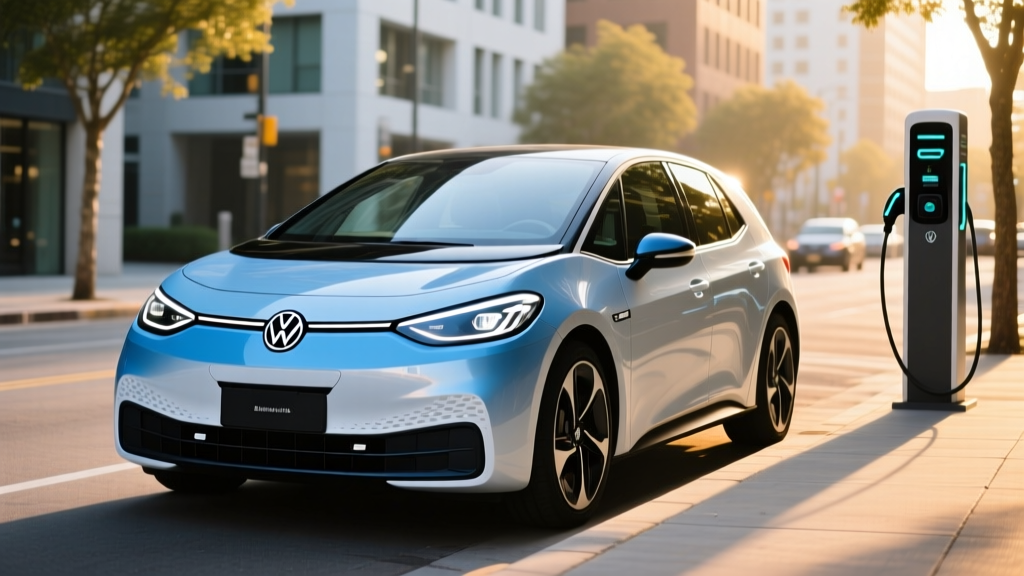
The Volkswagen ID.3 has been one of Europe's best-selling electric hatchbacks since its 2020 launch, but for US-based EV shoppers, it remains a tantalizing "what if." As of 2026, Volkswagen has not officially brought the ID.3 to American shores — the US lineup instead centers on the larger ID.4 crossover. Yet global interest persists, and with VW's ongoing software and battery updates, the ID.3 deserves a thorough, data-driven look for anyone considering an import, tracking VW's global EV strategy, or simply benchmarking the compact EV hatchback segment.
This review covers the latest ID.3 specifications (including the refreshed 2024+ model with updated software and the GTX performance variant), real-world range expectations, charging performance, pricing in European markets with US-equivalent context, and how it stacks up against competitors you can buy stateside.
Quick Verdict: A Capable Compact EV, Unavailable in the US
Range and Efficiency: WLTP vs. Real-World Expectations
The ID.3 is offered with two battery sizes across its lineup. The critical distinction for US readers: Volkswagen publishes range under the WLTP cycle (used in Europe), which tends to run 15-20% higher than EPA estimates. Here's what the numbers actually mean for real driving.
| Spec | Pro S (58 kWh) | Pro S (77 kWh) |
|---|---|---|
| Battery (usable) | 58 kWh (NMC) | 77 kWh (NMC) |
| WLTP Range | 263 mi (424 km) | 348 mi (560 km) |
| Est. EPA-Equivalent Range | ~215-230 mi | ~290-310 mi |
| Efficiency (WLTP) | ~15.5 kWh/100 km (~25 kWh/100 mi) | ~15.9 kWh/100 km (~25.6 kWh/100 mi) |
| Est. MPGe (EPA-equiv.) | ~130 MPGe combined | ~128 MPGe combined |
Charging Performance: DC Fast-Charge and Home Level 2
Charging speed is where the ID.3 is competent but not class-leading. Volkswagen equips the ID.3 with a CCS2 connector in Europe (CCS1 equivalent in North America, had it been sold here). Here's the full charging picture:
| Charging Level | Pro S (58 kWh) | Pro S (77 kWh) |
|---|---|---|
| Max DC Fast Charge | 120 kW (peak) | 170 kW (peak) |
| 10-80% DCFC Time | ~30 minutes | ~30 minutes |
| Level 2 AC (onboard charger) | 11 kW (3-phase) | 11 kW (3-phase) |
| Level 2 Full Charge Time | ~6 hours | ~7.5 hours |
| Level 1 (120V, ~1.4 kW) | ~41 hours (0-100%) | ~55 hours (0-100%) |
Charging curve reality: The 77 kWh model peaks at 170 kW but sustains that rate only briefly — typically from 10-30% State of Charge (SoC). Above 50%, the curve tapers significantly, dropping below 80 kW by 60% SoC and below 40 kW past 80%. This is standard NMC chemistry behavior driven by thermal management and cell-protection protocols, but it means your average charging rate during a 10-80% session is closer to 100-110 kW, not the 170 kW headline figure.
US home charging note: European ID.3 models use an 11 kW onboard charger designed for 3-phase AC power, which is uncommon in US residences. On a standard US single-phase Level 2 setup (240V, 48A / 11.5 kW), the ID.3 would charge at a similar rate, adding roughly 30-35 miles of range per hour of Level 2 charging.
Performance and Drivetrain
The ID.3 is a rear-wheel-drive (RWD) hatchback built on VW's MEB platform. It's tuned for efficiency and daily comfort, not track performance — though the GTX variant adds meaningful punch.
| Variant | Horsepower | Torque | 0-62 mph (0-100 km/h) | Drivetrain |
|---|---|---|---|---|
| Pro S (58 kWh) | 201 hp | 229 lb-ft | 7.3 sec | RWD |
| Pro S (77 kWh) | 201 hp | 229 lb-ft | 7.9 sec | RWD |
| GTX (79 kWh) | 282 hp | 402 lb-ft | 6.0 sec | RWD |
For context, the standard ID.3's ~7.3-second 0-62 mph time (roughly 7.0 seconds 0-60 mph) puts it in line with a Honda Civic Sport — quick enough for confident highway merging but not thrilling. The GTX's 282 hp and 6.0-second sprint bring it closer to a Golf GTI, which is the spiritual comparison VW intends.
All variants feature regenerative braking with adjustable levels via steering-wheel paddles, though the ID.3 does not offer true one-pedal driving (the car creeps at low speed rather than coming to a full stop under regen alone).
Interior, Cargo, and Technology
The ID.3's cabin is minimalist in the VW ID-family tradition — a compact digital instrument cluster, a 12.9-inch central touchscreen (updated from the earlier 10-inch unit on refreshed 2024+ models), and a small toggle-style gear selector behind the steering wheel.
Passenger and cargo dimensions:
- Rear legroom: ~35.4 inches — generous for a compact hatchback
- Cargo volume (seats up): ~13.6 cu ft (385 liters)
- Cargo volume (seats folded): ~44.7 cu ft (1,267 liters)
- No front trunk (frunk): The MEB platform's electronics occupy the front compartment
Infotainment and driver assists: The updated ID. Software 4.0 (on 2024+ models) addresses many early complaints about laggy touch-capacitive sliders and unresponsive menus. Wireless Apple CarPlay and Android Auto are standard. Driver-assistance features include:
- Adaptive cruise control with stop-and-go
- Lane-keeping assist (Travel Assist) — SAE Level 2, requiring continuous driver supervision
- Park Assist with semi-autonomous parking maneuvers
- Front and rear parking sensors with 360° camera available
Pricing, Tax Credits, and US Availability
Here's the critical section for US readers: the Volkswagen ID.3 is not sold in the United States and has no US MSRP. It is not listed on fueleconomy.gov and carries no EPA certification. Volkswagen has consistently stated the ID.3 is designed for European and select Asian markets, with the larger ID.4 crossover serving as the brand's US EV volume model.
European pricing for reference (2025-2026 model year):
- ID.3 Pro (58 kWh): Starting at approximately €36,000 (~$39,000 USD)
- ID.3 Pro S (77 kWh): Starting at approximately €42,000 (~$45,500 USD)
- ID.3 GTX (79 kWh): Starting at approximately €46,000 (~$50,000 USD)
How the ID.3 Compares to US-Available Alternatives
Since you can't buy an ID.3 in the US, here's how its closest competitors stack up — vehicles you can actually purchase:
| Spec | VW ID.3 (77 kWh) | Chevrolet Bolt EV | Nissan Leaf (62 kWh) | Hyundai Kona Electric |
|---|---|---|---|---|
| EPA Range | ~290-310 mi (est.) | 259 mi | 212 mi | 261 mi |
| Battery | 77 kWh NMC | 65 kWh NMC | 62 kWh NMC | 64.8 kWh NMC |
| DC Fast Charge | 170 kW | 55 kW (CCS) | 100 kW (CCS) | 100+ kW (CCS/NACS) |
| 0-60 mph | ~7.6 sec (est.) | 6.5 sec | 6.9 sec | 7.2 sec |
| US MSRP (approx.) | N/A (not sold) | ~$28,000* | ~$30,000 | ~$33,000 |
*Bolt EV production ended in late 2023; available on the used market. Next-gen Bolt expected ~2026.
The ID.3's range and charging speed would place it near the top of this segment — but its absence from the US market makes the comparison academic. The Hyundai Kona Electric is arguably the closest US-market equivalent in spirit: similar size, similar price point, and competitive range.
Battery Warranty and Longevity
Volkswagen provides the following warranty coverage for the ID.3 in European markets:
- High-voltage battery: 8 years / 160,000 km (~100,000 miles), guaranteeing minimum 70% net capacity retention
- Vehicle warranty: 3 years / 60,000 km (~37,000 miles) in most EU markets
- Battery chemistry: NMC (nickel manganese cobalt) — offers higher energy density than LFP but requires more careful charge management (avoid sustained 100% SoC for optimal longevity)
The 70% capacity retention threshold at 8 years/100,000 miles is industry-standard and matches what VW offers on the US-market ID.4. Real-world degradation data from European fleet operators and Geotab's battery health studies suggest most NMC packs lose roughly 1-2% capacity per year under normal use, meaning the ID.3's battery should comfortably exceed the warranty threshold under typical ownership.
Who Is the VW ID.3 For?
- Urban commuters who want a compact footprint with strong range for occasional longer trips
- Small families needing hatchback practicality without crossover bulk
- Company-car drivers in Europe benefiting from EV tax incentives
- US buyers (it simply isn't available)
- Buyers needing AWD or towing capability (RWD only, no tow rating published)
- Those who prioritize physical infotainment controls over touchscreens
Pros and Cons
Pros
- Strong range from the 77 kWh battery (~290+ mi EPA-est.)
- Spacious interior and cargo area for a compact hatch
- Competitive 170 kW DC fast-charging (77 kWh model)
- Tight turning radius — excellent for city driving
- Updated software (4.0+) resolves many early issues
- GTX variant offers genuine hot-hatch performance
Cons
- Not available in the United States
- Touch-capacitive controls frustrate many drivers
- No front trunk (frunk)
- 58 kWh model's 120 kW DCFC is below segment average
- Regen braking doesn't enable full one-pedal driving
- European pricing translates to a premium US price if imported
Frequently Asked Questions
What is the real-world range of the Volkswagen ID.3?
The 77 kWh ID.3 Pro S achieves up to 348 miles under WLTP testing, which translates to roughly 290-310 miles EPA-equivalent. In real-world mixed driving at highway speeds, expect 260-280 miles. In cold weather (below freezing), range drops to approximately 210-230 miles due to battery resistance and cabin heating demands. The 58 kWh model delivers roughly 180-200 miles in real-world conditions.
How fast does the ID.3 charge at home and on DC fast chargers?
The 77 kWh model peaks at 170 kW on DC fast charging, achieving 10-80% in approximately 30 minutes (with charge-curve taper above 50%). At home on an 11 kW Level 2 charger, a full charge takes about 7.5 hours. The 58 kWh model peaks at 120 kW DC with a similar 10-80% time of ~30 minutes.
Does the VW ID.3 qualify for the US federal EV tax credit?
No. The ID.3 is not sold in the United States and therefore is not eligible for the IRS §30D Clean Vehicle Credit. Federal tax credits apply only to new clean vehicles purchased from authorized US dealers, subject to MSRP caps ($55,000 for sedans/hatchbacks), buyer income limits, and battery component/critical minerals sourcing requirements.
Is the VW ID.3 worth buying over competitors?
In European markets, the ID.3 is a strong contender against the MG4, Renault Megane E-Tech, and BYD Dolphin — offering superior range (77 kWh version), brand cachet, and a refined ride. However, its infotainment ergonomics remain a weak point. For US buyers, the question is moot: the ID.3 isn't available. Consider the Hyundai Kona Electric, the upcoming next-gen Chevrolet Bolt, or VW's own ID.4 instead.
Will Volkswagen ever sell the ID.3 in the US?
As of 2026, Volkswagen has not announced plans to bring the ID.3 to the US market. The brand's US EV strategy focuses on the ID.4, ID.7 sedan, and ID.Buzz — all larger vehicles better suited to American preferences. The compact hatchback segment has shrunk in the US, making an ID.3 launch unlikely in the near term.
What battery chemistry does the ID.3 use?
The ID.3 uses NMC (nickel manganese cobalt) lithium-ion cells supplied primarily by LG Energy Solution and SK On. NMC offers higher energy density than LFP (lithium iron phosphate), enabling the ID.3's strong range in a compact package, but benefits from regular charging to 80% rather than 100% for optimal long-term health. Volkswagen's battery management system includes a top-end buffer to protect cells even when the display reads 100%.