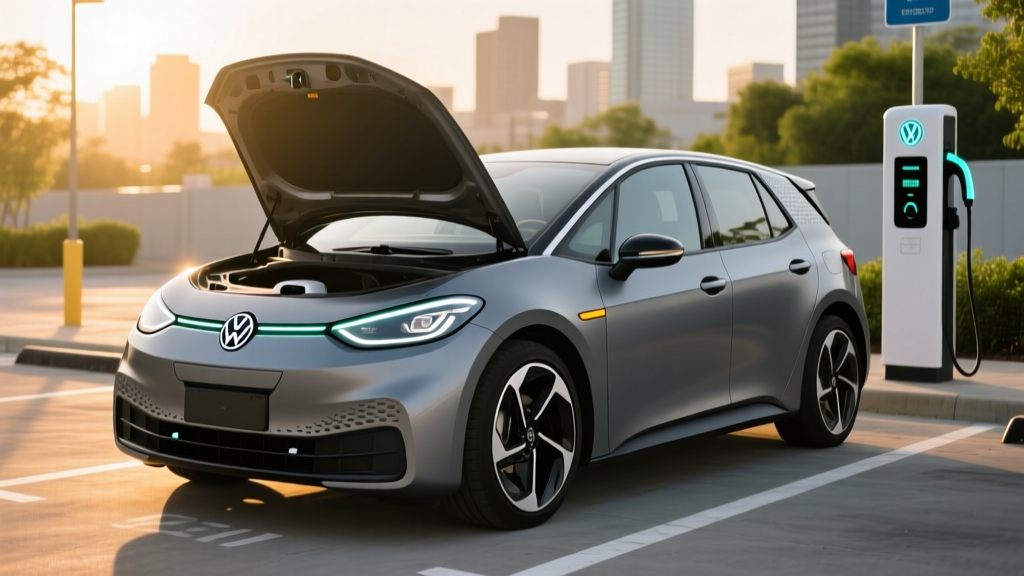
The Volkswagen ID.3 has been Europe's best-selling electric hatchback since its 2020 launch, but for US-based EV shoppers, it remains a tantalizing "what if." As of the 2026 model year, Volkswagen has not brought the ID.3 to North America, instead focusing on the larger ID.4 crossover and the ID.7 sedan. Yet with 480 monthly US searches and growing interest in affordable electric hatchbacks, the ID.3 deserves a thorough, data-driven examination — whether you're a prospective import buyer, an expat planning a move, or simply benchmarking the global EV market.
This review covers the 2026 Volkswagen ID.3 with exact specifications drawn from VW's European press materials, Volkswagen Newsroom, and independent testing. We'll translate WLTP figures into realistic US expectations, break down its MEB-platform charging curve, and evaluate whether this compact EV could compete with stateside rivals like the Chevrolet Bolt EV, Nissan Leaf, and Hyundai Kona Electric — if it ever arrived.
2026 VW ID.3 at a Glance: Key Specifications
| Specification | Value |
|---|---|
| EPA-Estimated Range | Not EPA-rated (US estimate: ~230–245 mi) |
| WLTP Range | Up to 429 km (266 mi) |
| Battery (Usable / Gross) | 77 kWh usable / 86 kWh gross |
| Battery Chemistry | NMC (Nickel Manganese Cobalt) |
| Max DC Fast Charge | 170 kW peak (CCS2 in Europe) |
| 10–80% DC Charge Time | ~28 minutes (optimal conditions) |
| Level 2 AC Charge Rate | 11 kW (3-phase) / ~7.2 kW (single-phase) |
| Motor / Drivetrain | Single motor, RWD |
| Horsepower / Torque | 228 hp (170 kW) / 229 lb-ft |
| 0–62 mph (0–100 km/h) | 7.1 seconds |
| Estimated US Efficiency | ~110 MPGe / ~30 kWh/100 mi |
| Cargo Volume | 13.6 cu ft (385 L) rear seats up; 44.7 cu ft (1,267 L) folded |
| Base Price (Europe) | €43,995 (~$47,500 USD) for Pro S trim |
| US Availability | Not sold in North America |
| Battery Warranty (Europe) | 8 years / 160,000 km (~99,400 mi), 70% capacity retention |
Range & Efficiency: WLTP vs. Real-World Expectations
The 2026 ID.3 Pro S carries an 86 kWh gross (77 kWh usable) NMC battery pack mounted low in the MEB skateboard platform. Volkswagen quotes a WLTP combined range of 429 km (266 miles) for the top-spec Pro S. The smaller Pro trim with the 58 kWh usable pack achieves up to 352 km (219 mi) WLTP.
WLTP is more optimistic than the US EPA cycle. Based on MEB-platform efficiency data from the ID.4 (which shares architecture), we estimate a US EPA rating of approximately 230–245 miles for the Pro S. In real-world driving:
• City/commuter driving: 240–260 mi achievable with regen-heavy routes
• Highway (70+ mph sustained): Expect 190–210 mi — the boxy hatchback shape and single-speed reduction gear penalize high-speed efficiency
• Cold weather (below 32°F / 0°C): 160–185 mi — the ID.3's resistive PTC heater (no heat pump on base trims) consumes significant energy; the optional heat pump on higher trims recovers ~15–20% of winter range loss
Efficiency works out to roughly 30 kWh/100 mi in mixed driving, which translates to an estimated 110 MPGe combined. That's competitive with the Hyundai Kona Electric (120 MPGe) but trails the lighter Chevrolet Bolt EV (120 MPGe) due to the ID.3's heavier 4,034 lb (1,830 kg) curb weight — a consequence of that large 86 kWh pack.
Charging Speed & Infrastructure: DC Fast, Level 2 & Home Setup
The ID.3 uses the CCS2 connector in European markets (equivalent to CCS1 in North America). VW's MEB platform supports DC fast charging up to 170 kW peak on the Pro S — an improvement over the original 125 kW cap on 2020–2022 models, achieved through software and thermal-management updates.
| Charging Level | Power | Miles Added per Hour | Notes |
|---|---|---|---|
| Level 1 (120V household) | ~1.4 kW | ~4–5 mi/hr | Emergency/trickle only; full charge in 60+ hours |
| Level 2 (240V, single-phase) | 7.2 kW | ~22–24 mi/hr | Full charge in ~11 hours (77 kWh usable) |
| Level 2 (240V, 3-phase EU) | 11 kW | ~34–36 mi/hr | Requires 3-phase supply; full charge in ~7.5 hours |
| DC Fast Charge (peak) | 170 kW | ~500+ mi/hr (at peak) | 10–80% in ~28 min; tapers significantly above 80% |
Charging curve reality: The 170 kW peak is achieved between roughly 5% and 30% state of charge. Between 30–60% SoC, rates hold around 120–140 kW. Above 80%, charging drops to under 50 kW to protect the NMC cells — so that last 20% can add 20+ minutes. For road-trip planning, plan your stops around the 10–80% window for the fastest turnaround.
Preconditioning is available via the vehicle's navigation system: when a DC fast-charger is set as your destination, the battery thermal management system warms or cools the pack to optimal temperature for maximum charge acceptance. This is critical in cold weather, where an un-preconditioned pack may accept only 50–80 kW initially.
Performance & Driving Dynamics
The ID.3 Pro S sends 228 hp (170 kW) and 229 lb-ft of torque to the rear wheels via a single permanent-magnet synchronous motor. The 0–62 mph (0–100 km/h) sprint takes 7.1 seconds; we estimate 0–60 mph in approximately 6.8 seconds. That's brisk for a compact hatchback — quicker than a Mazda3 2.5 Turbo and comparable to the Hyundai Kona Electric's 7.2-second run.
Driving dynamics are where the MEB platform shows its character. The rear-mounted motor and low battery give the ID.3 a tight 33.5-foot (10.2 m) turning circle — excellent for urban maneuvering. The steering is light and precise, though not sporty. Ride quality is firm but well-damped; the 1,830 kg mass is managed competently by the multi-link rear suspension.
Regenerative braking offers multiple modes: a coasting "D" mode, a stronger "B" mode for one-pedal-style driving (though it doesn't come to a complete stop), and adaptive regen that uses the front radar to auto-adjust deceleration based on traffic ahead. It's a well-executed system, though enthusiasts may miss the full one-pedal stop found in the Hyundai Ioniq 5 or Tesla Model 3.
Interior, Cargo & Technology
The ID.3's cabin follows VW's minimalist ID. family design: a compact 5.3-inch digital instrument cluster behind the steering wheel, a centrally mounted 12.9-inch infotainment touchscreen (upgraded from 12-inch on 2024+ models), and a column-mounted rotary gear selector that frees up console space.
Dimensions & practicality:
- Rear legroom: 35.8 in (909 mm) — adequate for adults on shorter trips
- Front headroom: 40.7 in (1,034 mm) — generous thanks to the flat EV floor
- Cargo (rear seats up): 13.6 cu ft (385 L)
- Cargo (rear seats folded): 44.7 cu ft (1,267 L)
- No front trunk (frunk) — the MEB platform's electronics occupy that space
The 13.6 cu ft trunk is the ID.3's most obvious limitation versus crossovers. A VW ID.4 offers 30.3 cu ft behind the rear seats. For comparison, the Hyundai Kona Electric provides 25.8 cu ft. If you regularly haul cargo or a stroller, the hatchback form factor will feel tight.
Tech highlights:
- ID. Light — an LED strip across the dashboard that pulses for navigation prompts, incoming calls, and charging status
- Augmented-reality head-up display (optional on Pro S) projecting navigation arrows onto the windshield
- Travel Assist with swerve support — VW's Level 2 ADAS combining adaptive cruise, lane centering, and lane-change assist (hands on wheel required)
- Park Assist Plus with memory parking — the car can learn and repeat a parking maneuver (e.g., pulling into your garage)
- Over-the-air (OTA) software updates for infotainment and powertrain calibration
Notable drawbacks: The infotainment system, while improved with the 2024+ software refresh, still draws criticism for capacitive touch sliders (volume and temperature) that lack backlighting and are fiddly to use while driving. The absence of physical climate knobs is a persistent annoyance in VW's ID. lineup.
Pricing, Tax Credits & Value Proposition
Because the ID.3 is not sold in the United States, there is no US MSRP. European pricing for the 2026 model year starts at approximately €36,495 (~$39,400 USD) for the base Pro trim with the 58 kWh battery, and €43,995 (~$47,500 USD) for the Pro S with the 77 kWh usable pack. A well-equipped Pro S with the heat pump, AR head-up display, and premium audio pushes toward €50,000 (~$54,000 USD).
Since the VW ID.3 is not sold in the US, it does not qualify for the IRS §30D clean vehicle credit. If VW were to import it, eligibility would depend on meeting MSRP caps ($55,000 for cars), buyer income limits ($150,000 single / $300,000 joint AGI), and battery critical-mineral and component sourcing requirements. Given VW's current US battery supply chain, qualification would be uncertain. Always verify current-year rules at irs.gov and consult a tax professional.
For European buyers, the ID.3 competes with the MG4 Electric (starting ~€35,000), the Renault Mégane E-Tech (~€42,000), and the BYD Dolphin (~€35,000). The Pro S's €44,000 price positions it as a premium option in the segment, justified by its larger battery, refined ride, and VW dealer network.
Who Should Consider the ID.3 — And Who Shouldn't
- Class-leading 266 mi WLTP range (Pro S)
- Tight turning circle ideal for cities
- Refined ride and cabin quietness
- 170 kW DC charging (10–80% in ~28 min)
- Strong VW dealer and service network in Europe
- 8-year / 160,000 km battery warranty
- Not available in the United States
- Small trunk (13.6 cu ft) for the footprint
- Capacitive touch controls frustrate while driving
- No frunk for charging cables or small items
- Heavier than rivals — impacts efficiency at highway speed
- No heat pump on base trims — winter range suffers
Best suited for: European urban commuters and small households who prioritize range and refinement over cargo space. The Pro S's 266 mi WLTP range covers most weekly commutes with one home charge, and the compact dimensions make parking effortless. It's also a strong company-car choice in markets with benefit-in-kind tax advantages for EVs.
Not ideal for: Families needing cargo versatility (choose the ID.4 or a compact EV SUV), road-trippers who frequently drive 300+ miles between stops (the 170 kW charge rate, while decent, isn't class-leading — the Hyundai Ioniq 5 peaks at 240 kW), or anyone in the US market (where it simply isn't an option).
ID.3 vs. Key Competitors: How It Stacks Up
| Model | WLTP Range | Battery (Usable) | Max DC kW | 10–80% Time | 0–62 mph | Starting Price (EU) |
|---|---|---|---|---|---|---|
| VW ID.3 Pro S | 429 km (266 mi) | 77 kWh NMC | 170 kW | ~28 min | 7.1 sec | €43,995 |
| MG4 Extended Range | 450 km (280 mi) | 77 kWh NMC | 140 kW | ~35 min | 7.9 sec | €36,990 |
| Renault Mégane E-Tech 60 | 450 km (280 mi) | 60 kWh NMC | 130 kW | ~37 min | 7.4 sec | €42,000 |
| BYD Dolphin Design | 427 km (265 mi) | 60.4 kWh LFP | 88 kW | ~45 min | 7.0 sec | €35,990 |
The ID.3 Pro S wins on charging speed and the breadth of VW's service network, but the MG4 undercuts it on price by ~€7,000 with comparable range. The Renault offers a more stylish interior but a smaller battery. The BYD Dolphin's LFP chemistry sacrifices range and charge speed for long-term durability and lower cost — a trade-off worth considering for high-mileage drivers.
Frequently Asked Questions
Will the VW ID.3 ever come to the United States?
As of early 2026, Volkswagen has confirmed no plans to sell the ID.3 in North America. VW's US EV strategy centers on the ID.4 (assembled in Chattanooga, TN), the ID.7 sedan, and the upcoming ID.2all subcompact. The ID.3's hatchback form factor and European-oriented pricing make it a tough sell in the US, where crossovers dominate. If you want a similar MEB-based experience stateside, the ID.4 is the closest equivalent.
What is the real-world range of the ID.3 Pro S?
VW quotes 429 km (266 mi) under the WLTP cycle. In mixed real-world driving, expect approximately 230–250 miles in moderate temperatures, dropping to 160–185 miles in sustained sub-freezing conditions without a heat pump. Highway-only driving at 75+ mph will yield roughly 190–210 miles. These estimates are based on MEB-platform efficiency data and independent European testing.
How fast does the ID.3 charge at home and on the road?
At home on a 240V Level 2 charger (single-phase, 7.2 kW), the ID.3 Pro S adds about 22–24 miles of range per hour, reaching a full charge in roughly 11 hours. On a DC fast charger, it peaks at 170 kW and can go from 10% to 80% in approximately 28 minutes under optimal thermal conditions. Preconditioning via navigation routing is essential for achieving peak rates in cold weather.
Does the ID.3 qualify for the US federal EV tax credit?
No — because it is not sold in the US, the ID.3 is not eligible for the IRS §30D clean vehicle credit. European buyers should consult their national and local incentive programs, which vary by country (e.g., Germany's Umweltbonus was discontinued in 2024; France's bonus écologique remains available with income-based tiers).
Is the ID.3 worth buying over the MG4 or Renault Mégane E-Tech?
The ID.3 Pro S is the refined, range-optimized choice if you value charging speed, cabin quietness, and VW's dealer network. The MG4 Extended Range delivers similar WLTP range for €7,000 less but charges slower (140 kW peak) and has a firmer ride. The Renault Mégane E-Tech offers a more premium interior feel but a smaller 60 kWh battery limits real-world range. Test-drive all three — the decision often comes down to ride comfort preference and local dealer proximity.
What is the battery warranty on the ID.3?
Volkswagen provides an 8-year / 160,000 km (~99,400 mi) warranty on the ID.3's high-voltage NMC battery, guaranteeing a minimum of 70% state-of-health (capacity retention) over that period. This is in line with industry standards (Hyundai offers 8yr/100,000 mi in the US; Tesla offers 8yr/120,000 mi for Model 3 RWD). For European drivers covering 20,000 km/year, the warranty provides coverage through year eight of ownership.