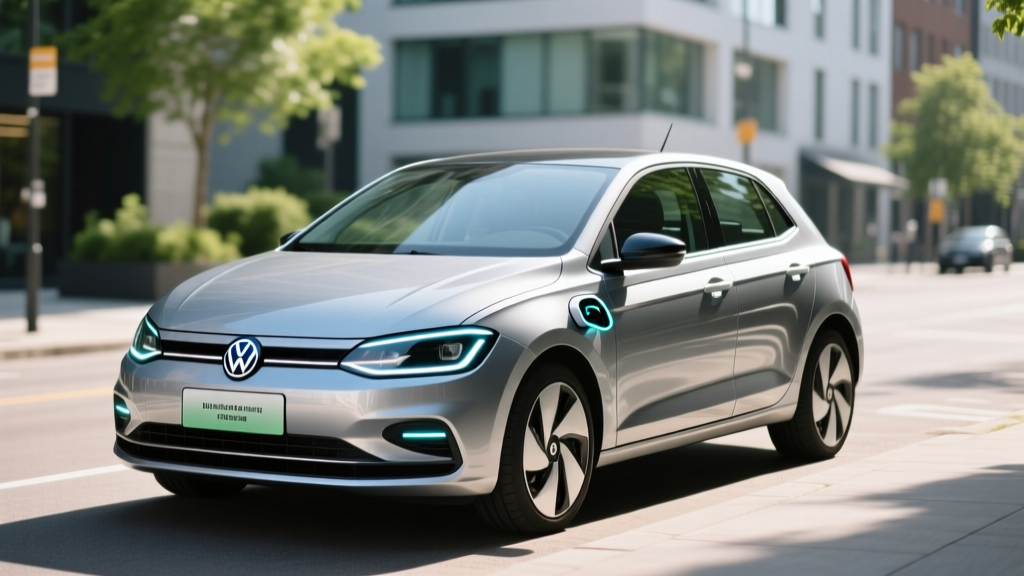
The bottom line: Volkswagen revealed the affordable ID Polo electric vehicle in Europe as a subcompact EV targeting a starting price near €25,000 (roughly $27,000 USD before any incentives) with an estimated WLTP range of up to 420 km (~260 miles). It rides on VW's new MEB+ platform with a ~48 kWh usable battery, supports DC fast charging up to 110 kW, and is slated for European deliveries in 2026. For US buyers: Volkswagen has not confirmed a North American launch, and if it does arrive, expect a higher MSRP, EPA range lower than the WLTP figure, and uncertain §30D tax-credit eligibility due to battery-sourcing rules.
The compact EV segment has been dominated by cars that cost $40,000 or more in the United States. The ID Polo is Volkswagen's attempt to change that math — at least on the other side of the Atlantic. As a successor in spirit to the discontinued e-Up! and a battery-electric sibling to the long-running Polo hatchback, it occupies a space American buyers have largely been denied: a genuinely affordable, city-friendly electric car with real-world usability. Let's dissect what VW has announced, what the numbers actually mean, and whether this car — or something like it — makes financial sense for you.
Specs That Matter: Range, Battery, and Charging
| Specification | VW ID Polo (Announced EU Spec) |
|---|---|
| Battery (usable) | ~48 kWh (LFP chemistry expected for base trim) |
| WLTP Range | Up to 420 km (~261 mi) |
| Estimated EPA Range | ~210–230 mi (if US-spec, based on typical WLTP-to-EPA discount) |
| Peak DC Fast Charge | Up to 110 kW |
| 10–80% DC Charge Time | ~25 minutes (estimated) |
| Level 2 AC Charging | 11 kW onboard charger |
| Motor Output | ~114 hp (85 kW) front-wheel drive |
| 0–100 km/h (0–62 mph) | ~10.0 seconds (est.) |
| EU Starting Price | ~€25,000 (~$27,000 USD) |
Real-world range reality check: The 420 km WLTP figure is a European testing standard that tends to overstate range compared to the US EPA cycle by 10–20%. If VW brings the ID Polo stateside, expect an EPA sticker closer to 210–230 miles. In cold weather (below 40°F), plan for another 15–25% reduction — that puts winter highway range potentially in the 160–180 mile bracket. For city driving with regenerative braking, you'll likely see results closer to the sticker number.
The LFP (lithium iron phosphate) chemistry choice for the base battery is significant. LFP trades some energy density for longer cycle life, lower cost, and better thermal stability. It also tolerates regular 100% charging without the degradation concerns associated with NMC (nickel manganese cobalt) cells. If you're a daily commuter who charges at home every night, LFP is arguably the better chemistry for your use case — even though the total kWh is modest.
How the ID Polo Compares to Gas and Hybrid Alternatives
The ID Polo's natural cross-shops in Europe are the Renault 5 E-Tech, the Citroën ë-C3, and the gas-powered VW Polo. For US buyers considering a subcompact EV, the comparison set shifts to cars like the Nissan Leaf, the Chevy Bolt EV (if it returns for 2026), and gas equivalents like the Honda Civic or Toyota Corolla hatchback.
| Metric | VW ID Polo (EU Est.) | VW Polo 1.0 TSI (Gas) | Toyota Corolla Hybrid (US) |
|---|---|---|---|
| Starting Price | ~€25,000 ($27k) | ~€20,000 ($21.5k) | $23,500 |
| Energy/Fuel Cost per Mile | ~€0.05/mi (home charge) | ~€0.12/mi (gasoline) | ~$0.09/mi (gasoline) |
| Range / Tank | ~260 mi (WLTP) | ~435 mi | ~530 mi |
| Refuel/Recharge Time | ~25 min (10–80% DC) | ~5 min | ~5 min |
| Annual Maintenance (est.) | ~$300 | ~$700 | ~$600 |
| CO₂ Tailpipe | 0 g/mi | ~120 g/km | ~100 g/km |
The per-mile energy cost is where the ID Polo wins decisively — assuming you charge at home. At the European average electricity price of roughly €0.30/kWh and an efficiency of about 14 kWh/100 km, you're paying approximately €0.04–0.05 per kilometer. A gas Polo at 5.5 L/100 km with fuel at €1.80/L costs roughly three times as much per kilometer. Over 15,000 km (about 9,300 miles) per year, that's a fuel-cost savings of roughly €1,000–1,200 annually.
The gap narrows if you rely exclusively on public DC fast charging. At €0.50–0.70/kWh on networks like Ionity or Fastned, your per-mile cost climbs to €0.07–0.10 — still cheaper than gas, but no longer dramatically so. This is why home charging access is the single most important variable in EV ownership economics.
Real Ownership Costs: The 5-Year Picture
| Cost Category (5 Years / 75,000 km) | ID Polo EV (Home Charging) | VW Polo Gas |
|---|---|---|
| Purchase Price | ~€25,000 | ~€20,000 |
| Fuel / Electricity | ~€2,250 | ~€6,750 |
| Maintenance | ~€1,500 | ~€3,500 |
| Insurance (avg.) | ~€4,500 | ~€3,750 |
| Estimated Depreciation | ~€12,500 | ~€9,000 |
| Total 5-Year Cost | ~€45,750 | ~€43,000 |
The numbers reveal a familiar EV ownership pattern: you pay more upfront and recoup through lower running costs, but the total-cost gap is tight. The ID Polo's €2,750 five-year deficit versus its gas sibling could be erased entirely by European purchase incentives (which vary by country — Germany's environmental bonus, France's ecological bonus, etc.). In a US scenario, §30D federal tax credit eligibility would be the swing factor, though battery-sourcing and critical-mineral requirements make that uncertain for a European-built VW. Always verify current-year rules at IRS.gov.
Insurance premiums for EVs tend to run 10–20% higher than equivalent gas cars, driven by higher repair costs for battery-adjacent damage and specialized labor. Get a quote before you commit — this is a cost many first-time EV buyers overlook.
Charging at Home vs. Public: What First-Time Buyers Must Know
The ID Polo's 11 kW onboard AC charger is competitive for its class. On a European three-phase home wallbox, a full 0–100% charge takes roughly 5 hours. On a standard single-phase household outlet (2.3 kW, Level 1 equivalent), you're looking at over 20 hours — making a dedicated home charger practically mandatory for daily use.
On DC fast charging, the 110 kW peak rate means you'll add roughly 150 km (93 mi) of range in 15 minutes under ideal conditions. However, peak rate is not sustained rate. Expect the charge curve to taper significantly above 60–70% state of charge. A realistic 10–80% session will average closer to 70–80 kW, which is why VW quotes roughly 25 minutes rather than the theoretical 18 you'd get at sustained peak.
Common EV Misconceptions vs. Reality
| Myth | Fact |
|---|---|
| "The battery will need replacing in 5 years." | VW typically warrants its EV batteries for 8 years / 160,000 km at 70% capacity retention. LFP chemistry degrades even more slowly — most owners will trade the car before meaningful range loss. |
| "You can't take an EV on a road trip." | With 110 kW DC charging, a 30-minute stop every 2–2.5 hours keeps you moving. It's slower than gas, but pairs naturally with rest breaks. Route planning via apps like ABRP or the VW in-car nav is essential. |
| "Cold weather makes EVs useless." | Cold reduces range 15–25% and slows charging. Preconditioning the battery (heating it before you arrive at a charger) mitigates the charging slowdown. Garaged cars fare much better. |
| "EVs are worse for the environment because of battery mining." | Lifecycle analyses from ICCT and Transport & Environment consistently show EVs produce fewer total emissions than gas cars within 1–2 years of driving, even accounting for battery manufacturing. LFP chemistry avoids cobalt entirely. |
US Availability: Should You Wait?
Here's where the story gets frustrating for American buyers. Volkswagen has not confirmed a US launch for the ID Polo. VW's North American EV strategy has focused on the ID.4 crossover and the upcoming ID.7 sedan, both built in Emden, Germany, or Chattanooga, Tennessee. A subcompact hatchback at a $27,000 price point would face steep headwinds in the US market: thin margins, consumer preference for crossovers, and the need to re-engineer for US crash standards and charging infrastructure (NACS connector compatibility, which VW has committed to for future models).
If VW does eventually bring an ID Polo equivalent stateside, expect:
- A starting MSRP closer to $29,000–$32,000 after US-spec adjustments
- NACS charging port (replacing CCS for future VW models in North America)
- EPA range of 210–230 miles
- Uncertain §30D tax credit eligibility — the credit requires final assembly in North America and specific battery-sourcing thresholds that a European-built VW would not meet
For now, US buyers seeking an affordable compact EV should look at the used market (a 2023–2025 Chevy Bolt EV or Bolt EUV can be had for $18,000–$25,000 and qualifies for the up-to-$4,000 used clean vehicle credit if income and dealer requirements are met).
Decision Framework: Is the ID Polo (or Its Equivalent) Right for You?
Choose a subcompact EV like the ID Polo if:
- You have reliable home charging (garage or driveway with a 240V outlet or wallbox)
- Your daily commute is under 80 miles round-trip
- You want the lowest possible per-mile operating cost
- You're in Europe (or willing to wait for a US equivalent)
- You value LFP battery longevity and can charge to 100% daily without worry
Look at a PHEV or gas car instead if:
- You live in an apartment with no charging access and public chargers are scarce
- You regularly drive 200+ miles between stops in rural areas
- You live in an extreme-cold climate (below 0°F regularly) where range loss compounds
- You need to tow — the ID Polo is not rated for meaningful towing
- You need the car today and can't wait for an uncertain US launch
Frequently Asked Questions
When will the VW ID Polo be available to buy?
European deliveries are expected to begin in mid-to-late 2026, with pre-orders opening in select markets earlier in the year. No US timeline has been announced.
What battery chemistry does the ID Polo use?
VW has indicated the base-trim ID Polo will use LFP (lithium iron phosphate) cells, likely supplied by CATL or a similar tier-one manufacturer. Higher trims may use NMC for greater energy density and range.
Can the ID Polo DC fast charge at 110 kW continuously?
No. Peak charge rate of 110 kW is achieved at low state of charge (roughly 10–30%). The charge curve tapers progressively — expect roughly 70–80 kW average across a 10–80% session. This is normal for all EVs and is why "peak kW" alone is a misleading spec.
Will the ID Polo qualify for the US federal EV tax credit?
Almost certainly not in its European-built form. The §30D credit requires final assembly in North America and compliance with critical-mineral and battery-component sourcing thresholds. A European-built VW would not meet these requirements. Rules can change — always check IRS guidance and consult a tax professional for your situation.
How does the ID Polo compare to the Renault 5 E-Tech?
Both target the affordable subcompact segment with similar pricing and range. The Renault 5 E-Tech offers up to 400 km WLTP range from a 52 kWh battery and starts around €25,000. The ID Polo differentiates with VW's MEB+ platform, potentially faster DC charging, and a more conventional hatchback design. Both are strong options in Europe — cross-shop them based on interior space, infotainment preference, and dealer proximity.
What's the warranty on the ID Polo battery?
VW's standard EV battery warranty in Europe is 8 years or 160,000 km (whichever comes first), guaranteeing at least 70% of original capacity. LFP batteries typically degrade more slowly than NMC, so most owners should expect to retain well above the threshold.