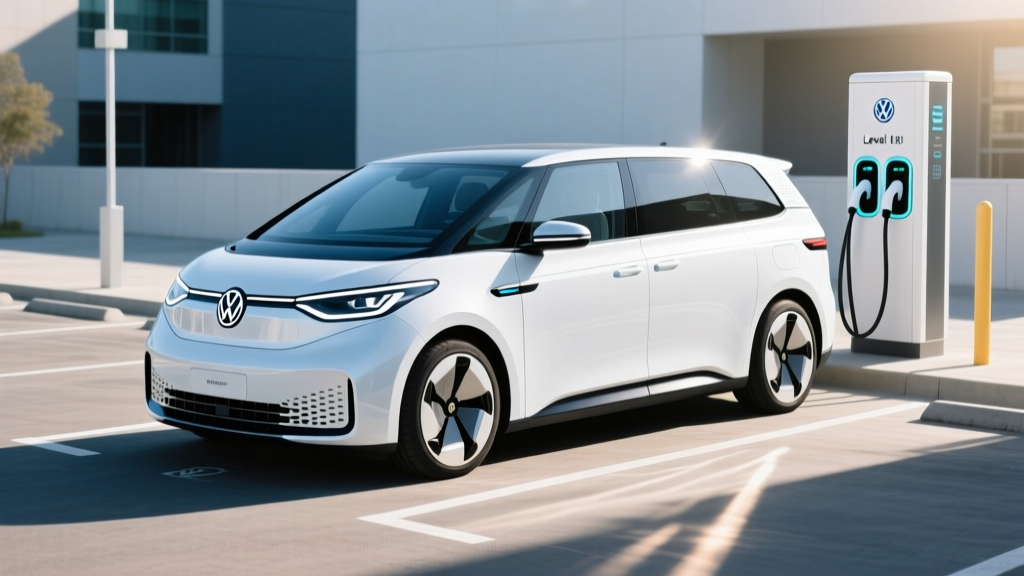
The Volkswagen ID. Buzz is the first retro-styled electric minivan to reach US showrooms, reviving the iconic Microbus silhouette on VW's MEB electric platform. For buyers weighing Volkswagen ID. Buzz car leasing versus purchasing outright, the math hinges on three numbers: a $59,995 starting MSRP, a 234-mile EPA range, and a rapidly shifting federal tax credit landscape. This profile breaks down every spec that matters to a real lease or purchase decision.
Range, Battery, and Real-World Efficiency
The ID. Buzz uses a 91 kWh gross battery pack (approximately 86 kWh usable) with nickel-manganese-cobalt (NMC) chemistry, chosen for its higher energy density over LFP alternatives. The single-motor rear-wheel-drive model carries the top EPA range rating, while the dual-motor 4Motion AWD variant trades roughly 20 miles of range for all-weather traction.
| Specification | RWD (Pro S) | AWD (Pro S Plus) |
|---|---|---|
| Battery (gross / usable) | 91 kWh / ~86 kWh | 91 kWh / ~86 kWh |
| Chemistry | NMC | NMC |
| EPA Range | 234 miles | 214–231 miles |
| MPGe (combined) | 87 MPGe | 82–85 MPGe |
| Efficiency (kWh/100 mi) | ~39 kWh/100 mi | ~40–42 kWh/100 mi |
Charging Speeds: DC Fast and Home Level 2
VW equips the ID. Buzz with a 170 kW peak DC fast-charging rate on the CCS1 connector. That puts it a tier below the Hyundai Ioniq 5's 350 kW capability but on par with most mainstream three-row electric SUVs. On a 150+ kW station, the charge curve holds near peak through roughly 30% state of charge before tapering progressively.
| Charge Level | Power / Rate | Time or Speed | Connector |
|---|---|---|---|
| Level 1 (120V) | 1.3 kW | ~3 mi/hr | NEMA 5-15 / J1772 |
| Level 2 (240V, 48A) | 11 kW | ~28 mi/hr; 0–100% in ~9 hrs | J1772 |
| DC Fast Charge | 170 kW peak | 10–80% in ~26 min | CCS1 |
The 10–80% DC fast-charge time of roughly 26 minutes is adequate for highway rest stops but not class-leading. For context, a Kia EV9 on a 350 kW charger achieves 10–80% in about 20 minutes. On the home front, the 11 kW onboard charger means a full overnight replenishment on a Level 2 wallbox is straightforward — most owners will plug in at 30–40% SoC and wake to a full battery by morning. According to fueleconomy.gov, the ID. Buzz RWD achieves 87 MPGe combined, which translates to roughly $0.11–0.14 per mile at the national average residential electricity rate of $0.17/kWh.
Performance, Drivetrain, and Driving Dynamics
The ID. Buzz is not a performance vehicle — and it doesn't pretend to be. The single-motor RWD setup delivers 282 horsepower and 406 lb-ft of torque, achieving a 0–60 mph time of approximately 7.9 seconds. The dual-motor AWD variant bumps output to 335 horsepower with a 0–60 of roughly 7.0 seconds, aided by the instant torque delivery that characterizes all EVs.
| Metric | RWD | AWD (4Motion) |
|---|---|---|
| Horsepower | 282 hp | 335 hp |
| Torque | 406 lb-ft | 406 lb-ft |
| 0–60 mph | ~7.9 sec | ~7.0 sec |
| Top Speed | 90 mph (electronically limited) | 90 mph |
| Towing Capacity | Not rated | Not rated |
Ride quality benefits from the low center of gravity inherent to the MEB skateboard platform. Regenerative braking offers multiple levels selectable via steering-wheel paddles, though the ID. Buzz does not offer true one-pedal driving — it will not come to a complete stop without brake-pedal input. The 90 mph speed limiter is worth noting for drivers in unrestricted-speed zones; VW has prioritized range preservation over top-end performance.
Pricing, Trims, and Federal Tax Credit Eligibility
The ID. Buzz launched in the US for the 2025 model year in three trim levels. Pricing places it firmly in premium minivan territory, competing less with budget family haulers and more with lifestyle-oriented vehicles.
| Trim | Drivetrain | Base MSRP | Est. After §30D Credit* |
|---|---|---|---|
| Pro S | RWD | $59,995 | $52,495 (if eligible) |
| Pro S | AWD | $63,495 | $55,995 (if eligible) |
| Pro S Plus | AWD | $69,995 | $62,495 (if eligible) |
| 1st Edition (Launch) | AWD | $65,495 | $57,995 (if eligible) |
*Federal tax credit eligibility under IRS §30D is subject to multiple requirements that change frequently. As of 2025/2026 rules, buyers must meet:
- Income caps: AGI ≤ $150,000 (single), $225,000 (head of household), $300,000 (joint filers)
- MSRP cap: Vans classified as SUVs qualify up to $80,000 MSRP — the ID. Buzz clears this
- Battery sourcing: Critical minerals and battery components must meet phased-in domestic/free-trade requirements — VW's supply chain compliance varies by build date; verify with your dealer and consult IRS.gov §30D guidance
- Point-of-sale transfer: Eligible buyers can apply the credit as a down-payment reduction at purchase; for leases, the credit technically flows to the lessor (VW Credit), who may pass it through as a capitalized-cost reduction — confirm with the dealer
Interior Space, Cargo, and Family Practicality
The ID. Buzz is a three-row vehicle, but its interior packaging differs meaningfully from traditional minivans like the Toyota Sienna or Chrysler Pacifica. The flat floor (no transmission tunnel) creates a spacious feeling, and the sliding second-row bench on the Pro S Plus offers flexibility that fixed captain's chairs do not.
| Dimension | Measurement |
|---|---|
| Seating Capacity | 7 passengers (Pro S); 6–7 (Pro S Plus) |
| Cargo (behind 3rd row) | 18.2 cu ft |
| Cargo (3rd row folded) | 75.5 cu ft |
| Cargo (2nd & 3rd folded) | 131.5 cu ft |
| Wheelbase | 127.5 in (long-wheelbase US version) |
| Overall Length | 195.4 in |
The 18.2 cu ft behind the third row is tight compared to the Sienna's ~33 cu ft in the same configuration. For families who regularly carry seven passengers and luggage, a traditional hybrid minivan still offers more cargo flexibility. However, for five-passenger duty with the third row folded, the ID. Buzz provides a massive, flat cargo area suitable for furniture, bikes, or a week's worth of camping gear.
Technology, Driver Assists, and Standout Features
The ID. Buzz runs VW's latest ID. Software 4.0 on a 12.9-inch infotainment touchscreen with wireless Apple CarPlay and Android Auto. The digital cockpit features a compact 5.3-inch driver display with key information, while most secondary controls migrate to the central screen — a choice that frustrates some drivers seeking physical buttons for climate and volume.
Standard driver-assistance features (IQ.DRIVE suite, SAE Level 2):
- Travel Assist (adaptive cruise + lane centering, hands-on-wheel)
- Front Assist with automatic emergency braking and pedestrian detection
- Blind-spot monitor with rear cross-traffic alert
- Park Assist Plus with memory parking
- Dynamic Road Sign Display
The most distinctive feature is, of course, the design. The two-tone paint options (available on Pro S Plus and 1st Edition), the illuminated VW logo, and the short overhangs create curb appeal that no competitor matches. The panoramic fixed glass roof on upper trims floods the cabin with light, though it does sacrifice a few miles of range to added weight and thermal load.
Leasing vs. Buying the ID. Buzz: Which Makes Sense?
Given the ID. Buzz's premium pricing, evolving battery-sourcing rules, and the niche nature of a retro electric van, leasing offers several strategic advantages:
Advantages of Leasing
- Bypass §30D battery-sourcing uncertainty — lessor captures credit via §45W
- Lower monthly payment vs. financing at current 6–7% APR
- Protection against EV depreciation risk (residual values still uncertain)
- Upgrade path when solid-state or longer-range models arrive
- Warranty covers the full lease term (4-yr/50,000-mi basic; 8-yr/100,000-mi battery)
Advantages of Buying
- Full ownership of §30D credit (if eligible and sourcing qualifies)
- No mileage penalties (10,000–15,000 mi/yr lease limits are restrictive for road trippers)
- No disposition fee or wear-and-tear charges at turn-in
- Long-term cost advantage if you keep the vehicle 8+ years
- Ability to modify (roof racks, wraps, aftermarket wheels)
For most buyers exploring Volkswagen ID. Buzz car leasing, the sweet spot is a 36-month lease with 12,000 annual miles, where the lease-cash incentive (if VW passes through the $7,500) can bring monthly payments into the $650–$850 range depending on money factor and residual. Compare this to a purchase at 6.5% APR over 72 months, which yields roughly $950–$1,050/month before tax credit application.
Competitor Comparison: ID. Buzz vs. Alternatives
| Spec | VW ID. Buzz AWD | Kia EV9 GT-Line AWD | Chrysler Pacifica Hybrid |
|---|---|---|---|
| Powertrain | BEV | BEV | PHEV |
| EPA Range / EV Miles | 214–231 mi | 270–300 mi | 32 mi EV + 520 mi total |
| Battery | 91 kWh NMC | 100 kWh NMC | 16 kWh NMC |
| DC Fast Charge | 170 kW / ~26 min | 350 kW / ~20 min | N/A (Level 2 only) |
| Starting MSRP | $59,995 | $59,900 | $51,095 |
| Third Row + Cargo | Tight behind 3rd | Moderate | Best in class |
| §30D Eligible | Yes (sourcing dependent) | Yes (sourcing dependent) | Yes (sourcing dependent) |
The Kia EV9 offers more range, faster charging, and comparable pricing — but it's a conventional SUV shape, not a minivan or lifestyle van. The Chrysler Pacifica Hybrid remains the practical family choice with superior cargo room and no range anxiety, though it sacrifices the all-electric driving experience and fuel-cost savings. The ID. Buzz occupies a unique niche: it's a design statement and an electric commuter that happens to carry seven people, not a pure utility play.
Warranty Coverage
| Coverage | Term |
|---|---|
| Basic / Bumper-to-Bumper | 4 years / 50,000 miles |
| Powertrain | 4 years / 50,000 miles |
| Battery (capacity retention) | 8 years / 100,000 miles (≥70% SoH) |
| Roadside Assistance | 3 years / 36,000 miles |
| Corrosion Perforation | 7 years / 100,000 miles |
The 8-year/100,000-mile battery warranty with a 70% state-of-health floor is industry-standard and aligns with federal requirements. VW's NMC pack should retain well above this threshold under normal use — most modern EV batteries show 85–92% SoH at the 8-year mark based on fleet data from earlier MEB vehicles like the ID.4.
Who Should Lease the ID. Buzz?
Lease the ID. Buzz if:
- You want an electric family vehicle with unmistakable style and daily-commute range adequacy
- Your typical daily driving is under 100 miles round-trip with home Level 2 charging
- You value the §45W lease-credit pass-through and want to avoid battery-sourcing risk
- You primarily need 5-passenger-plus-cargo space, with occasional 7-passenger use
Look elsewhere if:
- You regularly road-trip 300+ miles and need 300-mile range with 15-minute fast charges
- Maximum third-row cargo is non-negotiable (choose Pacifica Hybrid or Sienna)
- You want to tow (the ID. Buzz is not tow-rated in the US market)
- Budget is the primary driver (the Pacifica Hybrid starts $9,000 lower)
Frequently Asked Questions
What is the real-world range of the Volkswagen ID. Buzz?
The EPA rates the RWD ID. Buzz at 234 miles and AWD at 214–231 miles. In real-world highway driving at 70 mph, expect 200–215 miles from the RWD model. Cold weather (below 32°F) can reduce this to 165–185 miles due to cabin heating demands and increased battery internal resistance. Preconditioning the battery while plugged in helps mitigate cold-weather losses.
How fast does the ID. Buzz charge?
On a DC fast charger, the ID. Buzz peaks at 170 kW and charges from 10–80% in approximately 26 minutes. At home on a Level 2 (240V, 48A) wallbox, the 11 kW onboard charger delivers roughly 28 miles of range per hour, fully replenishing the battery in about 9 hours. Level 1 (120V) trickle charging adds only about 3 miles per hour — adequate only for emergency top-ups.
Does the ID. Buzz qualify for the $7,500 federal tax credit?
The ID. Buzz's MSRP falls under the $80,000 van/SUV cap, and income-eligible buyers can potentially claim the full §30D credit. However, battery-sourcing and critical-mineral requirements may reduce or eliminate the credit depending on the specific build date and supply chain. When leasing, the lessor (VW Credit) can claim the commercial vehicle credit (§45W), which has fewer sourcing restrictions, and may pass savings to you as lease cash. Always verify current eligibility on IRS.gov and with your dealer before signing.
Is the VW ID. Buzz worth it vs. the Kia EV9 or a hybrid minivan?
If you prioritize design, all-electric daily driving, and a unique ownership experience, the ID. Buzz has no direct rival. If maximum range, fastest charging, and pure utility matter more, the Kia EV9 is the stronger electric choice. If cargo flexibility and zero range anxiety are paramount, the Chrysler Pacifica Hybrid or Toyota Sienna remain superior family tools at lower prices. The ID. Buzz is a lifestyle purchase that happens to be practical — not a pure utility optimization.
What are the biggest pros and cons of the ID. Buzz?
Pros: Iconic retro design with strong curb appeal; flat floor and spacious cabin feel; adequate 234-mile range for daily commuting; quiet, smooth electric drivetrain; strong lease-credit pathway via §45W.
Cons: Cargo behind third row is tight (18.2 cu ft); 170 kW charging is slower than class leaders; no towing rating; 90 mph speed limiter; touch-heavy interior controls; premium pricing for the segment.
Can I charge the ID. Buzz at Tesla Superchargers?
As of 2025, the ID. Buzz uses the CCS1 connector and does not natively support Tesla's NACS connector. VW has committed to transitioning to NACS for future models, and current CCS vehicles can access select Tesla Supercharger stalls using a VW-approved CCS-to-NACS adapter — check VW's official compatibility list before relying on this for road trips. The Electrify America network (which VW helped fund) remains the primary DC fast-charging option.