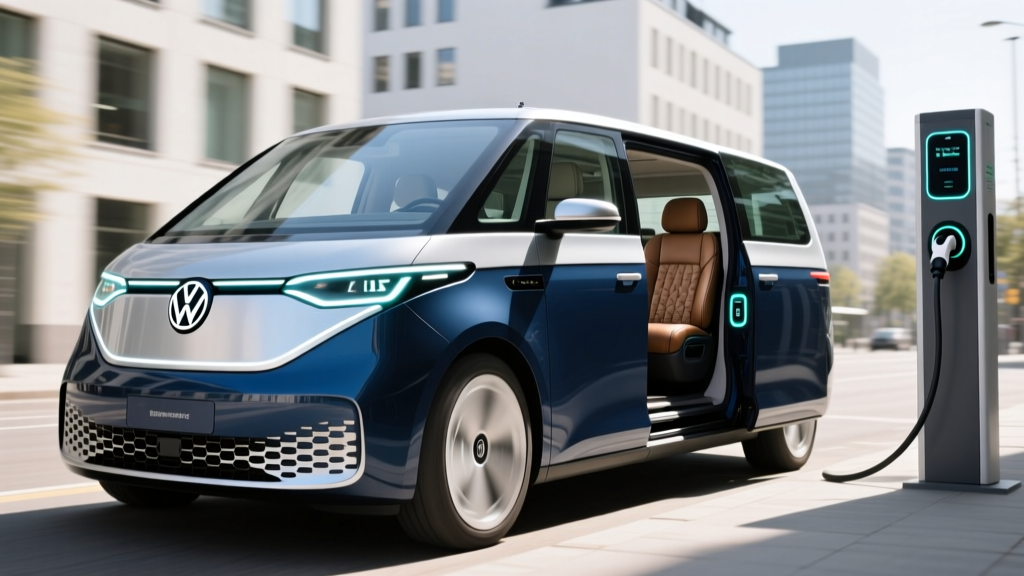
Quick Answer: The Volkswagen ID. Buzz is the brand's electric reinterpretation of the classic Microbus, now sold in the U.S. as a three-row passenger van. For the 2025–2026 model years, the long-wheelbase (LWB) version delivers an EPA-estimated 234 miles of range from a 91 kWh (usable) battery, seats up to seven, and starts around $59,995 before incentives. It charges at up to 175 kW on DC fast chargers (10–80% in roughly 26 minutes). It qualifies for a partial or full §30D federal tax credit depending on your income, battery sourcing, and point-of-sale transfer eligibility — but not every buyer will receive the full $7,500.
Is the Volkswagen EV Van Right for Your Family?
The ID. Buzz occupies a niche that no other mainstream EV fills in the U.S. market: a retro-styled, three-row electric people-mover. If you've been searching for a "volkswagen ev van" and wondering whether it can replace your gas minivan, the answer depends on your daily driving patterns, charging access, and budget.
The ID. Buzz makes sense if your typical day involves 100–150 miles of mixed driving with reliable overnight Level 2 charging at home. It struggles as a sole vehicle for families who regularly take 300+ mile road trips through sparse charging corridors, or who live in apartments without charging infrastructure. Unlike the Chrysler Pacifica Hybrid (a PHEV minivan with 32 miles of electric-only range and a gas backup), the ID. Buzz is fully electric — meaning range planning matters on long hauls.
Decision Framework: Should You Buy the ID. Buzz?
- Choose the ID. Buzz if: You need three rows, have home Level 2 charging, drive under 200 miles daily, and value a distinctive design with low running costs.
- Choose a PHEV minivan (e.g., Pacifica Hybrid) if: You frequently exceed 250 miles between stops, lack reliable home charging, or need a gas fallback for remote road trips.
- Wait or reconsider if: You tow (the ID. Buzz is not rated for towing in the U.S.), need AWD (not yet offered), or your budget caps below $50,000.
ID. Buzz Specs: Range, Battery, and Charging
| Specification | ID. Buzz LWB (2025–2026) |
|---|---|
| EPA Range | 234 miles (Pro S trim, RWD) |
| Real-World Range (highway/cold) | ~180–210 miles (70+ mph sustained); ~160–185 miles in sub-30°F weather |
| Battery (usable) | 91 kWh, NMC chemistry |
| Drivetrain | Rear-wheel drive, single motor (AWD announced, not yet available in U.S.) |
| Horsepower | 282 hp |
| 0–60 mph | ~7.9 seconds |
| Max DC Fast Charge | 175 kW (peak) |
| 10–80% DC Charge Time | ~26 minutes |
| Level 2 Charge Rate | 11 kW onboard charger (~7 hours for full charge on 48A circuit) |
| Connector | CCS1 (NACS adapter expected via Volkswagen's network partnerships) |
| Seating | 7 passengers (2-3-2 layout) |
| Cargo (behind 3rd row) | ~18.2 cu ft |
| Battery Warranty | 8 years / 100,000 miles (≥70% capacity retention) |
| Base MSRP | $59,995 (Pro S); $63,495 (1st Edition) |
Real-World Range Reality: The EPA rates the ID. Buzz LWB at 234 miles, but that figure assumes mixed driving at moderate speeds. On a flat, 75-mph highway run at 70°F, expect roughly 195–210 miles before hitting 10% SoC. In freezing temperatures (below 30°F), cabin heating and battery thermal management can reduce range by 20–30%, yielding approximately 160–185 miles. This is typical for a large, boxy EV — the aerodynamic profile of a van works against highway efficiency. Plan charging stops accordingly on road trips.
Charging Curve Explained
The 175 kW peak charge rate applies only between roughly 10–40% State of Charge. Above 60%, the charge rate tapers significantly — by 80%, you'll see roughly 50–60 kW. This is normal lithium-ion behavior to protect battery longevity, but it means the last 20% (80–100%) takes nearly as long as the first 70%. On road trips, plan to charge from 10–80% and drive on, rather than topping off to full.
How the ID. Buzz Compares to Gas and Hybrid Minivans
The ID. Buzz doesn't have a direct EV rival in the U.S. minivan segment. Its closest comparisons are the gas-powered Honda Odyssey and Toyota Sienna Hybrid. Here's how they stack up on the numbers that matter:
| Metric | VW ID. Buzz (EV) | Toyota Sienna (HEV) | Honda Odyssey (Gas) |
|---|---|---|---|
| Powertrain | Battery Electric | Hybrid (HEV) | Gasoline V6 |
| EPA Range / MPG | 234 mi / 87 MPGe (combined) | 36 MPG combined | 22 MPG combined |
| Starting MSRP | $59,995 | $38,085 | $39,635 |
| Fuel/Energy Cost (15,000 mi/yr) | ~$600–$900 (home charging at $0.14/kWh) | ~$1,460 (at $3.50/gal) | ~$2,385 (at $3.50/gal) |
| Annual Maintenance (est.) | ~$200–$400 | ~$500–$700 | ~$600–$900 |
| Seating | 7 | 7–8 | 7–8 |
| Towing Capacity | Not rated (U.S.) | 3,500 lbs | 3,500 lbs |
| Federal Tax Credit | Up to $7,500 (§30D, eligibility varies) | None (HEV) | None |
The ID. Buzz costs roughly $20,000–$22,000 more upfront than a base Sienna or Odyssey. However, the energy savings are substantial: charging at home at a national average of $0.14/kWh costs roughly $0.04–$0.06 per mile, compared to $0.16–$0.18 per mile for the Sienna hybrid and $0.22+ for the gas Odyssey. Over five years and 75,000 miles, that translates to $6,000–$10,000 in fuel savings — not including reduced maintenance (no oil changes, no transmission fluid, far less brake wear thanks to regenerative braking).
Even after applying a potential $7,500 federal tax credit (reducing the effective price to ~$52,500), the ID. Buzz still carries a significant price premium. The break-even point versus a Sienna Hybrid is roughly 7–9 years for most drivers, making it a long-term value play rather than an immediate cost saver.
Real Ownership Costs: 5-Year Breakdown
| Cost Category | ID. Buzz (5 Years) | Sienna HEV (5 Years) |
|---|---|---|
| Purchase Price (after tax credit) | ~$52,500* | $38,085 |
| Energy/Fuel (75,000 mi total) | ~$3,750 | ~$7,300 |
| Maintenance | ~$1,500 | ~$3,000 |
| Insurance (avg) | ~$9,000 | ~$7,500 |
| Estimated Depreciation | ~$22,000 | ~$14,000 |
| Total 5-Year Cost | ~$88,750 | ~$69,885 |
*Assumes full $7,500 §30D credit eligibility. Actual credit depends on income, battery sourcing, and MSRP caps. See IRS guidance below.
Key cost factors to understand:
- Home charging installation: If you need a 240V/48A Level 2 circuit installed, budget $800–$2,500 for the electrician, panel work, and permit. A panel upgrade to 200A can add $1,500–$3,500 if your existing panel is insufficient.
- Insurance: EV insurance premiums run 15–25% higher than comparable gas vehicles, driven by higher repair costs and battery replacement risk. Get quotes before purchasing.
- Depreciation: EV depreciation has been volatile. The ID. Buzz's retro appeal may help residual values, but EV market-wide depreciation currently exceeds that of Toyota hybrids. Plan conservatively.
- Public charging costs: If you rely on DC fast charging networks (Electrify America, EVgo), expect $0.35–$0.55/kWh — which can double your per-mile energy cost versus home charging. The ID. Buzz's 91 kWh battery means a 10–80% public charge session costs roughly $22–$35.
Federal Tax Credit: What You Actually Qualify For
The ID. Buzz's eligibility for the §30D Clean Vehicle Credit is not guaranteed for every buyer. Here's what determines your credit:
- MSRP Cap: Vans qualify under the $80,000 MSRP ceiling — the ID. Buzz clears this easily at ~$59,995–$63,495.
- Buyer Income Cap: Modified AGI must not exceed $300,000 (joint), $225,000 (head of household), or $150,000 (single).
- Battery Sourcing: The credit is split into two halves — $3,750 for critical minerals and $3,750 for battery component assembly. Sourcing requirements tighten annually. Verify the ID. Buzz's current sourcing status on fueleconomy.gov before purchasing, as eligibility can shift mid-year.
- Point-of-Sale Transfer: As of 2024+, you can transfer the credit to the dealer at purchase, reducing your out-of-pocket cost immediately rather than waiting for tax filing. The dealer must be IRS-registered.
- Final Assembly: The vehicle must undergo final assembly in North America. Confirm the ID. Buzz's assembly location via the VIN decoder on fueleconomy.gov.
Critical caveat: Battery sourcing rules have disqualified several previously eligible EVs. Always verify current eligibility within 30 days of purchase — do not rely on outdated forum posts or year-old articles. Consult a tax professional for your specific situation.
Common Misconceptions About the ID. Buzz
| Myth | Fact |
|---|---|
| "It gets 234 miles no matter how you drive." | EPA estimates assume mixed driving. Sustained highway speeds above 70 mph and cold weather reduce real range to 160–210 miles depending on conditions. |
| "The $7,500 tax credit applies to everyone." | Income caps, battery sourcing rules, and MSRP limits all apply. Some buyers qualify for $3,750, others for $7,500, and some for $0. |
| "It charges as fast as a Tesla." | At 175 kW peak, the ID. Buzz is slower than the Tesla Model X (250 kW) or Hyundai Ioniq 9 (350 kW). A 10–80% charge takes ~26 minutes, which is adequate but not class-leading. |
| "I don't need home charging — public chargers are everywhere." | Public DC charging at $0.40–$0.55/kWh costs 3–4× more than home charging. Without home access, your annual energy bill can exceed $2,500, eroding most of the EV cost advantage. |
| "The battery will need replacing in 5 years." | VW warranties the battery for 8 years/100,000 miles at ≥70% capacity. Modern NMC batteries in thermally managed systems typically retain 85–90% capacity at 100,000 miles based on industry degradation data. |
| "It can tow my trailer." | The U.S.-spec ID. Buzz is not rated for towing. If you need to tow, look at the Rivian R1S, Kia EV9, or a hybrid minivan. |
Charging at Home: What You Need to Know
The ID. Buzz's 11 kW onboard charger means it can accept the full output of a 48-amp Level 2 home charger (like a ChargePoint Home Flex or Emporia Level 2). On a 240V/48A circuit, a full charge from 0–100% takes approximately 9 hours — easily accomplished overnight.
| Charging Level | Power | Miles Added Per Hour | Full Charge Time |
|---|---|---|---|
| Level 1 (120V outlet) | ~1.4 kW | ~3–4 mi/hr | ~65 hours |
| Level 2 (240V, 48A) | 11 kW (vehicle-limited) | ~28–32 mi/hr | ~9 hours |
| DC Fast Charge | Up to 175 kW (peak) | ~130–150 mi/hr (at peak) | 10–80% in ~26 min |
Home installation reality: A standard Level 2 installation (running a 60A circuit with a 48A continuous charger) costs $800–$2,500 if your electrical panel has capacity. If you need a panel upgrade from 100A to 200A service, add $1,500–$3,500. Always hire a licensed electrician and pull a permit — unpermitted electrical work can void home insurance and create fire risk. The IRS also offers a residential energy credit that may cover up to 30% of charger installation costs (capped at specific limits).
First-Time EV Buyer Checklist
If the ID. Buzz is your first EV, here's what to prepare before signing:
- Verify home charging feasibility: Confirm you have a 240V outlet (NEMA 14-50 or hardwired circuit) or can install one. Get an electrician quote before buying.
- Test your commute: Drive your typical weekly route and total the miles. If it's under 200 miles round-trip with home charging, the ID. Buzz handles it effortlessly.
- Download charging apps: PlugShare, Electrify America, and EVgo apps let you map DC fast chargers along your common road-trip routes. Check coverage before you need it.
- Get insurance quotes early: EV insurance varies wildly by carrier. Some insurers (like Tesla Insurance or EV-specific programs) may offer better rates. Shop 3+ quotes.
- Verify tax credit eligibility: Check fueleconomy.gov for the specific VIN's credit status, confirm your income is under the cap, and ask the dealer about point-of-sale transfer.
- Understand preconditioning: The ID. Buzz can precondition its battery before DC fast charging (via navigation routing to a charger). This warms the battery for faster charge acceptance — especially critical in cold weather. Always navigate to your charger rather than just driving there.
Can the VW ID. Buzz replace my gas minivan for daily use?
Yes, if your daily driving is under 150 miles and you can charge at home overnight. The 234-mile EPA range (real-world ~200 miles in mild conditions) covers most family routines with margin. For regular 300+ mile trips, you'll need to plan 25-minute DC fast charging stops — which is manageable but requires route planning.
Does the ID. Buzz have all-wheel drive?
Not in the U.S. market as of the 2025–2026 model year. Volkswagen has announced an AWD variant (dual-motor, ~335 hp), but it is not yet available for American buyers. If AWD is non-negotiable for snow-belt driving, consider the Kia EV9 (AWD available) or wait for VW's timeline update.
How long does the ID. Buzz battery last?
VW warranties the high-voltage battery for 8 years or 100,000 miles, guaranteeing at least 70% capacity retention. Based on industry data for thermally managed NMC packs, most owners see 85–92% capacity at 100,000 miles. A full battery replacement (if needed out of warranty) is estimated at $12,000–$18,000, though this cost is expected to decline as the battery supply chain matures.
What happens if I can't charge at home?
Public DC fast charging costs $0.35–$0.55/kWh, making the ID. Buzz cost roughly $0.12–$0.17 per mile to fuel — still cheaper than gas, but far more than the $0.04–$0.06/mile home-charging rate. If you rely entirely on public charging, your annual energy cost rises to $1,800–$2,550 (at 15,000 miles/year). Factor this into your budget. Also account for the time cost: a 10–80% charge takes ~26 minutes, and you may need to detour to find an available, functioning charger.
Is the ID. Buzz eligible for the full $7,500 federal tax credit?
Eligibility depends on your income (under $300k joint / $150k single), the battery's critical mineral and component sourcing (which changes periodically), and the vehicle's MSRP (under $80k for vans — the ID. Buzz qualifies). Check the latest status on IRS.gov and fueleconomy.gov within 30 days of purchase. The credit can be transferred to the dealer at point of sale to reduce your purchase price immediately.