Is the 2026 Volkswagen ID. Buzz the Right EV for You?
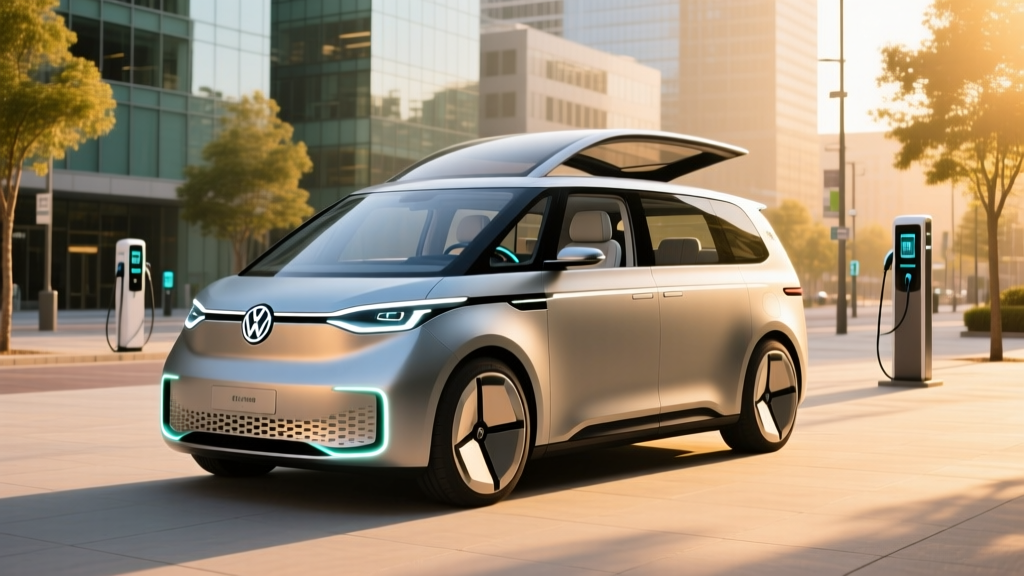
The 2026 Volkswagen ID. Buzz is a three-row electric minivan with an EPA-estimated 234 miles of range, a 91 kWh usable battery (NMC chemistry), and DC fast charging up to 200 kW (10–80% in approximately 26 minutes). Starting around $59,995, it qualifies as a minivan under IRS §30D rules, meaning it is eligible for up to $7,500 in federal tax credits if you meet income, sourcing, and point-of-sale transfer requirements. It trades range efficiency for interior volume and retro styling — if you need a spacious family hauler with three rows and don't routinely drive more than 200 miles between charges, the ID. Buzz is a compelling option. If maximum range per dollar is your priority, alternatives like the Kia EV9 offer more miles for less money.
Range, Battery, and Real-World Efficiency
The 2026 ID. Buzz comes in rear-wheel-drive (RWD) and all-wheel-drive (4Motion) configurations. Here are the hard numbers:
| Spec | ID. Buzz RWD (Std Range) | ID. Buzz 4Motion AWD |
|---|---|---|
| EPA Range | 234 miles | 217 miles |
| Battery (Usable) | 91 kWh (NMC) | 91 kWh (NMC) |
| Horsepower | 282 hp | 335 hp |
| 0–60 mph | ~7.9 sec | ~6.5 sec |
| Max DC Fast Charge | 200 kW | 200 kW |
| 10–80% DC Charge | ~26 min | ~26 min |
| Level 2 Charge (AC) | 11 kW (~9.5 hrs 0–100%) | 11 kW (~9.5 hrs 0–100%) |
| MPGe (Combined) | 87 MPGe | 81 MPGe |
| Towing Capacity | Not rated | Not rated |
| Base MSRP | $59,995 | $63,495 |
Real-World Range Expectations
The EPA sticker says 234 miles for the RWD model. In practice, plan for:
- Highway driving (75 mph): ~195–210 miles — the ID. Buzz's boxy shape creates significant aerodynamic drag at speed.
- Cold weather (below 32°F): ~165–185 miles — NMC batteries lose 20–30% capacity in freezing temps without consistent preconditioning.
- Mixed city/suburban: ~220–230 miles — regenerative braking recovers energy in stop-and-go traffic.
The ID. Buzz uses NMC (nickel manganese cobalt) battery chemistry, which offers higher energy density than LFP but is more sensitive to sustained 100% charging. For daily use, VW recommends setting the charge limit to 80% to preserve long-term battery health.
For comparison, the ID. Buzz's 87 MPGe combined translates to roughly 2.9 kWh per mile. That's notably less efficient than a Tesla Model Y (122 MPGe) but on par with other large three-row EVs. According to fueleconomy.gov, the ID. Buzz consumes about 34 kWh per 100 miles — expect to use roughly 31–37 kWh for a full charge from 10% to 100%.
Charging: Home Setup and Public Network Reality
The ID. Buzz charges via CCS1 connector (standard on most non-Tesla EVs). VW has partnered with Electrify America, and the vehicle includes a complimentary charging period on that network. Here's what charging looks like across levels:
| Level | Power | Miles Added/Hour | Typical Use Case |
|---|---|---|---|
| Level 1 (120V) | 1.4 kW | ~3–4 mi/hr | Emergency/trickle only |
| Level 2 (240V, 48A) | 11.5 kW | ~30–35 mi/hr | Home overnight charging |
| DC Fast Charge | Up to 200 kW | ~180+ mi in 26 min (10–80%) | Road trips, quick top-ups |
Charging curve reality: The 200 kW peak only sustains between roughly 10–30% state of charge. From 30–60%, expect ~150 kW. From 60–80%, it tapers to ~90–110 kW. Above 80%, charging slows dramatically to protect the battery — a full 80–100% top-up can take as long as the 10–80% session. Always precondition the battery (via the VW app or scheduled departure) before DC fast charging to hit peak rates.
Home charging installation: A Level 2 home charger requires a 240V circuit (typically 60A breaker for a 48A charger). Expect to spend:
| Item | Cost Range |
|---|---|
| Level 2 charger (e.g., ChargePoint Home Flex, Emporia Vue) | $400–$700 |
| Electrician labor (standard install) | $500–$1,500 |
| Electrical panel upgrade (if needed, 200A service) | $1,500–$3,500 |
| Permit fees | $50–$200 |
| Total (no panel upgrade) | $950–$2,400 |
| Total (with panel upgrade) | $2,450–$5,900 |
Always get a quote from a licensed electrician before purchasing — older homes with 100A panels will likely need an upgrade to support simultaneous household loads and a 48A EV charger.
Pricing, Tax Credits, and Total Cost of Ownership
The 2026 ID. Buzz lineup breaks down as follows:
- ID. Buzz Pro S (RWD): $59,995 MSRP
- ID. Buzz Pro S Plus (RWD): $63,495 MSRP
- ID. Buzz 1st Edition (AWD): $65,495 MSRP (limited production)
Federal §30D Tax Credit Eligibility (2026 Rules)
The ID. Buzz is classified as a minivan, so the MSRP cap is $80,000 (not $55,000 as with sedans). Per IRS guidelines, eligibility requires:
- Adjusted gross income ≤ $150,000 (single) / $225,000 (head of household) / $300,000 (joint)
- Vehicle assembled in North America (the ID. Buzz is built in Hanover, Germany — this may disqualify it from the full §30D credit; check the latest IRS VIN-lookup tool at fueleconomy.gov)
- Battery critical minerals and component sourcing thresholds (phased annually through 2032)
- Point-of-sale transfer available at participating dealerships — reduces purchase price directly
Critical note: Because the ID. Buzz is assembled in Germany, it may not qualify for the full $7,500 credit under current North American assembly requirements. VW has indicated ongoing efforts to address sourcing compliance. Always verify current eligibility on fueleconomy.gov before purchasing. State incentives (e.g., California, Colorado, New York) may still apply regardless of assembly location.
| Cost Factor (5 Years / 75,000 Miles) | VW ID. Buzz (EV) | Honda Odyssey (Gas Minivan) |
|---|---|---|
| Purchase price (after incentives) | ~$54,995 (est. with partial credit) | ~$41,000 |
| Fuel / electricity | ~$3,750 (at $0.14/kWh avg) | ~$9,375 (at $3.50/gal, 22 MPG) |
| Maintenance | ~$1,200 (no oil, fewer brake jobs) | ~$3,500 |
| Insurance (avg) | ~$9,500 | ~$7,500 |
| Depreciation (est.) | ~$22,000 | ~$18,000 |
| 5-Year Total Cost | ~$91,445 | ~$79,375 |
The ID. Buzz costs roughly $12,000 more over five years than a gas minivan, primarily due to higher purchase price and depreciation. The fuel and maintenance savings (~$7,900 combined) partially offset this. If you secure a full $7,500 credit and your state offers additional rebates, the gap narrows to ~$4,500. For families who value the EV driving experience, instant torque, and zero tailpipe emissions, that premium may be acceptable.
EV vs. Gas Minivan: What the Data Shows
| Attribute | VW ID. Buzz (EV) | Honda Odyssey / Toyota Sienna Hybrid |
|---|---|---|
| Range | 217–234 mi (EPA) | 450–550 mi (gas/hybrid) |
| Refuel/Recharge time | 26 min (10–80% DC) | 5 min (gas station) |
| Third-row usability | Good (flat floor, no tunnel) | Excellent (proven packaging) |
| Cargo (behind 3rd row) | 18.2 cu ft | 32.8 cu ft (Odyssey) |
| Home refueling | Yes (wake up "full" daily) | No |
| Cold-weather range loss | 20–30% | Minimal (5–10%) |
| Driving dynamics | Quiet, instant torque, heavy (5,800+ lbs) | Refined, lighter, conventional |
The Sienna hybrid achieves 36 MPG combined — that's a formidable efficiency benchmark the ID. Buzz can't match in MPGe terms. But the EV advantage is daily home charging: if you can install Level 2 at home, you'll never visit a gas station for daily driving. Road trips require planning around DC fast chargers, particularly in rural corridors.
First-Time EV Buyer: What You Must Know Before Purchasing
The ID. Buzz is a large, heavy vehicle — and that shapes the ownership experience in ways new EV buyers should anticipate:
- Home charging is nearly mandatory. Relying solely on public DC fast charging with a 91 kWh battery means frequent 25–30 minute stops and higher per-kWh costs ($0.35–$0.55/kWh at Electrify America vs. $0.12–$0.18/kWh at home). Budget for a Level 2 install before taking delivery.
- Tire costs are higher. The ID. Buzz's weight (5,800+ lbs curb weight) accelerates tire wear. Expect to replace tires every 25,000–35,000 miles at $250–$350 per tire for the OEM-rated rubber.
- Insurance premiums run 15–25% higher than comparable gas minivans, reflecting repair costs and parts availability for a niche EV.
- The charge port is on the driver-side rear quarter panel — plan your parking orientation at home and at public chargers accordingly.
- Software and OTA updates are part of VW's ID. platform. Expect periodic updates that can improve charging curves and add features, but also occasional bugs that require dealer visits.
Common Misconceptions About the ID. Buzz
| Myth | Fact |
|---|---|
| "It gets 234 miles no matter how you drive it." | EPA is a lab estimate. Highway driving at 75 mph yields ~200 miles; freezing weather drops it to ~170 miles. |
| "It qualifies for the full $7,500 tax credit." | The ID. Buzz is assembled in Germany. North American assembly is a §30D requirement. Verify VIN eligibility at fueleconomy.gov before purchase. |
| "DC fast charging always hits 200 kW." | Peak rate only applies between ~10–30% SoC with a preconditioned battery. Average session rate is closer to 130–140 kW. |
| "I don't need a home charger." | Public DC charging costs 2–4x more per mile than home Level 2. Without home charging, the ID. Buzz's cost advantage over gas evaporates. |
| "The battery will need expensive replacement soon." | VW warranties the battery at 8 years/100,000 miles with a 70% capacity retention guarantee. Data from similar NMC packs shows 10–15% degradation over 100,000 miles under normal use. |
Decision Framework: Should You Buy the ID. Buzz?
Choose the VW ID. Buzz if:
- You need a three-row minivan and want an EV (the selection is very limited — Kia EV9 is the main rival)
- You can install a Level 2 home charger and will do 80%+ of charging at home
- Your typical daily driving is under 150 miles round-trip
- You value distinctive styling and VW's ID. software ecosystem
- You live in a state with additional EV incentives that offset the higher MSRP
Look elsewhere if:
- You regularly drive 300+ miles between stops — the 217–234 mile range will frustrate on road trips
- You cannot install home charging (apartment/condo without charger access)
- Budget is the primary concern — a Toyota Sienna hybrid costs $20,000 less and gets 36 MPG
- You need maximum cargo space — the Odyssey and Sienna offer significantly more room behind the third row
- You live in an extremely cold climate (consistent sub-20°F winters) and cannot garage the vehicle
Battery Warranty and Long-Term Ownership
VW covers the ID. Buzz battery with an 8-year/100,000-mile warranty guaranteeing at least 70% state of health (capacity retention). The broader vehicle warranty is 4 years/50,000 miles bumper-to-bumper. Based on data from VW's ID.4 (which shares the MEB platform and NMC chemistry), owners typically see 8–12% degradation over the first 60,000 miles, with the curve flattening afterward.
If out-of-warranty replacement is ever needed, a 91 kWh NMC pack currently costs in the range of $15,000–$22,000 for parts and labor — though prices are expected to decline as battery manufacturing scales. This is a worst-case scenario most owners will never face.
Frequently Asked Questions
Does the 2026 VW ID. Buzz have a frunk (front trunk)?
No. The ID. Buzz does not include a front trunk. All cargo space is in the rear, with 18.2 cu ft behind the third row and up to 137.5 cu ft with both rear rows folded.
Can the ID. Buzz tow a trailer?
VW has not published an official towing rating for the US-market ID. Buzz at launch. European-spec models are rated for approximately 2,200 lbs (braked), but US specifications should be confirmed with your dealer before attempting any towing.
Is the ID. Buzz self-driving?
No. The ID. Buzz comes equipped with VW's IQ.DRIVE suite, which is an SAE Level 2 driver-assistance system. It includes adaptive cruise control, lane-keeping assist, and travel assist. You must remain fully engaged with hands on the wheel and eyes on the road at all times. This is not autonomous driving.
How does the ID. Buzz compare to the Kia EV9?
The Kia EV9 starts lower (~$54,900), offers up to 304 miles of EPA range (Long Range RWD), and has more cargo space. The ID. Buzz counters with retro styling, a slightly more premium interior feel, and VW's charging network partnerships. If range and value lead your decision, the EV9 wins. If style and VW brand loyalty matter more, the ID. Buzz holds its own.
What happens if I charge to 100% every day?
With NMC chemistry, routinely charging to 100% accelerates degradation. VW recommends an 80% daily charge limit and reserving 100% for road trips. The battery management system includes a buffer, but consistently sitting at 100% — especially in hot climates — will reduce long-term capacity faster than following the 80% guideline.
Where can I find current tax credit eligibility for the ID. Buzz?
Check the official VIN lookup tool at fueleconomy.gov and consult IRS.gov §30D guidance. Tax professionals can help you navigate income caps and point-of-sale transfer options. State incentives vary — consult your state's energy office for local rebates.