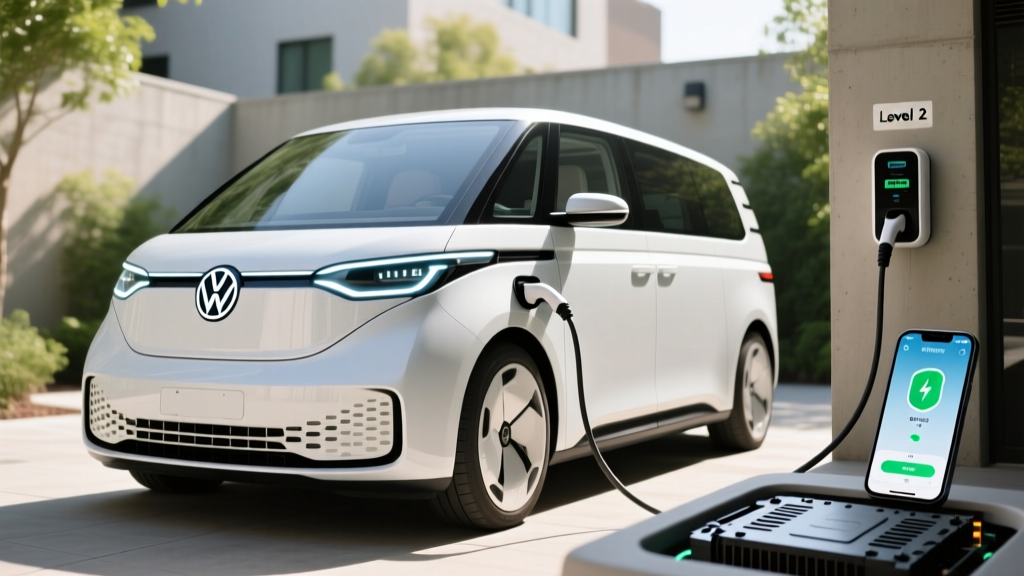
The retro-styled microbus is back, but the 2026 Volkswagen ID. Buzz electric van is no nostalgia act. Underneath the two-tone paint and surfboard-friendly silhouette sits VW's MEB electric platform—the same architecture beneath the ID.4 crossover—stretched to accommodate three rows of seating and serious cargo volume. For US buyers, the ID. Buzz arrives exclusively as a long-wheelbase model with a 91 kWh (usable) battery, available rear-wheel-drive or all-wheel-drive, and a starting price that lands squarely in premium minivan territory.
But does a 234-mile EPA range, a boxy aero profile, and a curb weight north of 5,700 pounds make sense in a market increasingly defined by 300+ mile crossovers? We've parsed the EPA data, VW's official specs, and real-world driving dynamics to give you the numbers that actually matter.
Range, Efficiency & Real-World Expectations
EPA Estimated: 234 miles (RWD) / 231 miles (AWD)
Real-World Highway (70 mph, 75°F): ~195–210 miles
Cold Weather (30°F, mixed driving): ~165–185 miles
The ID. Buzz's flat-front, boxy shape creates more aerodynamic drag than a sleek crossover. Expect a 10–15% highway penalty versus the EPA sticker, and up to 25–30% loss in freezing temperatures with cabin heating active.
The RWD model achieves an EPA-estimated 87 MPGe combined (roughly 39 kWh/100 mi), while the AWD 4Motion variant drops slightly to 84 MPGe combined (~40 kWh/100 mi). These are respectable figures for a vehicle with the frontal area of a small building, but they underscore that the ID. Buzz prioritizes interior volume over efficiency. For context, the Chrysler Pacifica Hybrid PHEV achieves 82 MPGe in electric mode but offers only 32 miles of electric range before switching to its gas engine.
If your typical week involves school runs, grocery hauls, and the occasional 150-mile round trip, the 234-mile range provides a comfortable buffer. Cross-country road trips, however, require planning: DC fast-charging stops every 150–170 real-world miles are the norm, not the exception.
Battery, Chemistry & Longevity
| Spec | Value |
|---|---|
| Gross Capacity | 91 kWh |
| Usable Capacity | ~86 kWh |
| Chemistry | NMC (Nickel Manganese Cobalt) |
| Thermal Management | Active liquid cooling/heating |
| Battery Warranty | 8 years / 100,000 miles (70% capacity retention) |
VW uses NMC chemistry in the ID. Buzz rather than the LFP (lithium iron phosphate) packs found in some base-trim Tesla and Ford models. NMC offers higher energy density—critical for fitting enough cells into the MEB floor to push range above 230 miles—but it comes with a slightly different care profile. VW recommends keeping the state of charge between 20% and 80% for daily use, reserving 100% charges for road trips. The 8-year/100,000-mile battery warranty guarantees at least 70% capacity retention, which is industry-standard and consistent with DOT/EPA battery longevity data showing most liquid-cooled NMC packs retain 85–90% after 100,000 miles.
Charging Speed: DC Fast, Level 2 & Home Setup
| Charging Level | Power (kW) | Speed / Time |
|---|---|---|
| Level 1 (120V household) | ~1.4 kW | ~3 miles per hour |
| Level 2 (240V, 32A) | 7.7 kW | ~19 miles per hour; full charge in ~11 hrs |
| Level 2 (240V, 48A) | 11.5 kW | ~28 miles per hour; full charge in ~7.5 hrs |
| DC Fast Charge (peak) | 170 kW (CCS) | 10–80% in ~26 minutes |
The ID. Buzz peaks at 170 kW on DC fast chargers using the CCS1 connector. That's a meaningful figure, but context matters: the charge curve tapers significantly above 80% state of charge, so a 10–80% session takes roughly 26 minutes while a 10–100% session stretches past 45 minutes. On a 300-mile road trip, plan to charge to 80% and move on—that's where the math favors speed.
At home, the onboard 11.5 kW AC charger (on higher trims) is a strong point. A 48-amp Level 2 wall connector on a NEMA 14-50 or hardwired circuit adds roughly 28 miles of range per hour, meaning an overnight session easily replenishes a full day's driving. Most ID. Buzz owners will find a Level 2 home installation costs $500–$1,500 for the charger plus electrician labor, assuming a 200-amp electrical panel with available capacity.
Important note: VW uses the CCS1 connector for the US market. While the industry is shifting toward NACS (Tesla's standard), VW has committed to CCS through the current MEB generation. Adapters for Tesla Superchargers are available from third parties, but native NACS adoption is expected on VW's next-generation SSP platform.
Performance, Drivetrain & Driving Dynamics
| Spec | RWD (Pro S) | AWD 4Motion |
|---|---|---|
| Horsepower | 282 hp | 335 hp |
| Torque | 406 lb-ft | 406 lb-ft (combined) |
| 0–60 mph | ~7.9 seconds | ~6.1 seconds |
| Top Speed | 99 mph (electronically limited) | 99 mph |
| Towing Capacity | 2,500 lbs | 2,500 lbs |
The rear-wheel-drive ID. Buzz uses a single APP550 electric motor on the rear axle producing 282 hp. That's adequate for merging and city driving, but the 7.9-second 0–60 time won't win any stoplight races. The AWD 4Motion adds a front-axle induction motor for 335 combined hp and a significantly quicker 6.1-second sprint—worth the ~$4,000 upcharge if you frequently carry a full load of passengers and cargo or deal with snowy roads.
Driving dynamics are what you'd expect from a 5,700-pound van: composed and quiet at highway speeds thanks to the low center of gravity from the floor-mounted battery, but with noticeable body roll through corners and a firm ride over broken pavement. The turning circle is surprisingly tight at 36.8 feet (curb-to-curb), making the ID. Buzz manageable in urban parking lots despite its 195-inch overall length.
Interior Space, Cargo & Practicality
This is where the ID. Buzz justifies its existence. The long-wheelbase US model offers:
- Passenger capacity: 7 (2-3-2 seating) or 6 (2-2-2 captain's chairs, optional)
- Cargo behind 3rd row: 18.4 cu ft
- Cargo behind 2nd row (3rd row folded): 75.5 cu ft
- Max cargo (2nd & 3rd rows folded): 131.2 cu ft
- Second-row legroom: 37.6 inches
- Third-row legroom: 33.5 inches
- Sliding side doors: Power-operated, with kick-sensor opening on 1st Edition and higher trims
The third row is genuinely usable for adults on shorter trips—a rarity in the EV space and a clear advantage over three-row crossovers like the Kia EV9 (32.0 inches of third-row legroom). The flat floor, enabled by the skateboard battery architecture, creates an airy cabin with a commanding view forward. The available panoramic fixed glass roof floods the interior with light but does reduce cargo stacking height slightly.
One practical note: the ID. Buzz does not offer a front trunk (frunk). The hood area houses the HVAC system and power electronics, so all cargo goes in the rear. For a vehicle this size, that's a minor trade-off.
Pricing, Trims & Federal Tax Credit
| Trim | MSRP (incl. destination) | After Potential §30D Credit |
|---|---|---|
| Pro S (RWD) | $59,995 | $52,495* |
| Pro S (AWD 4Motion) | $63,995 | $56,495* |
| 1st Edition (AWD) | $69,995 | $62,495* |
*$7,500 credit assumes buyer meets all IRS §30D requirements. Eligibility is NOT guaranteed and depends on multiple factors.
- MSRP cap: Vans classified as SUVs/light trucks have an $80,000 MSRP cap — all ID. Buzz trims qualify ✓
- Buyer income cap: $150K single / $225K head of household / $300K joint MAGI
- Battery sourcing: Critical minerals and battery components must meet phased-in percentage thresholds from US/free-trade-agreement sources — verify VIN eligibility at fueleconomy.gov before purchase
- Point-of-sale transfer: As of 2024, you can transfer the credit to the dealer for an immediate price reduction at purchase (requires dealer registration and buyer tax-documentation)
- Tax liability: Credit is non-refundable — you must owe at least $7,500 in federal income tax to claim the full amount
The ID. Buzz's $59,995 starting price places it in competition with the Chrysler Pacifica Hybrid PHEV (~$52,000), the Kia EV9 three-row SUV (~$56,000 base), and loaded versions of the Toyota Sienna hybrid minivan (~$55,000). The VW's premium is justified by its all-electric powertrain, lower per-mile fuel cost, and distinctive design—but buyers sensitive to upfront cost should run a 5-year total cost of ownership comparison before committing.
Technology, Safety & Driver Assistance
The ID. Buzz comes standard with VW's IQ.DRIVE suite, which includes:
- Adaptive cruise control with stop-and-go
- Lane-keeping assist with active centering
- Front and rear automatic emergency braking
- Blind-spot monitoring with rear cross-traffic alert
- Travel Assist (combined lane + adaptive cruise for highway driving)
IQ.DRIVE and Travel Assist are Level 2 driver-assistance systems. The driver must remain attentive, keep hands on or near the wheel, and be prepared to take over instantly. This is NOT autonomous or "self-driving" capability. Only Level 4 services like Waymo operate without a driver engaged.
The infotainment system runs VW's ID.Software 4.0 on a 12.9-inch touchscreen with wireless Apple CarPlay and Android Auto. A heads-up display with augmented-reality navigation arrows is available on higher trims. Over-the-air updates are supported, and VW has improved the system's responsiveness over earlier ID.4 iterations, though the touch-capacitive sliders for volume and temperature remain a common complaint for being finicky while driving.
Who Should Buy the ID. Buzz?
- You need genuine 7-passenger seating with a usable third row and minivan-style sliding doors
- Most of your driving is within a 150-mile daily radius and you have reliable home Level 2 charging
- You value distinctive design and want an EV that stands out in the school pickup line
- You want zero tailpipe emissions for family hauling in urban and suburban environments
- You frequently drive 250+ mile highway stretches and don't want to plan DC fast-charging stops
- You live in a region with harsh winters and limited public charging infrastructure
- You need more than 2,500 lbs of towing capacity (the Kia EV9 tows up to 5,000 lbs)
- Budget is a primary concern — a loaded Sienna or Pacifica Hybrid delivers similar utility for $10–15K less
Pros & Cons Summary
- Best-in-class interior volume with genuinely usable 3rd row
- Minivan sliding doors with available hands-free opening
- Strong 11.5 kW Level 2 onboard charger
- Distinctive, head-turning design with heritage appeal
- Quiet, refined ride quality at highway speeds
- Low running costs vs. gas minivans (~$0.06/mi electricity vs ~$0.18/mi gas)
- 234-mile EPA range is tight for a vehicle this size
- 170 kW peak DC charging is slower than Hyundai/Kia's 800V rivals
- No frunk (front trunk) for additional cargo
- CCS1 connector (not NACS) limits native Tesla Supercharger access
- Touch-capacitive climate/volume controls frustrate some drivers
- Premium pricing vs. hybrid minivan alternatives
Frequently Asked Questions
What is the real-world range of the VW ID. Buzz?
The EPA rates the RWD ID. Buzz at 234 miles and the AWD at 231 miles. In real-world highway driving at 70 mph in moderate temperatures, expect 195–210 miles. In cold weather (below freezing), range can drop to 165–185 miles due to battery resistance and cabin heating demands.
How fast does the ID. Buzz charge at home and on the road?
On DC fast chargers, it peaks at 170 kW and charges from 10–80% in approximately 26 minutes. At home on a 48-amp Level 2 charger (11.5 kW), it adds about 28 miles of range per hour, fully recharging overnight in roughly 7.5 hours.
Does the Volkswagen ID. Buzz qualify for the federal EV tax credit?
The ID. Buzz's MSRP falls under the $80,000 van/SUV cap, so it clears that hurdle. However, full $7,500 credit eligibility depends on the buyer's income (MAGI limits apply), the vehicle's battery mineral/component sourcing compliance with current-year thresholds, and the buyer's federal tax liability. Always verify VIN eligibility at fueleconomy.gov and consult a tax professional before relying on the credit.
Is the ID. Buzz worth buying over a hybrid minivan?
If you have home charging, drive mostly within a 150-mile radius, and value zero tailpipe emissions, the ID. Buzz's lower per-mile energy cost ($0.06 vs. $0.18 for gas) and smoother driving experience make a compelling case. If you regularly tow, take long road trips, or live in a charging-desert region, the Chrysler Pacifica Hybrid or Toyota Sienna offer more flexibility at a lower price.
Can the ID. Buzz tow a trailer?
Yes, but modestly. The ID. Buzz is rated for 2,500 lbs of towing capacity across all trims—enough for a small utility trailer or a pair of jet skis, but not a boat or large camper. Towing also reduces range by approximately 30–40%.
What connector does the ID. Buzz use?
The US-market ID. Buzz uses the CCS1 connector for DC fast charging and the J1772 connector for Level 1/Level 2 AC charging. VW has not yet adopted the NACS (Tesla) connector on the current MEB platform.