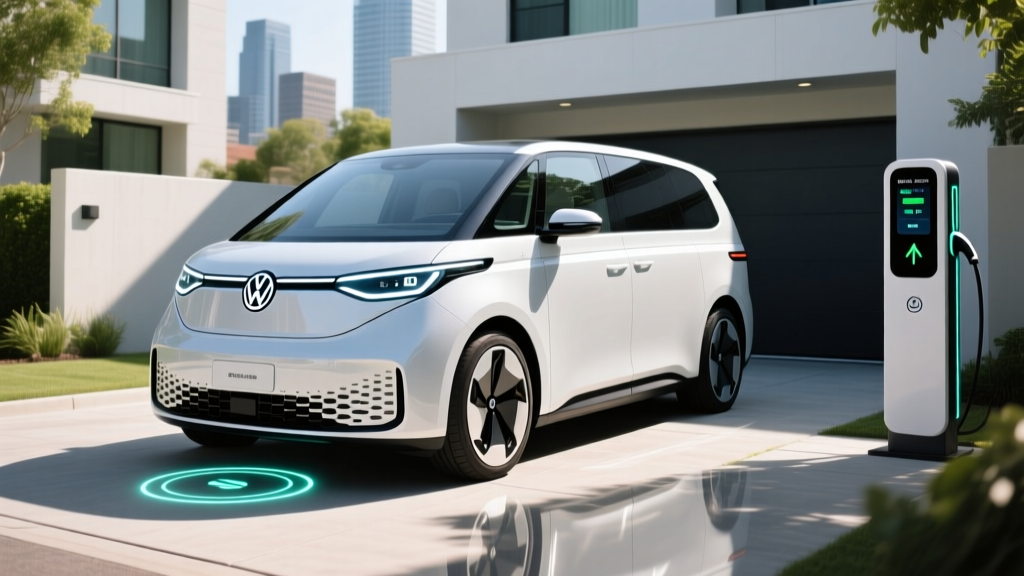
The Volkswagen ID. Buzz arrived in the United States for the 2025 model year carrying decades of microbus nostalgia and a very modern 91 kWh battery pack. As the first mainstream electric minivan sold in America since the concept-car era, it faces a specific question from family hauler shoppers: does the retro charm survive contact with real-world range, charging speeds, and minivan practicality?
After examining EPA data, charging curves, interior measurements, and current federal incentive rules, the answer is nuanced. The ID. Buzz delivers a usable 234-mile EPA range, competitive DC fast-charging, and a genuinely flexible three-row cabin — but it asks buyers to accept some trade-offs in highway efficiency and software polish that its rivals don't.
Range, Efficiency, and the Real-World Reality Check
Real-World Expectation: Plan for ~190–210 miles on sustained highway trips at 70+ mph. In cold weather (below 35°F), expect a 20–30% reduction, bringing usable range to roughly 160–185 miles. City and suburban driving with regenerative braking gets you closest to the EPA sticker.
The ID. Buzz uses a 91 kWh usable battery (NMC chemistry) mounted in the skateboard floor. On the EPA's fueleconomy.gov listing, the rear-wheel-drive model returns 87 MPGe combined, which translates to roughly 35–38 kWh per 100 miles in mixed driving. That's thirstier than a Tesla Model Y or Hyundai Ioniq 5, largely because of the Buzz's boxy aerodynamics and 5,800-pound curb weight.
The efficiency penalty matters most on road trips. At highway speeds, the flat front end and tall greenhouse create drag that drains the battery faster than sleeker crossovers. For daily commuting under 60 mph, you'll see numbers much closer to the EPA estimate, and one-pedal driving in B mode helps recapture energy in stop-and-go traffic.
Battery, Charging Speeds, and What to Expect at the Plug
Volkswagen equips the US-spec ID. Buzz with a 91 kWh (usable) lithium-ion NMC pack — not the LFP chemistry some competitors have adopted for standard-range models. NMC offers higher energy density, which matters in a heavy minivan, but it also means VW recommends capping daily charging at 80% for long-term battery health.
| Charging Level | Power / Rate | Speed (Miles Added) | Notes |
|---|---|---|---|
| Level 1 (120V household) | ~1.4 kW | ~3–4 miles per hour | Emergency/trickle only; full charge in 60+ hours |
| Level 2 (240V home) | 11 kW (48A) | ~26 miles per hour | Full 0–100% in ~9 hours; ideal overnight |
| DC Fast Charge | Peak 170 kW | 10–80% in ~26 min | CCS connector; tapers significantly above 80% |
The 170 kW peak DC fast-charge rate is respectable but not class-leading. Rivals like the Hyundai Ioniq 5 and Kia EV9 can peak at 200–240 kW thanks to 800V architectures, shaving 5–8 minutes off a 10–80% session. The ID. Buzz uses a conventional 400V system, so the charge curve tapers more gradually: you'll see 170 kW only between roughly 10–40% state of charge, then a step down to ~120 kW through 60%, and a slow crawl above 85%.
For home charging, the onboard 11 kW AC charger is a strong point. A properly installed 48-amp Level 2 circuit will replenish the battery fully overnight, which is essential for a family vehicle that needs to start every morning at full charge. Budget $500–$1,500 for a quality Level 2 home station plus electrician installation, and potentially more if your panel needs a 200-amp upgrade.
Performance and Drivetrain: RWD Standard, AWD Available
| Specification | Pro S (RWD) | Pro S Plus (AWD) |
|---|---|---|
| Drivetrain | Rear-Wheel Drive | Dual-Motor AWD |
| Horsepower | 282 hp | 335 hp |
| 0–60 mph | ~7.9 sec | ~6.5 sec |
| Top Speed | 99 mph (electronically limited) | 99 mph |
| Towing Capacity | Not rated | Not rated |
The ID. Buzz isn't quick by EV standards, but it's adequate for a three-row family hauler. The RWD model's 282 hp and 7.9-second 0–60 time handle merging and passing without drama. The AWD Pro S Plus adds a front motor for 335 hp total and drops the sprint to about 6.5 seconds — useful if you're frequently carrying six passengers and cargo up mountain grades.
Ride quality is a highlight. The long 127.5-inch wheelbase and low center of gravity produce composed, car-like handling that belies the van proportions. The turning radius is surprisingly tight, and the elevated seating position gives excellent forward visibility. Where the Buzz falls short is towing: Volkswagen has not published a US towing rating, so if you need to pull a trailer, the Kia EV9 (up to 5,000 lbs with the GT-Line AWD) is the electric three-row to consider.
Interior Space, Cargo, and Minivan Practicality
The ID. Buzz is a genuine three-row vehicle with seating for up to seven (2-3-2 layout) or six (2-2-2 with captain's chairs). Second-row legroom is generous at approximately 40 inches, and third-row adults will find it more accommodating than most midsize SUVs, though headroom is limited by the sloping rear glass.
Cargo volume behind the third row is approximately 18.5 cubic feet — enough for a week's groceries or a couple of carry-ons. Fold the third row flat and you unlock roughly 75 cubic feet, and with both rear rows down, the Buzz offers over 140 cubic feet of flat load space. The low, flat floor and wide side-opening doors make loading strollers and bulky items far easier than in any SUV.
What the Buzz doesn't offer is a traditional minivan feature set: there are no sliding rear doors (it uses conventional swing-out doors), no stow-and-go seating, and no available rear-seat entertainment system. The two-tone paint and retro styling turn heads, but buyers who prioritize pure minivan utility may find the Chrysler Pacifica Hybrid's sliding doors and fold-flat seats more practical.
Pricing, Trims, and Federal Tax Credit Eligibility
| Trim | Base MSRP | Est. Federal Credit (§30D) | Effective Price |
|---|---|---|---|
| Pro S (RWD) | $59,995 | Up to $7,500* | ~$52,495 |
| Pro S Plus (AWD) | $69,995 | Up to $7,500* | ~$62,495 |
| 1st Edition (AWD, limited) | $69,995 | Up to $7,500* | ~$62,495 |
*Federal tax credit eligibility under IRS §30D rules depends on multiple factors:
- MSRP Cap: Vans classified as SUVs have an $80,000 MSRP cap — the ID. Buzz qualifies on all trims.
- Buyer Income Limits: AGI must not exceed $300,000 (joint), $225,000 (head of household), or $150,000 (single).
- Battery Sourcing: Critical minerals and battery component requirements phase in annually. Verify current-year compliance on the IRS qualified vehicles list before purchasing.
- Point-of-Sale Transfer: Eligible buyers can transfer the credit to the dealer at purchase, reducing the out-of-pocket price immediately rather than waiting for tax filing.
The ID. Buzz is not cheap. At $59,995 to start, it undercuts the Kia EV9 only slightly and costs significantly more than a Chrysler Pacifica Hybrid. The federal credit helps, but state incentives vary widely — check your local DMV and utility for additional rebates. Insurance premiums also run 15–25% higher than comparable ICE minivans, a factor worth quoting before purchase.
Technology, Driver Assists, and Software Quirks
The ID. Buzz runs Volkswagen's ID. Software 4.0 on a 12.9-inch touchscreen with a 5.3-inch digital instrument cluster. Wireless Apple CarPlay and Android Auto are standard, as is a heated steering wheel and heated front seats on all trims. The available head-up display with augmented-reality navigation is a nice touch for a vehicle with this much windshield.
Driver assistance comes via VW's IQ.DRIVE suite, which includes adaptive cruise control with stop-and-go, lane centering, automatic emergency braking, and blind-spot monitoring. This is an SAE Level 2 system — it assists with steering and speed but requires the driver to remain fully engaged at all times. It is not autonomous driving.
Warranty and Long-Term Battery Outlook
Volkswagen backs the ID. Buzz with a 4-year/50,000-mile bumper-to-bumper warranty and an 8-year/100,000-mile battery and powertrain warranty. The battery warranty guarantees that the pack will retain at least 70% of its original capacity during that period — consistent with industry norms from Hyundai, Kia, and Ford.
NMC batteries in VW's MEB platform (shared with the ID.4) have shown moderate degradation in real-world use: approximately 5–8% capacity loss over the first 100,000 miles based on European ID.4 fleet data. The liquid-cooled thermal management system helps, but buyers in hot climates should precondition the battery and avoid frequent 100% charges to maximize longevity. Full battery replacement, if needed outside warranty, currently runs $15,000–$22,000 — a figure to keep in mind for second-ownership planning.
Pros, Cons, and the Decision Framework
- Unique, head-turning retro styling with two-tone paint options
- Genuine three-row seating with adult-usable third row
- Excellent ride quality and tight turning radius for its size
- 170 kW DC fast charging with CCS compatibility on most networks
- Low, flat cargo floor with up to 140+ cu ft of space
- Qualifies for full $7,500 federal tax credit (verify sourcing annually)
- Real-world highway range drops to ~190–210 miles — tight for road trips
- No sliding rear doors — a minivan staple
- Not rated for towing in the US market
- Infotainment capacitive sliders are frustrating to use while driving
- Starting MSRP near $60K is steep before incentives
- 400V architecture means slower DC charging vs 800V rivals
Look elsewhere if: You need to tow a trailer, regularly drive 300+ miles between charges, want sliding doors for tight parking lots, or prioritize the fastest possible DC charging. The Kia EV9 offers more range (304 mi EPA), 5,000-lb towing, and 800V fast charging — though with less character.
Frequently Asked Questions
What is the real-world range of the Volkswagen ID. Buzz?
The EPA rates the RWD ID. Buzz at 234 miles and the AWD at 231 miles. In real-world highway driving at 70–75 mph, expect roughly 190–210 miles. Cold weather (below 35°F) can reduce range by 20–30%, so winter road trips require careful planning around DC fast chargers.
How fast does the ID. Buzz charge at home and on the road?
On a Level 2 home charger (11 kW / 48A), the ID. Buzz gains about 26 miles of range per hour and charges fully in roughly 9 hours. On a DC fast charger, it peaks at 170 kW and charges from 10–80% in approximately 26 minutes, though the curve tapers above 80%.
Does the Volkswagen ID. Buzz qualify for the $7,500 federal EV tax credit?
As of the current tax year, the ID. Buzz appears on the IRS qualified vehicles list and is eligible for up to $7,500 under §30D, subject to buyer income caps ($300K joint / $150K single), the $80K MSRP cap for SUVs/vans, and battery sourcing requirements that update annually. The credit can be transferred to the dealer at point of sale. Always verify current eligibility at irs.gov before purchasing.
Is the ID. Buzz worth buying over the Kia EV9 or Chrysler Pacifica Hybrid?
It depends on priorities. The Kia EV9 offers more range (304 mi), faster charging, towing capability, and a lower starting price — but lacks the Buzz's charm and car-like ride. The Chrysler Pacifica Hybrid provides sliding doors, stow-and-go seats, and a ~$45K starting price, but only 32 miles of electric range before the gas engine kicks in. The Buzz wins on driving refinement and uniqueness; it loses on pure utility metrics.
Can the ID. Buzz tow a trailer?
Volkswagen has not published a US towing rating for the ID. Buzz. European-market versions are rated for up to 2,200 lbs (braked), but US-spec models are not officially rated. If towing is a priority, the Kia EV9 (up to 5,000 lbs) or Rivian R1S are better electric options.
Does the ID. Buzz have sliding rear doors?
No. The ID. Buzz uses conventional swing-out rear doors. This is one of the most common criticisms from minivan shoppers who rely on sliding doors for tight parking spaces and curbside child loading.