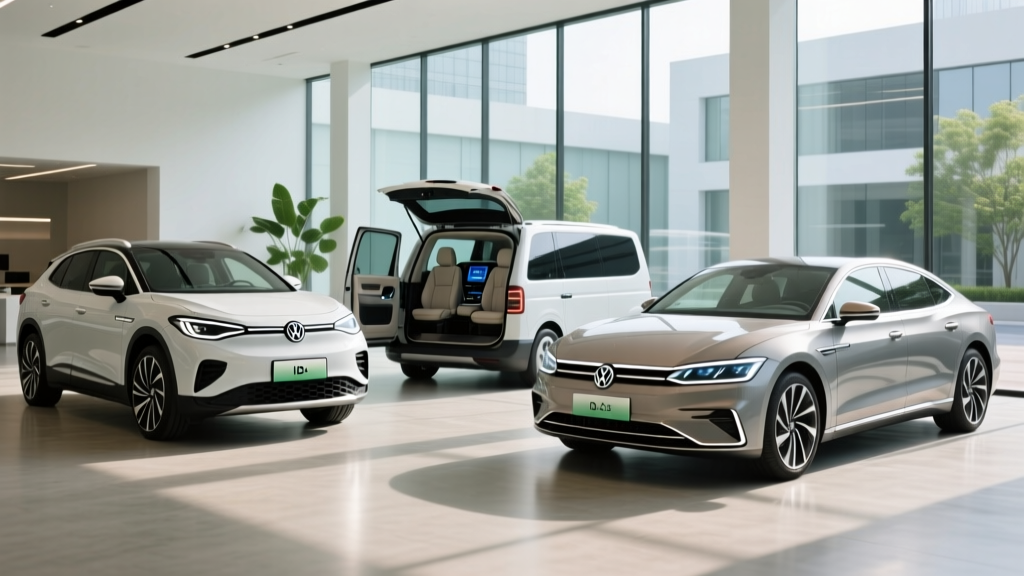
Which Volkswagen EV is right for you? The 2026 ID.4 is VW's mainstream electric SUV with up to 291 miles of EPA range and a starting MSRP near $40,000, making it the default pick for most families. The ID. Buzz is a retro-styled three-row electric van (EPA est. 231–234 miles) starting around $60,000, built for space and lifestyle over efficiency. The ID.7 sedan (announced for the U.S., EPA est. ~300+ miles) targets Tesla Model 3 buyers seeking a premium, long-range commuter. All three ride on VW's MEB platform, use NMC battery chemistry, and support DC fast charging up to 175–200 kW depending on the model.
The 2026 Volkswagen EV Lineup at a Glance
Volkswagen's U.S. electric portfolio centers on three distinct vehicles sharing the modular MEB architecture. Each serves a different buyer profile, and the differences in range, charging behavior, and pricing are substantial enough to matter at purchase time.
| Spec | 2026 ID.4 (Pro S AWD) | 2026 ID. Buzz (AWD) | 2026 ID.7 (Estimated) |
|---|---|---|---|
| Battery (usable) | 82 kWh, NMC | 86 kWh, NMC | 82 kWh, NMC |
| EPA Range | 291 mi (RWD) / 263 mi (AWD) | 231–234 mi | ~300+ mi (est.) |
| Peak DC Charge Rate | 175 kW | 200 kW | 200 kW (est.) |
| 10–80% DC Fast Charge | ~28 min | ~26 min | ~25 min (est.) |
| Level 2 Charge Rate | 11 kW | 11 kW | 11 kW |
| Horsepower | 295 hp (AWD) | 330 hp (AWD) | 282 hp (est.) |
| 0–60 mph | 5.7 sec (AWD) | 5.7 sec (AWD) | ~6.0 sec (est.) |
| Starting MSRP | ~$39,995 | ~$59,995 | TBA (est. ~$50,000) |
| Battery Warranty | 8 yr / 100,000 mi | 8 yr / 100,000 mi | 8 yr / 100,000 mi |
Sources: fueleconomy.gov, Volkswagen USA. ID.7 figures are preliminary estimates for an announced model not yet on sale in the U.S.
Real-World Range vs. EPA Stickers
EPA range estimates are measured under controlled conditions that rarely match a Tuesday commute in January. Here is what Volkswagen EV buyers should actually expect:
ID.4 RWD (EPA 291 mi): Expect 240–260 miles on a highway road trip at 70 mph. In cold weather (below 32°F), plan for 190–220 miles due to cabin heating demands and reduced battery chemistry efficiency.
ID. Buzz AWD (EPA 231 mi): The boxy aerodynamics and heavy curb weight (~5,500 lbs) cut real-world highway range to roughly 185–200 miles. Cold weather drops this to 155–175 miles.
ID.7 (EPA ~300+ mi est.): Sedan aerodynamics help. Expect 260–280 miles highway, with cold-weather range near 210–240 miles.
The ID.4's available heat pump (standard on higher trims) recovers waste heat from the drivetrain to warm the cabin, reducing cold-weather range loss by roughly 10–15% compared to resistive heating. If you live in the upper Midwest or Northeast, a heat pump is a non-negotiable spec to verify on your trim.
Charging Speeds and the Curve Reality
Volkswagen quotes peak DC fast-charge rates, but sustained charging speed matters more on road trips. The MEB platform's charge curve ramps quickly to peak kW, holds through roughly 30–60% state of charge (SoC), then tapers progressively.
| Charging Level | Power (kW) | Miles Added per Hour | Typical Use Case |
|---|---|---|---|
| Level 1 (120V) | 1.4 kW | ~4 mi/hr | Overnight trickle; emergency top-up |
| Level 2 (240V, 48A) | 11 kW | ~32–37 mi/hr | Home daily charging; full charge in 8–9 hr |
| DC Fast Charge | 175–200 kW (peak) | ~600–700 mi/hr (at peak) | Road trips; 10–80% in 25–28 min |
Key detail: kW (kilowatts) measures the rate of energy delivery — like water pressure from a hose. kWh (kilowatt-hours) measures the total energy stored in the battery — like the size of the tank. A 175 kW charger filling an 82 kWh battery doesn't fill it in 28 minutes flat; the rate slows as the battery approaches full, which is why manufacturers quote 10–80% times.
At an Electrify America 350 kW station, the ID.4 will peak near 175 kW but averages roughly 120–130 kW over a 10–80% session. That translates to adding about 170–180 real-world miles in 25–28 minutes. The ID. Buzz's slightly higher 200 kW peak and larger 86 kWh pack yield similar session times despite the heavier vehicle.
Volkswagen includes three years of unlimited 30-minute DC fast-charging sessions at Electrify America with new ID.4 and ID. Buzz purchases — a significant offset for road-trip fueling costs in the early ownership period.
Cost Breakdown: Purchase, Charging, and Ownership
Purchase Price and Tax Credits
The federal EV tax credit under IRS §30D offers up to $7,500 for qualifying new EVs, but eligibility depends on MSRP caps, buyer income limits, and battery critical-mineral sourcing requirements. As of 2026, the ID.4 (MSRP under the $80,000 SUV cap) may qualify for partial or full credit depending on battery sourcing — Volkswagen has been shifting supply chains to meet North American critical-mineral thresholds, but trim-level eligibility varies. The ID. Buzz, with an MSRP near $60,000, falls under the cap but faces the same sourcing scrutiny.
- MSRP Cap: ≤$80,000 for SUVs/vans (ID.4, ID. Buzz qualify); ≤$55,000 for sedans (ID.7 may be close to the line)
- Income Cap: AGI ≤$150,000 single / ≤$300,000 joint
- Battery Sourcing: Critical minerals and battery components must meet escalating North American thresholds — verify per VIN at the dealer
- Point-of-Sale Transfer: Eligible buyers can apply the credit as a down-payment reduction at purchase rather than waiting for tax filing
Always confirm credit eligibility with your tax professional and the dealer's VIN-level documentation before purchase. Rules change and vary by production batch.
| Cost Factor | ID.4 AWD (5 yr) | Comparable Gas SUV (5 yr) | Notes |
|---|---|---|---|
| Purchase Price (avg trim) | $47,000 | $40,000 | EV premium ~$7,000 before credits |
| Federal Tax Credit | –$3,750 to –$7,500 | $0 | Varies by sourcing; confirm per VIN |
| Fuel / Electricity (75,000 mi) | $3,200–$4,800 | $8,500–$10,200 | Home charging at $0.14/kWh vs. DCFC at $0.40/kWh; gas at $3.40/gal, 26 MPG |
| Maintenance | $1,200 | $3,500 | No oil changes, fewer brake replacements (regen braking) |
| Insurance (avg) | $9,500 | $7,800 | EV premiums run 15–25% higher on average |
| Estimated 5-Year Total | $57,150–$60,950 | $59,800–$61,500 | Near parity when credit applies; EV wins on home charging |
The math tilts decisively in the EV's favor if you charge at home on a standard Level 2 setup at residential electricity rates. Public DC fast charging at $0.35–$0.48/kWh erases most fuel-cost savings, making home charging access the single most important variable in EV ownership economics.
Home Charging Setup
A Level 2 home charger (240V, 48-amp circuit) delivers roughly 32–37 miles of range per hour, fully replenishing an ID.4 overnight. Installation costs vary:
| Component | Typical Cost Range |
|---|---|
| Level 2 Charger (hardware) | $400–$700 |
| Electrician labor (240V run, 50A circuit) | $800–$2,500 |
| Permit / inspection | $100–$400 |
| Panel upgrade (if needed, 200A service) | $1,500–$4,000 |
| Total (no panel upgrade) | $1,300–$3,600 |
| Total (with panel upgrade) | $2,800–$7,600 |
Homes with existing 200-amp electrical panels and garage proximity to the panel typically fall in the lower range. Older homes with 100-amp service or long conduit runs will require a panel upgrade. Always get a licensed electrician's assessment before committing to a vehicle purchase.
Volkswagen EVs vs. Gas and Hybrid Alternatives
| Metric | ID.4 AWD | Gas Compact SUV (AWD) | Compact PHEV SUV |
|---|---|---|---|
| EPA Combined Efficiency | 104 MPGe (32 kWh/100mi) | 28 MPG | 38 MPG + 30 mi electric |
| Fuel Cost per Mile | $0.04–$0.13 | $0.13–$0.15 | $0.05–$0.12 |
| Cargo Volume | 30.3 cu ft (rear seats up) | 33–37 cu ft | 30–34 cu ft |
| Maintenance Intervals | Tire rotation + cabin filter | Oil, filters, brakes, fluids | Oil + electric system checks |
| Cold-Weather Range Loss | 20–35% | ~5% (MPG drop) | Electric range drops 25–40% |
| Refuel/Recharge Time | 25–28 min (10–80% DCFC) | 5 min | 5 min (gas) / 2.5 hr (L2) |
The ID.4 wins on per-mile fuel cost and maintenance savings but loses on cargo flexibility and refueling speed compared to gas. A PHEV like the Toyota RAV4 Prime splits the difference: electric for short commutes, gas for road trips — ideal if you lack reliable home charging or frequently drive beyond 250 miles between stops.
Common Misconceptions About Volkswagen EVs
| Myth | Fact |
|---|---|
| "VW's software is broken and unreliable." | Early ID.4 models (2021–2023) had significant infotainment bugs. VW's 4.0 software update (rolled out progressively since late 2024) addressed most stability issues. New 2026 models ship with the improved stack, though the touchscreen-centric climate controls remain a UX complaint. |
| "The battery will need replacing in 5 years." | VW warranties the battery for 8 years/100,000 miles against degradation below 70% capacity. Industry-wide data from Recurrent Auto shows MEB batteries retaining 90%+ capacity at 60,000 miles. Replacement, if ever needed out of warranty, costs $15,000–$22,000 but is rarely required. |
| "You can't road-trip an ID.4." | The Electrify America network (which VW helped fund) covers all major U.S. interstate corridors. With 10–80% charges in ~28 minutes, a 600-mile trip requires two stops adding ~60 minutes total — manageable with planning via the EA or PlugShare apps. |
| "All VW EVs qualify for the full $7,500 tax credit." | Credit eligibility depends on battery sourcing, buyer income, and MSRP. Some ID.4 trims may qualify for $3,750 (partial) or the full $7,500 depending on the production batch's critical-mineral compliance. Verify per VIN. |
Decision Framework: Which Volkswagen EV Fits Your Life?
Choose the ID.4 if: You need a practical family SUV with 250+ real-world miles of range, can charge at home, and want the lowest entry price in VW's EV lineup. Best for daily commutes under 60 miles with occasional 300-mile road trips.
Choose the ID. Buzz if: You need three rows of seating, value the retro-lifestyle design, and primarily drive within a 150-mile daily radius. Accept that 185–200 real-world highway miles means more frequent charging stops on long trips. The 86 kWh pack and 200 kW peak charging partially offset the efficiency penalty.
Wait for the ID.7 if: You want a long-range sedan rivaling the Tesla Model 3 or Hyundai Ioniq 6, prioritize aerodynamic efficiency, and don't need SUV cargo height. U.S. availability and final pricing remain unconfirmed — check VW's announcements before planning a purchase timeline.
Look beyond VW if: You lack home charging access and your area has sparse DC fast-charging infrastructure, you regularly tow more than 2,700 lbs (the ID.4's max), or you need 300+ real-world highway miles without stopping. Consider a PHEV or the Hyundai Ioniq 5 (which offers NACS compatibility and 800V charging) instead.
Frequently Asked Questions
Does the Volkswagen ID.4 support NACS (Tesla-style) charging?
For 2026, VW continues to use the CCS1 connector on U.S. models. VW has not announced a factory NACS transition for the ID.4 or ID. Buzz as of early 2026, though adapters for Tesla Supercharger access are expected. Check VW's official announcements before purchase if Supercharger access is a priority.
How long does a VW EV battery actually last?
VW warranties the high-voltage battery for 8 years or 100,000 miles, guaranteeing at least 70% capacity retention. Real-world data from fleet operators and testing organizations suggests NMC batteries on the MEB platform degrade roughly 5–8% over the first 100,000 miles under normal use. Avoiding repeated 100% charges and frequent DC fast charging from very low SoC extends longevity.
Is the ID.4 good in snow and cold weather?
The AWD variant provides confident traction, and the available heat pump mitigates range loss. However, expect 20–35% range reduction in sustained sub-freezing temperatures. An ID.4 AWD with 263 EPA miles may deliver 180–210 real-world miles in winter. Preconditioning the battery while plugged in (using the VW app) restores some efficiency by warming the pack before departure.
What does home charging cost compared to gas?
At the U.S. average residential rate of ~$0.14/kWh, fully charging an ID.4's 82 kWh battery costs about $11.50, yielding roughly 240 real-world miles — equivalent to $0.048/mile. A gas SUV at 28 MPG with fuel at $3.40/gallon costs $0.121/mile. Over 15,000 annual miles, home charging saves roughly $1,100/year. Public DC fast charging at $0.40/kWh raises EV cost to ~$0.137/mile, erasing the advantage.
Can I tow with a Volkswagen ID.4?
The ID.4 AWD is rated to tow up to 2,700 lbs when equipped with the factory tow hitch. That covers a small utility trailer or a pair of jet skis but not a loaded travel trailer. Towing significantly reduces range — expect a 30–50% drop depending on trailer weight and aerodynamics.