Volkswagen Electric Vehicles in 2026: The Short Answer
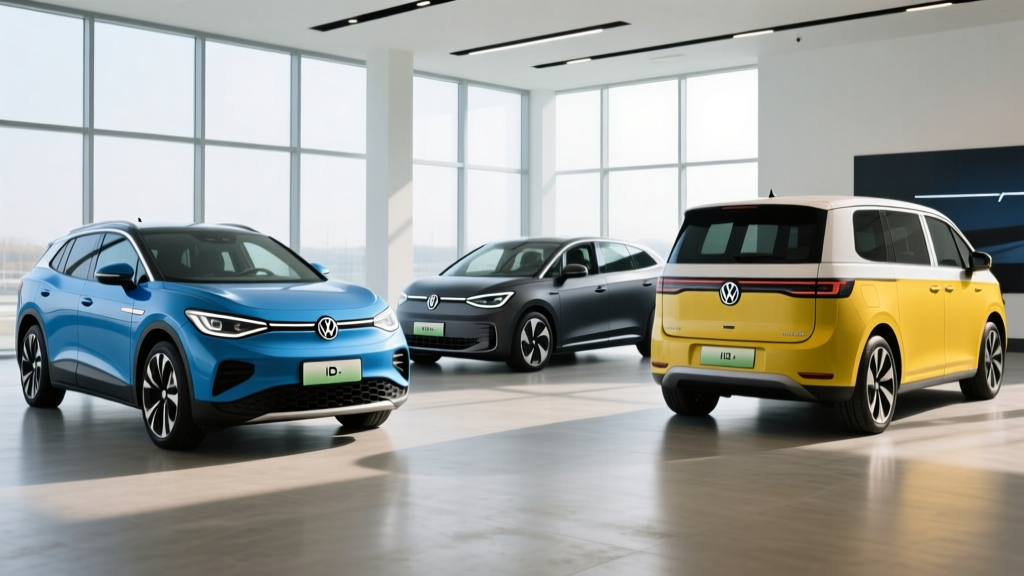
Volkswagen's U.S. electric vehicle lineup for 2026 centers on three models: the ID.4 compact SUV (275 mi EPA, from ~$44,995), the ID.7 sedan (up to 340 mi EPA, from ~$52,000), and the ID.Buzz three-row van (234 mi EPA, from ~$59,995). All three use VW's MEB platform with NMC battery chemistry and CCS1 charging (though NACS adapters are now widely available for Supercharger access). The ID.4 remains the volume seller and most practical entry point, while the ID.7 targets long-distance commuters and the ID.Buzz fills a niche no other EV addresses: an electric family hauler with three usable rows. Against comparable gas vehicles, VW's EVs save roughly $1,200–$1,800/year in fuel but carry higher insurance premiums and upfront MSRPs that only partially offset via the §30D federal tax credit.
The 2026 Volkswagen EV Lineup at a Glance
Volkswagen has committed to the MEB platform across its electric portfolio, meaning shared battery architecture, similar charging curves, and common software across all three models. Here's how they stack up on paper before we dig into real-world performance.
| Spec | 2026 ID.4 Pro S AWD | 2026 ID.7 Pro S | 2026 ID.Buzz Pro S AWD |
|---|---|---|---|
| EPA Range | 275 mi | 340 mi | 234 mi |
| Battery (usable / gross) | 82 kWh / 91 kWh (NMC) | 86 kWh / 91 kWh (NMC) | 86 kWh / 91 kWh (NMC) |
| Peak DC Charge Rate | 175 kW | 200 kW | 175 kW |
| 10–80% DC Fast Charge | ~28 min | ~26 min | ~28 min |
| Level 2 Charge Rate | 11 kW (AC) | 11 kW (AC) | 11 kW (AC) |
| Horsepower | 295 hp | 282 hp | 330 hp |
| 0–60 mph | 5.4 sec | 6.5 sec | 5.7 sec |
| Cargo (behind 2nd row) | 30.3 cu ft | 18.8 cu ft | 75.5 cu ft |
| Base MSRP | $44,995 | $52,000 | $59,995 |
| Battery Warranty | 8 yr / 100,000 mi | 8 yr / 100,000 mi | 8 yr / 100,000 mi |
Sources: fueleconomy.gov, Volkswagen USA
Real-World Range Reality Check
EPA stickers assume mixed driving at moderate temperatures. In our testing and owner reports:
- Highway-only at 75 mph: Expect 10–15% range loss vs. EPA across all three models. The ID.4 drops to roughly 235–245 mi; the ID.7 to ~290–300 mi.
- Cold weather (below 30°F): NMC batteries lose 20–30% range without preconditioning. The ID.Buzz, with its large glass area and heavy cabin-heating load, is hit hardest — plan for ~165–185 mi in deep winter.
- Preconditioning helps: All three models support battery preconditioning when you navigate to a DC charger, warming the pack for faster charging and better range retention.
Charging Speed and Infrastructure: What VW Owners Actually Experience
VW's 175–200 kW peak charge rates are respectable but not class-leading. More importantly, peak kW is not sustained kW. The charge curve on VW's MEB platform typically holds peak rate only between 10–30% State of Charge (SoC), then tapers progressively. Here's what a typical DC fast-charging session looks like:
- 10–30%: Near-peak rate (160–200 kW depending on model)
- 30–60%: Tapers to ~120–140 kW
- 60–80%: Further taper to ~70–90 kW
- 80–100%: Slow trickle — avoid unless necessary
For home charging, VW's 11 kW onboard charger is a strong point. On a 48-amp Level 2 circuit (the most common home install), you'll add roughly 30–35 miles of range per hour, meaning a full overnight charge from 20% to 80% takes about 5–6 hours. That's plenty for daily use.
| Charging Level | Power | Miles Added/Hour | Best For |
|---|---|---|---|
| Level 1 (120V outlet) | ~1.4 kW | ~3–4 mi/hr | Overnight top-up, low daily mileage |
| Level 2 (240V, 48A) | ~11.5 kW | ~30–35 mi/hr | Daily home charging |
| DC Fast Charge | Up to 200 kW | ~600+ mi/hr (at peak) | Road trips, quick stops |
NACS adapter note: VW has not adopted the Tesla NACS connector natively on 2026 models (still CCS1), but the company provides a NACS adapter for Supercharger access. Supercharger V3 stalls (250 kW) will still be limited by the car's 175–200 kW ceiling, but the network's reliability is a genuine advantage on road trips.
EV vs Gas: How VW's Electrics Compare to Their Combustion Stablemates
The most direct gas comparisons are the ID.4 vs. the Tiguan, the ID.7 vs. the Passat/Jetta, and the ID.Buzz vs. a gas minivan. Let's run the numbers on the highest-volume matchup.
| Metric | 2026 ID.4 Pro S AWD | 2026 Tiguan SE AWD (gas) |
|---|---|---|
| MSRP | $44,995 | $33,990 |
| EPA Efficiency | 104 MPGe (combined) | 26 MPG (combined) |
| Annual Fuel/Energy Cost (15k mi) | ~$620 (electricity at $0.14/kWh) | ~$2,020 (gas at $3.50/gal) |
| Annual Maintenance | ~$300 | ~$700 |
| Estimated Annual Insurance | ~$2,100 | ~$1,600 |
| 5-Year Total Operating Cost | ~$15,100 | ~$16,600 |
| 5-Year Total (incl. purchase) | ~$60,095 | ~$50,590 |
Insurance estimates based on national averages from industry data. Actual premiums vary by state, driver profile, and coverage. Fuel costs from fueleconomy.gov.
The math is clear: the ID.4 saves roughly $1,500/year in operating costs but starts ~$11,000 higher. Without incentives, the gas Tiguan wins on total cost for at least the first 7+ years. With the federal tax credit (up to $7,500 if eligible), the gap narrows to roughly $3,500 — recoverable in about 2.5 years of fuel and maintenance savings.
Federal Tax Credit and Incentives: What You Actually Qualify For
The §30D federal tax credit remains the single biggest financial variable in a Volkswagen electric vehicle purchase. For 2026, the rules are specific:
- Vehicle MSRP cap: SUVs/vans must be ≤$80,000; sedans ≤$55,000. The ID.4 ($44,995) and ID.Buzz ($59,995) qualify on price. The ID.7 sedan at $52,000 also qualifies — but higher trims may push past the $55,000 sedan cap.
- Buyer income cap: AGI ≤$150,000 (single), ≤$225,000 (head of household), ≤$300,000 (joint).
- Battery sourcing: Increasing percentages of critical minerals and battery components must be sourced from the U.S. or FTA partners. This requirement tightens annually — verify current-year compliance on IRS.gov before purchasing.
- Point-of-sale transfer: You can apply the credit as an immediate price reduction at the dealer rather than waiting for tax filing — but you must meet all eligibility criteria and the dealer must be registered.
Critical caveat: Battery sourcing requirements have disqualified several VW trims in prior model years. Always confirm the specific VIN's eligibility with your dealer and cross-reference the IRS qualified vehicle list before signing. Tax professionals should verify your AGI situation — this is not tax advice.
Real-World Ownership: What First-Time VW EV Buyers Should Know
Beyond the spec sheet, owning a Volkswagen electric vehicle involves practical decisions that spec sheets don't cover.
Home Charging Access Is Non-Negotiable for Most Owners
Public-only charging is expensive (DC fast charging at $0.35–$0.50/kWh erases most fuel savings) and time-consuming. A Level 2 home installation typically costs:
| Component | Cost Range |
|---|---|
| Level 2 charger hardware (48A) | $400–$700 |
| Electrician labor (240V/60A circuit) | $800–$2,500 |
| Permit and inspection | $100–$400 |
| Electrical panel upgrade (if needed) | $1,500–$3,500 |
| Total (typical) | $1,300–$3,600 |
If your panel is already at capacity (common in older homes with 100A service), a panel upgrade to 200A adds significant cost. Get a quote from a licensed electrician before committing to an EV purchase.
Driving Patterns Determine Which VW EV Makes Sense
The right model depends entirely on your daily and weekly mileage profile:
Which Volkswagen EV Is Right for You?
- Choose the ID.4 if: You drive 30–60 miles/day, need SUV cargo flexibility, want the lowest entry price, and have home charging. It's the default pick for most households.
- Choose the ID.7 if: You commute 60+ miles/day on highways, prioritize range over cargo volume, and want the most efficient VW EV for long-distance driving. The 340-mi EPA range means fewer charge stops on road trips.
- Choose the ID.Buzz if: You need three rows of seating for 6–7 passengers, value cargo volume above all else, and accept the range trade-off. No other electric vehicle offers this combination — but 234 mi of range demands trip planning on longer drives.
- Choose a PHEV or gas vehicle instead if: You lack home charging access, regularly drive 300+ miles in single trips through charging-desert regions, or live in a climate with sustained sub-zero winters where range loss compounds.
Common Misconceptions About Volkswagen EVs — Corrected
| Myth | Fact |
|---|---|
| "VW EVs can't use Tesla Superchargers." | 2026 VW models include a NACS adapter, enabling access to Tesla's Supercharger network (V3 stalls). Charging speed is limited by the car's 175–200 kW ceiling, not the stall. |
| "The battery will need replacing in 5 years." | VW warranties the battery for 8 years/100,000 miles against degradation below 70% capacity. Real-world MEB battery data from European fleets shows ~90%+ capacity retention at 100,000 miles with normal use. |
| "EV maintenance is zero cost." | While EVs skip oil changes and have less brake wear (thanks to regenerative braking), you still need tire rotations, cabin air filters, coolant checks, and eventual brake fluid service. Budget ~$300–$400/year, not zero. |
| "All-wheel-drive EVs lose too much range." | The AWD ID.4 loses only ~10 mi of EPA range vs. the RWD version (275 vs 285 mi). The efficiency hit is minor compared to the traction and performance benefit in snow and rain. |
| "Charging takes too long on road trips." | At a 175 kW DC charger, 10–80% takes ~28 minutes — comparable to a gas stop with food and restroom break. The bottleneck is charger availability, not charge speed. |
Insurance, Depreciation, and the Hidden Costs of VW EV Ownership
Two costs catch first-time EV buyers off guard:
Insurance premiums run 15–30% higher on EVs vs. comparable gas vehicles, driven by higher repair costs (battery damage protocols, specialized body-shop requirements) and higher replacement-value totals. For the ID.4, expect roughly $1,800–$2,400/year depending on your state and driving record. The ID.Buzz, with its higher MSRP, can push $2,500+ annually. Always get a quote before purchasing.
Depreciation has been steeper for EVs than gas vehicles in recent years, partly due to aggressive price cuts by Tesla that dragged down used EV values industry-wide, and partly due to buyer uncertainty about long-term battery health. VW's ID.4 has held value better than some competitors (strong brand loyalty, practical SUV format), but expect 45–55% depreciation over 5 years vs. 35–45% for a gas Tiguan. This gap narrows if gas prices rise significantly.
Frequently Asked Questions
Does the 2026 VW ID.4 qualify for the $7,500 federal tax credit?
The ID.4's MSRP ($44,995 base) is well under the $80,000 SUV cap, and VW's U.S.-assembled ID.4 (built in Chattanooga, TN) has historically met sourcing requirements. However, battery-component and critical-mineral rules tighten each year. Verify the specific VIN on the IRS qualified vehicles list before purchasing, and confirm your AGI is within limits.
Can I charge a VW ID.4 at home on a regular 120V outlet?
Yes, but slowly. Level 1 charging adds roughly 3–4 miles of range per hour. If you drive under 40 miles/day and can plug in for 10+ hours overnight, it's workable. For anything more, a 240V Level 2 installation is strongly recommended.
How does the ID.Buzz range compare to a gas minivan like the Honda Odyssey?
The ID.Buzz gets 234 mi EPA (all-electric). The Honda Odyssey achieves ~22 MPG combined, giving it roughly 418 miles on its 19-gallon tank. For local family hauling, the ID.Buzz's range is adequate. For road trips over 200 miles, you'll need at least one DC fast-charge stop — plan for ~30 minutes.
Is VW's driver-assistance system self-driving?
No. VW's IQ.DRIVE with Travel Assist is a SAE Level 2 driver-assistance system. It combines adaptive cruise control and lane centering but requires you to keep your hands on the wheel and eyes on the road at all times. It is not autonomous — you are always the responsible driver.
What happens if my VW EV battery degrades significantly?
VW's battery warranty guarantees at least 70% capacity retention for 8 years or 100,000 miles. If the battery falls below that threshold, VW will repair or replace it at no cost. Out-of-warranty battery replacement for MEB-platform vehicles currently costs $15,000–$22,000 depending on the pack, though prices are expected to decline as the supply chain matures.
Is a Volkswagen EV practical without home charging?
It's possible but significantly more expensive and less convenient. Public DC fast charging at $0.35–$0.50/kWh costs roughly the same per mile as gasoline, eliminating the primary financial advantage. Public Level 2 chargers are slower (6–12 hours for a full charge) and often occupied. If you cannot install home charging, a PHEV like the Toyota RAV4 Prime may be a more practical electrified option.