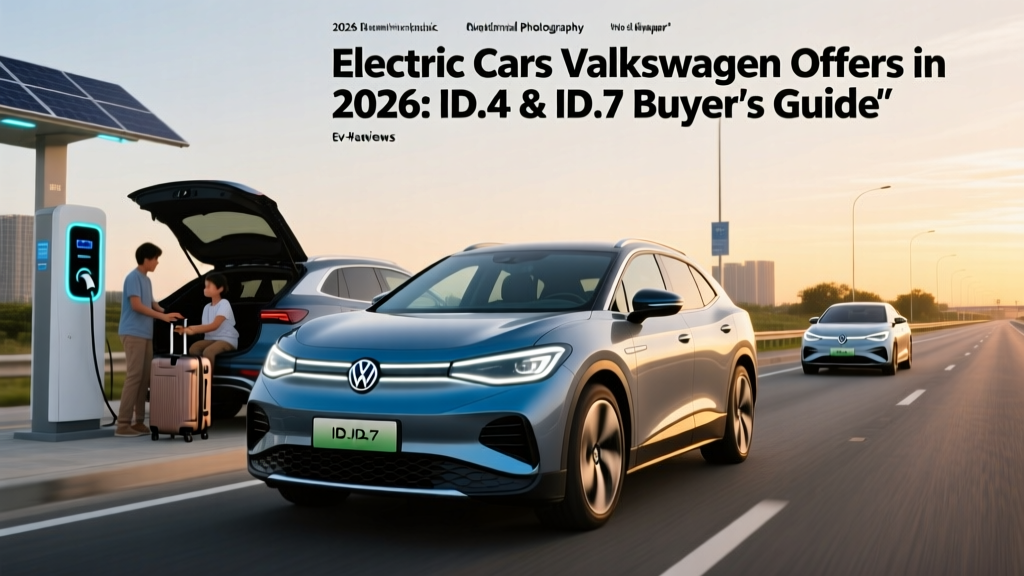
Quick Answer: Which Volkswagen EV Should You Buy?
Volkswagen sells two battery-electric models in the US for 2026: the ID.4 compact SUV (starting ~$39,735, EPA range up to 291 miles, 77 kWh NMC battery) and the ID.7 sedan (starting ~$49,995, EPA range up to 364 miles, 86 kWh NMC battery). The ID.4 is the volume seller and family hauler; the ID.7 targets highway commuters who need maximum range. Both use the MEB platform, support DC fast charging up to 175–200 kW, and qualify for varying levels of the federal §30D tax credit depending on battery-sourcing compliance and buyer income. If you need cargo space and AWD availability, choose the ID.4. If you prioritize efficiency and long-distance comfort, the ID.7 wins.
Volkswagen's 2026 Electric Vehicle Lineup at a Glance
Volkswagen's US electric strategy has narrowed to two core battery-electric vehicles (BEVs) after discontinuing the limited-run ID. Buzz microbus import plans. Both the ID.4 and ID.7 are built on VW's MEB (Modularer E-Antriebs-Baukasten) platform, sharing architecture but targeting distinct buyer profiles.
| Spec | 2026 VW ID.4 Pro S AWD | 2026 VW ID.7 Pro S |
|---|---|---|
| Body Style | Compact SUV | Midsize Sedan |
| Base MSRP | $44,235 | $49,995 |
| EPA Range | 263 mi (AWD) / 291 mi (RWD) | 364 mi |
| Battery (Usable) | 77 kWh, NMC | 86 kWh, NMC |
| Drivetrain | RWD or AWD | RWD |
| Horsepower | 282 hp (RWD) / 335 hp (AWD) | 282 hp |
| 0–60 mph | 7.7 sec (RWD) / 5.4 sec (AWD) | 6.5 sec |
| Peak DC Fast Charge | 175 kW | 200 kW |
| 10–80% DCFC Time | ~28 min | ~26 min |
| Level 2 Charge Rate | 11 kW (AC) | 11 kW (AC) |
| MPGe (Combined) | 104 MPGe (RWD) | 120 MPGe (est.) |
| Cargo Volume | 30.3 cu ft (rear seats up) | 18.1 cu ft (trunk) |
| Battery Warranty | 8 yr / 100,000 mi | 8 yr / 100,000 mi |
Sources: fueleconomy.gov, VW ID.4 official specs, VW ID.7 official specs.
Real-World Range: What the EPA Sticker Doesn't Tell You
EPA range estimates assume a mix of city and highway driving at moderate temperatures. In practice, your mileage will vary based on speed, climate, and terrain.
ID.4 Real-World Range Expectations
EPA Rating: 291 mi (Pro RWD) / 263 mi (Pro S AWD)
Highway (70–75 mph, 70°F): Expect ~235–255 mi. The ID.4's boxy SUV shape creates more aerodynamic drag, which penalizes highway efficiency more than city driving where regenerative braking recovers energy.
Cold Weather (20°F, cabin heat on): Expect ~185–215 mi. NMC batteries lose 20–30% of usable capacity in freezing temps, and resistive cabin heating draws significant power. The ID.4's available heat pump (standard on Pro S trims) mitigates this by ~10% compared to resistive heating alone.
Practical road-trip range: Plan for ~200–220 mi between DC fast-charge stops to maintain a comfort buffer and avoid charging above 80%, where the charge curve tapers sharply.
ID.7 Real-World Range Expectations
EPA Rating: 364 mi
Highway (70–75 mph, 70°F): Expect ~295–320 mi. The ID.7's lower, sleeker sedan profile yields a superior drag coefficient (~0.23 Cd vs the ID.4's ~0.28 Cd), preserving range at speed.
Cold Weather (20°F): Expect ~250–280 mi with heat pump engaged.
Practical road-trip range: ~260–280 mi between stops, making 300-mile legs feasible in moderate conditions — a meaningful advantage over the ID.4 on I-5 or I-95 corridors.
Charging Speed and Infrastructure: The Ownership Reality
Charging speed is where kW (power, the rate of energy delivery) and kWh (energy, the battery's total capacity) matter most. Both VW models support CCS1 connectors natively, and VW has confirmed NACS adapter availability for Tesla Supercharger access starting with 2025+ models — a critical infrastructure expansion for 2026 buyers.
| Charging Level | Power | ID.4 Miles Added/Hour | ID.7 Miles Added/Hour | Typical Use Case |
|---|---|---|---|---|
| Level 1 (120V outlet) | ~1.4 kW | ~4 mi/hr | ~5 mi/hr | Emergency/top-off only |
| Level 2 (240V, 48A) | 11 kW | ~35 mi/hr | ~42 mi/hr | Home overnight charging |
| DC Fast Charge (peak) | 175 kW (ID.4) / 200 kW (ID.7) | 10–80% in ~28 min | 10–80% in ~26 min | Road trips |
The charge-curve reality: VW's peak 175–200 kW rate is sustained from roughly 10–30% State of Charge (SoC). Beyond 50%, the rate tapers to ~100 kW, and above 80% it drops to under 50 kW to protect battery health. This is why the 10–80% metric matters more than peak kW alone — charging from 80–100% can add another 20+ minutes for relatively few miles.
Home charging setup: A Level 2 home charger (like a ChargePoint Home Flex or Wallbox Pulsar Plus) on a 240V/48A circuit will fully replenish either VW overnight in 7–9 hours. Installation typically costs $800–$2,500 depending on panel capacity and conduit run length. If your home has a 100A electrical panel, budget an additional $1,500–$3,000 for a panel upgrade to 200A — a common requirement for simultaneous EV charging and electric appliance loads.
Cost of Ownership: VW EV vs. Gas-Powered Tiguan and Passat
The purchase-price gap between electric and gas vehicles narrows when you factor in fuel savings, reduced maintenance, and available tax credits. Here's how a 5-year ownership comparison looks for the ID.4 AWD versus a comparably equipped VW Tiguan (2.0T AWD, ~$38,000 MSRP).
| Cost Category (5 Years / 75,000 mi) | 2026 ID.4 Pro S AWD | 2026 Tiguan SE R-Line AWD |
|---|---|---|
| Base MSRP | $44,235 | $38,090 |
| Federal Tax Credit (§30D) | Up to $7,500* | $0 |
| Effective Purchase Price | ~$36,735* | $38,090 |
| Fuel/Energy Cost (75k mi) | ~$3,900 (home L2, $0.14/kWh avg) | ~$9,750 (25 MPG, $3.25/gal) |
| Maintenance (5 yr) | ~$1,800 (tire rotation, cabin filter, fluid top-off) | ~$4,200 (oil changes, brakes, filters) |
| Insurance (5 yr avg) | ~$9,500 | ~$7,800 |
| Estimated Depreciation | ~$18,000 | ~$15,500 |
| 5-Year Total Cost of Ownership | ~$69,935 | ~$75,340 |
*Federal §30D credit eligibility depends on MSRP caps (SUVs: $80,000), buyer AGI limits ($150K single / $300K joint), and battery critical-mineral sourcing requirements that change annually. Verify current-year rules at irs.gov. The credit can now be transferred to the dealer as a point-of-sale discount.
Key takeaway: The ID.4 breaks even or comes out ahead over 5 years primarily through fuel and maintenance savings — roughly $8,250 combined — even with higher insurance premiums and slightly steeper depreciation. The breakeven point arrives around year 3–4 for most drivers covering 12,000–15,000 miles annually.
Federal Tax Credit Eligibility for Volkswagen EVs
The §30D New Clean Vehicle Credit offers up to $7,500, split into two halves: $3,750 for critical-mineral sourcing compliance and $3,750 for battery-component manufacturing requirements. Volkswagen's MEB-platform vehicles have faced shifting eligibility as supply-chain sourcing rules tighten annually under the Inflation Reduction Act.
- MSRP Cap: SUVs (ID.4) must be under $80,000; sedans (ID.7) under $55,000. Both VW models qualify on price.
- Buyer Income Cap: Modified AGI must not exceed $150,000 (single), $225,000 (head of household), or $300,000 (joint filers).
- Battery Sourcing: Critical minerals and battery components must meet escalating domestic/free-trade-agreement thresholds. VW has worked to qualify the ID.4 for the full $7,500 through North American cathode sourcing, but verify the current-year status before purchase.
- Point-of-Sale Transfer: You can assign the credit to the dealer at purchase, reducing your out-of-pocket cost immediately rather than waiting for a tax refund.
- Final Assembly: Vehicle must undergo final assembly in North America. The US-market ID.4 is assembled in Chattanooga, TN. The ID.7 is assembled in Emden, Germany — which may disqualify it from §30D depending on current-year rules. Confirm at fueleconomy.gov.
⚠ Assembly-location caveat: The ID.7's German assembly has been a sticking point for §30D eligibility. Some buyers have accessed partial credits or leased to capture the commercial clean vehicle credit (§45W) passed through by the leasing company. Consult a tax professional before relying on credit projections.
Common Misconceptions About Volkswagen EVs
| Myth | Fact |
|---|---|
| "VW's EV software is still broken and unusable." | VW's ID. Software 4.0 (rolled out via OTA to 2024+ models and standard on 2026 models) significantly improved infotainment responsiveness, voice recognition, and route planning. The touch-slider volume controls remain frustrating, but the core UX is now competitive. |
| "The battery will need replacing in 5 years." | VW warranties the high-voltage battery for 8 years/100,000 miles against degradation below 70% of original capacity. Real-world data from European ID.4 fleets shows ~5–8% degradation at 100,000 km (~62,000 mi) with normal DCFC use. Full battery replacement (if ever needed) runs $15,000–$20,000 but is rare within the warranty period. |
| "You can't road-trip an ID.4 — charging takes too long." | A 10–80% DC fast charge takes ~28 minutes at a 175+ kW station. On a 600-mile trip, you'd stop twice for ~30 minutes each — adding ~1 hour total vs. a gas car. The Electrify America network (which VW helped fund) now has 1,000+ US stations with 150–350 kW chargers, plus NACS adapter access to 20,000+ Tesla Superchargers. |
| "EVs are worse in winter." | Range drops 20–30% in freezing temperatures — real and measurable. But preconditioning (warming the battery while plugged in) and using seat/steering-wheel heat instead of cabin air recovers significant range. AWD ID.4 models also provide excellent winter traction with instant torque and a low center of gravity. |
| "VW EVs depreciate terribly." | Early ID.4 lease returns did see steep depreciation (40–50% over 3 years) due to price cuts and market oversupply. However, 2025–2026 models with improved software and competitive pricing have stabilized residual values to ~45–55% retention at 3 years, per Kelley Blue Book estimates — closer to segment averages. |
Decision Framework: Is a Volkswagen EV Right for You?
Choose the VW ID.4 if:
- You need a compact SUV with 30+ cu ft of cargo space and available AWD for snow/rain climates.
- Your daily commute is under 80 miles round-trip (the 291-mi RWD range covers this for 3+ days between charges).
- You can install a Level 2 home charger — this unlocks $0.04–0.05/mile "fuel" cost vs. $0.13/mile for gas.
- You want a US-assembled EV with stronger §30D tax credit eligibility (Chattanooga-built).
- Budget target: ~$37,000–$45,000 after incentives.
Choose the VW ID.7 if:
- You're primarily a highway commuter covering 40+ miles daily at 65–80 mph and need maximum range.
- You prioritize ride refinement, cabin quietness, and sedan aerodynamics over cargo height.
- You regularly drive 250+ mile corridors (e.g., LA–San Diego, Boston–NYC) and want fewer charge stops.
- You're comfortable with potential §30D ineligibility due to German assembly, or plan to lease.
- Budget target: ~$50,000–$58,000.
Consider a PHEV or gas alternative if:
- You have no access to home or workplace charging and rely solely on public infrastructure in a charging-desert region.
- You regularly tow over 2,700 lbs (the ID.4's max tow rating) or take extended off-grid trips.
- Your annual mileage is under 6,000 miles — the fuel savings won't offset the EV purchase premium within a typical ownership cycle.
What First-Time VW EV Buyers Should Know Before Signing
- Test the infotainment in person. VW's capacitive touch controls and haptic steering-wheel buttons polarize owners. Spend 20 minutes in the driver's seat adjusting climate, nav, and media before committing.
- Activate the Electrify America plan. VW includes 2 years of unlimited 30-minute DC fast-charging sessions on Electrify America for new ID.4 and ID.7 buyers. This covers most road-trip charging costs for the first ownership years.
- Understand regen braking modes. VW's ID models offer adjustable regenerative braking (B mode for strong regen, D mode for coasting). Unlike some competitors, VW does not offer true one-pedal driving to a complete stop — you'll still use the friction brake at low speeds. This is a deliberate engineering choice to maintain brake-system readiness.
- Check your electrical panel before delivery. Schedule an electrician assessment 2–4 weeks before your car arrives. A Level 2 charger installation can take 1–3 weeks for permitting and work, especially if a panel upgrade is required.
- Lease if tax-credit eligibility is uncertain. Leasing converts the §30D credit into a commercial credit (§45W) that the lessor can claim and pass through as a capitalized-cost reduction, regardless of the vehicle's assembly location or your personal income. This has been a popular strategy for ID.7 buyers.
Frequently Asked Questions
Does Volkswagen make any other electric cars besides the ID.4 and ID.7?
For the US market in 2026, no. The ID. Buzz (retro microbus) was initially planned for US import but VW pivoted to focus on the ID.4 and ID.7 sedan. The ID.3 hatchback and ID.5 crossover sold in Europe are not available in the US. VW has announced next-generation SSP-platform vehicles for later this decade, but nothing is currently on sale beyond these two models.
How reliable are Volkswagen EVs compared to Tesla or Hyundai?
VW's MEB platform has shown average reliability in Consumer Reports surveys, ranking below Hyundai/Kia (which scored well with the Ioniq 5/6) and roughly comparable to early Tesla Model Y build quality. Common complaints center on 12V auxiliary battery drain (addressed in 2025+ software updates) and early-model infotainment glitches. The drivetrain and battery systems themselves have been robust, with few reports of motor or cell failures.
Can I charge a VW ID.4 at a Tesla Supercharger?
Yes, with VW's NACS adapter (available through VW dealers for CCS-equipped models). This opens access to Tesla's Supercharger network, which adds 20,000+ DC fast-charging stalls to your route-planning options. Charging speed will be limited to the ID.4's 175 kW peak, but most V3/V4 Superchargers support that rate comfortably.
What happens if the ID.4 battery degrades past 70%?
If your battery's State of Health (SoH) drops below 70% of original capacity within the 8-year/100,000-mile warranty period, VW will repair or replace the battery at no cost. In practice, NMC chemistry in VW's thermal-managed pack shows gradual, linear degradation — typically 5–8% loss in the first 60,000 miles, then slowing. Catastrophic failure is extremely rare. Out-of-warranty replacement costs $15,000–$20,000, though by year 10+ the vehicle's residual value may not justify it.
Is the ID.4 AWD worth the range trade-off?
The AWD (Pro S) sacrifices 28 miles of EPA range (263 vs 291) and costs ~$3,800 more than the RWD Pro. You gain 53 additional horsepower (335 vs 282), a 0–60 time of 5.4 seconds, and substantially better traction in rain and snow. For buyers in the Mountain West, Northeast, or Pacific Northwest, the AWD upgrade is justified. In Sun Belt states with dry winters, the RWD is the more efficient and cost-effective pick.