Quick Answer: Are Volkswagen EV Cars Worth Buying in 2026?
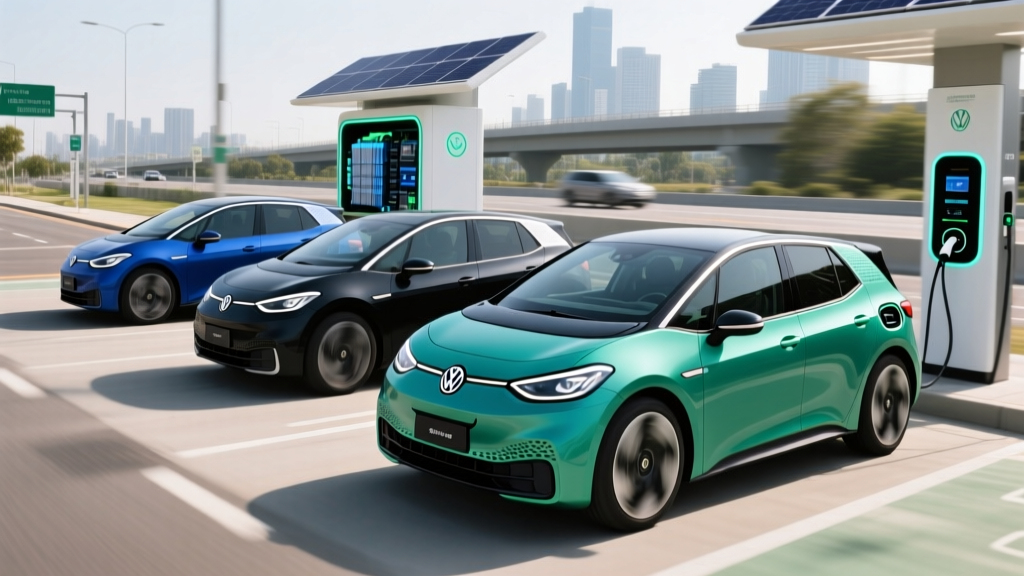
Volkswagen's current U.S. EV lineup — the ID.4 SUV, ID.7 sedan, and ID.Buzz minivan — targets buyers who want European driving dynamics, practical range (250–291 miles EPA), and mainstream pricing ($39,730–$53,495 MSRP). All three use VW's MEB platform with rear- or all-wheel drive, 82–91 kWh NMC battery packs, and DC fast-charging rates up to 175–200 kW (10–80% in roughly 25–30 minutes). The ID.4 and select trims currently qualify for partial or full federal §30D tax credits depending on battery-sourcing compliance and buyer income, though eligibility shifts annually. If you have Level 2 home charging, drive under 300 miles daily, and want a non-Tesla EV with strong dealer support, VW's lineup is competitive. If you live in a charging desert, frequently tow, or need 350+ mile range, look at Hyundai/Kia's E-GMP platform or extended-range options instead.
The 2026 Volkswagen EV Lineup: Specs at a Glance
Volkswagen sells three battery-electric vehicles in the United States for the 2026 model year. Here is how they stack up on the numbers that matter most.
| Spec | ID.4 (AWD Pro S) | ID.7 (Pro S) | ID.Buzz (AWD) |
|---|---|---|---|
| Base MSRP | $46,895 | $52,895 | $59,995 |
| EPA Range | 263 mi | 291 mi | 234 mi |
| Battery (usable) | 82 kWh, NMC | 86 kWh, NMC | 91 kWh, NMC |
| Peak DC Charge Rate | 175 kW | 200 kW | 200 kW |
| 10–80% DC Fast Charge | ~28 min | ~26 min | ~26 min |
| Level 2 (240V) Rate | 11 kW | 11 kW | 11 kW |
| Horsepower | 295 hp | 282 hp | 282 hp |
| 0–60 mph | 5.4 sec | 6.5 sec | 7.9 sec |
| MPGe (combined) | 104 MPGe | 115 MPGe | 87 MPGe |
| Battery Warranty | 8 yr / 100,000 mi | 8 yr / 100,000 mi | 8 yr / 100,000 mi |
Real-World Range vs. EPA Sticker
EPA range is measured under controlled lab conditions. In real-world testing, expect the following adjustments:
- Highway driving (75 mph sustained): Subtract 10–15%. The ID.7's 291-mile EPA rating drops to roughly 250–260 miles at interstate speeds.
- Cold weather (below 32°F): Subtract 20–30% without a heat pump engaged. VW includes a heat pump on Pro S trims, which reduces cold-weather loss to approximately 15–20%.
- Cargo-heavy / towing: The ID.Buzz loaded with passengers and cargo may see a 10–15% range reduction.
Bottom line: plan trips around 70–75% of the EPA sticker to maintain a safe buffer.
Volkswagen EV Cars vs. Gas and Hybrid Alternatives
How do VW's electrics compare to the vehicles they aim to replace? Let's look at the ID.4 against the Tiguan (gas) and the ID.7 against the Passat-era midsize sedan segment.
| Metric | ID.4 AWD Pro S | Tiguan SE R-Line (Gas AWD) | ID.7 Pro S | Toyota Camry SE (Hybrid) |
|---|---|---|---|---|
| Base MSRP | $46,895 | $36,890 | $52,895 | $33,545 |
| Fuel/Energy Cost per Mile | ~$0.045 (home L2) | ~$0.16 (gas, $3.50/gal) | ~$0.040 | ~$0.085 |
| Energy/MPG | 104 MPGe | 25 MPG combined | 115 MPGe | 47 MPG combined |
| Annual Fuel Cost (15k mi) | ~$675 | ~$2,100 | ~$600 | ~$1,120 |
| 5-Year Fuel Cost | ~$3,375 | ~$10,500 | ~$3,000 | ~$5,600 |
| Maintenance (5-year est.) | ~$1,500 | ~$3,500 | ~$1,500 | ~$2,800 |
| Federal Tax Credit (§30D) | Up to $7,500* | None | Up to $7,500* | None |
* §30D eligibility depends on buyer income (≤$150K single / ≤$300K joint), MSRP caps ($55K sedans, $80K SUVs/vans), and critical-mineral/battery-component sourcing. Always verify current-year rules at IRS.gov before purchasing.
The math is clear: over five years, the ID.4 saves roughly $9,000 in fuel and maintenance compared to the Tiguan — enough to offset most of the MSRP gap before any tax credit. The ID.7 vs. Camry hybrid comparison is tighter because the Camry is already highly efficient and significantly cheaper upfront. The ID.7 wins on driving refinement and zero tailpipe emissions; the Camry wins on purchase price and no charging requirement.
Real Ownership Costs: 5-Year Breakdown
Sticker price tells only part of the story. Here is a total-cost-of-ownership estimate for the ID.4 AWD Pro S over five years and 75,000 miles, compared to the Tiguan AWD.
| Cost Category | ID.4 AWD Pro S | Tiguan SE R-Line AWD |
|---|---|---|
| Purchase Price (MSRP) | $46,895 | $36,890 |
| Federal Tax Credit (§30D) | −$7,500* | $0 |
| Net Purchase | $39,395 | $36,890 |
| Home Charger Install (L2) | $1,200 | $0 |
| Fuel/Energy (5 years) | $3,375 | $10,500 |
| Maintenance (5 years) | $1,500 | $3,500 |
| Insurance (5-year est.) | $8,500 | $6,800 |
| Estimated Depreciation | $18,000 | $14,500 |
| Total 5-Year Cost | $71,970 | $72,190 |
Key takeaways:
- Insurance is 20–25% higher for the ID.4 due to battery replacement cost exposure and higher repair complexity. Get quotes before committing.
- Depreciation remains elevated for VW EVs compared to Toyota/Honda, though the gap has narrowed since 2024 price resets.
- Home Level 2 installation typically runs $800–$2,000 for a 48-amp hardwired charger, assuming a 200-amp panel with spare capacity. A panel upgrade to 200A can add $2,000–$4,000.
- Public DC fast charging costs roughly 2.5–3× home rates ($0.35–$0.55/kWh on networks like Electrify America), so frequent road-trip charging shifts the economics.
Charging Volkswagen EV Cars: What You Need to Know
VW's MEB platform charges on the slower side compared to Hyundai/Kia's 800V E-GMP architecture (which peaks at 240+ kW). Here is what charging looks like across levels:
| Charging Level | Power (kW) | Miles Added per Hour | Use Case |
|---|---|---|---|
| Level 1 (120V household) | 1.4 kW | ~4 mi/hr | Overnight trickle, emergencies |
| Level 2 (240V, 48A) | 11 kW | ~33 mi/hr | Daily home/workplace charging |
| DC Fast Charge (ID.4) | Peak 175 kW | ~200 mi in 28 min | Road trips (10–80%) |
| DC Fast Charge (ID.7/Buzz) | Peak 200 kW | ~230 mi in 26 min | Road trips (10–80%) |
Charge-curve reality: Peak kW is sustained only between roughly 10–40% state of charge. Above 60%, charging tapers significantly — expect 50–80 kW between 60–80%, and below 25 kW above 90%. This is why VW quotes 10–80% times rather than 0–100%. On a road trip, plan to charge from 10–80% and drive on; charging from 80–100% takes nearly as long as the first 70%.
Connector note: All 2026 VW EVs in the U.S. ship with a CCS1 port. VW has announced future NACS adoption but has not confirmed a model-year switchover. Adapters (CCS-to-NACS) are available for Tesla Supercharger access where VW has enabled software compatibility — verify with your dealer before relying on this.
Federal Tax Credit Eligibility for VW EVs
The §30D Clean Vehicle Credit offers up to $7,500, but qualification is a moving target due to battery-sourcing and critical-mineral requirements that tighten each year. Here is the checklist as of 2026:
- Buyer income cap: ≤$150,000 single filer / ≤$225,000 head of household / ≤$300,000 joint (modified AGI)
- MSRP cap: ≤$55,000 for sedans (ID.7) / ≤$80,000 for SUVs and vans (ID.4, ID.Buzz)
- Battery component sourcing: Percentage of components manufactured or assembled in North America must meet annual thresholds (check current-year IRS guidance)
- Critical minerals: Percentage of critical minerals sourced from the U.S. or FTA partners must meet annual thresholds
- Point-of-sale transfer: Eligible buyers can transfer the credit to the dealer at purchase, reducing the out-of-pocket price immediately
- Foreign entity of concern (FEOC): Vehicles with battery components or critical minerals from certain prohibited foreign entities are disqualified
The ID.4 (built in Chattanooga, TN) has historically qualified more broadly than imported VW models. The ID.7 and ID.Buzz, built in Emden, Germany, face stricter sourcing hurdles. Always verify current eligibility at IRS.gov and confirm with your dealer's F&I department before signing.
Common Misconceptions About Volkswagen EVs
| Myth | Fact |
|---|---|
| "VW EV batteries won't last." | VW warranties the battery for 8 years/100,000 miles at ≥70% capacity retention. Real-world MEB fleet data shows approximately 5–8% degradation at 60,000 miles with normal use. |
| "I can't road-trip in an ID.4." | With DC fast-charging at 175 kW and Electrify America's expanding network (which VW helped fund), 300-mile trips require one 25-minute stop. Planning apps like A Better Routeplanner handle this automatically. |
| "EVs are worse in winter." | Range drops 15–20% in cold weather with VW's heat pump equipped. Preconditioning while plugged in mitigates this. AWD ID.4 models deliver strong winter traction with instant torque. |
| "Charging takes too long." | Home Level 2 adds ~33 miles per hour. Most owners charge overnight and start every day "full." DC fast charging adds 200+ miles in 25–30 minutes on road trips — comparable to a meal break. |
| "VW's EV software is broken." | Early ID.4 models (2021–2023) had significant software complaints. VW's ID.software 4.0 and later updates have resolved most issues, including faster infotainment response and improved route planning. |
Decision Framework: Which Volkswagen EV Is Right for You?
Choose the ID.4 if:
- You need a compact SUV with cargo space (30.3 cu ft behind rear seats) and optional AWD
- Your budget is $40,000–$50,000 after tax credit
- You want a vehicle built in the U.S. with the best §30D eligibility odds
- Daily driving is under 200 miles with home Level 2 charging
Choose the ID.7 if:
- You want the longest range in the VW lineup (291 miles EPA)
- You prefer sedan driving dynamics and a lower center of gravity
- You commute long distances and value efficiency (115 MPGe)
- You don't need SUV cargo height or towing
Choose the ID.Buzz if:
- You need three-row seating for up to 7 passengers
- You want a distinctive design with strong cargo versatility
- Range needs are modest (under 200 miles daily) or you have reliable charging
- Budget allows $55,000+ after potential credits
Look elsewhere if:
- You need 350+ mile range (consider Lucid Air, Tesla Model S, or upcoming solid-state platforms)
- You live in an area with minimal DC fast-charging infrastructure
- You frequently tow over 2,500 lbs (EV range drops 40–50% while towing)
- You cannot install Level 2 charging at home or work
First-Time EV Buyer: What to Know Before You Sign
If this is your first electric vehicle, these practical considerations will determine whether ownership is seamless or frustrating:
Home Charging Is Non-Negotiable for Most Owners
Over 80% of EV charging happens at home. Without Level 2 access (a 240V circuit, typically 40–48 amps), you will rely on public charging, which is 2–3× more expensive and less convenient. Budget $1,000–$2,000 for professional installation of a hardwired Level 2 charger. If your electrical panel is maxed out, a panel upgrade adds $2,000–$4,000 — get a licensed electrician's assessment before purchasing.
Your Driving Pattern Determines EV Suitability
If your daily round-trip commute is under 200 miles and you can charge at home, any VW EV will work effortlessly. If you regularly drive 300+ miles in a day, you will need to plan DC fast-charging stops (add 25–30 minutes per stop). For frequent long-distance drivers, the ID.7's 291-mile range and 115 MPGe efficiency make it the most road-trip-friendly VW.
Climate Matters More Than You Think
In regions with sustained sub-freezing winters, expect 15–25% range reduction. VW's heat pump (standard on Pro S trims) helps, but preconditioning while plugged in is the single most effective cold-weather strategy. In hot climates, battery degradation can accelerate slightly; VW's liquid thermal management system mitigates this, and the 8-year/100,000-mile battery warranty provides protection.
Insurance Costs Are Higher — Get Quotes First
EV insurance premiums run 15–25% above equivalent gas vehicles due to higher repair costs and battery replacement exposure. Shop quotes from EV-friendly insurers (GEICO, Progressive, State Farm all cover EVs) before committing to a purchase.
Does the Volkswagen ID.4 qualify for the full $7,500 federal tax credit?
Eligibility depends on current-year battery-sourcing rules, buyer income, and MSRP caps. The ID.4, built in Tennessee, has historically qualified more broadly than VW's German-built models. Verify current eligibility at IRS.gov and confirm with your dealer before purchasing.
How long does it take to charge a VW ID.4 at home?
On a Level 2 (240V, 48-amp) charger delivering 11 kW, a full 0–100% charge takes roughly 8.5 hours for the 82 kWh battery. Most owners charge from 20–80% overnight, which takes about 4.5 hours.
What is the real-world range of the VW ID.7?
The EPA rates the ID.7 Pro S at 291 miles. Real-world highway driving at 75 mph yields approximately 250–260 miles. In cold weather with the heat pump, expect 240–250 miles. Plan conservatively around 220 miles for road-trip buffers.
Can I use Tesla Superchargers with a Volkswagen EV?
VW has announced future NACS adoption, but 2026 models ship with CCS1 ports. CCS-to-NACS adapters are available, and VW has enabled software compatibility for select Supercharger stations. Confirm adapter availability and station access with your dealer before relying on Tesla's network.
How much does it cost to replace a VW EV battery out of warranty?
Out-of-warranty MEB battery replacement costs are estimated at $12,000–$18,000 depending on pack size and labor. However, real-world degradation data suggests most MEB batteries retain 85–92% capacity at 100,000 miles, making full replacement unlikely within the vehicle's typical lifespan.
Is the ID.Buzz practical for daily family use?
The ID.Buzz offers three-row seating, excellent visibility, and versatile cargo space. Its 234-mile EPA range is the shortest in VW's lineup, making it best suited for families with daily driving under 180 miles and reliable home charging. For longer-range family hauling, consider a PHEV minivan like the Chrysler Pacifica Hybrid.