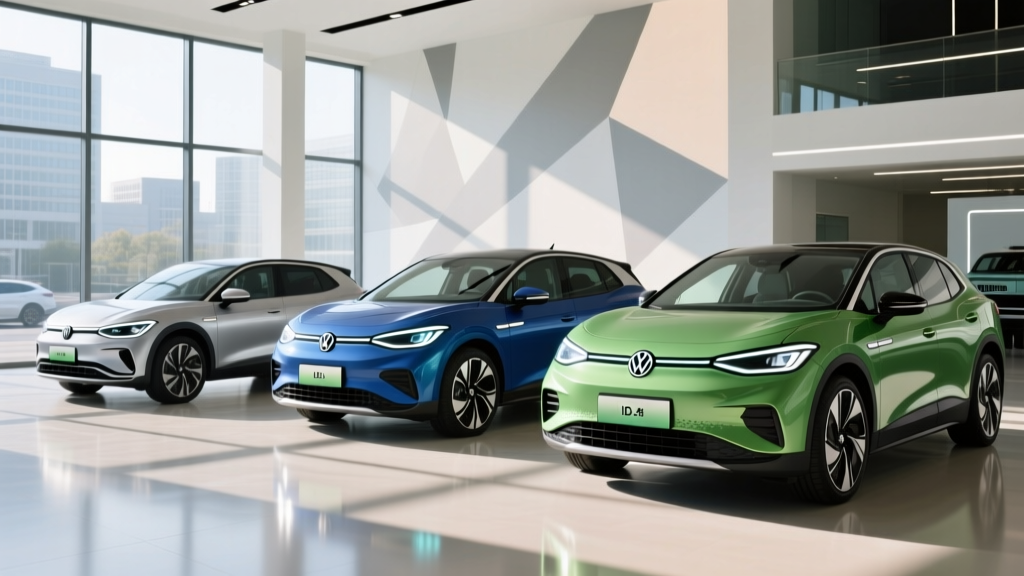
Quick Answer: Volkswagen currently sells two EVs in the US: the ID.4 compact SUV (starting ~$39,735, EPA range up to 291 miles) and the ID.7 sedan (starting ~$49,995, EPA range up to 342 miles). Both use NMC battery chemistry, support up to 175 kW DC fast charging (10-80% in ~30 minutes), and qualify for partial or full federal tax credits depending on trim, sourcing, and buyer income. The ID.4 is VW's volume seller and best value for most buyers; the ID.7 targets sedan buyers needing maximum range and highway comfort.
Current Volkswagen EV Car Models Available in the US
Volkswagen's American EV lineup has consolidated around two production models for 2026. The ID.Buzz three-row van launched in late 2024 but was pulled from the US market after the 2025 model year due to slow uptake and battery-sourcing complications that affected its credit eligibility. The ID.4 remains the brand's EV anchor, while the ID.7 sedan fills the gap left by the discontinued Passat and Arteon for buyers who prefer a traditional trunk.
| Spec | 2026 ID.4 (Pro S AWD) | 2026 ID.7 (Pro S) |
|---|---|---|
| Base MSRP | $46,235 | $49,995 |
| EPA Range | 263 mi (AWD) / 291 mi (RWD) | 342 mi |
| Battery (usable) | 82 kWh, NMC | 86 kWh, NMC |
| Peak DC Fast Charge | 175 kW | 175 kW (200 kW w/ update) |
| 10-80% DCFC Time | ~30 min | ~28 min |
| Level 2 Rate | 11 kW (48A) | 11 kW (48A) |
| Horsepower | 295 hp (AWD) | 282 hp (RWD) |
| 0-60 mph | 5.7 sec | 6.5 sec |
| MPGe (combined) | 104 MPGe | 115 MPGe |
| Battery Warranty | 8 yr / 100,000 mi | 8 yr / 100,000 mi |
| §30D Credit Eligible | Up to $7,500 (varies by trim) | Up to $7,500 (varies) |
Real-World Range Reality: The ID.4 Pro S AWD's 263-mile EPA rating drops to approximately 210-230 miles at sustained 75 mph highway speeds, and further to 175-200 miles in sub-30°F winter conditions without preconditioning. The ID.7's superior aerodynamics (0.23 Cd vs the ID.4's 0.28) help it hold closer to its sticker in highway driving — expect ~280-300 miles real-world in mild weather. Always plan road trips around 80% of EPA to maintain a safety buffer and account for charging-curve taper above 80% SoC.
Volkswagen EV vs Gas: Real Cost Comparison
The most common question from VW shoppers is whether an ID.4 or ID.7 actually saves money compared to a similarly sized gas vehicle like the Tiguan or the outgoing Jetta. The answer depends heavily on your electricity rate, annual mileage, and whether you qualify for the federal tax credit.
| Cost Factor | ID.4 Pro S AWD | Tiguan SE (Gas AWD) |
|---|---|---|
| MSRP | $46,235 | $35,495 |
| Federal Tax Credit (§30D) | Up to -$7,500* | $0 |
| Effective Purchase Price | ~$38,735 | $35,495 |
| Annual Fuel/Energy (15k mi) | ~$630 (home, $0.14/kWh) | ~$1,875 (gas, $3.50/gal, 24 mpg) |
| 5-Year Fuel/Energy Total | ~$3,150 | ~$9,375 |
| Annual Maintenance | ~$300 | ~$750 |
| 5-Year Maintenance | ~$1,500 | ~$3,750 |
| Insurance (annual avg) | ~$1,950 | ~$1,550 |
| 5-Year Total Cost of Ownership | ~$55,135 | ~$57,995 |
*§30D eligibility requires buyer AGI under $150k single / $300k joint, vehicle MSRP under $80k (SUVs), and compliance with critical-mineral and battery-component sourcing rules. Credit amount varies by sourcing compliance. Verify current-year rules at IRS.gov §30D. Point-of-sale transfer is available through registered dealers.
The ID.4 reaches cost parity with the Tiguan around year 4 when the full credit applies, primarily through fuel and maintenance savings. Without the credit, the payback stretches to 6-7 years. The ID.7's higher MSRP makes the math tighter against a used gas sedan but still favorable against a new mid-size gas car over 5 years.
Charging the Volkswagen EV Car: What You Actually Need
Both the ID.4 and ID.7 use the NACS (Tesla-style) connector as of the 2025 model year, following VW's adoption of the North American Charging Standard. This means direct access to the Tesla Supercharger network (over 25,000 stalls in North America) without an adapter, plus continued compatibility with Electrify America, EVgo, and ChargePoint stations that have deployed NACS cables.
| Charging Level | Power (kW) | Miles Added/Hour | Typical Use Case |
|---|---|---|---|
| Level 1 (120V outlet) | 1.2-1.4 kW | ~3-4 mi/hr | Emergency/top-off only |
| Level 2 (240V, 48A) | 11 kW | ~30-35 mi/hr | Home daily charging, full overnight fill |
| DC Fast (peak) | 175-200 kW | ~180-220 mi in 10 min | Road trips; 10-80% in ~28-30 min |
Charging-curve reality check: The ID.4 and ID.7 do not sustain peak 175 kW for the entire session. The charge rate peaks around 25-30% SoC and begins tapering noticeably above 60%, dropping below 75 kW past 80%. A 10-80% session takes roughly 30 minutes, but pushing from 80-100% can add another 25-30 minutes. Plan road-trip stops around 10-80% sessions to avoid wasting time at the taper.
Home charging installation: A Level 2 home charger (such as the ChargePoint Home Flex or Emporia Vue) costs $400-$700 for the unit. Professional installation by a licensed electrician typically runs $500-$2,000 depending on panel proximity and whether your home's electrical panel needs an upgrade to 200A. Total installed cost: $900-$2,700 for most homes. A panel upgrade can add $1,500-$3,500. Always get a quote from a licensed electrician before committing to a specific charger.
Federal Tax Credit: Does a Volkswagen EV Car Qualify?
The §30D Clean Vehicle Credit offers up to $7,500 for new EVs, split into two $3,750 halves: one for critical-mineral sourcing and one for battery-component sourcing. Volkswagen has worked to shift its battery supply chain to comply, but eligibility varies by model year, trim, and production batch.
- MSRP Cap: ID.4 qualifies (SUV cap: $80,000). ID.7 qualifies (sedan cap: $55,000 — verify trim MSRP stays under).
- Buyer Income Cap: AGI must not exceed $150,000 (single), $225,000 (head of household), or $300,000 (married filing jointly).
- Battery Sourcing: Critical-mineral and component requirements tighten annually. Check the specific VIN's eligibility on fueleconomy.gov before purchasing.
- Point-of-Sale Transfer: You can transfer the credit to the dealer at purchase, reducing your out-of-pocket cost immediately rather than waiting for tax filing.
- Assembly: Vehicle must undergo final assembly in North America. Both the US-market ID.4 (Chattanooga, TN) and ID.7 (Emden, Germany — verify current assembly location) need confirmation.
Critical note: The ID.7's German assembly location has been a moving target for §30D eligibility. Volkswagen has signaled plans to shift ID.7 production, but always confirm final assembly and sourcing compliance for the specific model year and VIN you're purchasing. The ID.4 built in Chattanooga generally has stronger sourcing compliance.
Common Misconceptions About Volkswagen EVs
| Myth | Fact |
|---|---|
| "VW EVs have unreliable software." | Early 2021-2022 ID.4 models had significant software bugs. VW's Software 4.0 (introduced for 2025) resolved most infotainment and charging handshake issues. Current models are competitive with rivals. |
| "The battery will need replacing in 5 years." | VW warranties the battery for 8 years/100,000 miles at 70% capacity retention. Real-world degradation data from European ID.4 fleets shows ~5-8% loss after 100,000 miles. Full replacement (rare) costs $12,000-$18,000. |
| "I can't take a VW EV on road trips." | With NACS access to the Supercharger network and Electrify America's 150-350 kW stations, both models can add 150+ miles in a 15-minute stop. A 300-mile trip requires one 20-25 minute charge stop. |
| "EVs are worse in winter." | Range drops 15-30% in sub-freezing temps. Both VWs offer a heat pump (standard on Pro S trims) that recovers ~10-15% of that loss. Preconditioning while plugged in further mitigates the impact. |
| "Charging is more expensive than gas." | At the US average residential rate of $0.16/kWh, the ID.4 costs ~$0.045/mile to fuel. A 24 mpg gas SUV at $3.50/gal costs ~$0.146/mile. Public DCFC pricing ($0.35-$0.55/kWh) narrows the gap but home charging remains decisively cheaper. |
Decision Framework: Which Volkswagen EV Car Is Right for You?
Choose the ID.4 if:
- You need a compact SUV with cargo space (30.3 cu ft rear, 64.2 cu ft folded)
- Your budget is under $47,000 before incentives
- You want AWD for snow/climate traction (available on Pro S and above)
- Most of your driving is under 200 miles/day with home charging
- You prioritize North American assembly for strongest tax-credit eligibility
Choose the ID.7 if:
- You prefer a sedan with a trunk and superior highway aerodynamics
- You regularly drive 250+ miles between charges (342 mi EPA range)
- Highway comfort and low wind noise are top priorities
- You don't need AWD (RWD only in the US market)
- You can verify §30D eligibility for the specific model year and VIN
Choose neither (consider a PHEV or competitor) if:
- You lack access to home or workplace Level 2 charging
- You regularly tow more than 2,700 lbs (ID.4 max tow rating)
- You need three rows of seating (look at the Kia EV9 or wait for VW's next SUV)
- Your budget is firmly under $35,000 (consider a used ID.4 or the Chevy Equinox EV)
Ownership Realities: What First-Time VW EV Buyers Should Know
Home charging is essential. Public DC fast charging works for road trips, but daily EV ownership depends on Level 2 home charging. If you live in an apartment or condo without charging access, weigh the inconvenience and cost of relying solely on public infrastructure before purchasing. Workplace charging can partially substitute.
Insurance costs more. EV insurance premiums run 15-25% higher than equivalent gas vehicles due to repair complexity and battery replacement costs. Get a quote from your insurer before purchasing — some carriers (like Progressive and State Farm) have narrowed the gap, while others still price EVs aggressively.
Maintenance is minimal but not zero. Expect cabin air filter replacements ($50-$80 every 2 years), tire rotations ($25-$50 every 7,500 miles — EVs wear tires faster due to instant torque and heavier weight), brake fluid checks, and wiper fluid. No oil changes, spark plugs, or transmission service. Budget $200-$400/year.
Tires are your biggest recurring cost. The ID.4's 255/55R19 tires run $200-$280 each and typically last 25,000-35,000 miles due to the vehicle's 4,600+ lb curb weight and regenerative braking patterns. Budget $800-$1,100 for a set every 3-4 years.
Resale value is stabilizing. After steep depreciation in 2023-2024 (when used EV prices dropped 30%+), the ID.4 has held value better since VW cut new-vehicle pricing and the used-EV market normalized. Expect 45-55% retention after 3 years — below a RAV4 Hybrid but competitive with other EVs. Source: Kelley Blue Book residual data.
Frequently Asked Questions
Is the Volkswagen ID.4 a reliable EV?
Post-2024 model year ID.4 vehicles show improved reliability after VW addressed early software and 12V battery issues. The drivetrain and battery pack have been trouble-free in fleet data. IIHS gives the ID.4 top safety marks. Consumer Reports rates recent models as average to above-average for reliability.
Can I charge a Volkswagen EV at a Tesla Supercharger?
Yes. Starting with the 2025 model year, VW adopted the NACS connector natively. Both the ID.4 and ID.7 can plug directly into Tesla Supercharger V3 (150 kW) and V4 stalls without an adapter. You'll need to activate charging through the Tesla app or your VW in-car system, depending on the station.
What happens if the battery degrades past 70%?
VW's battery warranty covers capacity below 70% for 8 years or 100,000 miles. If your battery falls below that threshold within the warranty period, VW will repair or replace it at no cost. Out-of-warranty replacement costs $12,000-$18,000 depending on the pack, though this is rare — NMC chemistry in VW's thermal management system has shown strong longevity in European fleet data.
How does the ID.4 compare to the Hyundai Ioniq 5 or Tesla Model Y?
The ID.4 prioritizes ride comfort and traditional SUV ergonomics over the Ioniq 5's retro-futurist design and 800V ultra-fast charging (10-80% in ~18 min). The Model Y offers more range (320+ mi) and Supercharger-native access but a firmer ride and polarizing interior minimalism. The ID.4 wins on suspension comfort and dealer service accessibility; it loses on charging speed and cargo volume to both rivals.
Is VW discontinuing EVs or going back to gas cars?
No. Volkswagen has committed to a fully electric lineup in Europe by 2033 and continues to invest in its SSP (Scalable Systems Platform) for next-generation EVs. The US lineup may shift models, but VW's EV commitment is firm. The ID.4 will continue receiving updates, and additional models (including a compact EV below the ID.4) are in development for the late 2020s.