Quick Answer: Is a Volkswagen EV Right for You?
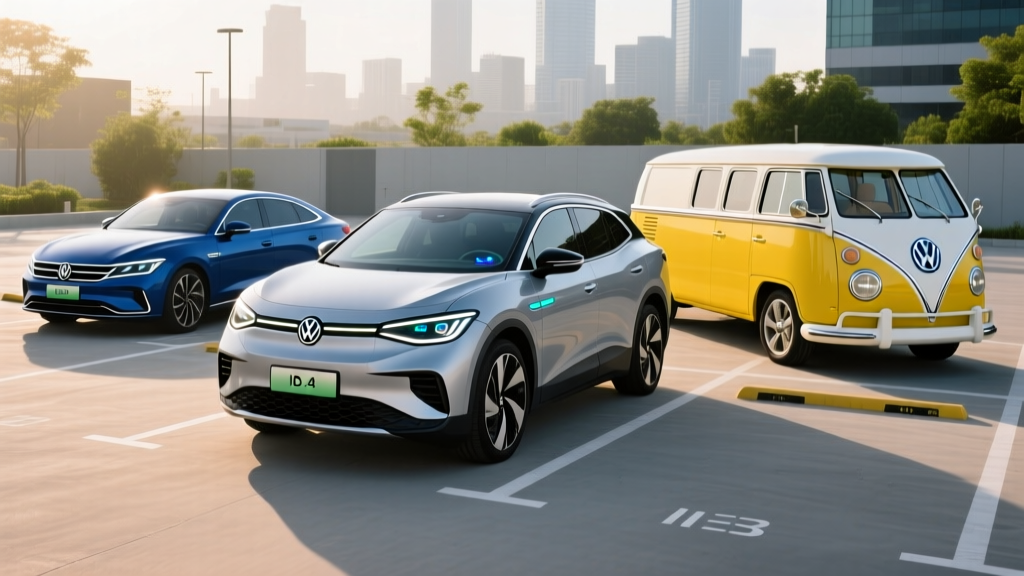
Volkswagen's 2026 U.S. electric lineup includes three distinct models: the ID.4 compact SUV (275-mile EPA range, from ~$40,790), the ID.7 sedan (~340-mile EPA range, from ~$49,990), and the ID.Buzz three-row van (234-mile EPA range, from ~$59,995). The ID.4 remains the volume seller and best value, especially if it qualifies for the federal §30D tax credit of up to $7,500. All three ride on VW's MEB platform with NMC battery chemistry and support DC fast charging up to 175–200 kW. Choose VW if you want European driving dynamics, a practical cabin, and a mainstream dealer network — but look elsewhere if you need 350+ mile range or the fastest charging in the segment.
The 2026 Volkswagen EV Lineup at a Glance
Volkswagen has committed to a fully electric future, but in 2026 its U.S. showroom is focused and practical rather than sprawling. Here's how the three models stack up on the metrics that matter most to buyers.
| Spec | 2026 ID.4 (AWD Pro S) | 2026 ID.7 (Pro S) | 2026 ID.Buzz (AWD) |
|---|---|---|---|
| Battery (usable) | 82 kWh (NMC) | 86 kWh (NMC) | 91 kWh (NMC) |
| EPA Range | 275 mi | ~340 mi | 234 mi |
| Peak DC Fast Charge | 175 kW | 200 kW | 200 kW |
| 10–80% DCFC Time | ~28 min | ~26 min | ~28 min |
| Level 2 (AC) Rate | 11 kW | 11 kW | 11 kW |
| Horsepower | 295 hp | 282 hp | 330 hp |
| 0–60 mph | 5.7 sec | 6.5 sec | 5.7 sec |
| MPGe (combined) | 104 MPGe | ~115 MPGe | 88 MPGe |
| Starting MSRP | ~$40,790 | ~$49,990 | ~$59,995 |
| Battery Warranty | 8 yr / 100,000 mi | 8 yr / 100,000 mi | 8 yr / 100,000 mi |
Sources: fueleconomy.gov, Volkswagen USA. ID.7 figures are EPA-estimated for the U.S. market. All MSRPs exclude destination charge.
The ID.4's EPA-rated 275 miles assumes a mix of city and moderate-speed driving. On sustained 75-mph highway runs, expect ~240–250 miles. In freezing temperatures (below 32°F), range can drop to ~200–220 miles due to cabin heating and battery chemistry limitations. The ID.7's more aerodynamic sedan body yields better highway retention — roughly 300–310 real-world miles on the highway. The boxy ID.Buzz suffers the most at speed: plan for ~190 miles at highway speeds in cold weather.
Volkswagen EV vs. Gas and Hybrid: Cost Comparison
The strongest argument for any Volkswagen electric vehicle comes down to operating cost. Let's compare the ID.4 AWD Pro S against two baselines: a similarly priced gas compact SUV (Tiguan) and a Toyota RAV4 Hybrid.
| Metric (5-Year / 75,000 mi) | ID.4 AWD Pro S | Tiguan (Gas) | RAV4 Hybrid |
|---|---|---|---|
| Purchase Price (MSRP) | $40,790 | $31,490 | $34,500 |
| Fed. Tax Credit (§30D) | Up to $7,500* | $0 | $0 |
| Effective Purchase Price | ~$33,290 | $31,490 | $34,500 |
| Fuel / Energy Cost (5 yr) | ~$4,500** | ~$9,800 | ~$6,200 |
| Maintenance (5 yr) | ~$1,800 | ~$3,500 | ~$3,000 |
| Total 5-Year Cost | ~$39,590 | ~$44,790 | ~$43,700 |
*§30D credit eligibility depends on buyer income caps ($150K single / $300K joint), MSRP caps ($55K SUVs / $80K vans), battery sourcing, and assembly requirements. Always verify at irs.gov and consult a tax professional.
**Energy cost assumes 80% home Level 2 charging at $0.16/kWh national average and 20% public DCFC at $0.40/kWh. Actual costs vary significantly by utility rate and charging behavior.
The math is clear: the ID.4 breaks even or beats a gas Tiguan within 3–4 years if you qualify for the full tax credit and charge primarily at home. The RAV4 Hybrid sits in the middle — lower fuel cost than gas but no credit to offset its purchase price. However, if you cannot charge at home and must rely entirely on public DC fast charging, the ID.4's energy cost rises to roughly $7,500 over five years, narrowing the advantage considerably.
Charging: What Volkswagen EV Owners Need to Know
Every 2026 Volkswagen EV sold in the U.S. now ships with the NACS (Tesla-style) charge port, giving native access to Tesla Superchargers via the NACS standard — no adapter needed. VW also maintains compatibility with Electrify America, EVgo, and other networks through the CCS-to-NACS adapter included with earlier CCS-port vehicles.
| Level | Power (kW) | Miles Added/Hour (ID.4) | Best For |
|---|---|---|---|
| Level 1 (120V) | ~1.4 kW | ~4 mi/hr | Emergency / overnight trickle |
| Level 2 (240V, 48A) | 11 kW | ~33 mi/hr | Daily home / workplace charging |
| DC Fast (175–200 kW) | Up to 200 kW | ~200 mi in 20 min | Road trips |
Charging curve reality: The ID.4 peaks at 175 kW only between roughly 10–30% state of charge. From 30–60% it sustains around 120–140 kW, then tapers to ~70 kW by 80%, and drops sharply above 80%. This is why VW quotes 10–80% times (~28 minutes) rather than 0–100%. Charging from 80–100% on DCFC can add another 20+ minutes — plan your road-trip stops to 80% and move on.
Home charging setup: A Level 2 home installation with a 48-amp hardwired charger (like the Emporia Vue or ChargePoint Home Flex) typically costs $1,200–$2,500 including electrician labor and permit, assuming your electrical panel has spare capacity. If you need a 200-amp panel upgrade, add $1,500–$3,000. Most ID.4 owners report that a full overnight charge on Level 2 (roughly 8 hours from 10% to 100%) is more than sufficient for daily driving.
Federal Tax Credit Eligibility for Volkswagen EVs
Not every Volkswagen electric vehicle qualifies for the full §30D federal tax credit, and not every buyer is eligible. Here's the current checklist:
- MSRP cap: SUVs and vans must be under $80,000; sedans under $55,000. All current VW EVs clear this threshold.
- Buyer income cap: Modified AGI must not exceed $150,000 (single), $225,000 (head of household), or $300,000 (joint filing).
- North American assembly: The ID.4 is built in Chattanooga, Tennessee — qualifying. The ID.7 and ID.Buzz are assembled in Germany, which disqualifies them from the §30D new-vehicle credit unless leasing (the commercial §45W credit may apply to the lessor, who may pass savings through).
- Battery sourcing: Critical minerals and battery components must meet phased-in percentage thresholds from U.S. free-trade partners. Verify the specific VIN on fueleconomy.gov.
- Point-of-sale transfer: Eligible buyers can transfer the credit to the dealer at purchase, reducing the out-of-pocket price immediately rather than waiting for a tax refund.
Bottom line: The ID.4 is the most credit-friendly VW EV. If you want the ID.7 or ID.Buzz, leasing may unlock savings the purchase credit doesn't offer — ask the dealer about pass-through lease incentives.
Real-World Ownership: What First-Time VW EV Buyers Should Know
| Common Misconception | Fact |
|---|---|
| "The battery will need replacing in 5 years." | VW warranties the battery for 8 years / 100,000 miles with a 70% capacity retention guarantee. Real-world MEB data shows ~8–10% degradation at 100K miles under normal use. |
| "EVs cost more to insure." | Partially true. ID.4 premiums average 10–15% higher than a Tiguan due to repair complexity and parts cost. Shop quotes before buying — variation between insurers is large. |
| "I'll be stranded without home charging." | Doable but inconvenient. Public DCFC costs 2–3× more per mile than home charging. If you lack home charging, a PHEV like the Toyota RAV4 Prime may be a better fit. |
| "275 miles of range isn't enough." | The average American drives ~37 miles/day (FHWA data). A 275-mile ID.4 covers 7+ days of average driving between charges. Road trips require planning but are feasible with NACS Supercharger access. |
Climate matters. If you live in northern-tier states with sustained sub-freezing winters, the ID.4's heat pump (standard on Pro S and above) helps, but expect 20–30% range loss compared to EPA figures. Preconditioning the battery while plugged in — using the VW Car-Net app to set a departure time — mitigates this by warming the pack before you drive, preserving range and enabling faster regenerative braking.
Software and infotainment. VW's ID.Software 4.0 (rolled out through 2025–2026 updates) significantly improved the earlier ID.4's sluggish touch-slider climate controls and laggy navigation. However, some owners still report occasional OTA update glitches. If infotainment responsiveness is a top priority, test-drive and compare against Hyundai's Ioniq 5 or Tesla's Model Y interface.
Decision Framework: Which Volkswagen EV Fits Your Life?
Choose the ID.4 if:
- You want the best value in VW's EV lineup and eligibility for the $7,500 federal tax credit
- You need a compact SUV with 275 miles of range for commuting and weekend trips
- You prioritize U.S.-built vehicles and Chattanooga assembly matters to you
- Your typical daily drive is under 80 miles round-trip
Choose the ID.7 if:
- You want sedan efficiency with 340+ miles of EPA range for long highway commutes
- You're willing to forgo the purchase tax credit (or lease to capture savings)
- You want VW's most refined, quietest EV cabin with premium materials
- You don't need SUV ride height or cargo versatility
Choose the ID.Buzz if:
- You need three rows and seating for up to 7 passengers
- You want a distinctive, lifestyle-oriented vehicle and accept the range trade-off
- You'll use it primarily for local family hauling, not cross-country road trips
- The 234-mile EPA range covers your daily needs with margin
Consider a non-VW alternative if:
- You need 350+ mile range → Hyundai Ioniq 6 (361 mi) or Tesla Model 3 Long Range (363 mi)
- You want the fastest charging → Hyundai/Kia E-GMP platform (10–80% in ~18 min at 350 kW)
- You need maximum cargo space in an EV SUV → Rivian R1S or Tesla Model X
5-Year Total Cost of Ownership: ID.4 vs. the Competition
| 5-Year Cost Category | VW ID.4 AWD | Tesla Model Y LR | Hyundai Ioniq 5 SEL |
|---|---|---|---|
| Effective Price (after credit) | ~$33,290 | ~$38,990 | ~$38,500 |
| Energy (home + public mix) | $4,500 | $4,100 | $4,400 |
| Insurance (est. avg) | $9,500 | $10,200 | $8,800 |
| Maintenance | $1,800 | $1,500 | $1,700 |
| Est. Depreciation (5 yr) | $14,000 | $15,500 | $13,200 |
| Total 5-Year Cost | ~$63,090 | ~$70,290 | ~$66,600 |
Depreciation estimates based on historical EV resale trends. Actual values depend on market conditions, mileage, and condition. Insurance varies widely by driver profile and state.
Frequently Asked Questions
Does the Volkswagen ID.4 qualify for the full $7,500 federal tax credit?
The ID.4 assembled in Chattanooga, TN, qualifies for the §30D credit if the buyer meets income caps and the specific VIN passes battery-sourcing requirements. Always verify the exact vehicle on fueleconomy.gov before purchase. The credit can be transferred to the dealer at point of sale, reducing your drive-off price immediately.
How long does it take to charge a Volkswagen EV at home?
On a Level 2 (240V, 48A) home charger delivering 11 kW, a fully depleted ID.4 (82 kWh usable) takes roughly 8 hours from 0–100%. In practice, most owners plug in at 20–30% and wake up to 80–90% — about 5–6 hours. A standard 120V outlet (Level 1) adds only about 4 miles per hour and is best reserved for emergencies or low-mileage days.
Is Volkswagen's charging network reliable?
VW's NACS port gives you direct access to Tesla's Supercharger network, which consistently ranks highest in reliability among DC fast-charging providers. Electrify America (founded by VW as part of its Dieselgate settlement) has improved but still sees higher downtime rates than Superchargers. Use the PlugShare or A Better Routeplanner apps to check station status before road trips.
What happens if the VW EV battery degrades significantly?
Volkswagen warranties its high-voltage battery for 8 years or 100,000 miles, guaranteeing at least 70% of original capacity. If capacity falls below that threshold within the warranty period, VW will repair or replace the battery at no cost. Out-of-warranty replacement for an MEB battery pack currently ranges from $12,000–$18,000 depending on the model, though prices are expected to decline as the supply chain matures.
Should I buy or lease a Volkswagen electric vehicle?
If the ID.4 qualifies for the full §30D credit and you meet income requirements, buying often yields the best total cost. For the German-built ID.7 and ID.Buzz, leasing may be the smarter financial move — the lessor can claim the commercial clean vehicle credit (§45W) and pass savings through as a lower lease payment. Compare both scenarios with your dealer's finance desk before deciding.