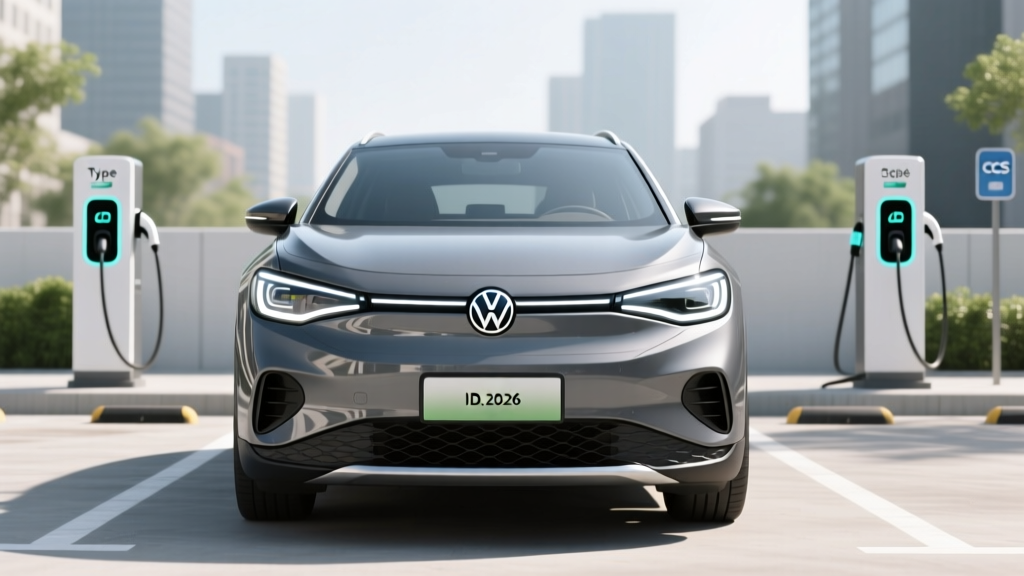
Leasing an electric vehicle has become one of the smartest ways to access EV technology without committing to long-term depreciation risk. For buyers eyeing a Volkswagen electric lease in 2026, the ID.4 compact SUV remains the brand's primary EV offering in the U.S. — and a compelling case study in how federal incentives, lower running costs, and lease economics intersect. But the math isn't always straightforward. A lease can either amplify your savings or mask hidden costs depending on how you structure it.
This guide walks through the real numbers behind leasing and owning a 2026 Volkswagen ID.4: the 5-year total cost of ownership, federal and state incentive eligibility, per-mile charging costs versus gas, insurance premiums, and what happens at lease-end when residual values matter. Every figure below is grounded in EPA data, IRS rules, and manufacturer specifications — not marketing brochures.
2026 Volkswagen ID.4: The Baseline Specs
Before calculating costs, you need the vehicle's core specifications. The 2026 ID.4 carries over the updated powertrain and battery introduced for the 2025 model year, with minor software and pricing adjustments.
| Specification | RWD Standard | AWD Pro S |
|---|---|---|
| Base MSRP | $41,990 | $49,490 |
| EPA Range | 275 miles | 263 miles |
| Real-World Range (highway/cold) | ~220–245 miles | ~210–235 miles |
| Battery Capacity (usable) | 82 kWh (NMC) | 82 kWh (NMC) |
| Peak DC Fast Charge Rate | 175 kW | 175 kW |
| 10–80% DC Fast Charge Time | ~28 minutes | ~28 minutes |
| Level 2 Charge Rate (AC) | 11 kW | 11 kW |
| Horsepower | 282 hp | 335 hp |
| 0–60 mph | 7.3 sec | 5.4 sec |
| EPA Efficiency (Combined MPGe) | 107 MPGe | 98 MPGe |
| Battery/Powertrain Warranty | 8 years / 100,000 miles | 8 years / 100,000 miles |
| Connector | NACS (native) | NACS (native) |
Leasing vs. Buying: The Volkswagen ID.4 in 2026
A Volkswagen electric lease typically runs 36 or 39 months with 10,000 to 15,000 annual miles. In early 2026, VW Credit has been offering ID.4 lease deals in the range of $299–$449/month depending on trim, region, and down payment (commonly called "due at signing" — usually $2,500–$3,999). These numbers fluctuate monthly and vary by dealership.
The critical advantage of leasing in 2026 is how the federal tax credit interacts with lease agreements. Under the IRS §30D clean vehicle credit rules, the $7,500 credit is subject to strict income caps, MSRP limits, and battery-sourcing requirements when claimed as a purchase credit. However, under the "commercial vehicle" lease loophole (IRS §45W), many leased EVs can pass the full $7,500 to the lessee as a capitalized cost reduction — even if the vehicle's battery sourcing or the buyer's income wouldn't otherwise qualify. This has been a significant lease incentive, though automakers and dealers handle it differently.
Federal Tax Credit Eligibility: §30D Rules for 2026
If you're buying rather than leasing — or want to understand what the credit requires — here are the current §30D rules as of the 2026 tax year. These apply to purchases where you claim the credit on your tax return or take it as a point-of-sale transfer at the dealer.
- Credit Amount: Up to $7,500 ($3,750 for critical minerals + $3,750 for battery components)
- Buyer Income Caps (Modified AGI): $150,000 single / $225,000 head of household / $300,000 married filing jointly
- MSRP Caps: $80,000 for SUVs, pickups, and vans; $55,000 for sedans and other vehicles
- Battery Sourcing: Critical minerals must be extracted or processed in the U.S. or a free-trade-agreement country (percentage thresholds increase annually)
- Component Manufacturing: Battery components must be manufactured or assembled in North America (percentage thresholds increase annually)
- Foreign Entity of Concern (FEOC): Vehicles with battery components from a FEOC are disqualified entirely
- Point-of-Sale Transfer: Eligible buyers can transfer the credit to the dealer for an immediate price reduction at purchase
For the 2026 ID.4: the MSRP of $41,990–$49,490 falls well under the $80,000 SUV cap. However, battery-sourcing compliance is the variable — VW has been shifting supply chains to meet North American content thresholds. Check the fueleconomy.gov tax credit lookup for the specific trim and model year before committing, as eligibility can change mid-year based on battery supplier updates.
5-Year Total Cost of Ownership Breakdown
Whether you lease or buy, understanding the full 5-year picture requires looking beyond monthly payments. Below is a modeled 5-year TCO for a 2026 ID.4 RWD Standard trim purchased at MSRP with the full $7,500 federal credit applied, compared against a similarly priced gas compact SUV (2026 Toyota RAV4 LE AWD at ~$33,000 MSRP).
| Cost Category | VW ID.4 RWD (EV) | Toyota RAV4 LE AWD (Gas) |
|---|---|---|
| Purchase Price (after credit) | $34,490 | $33,000 |
| Charging / Fuel (60,000 mi) | $3,600 | $7,200 |
| Insurance (5 years) | $9,750 | $7,500 |
| Maintenance (5 years) | $1,200 | $3,100 |
| Estimated Depreciation | $17,250 | $12,500 |
| State Registration (avg) | $650 | $550 |
| Total 5-Year Cost | $66,940 | $63,850 |
Several takeaways from this breakdown:
Charging savings are substantial. At a blended home-charging rate of $0.14/kWh and the ID.4's efficiency of roughly 3.0 miles/kWh, you're paying about $0.047/mile for electricity. The RAV4 at 30 MPG combined and $3.60/gallon gasoline costs $0.12/mile. Over 60,000 miles, that's a $3,600 fuel savings for the EV. Public DC fast charging at $0.35–$0.50/kWh raises your average if you rely on it heavily.
Insurance is the EV penalty. The ID.4 costs roughly 25–35% more to insure than the RAV4. Insurers cite higher repair costs, specialized parts, and battery replacement risk. Expect $1,800–$2,100/year for the ID.4 versus $1,400–$1,600 for the RAV4 with equivalent coverage. Shop quotes from multiple carriers — some insurers now offer EV-specific discounts.
Depreciation remains the wildcard. EV resale values have been volatile. The ID.4 has historically retained 40–50% of its value after 5 years, compared to 55–62% for the RAV4. However, this gap has been narrowing as EV adoption grows and battery confidence increases. The $7,500 credit effectively lowers your depreciation basis, partially offsetting the weaker residual.
Charging Costs vs. Gasoline: The Per-Mile Math
The single largest operational savings from a Volkswagen electric lease comes at the "pump." Here's the detailed cost-per-mile comparison using realistic 2026 figures:
| Scenario | Cost per kWh or Gallon | Vehicle Efficiency | Cost per Mile |
|---|---|---|---|
| ID.4 — Home Level 2 (avg U.S. electricity) | $0.14/kWh | 3.0 mi/kWh | $0.047 |
| ID.4 — Public DC Fast Charging | $0.42/kWh | 3.0 mi/kWh | $0.140 |
| ID.4 — Blended (80% home / 20% public) | $0.196/kWh | 3.0 mi/kWh | $0.065 |
| Gas SUV — 30 MPG combined | $3.60/gallon | 30 mi/gallon | $0.120 |
| Gas SUV — 25 MPG (city-heavy) | $3.60/gallon | 25 mi/gallon | $0.144 |
At the blended rate, the ID.4 saves about $0.055/mile versus the gas SUV — or $3,300 over 60,000 miles. If you charge almost exclusively at home with cheap overnight electricity ($0.08–$0.10/kWh in some utility territories), the savings widen to $4,500+. If you rely entirely on public DC fast chargers, the EV advantage essentially disappears.
This is why home charging access is the make-or-break factor for any EV lease. Before signing, confirm your residence can support a Level 2 (240V) installation. A typical home Level 2 setup costs $800–$2,000 including the charger and electrician labor, assuming your electrical panel has capacity. Panel upgrades can add $1,500–$4,000.
Maintenance Savings: What You Skip and What You Still Pay
EVs have far fewer moving parts than internal-combustion vehicles, but "zero maintenance" is a myth. Here's the realistic 5-year maintenance picture:
| Maintenance Item | VW ID.4 (EV) | Gas Compact SUV |
|---|---|---|
| Oil Changes | $0 (none required) | $600–$900 |
| Brake Pads/Rotors | $0–$200 (regen extends life) | $500–$800 |
| Tire Rotation & Replacement | $800–$1,200 (EVs wear tires faster) | $600–$900 |
| Cabin Air Filter | $150–$250 | $150–$250 |
| Coolant/Fluid Service | $100–$150 | $200–$350 |
| Transmission Fluid | $0 (single-speed reduction gear) | $150–$250 |
| Spark Plugs / Ignition | $0 | $200–$400 |
| Wipers, Bulbs, Misc. | $150–$200 | $150–$200 |
| Total Estimated 5-Year | $1,200–$2,000 | $2,550–$4,050 |
The biggest EV maintenance surprise is tire wear. Electric vehicles are heavier (the ID.4 weighs ~4,600 lbs) and deliver instant torque, which accelerates tire wear by 15–25% compared to equivalent gas vehicles. Budget for at least one tire replacement set during a 5-year ownership period. Regenerative braking, however, dramatically extends brake pad life — many EV owners report original brake pads lasting 80,000+ miles.
State, Local, and Utility Incentives
Beyond the federal §30D credit, a patchwork of state and utility incentives can further reduce the cost of your Volkswagen electric lease or purchase. These vary enormously by location and change frequently, so always verify current programs.
Notable state-level incentives (as of early 2026):
- California (CVRP): Up to $2,000 rebate for income-qualified buyers; additional $1,000 for low-income applicants
- Colorado: Up to $5,000 state tax credit for EVs under $80,000 MSRP
- New York: Up to $2,000 point-of-sale rebate (Drive Clean Rebate)
- Massachusetts (MOR-EV): Up to $3,500 for income-qualified buyers
- Oregon: Up to $2,500 base rebate + $5,000 for income-qualified (Charge Ahead program)
Utility rebates are often overlooked but can be significant. Many electric utilities offer $250–$1,000 rebates for purchasing an EV and/or installing a home Level 2 charger. Some utilities also offer time-of-use (TOU) rate plans that reduce overnight charging costs to $0.06–$0.09/kWh. Check your local utility's EV programs page — these are separate from and stack on top of state and federal incentives.
Insurance, Depreciation, and the Lease-End Equation
Two cost categories deserve deeper discussion because they disproportionately affect EV ownership economics:
Insurance: The ID.4's higher insurance cost stems from several factors. Repair shops charge more for high-voltage system diagnostics and battery-safe procedures. Replacement parts — particularly the battery pack ($15,000–$22,000 if out of warranty) and advanced driver-assistance sensors — are expensive. Collision data for newer EV models is still building, and insurers price in uncertainty. Strategies to reduce premiums: bundle policies, maintain a clean record, ask about EV-specific discounts (some carriers like Progressive and State Farm have begun offering them), and consider higher deductibles if you have savings to cover them.
Depreciation and lease residuals: When you lease, the residual value (what the car is predicted to be worth at lease-end) directly determines your monthly payment. VW Credit sets ID.4 residuals based on market forecasts. In 2025–2026, EV residuals have been improving as the used EV market stabilizes, but they remain below comparable gas vehicles. A higher residual means a lower lease payment. If you plan to buy out the lease at term-end, compare the residual price to the actual used market value at that time — you may find a deal or an overpriced buyout.
For buyers, the 8-year/100,000-mile battery warranty provides a floor of confidence. VW warrants the ID.4's battery to retain at least 70% of its original capacity during that period. Real-world data from 2021–2024 ID.4 models suggests degradation of 5–8% over the first 60,000 miles — well within warranty thresholds.
Decision Framework: Should You Lease the 2026 ID.4?
Choose a Volkswagen electric lease if:
- You want to access the $7,500 federal credit via the §45W commercial lease pathway regardless of income or battery-sourcing restrictions
- You drive 10,000–15,000 miles/year and can charge at home most nights
- You want to avoid long-term depreciation risk as EV technology rapidly evolves
- You plan to upgrade to a newer EV with better range or charging speed in 3 years
- Your state offers stacking rebates that reduce the effective lease cost further
Choose to buy instead if:
- You qualify for the full $7,500 §30D purchase credit (income and sourcing both clear)
- You drive fewer than 10,000 miles/year and want to keep the vehicle 7+ years
- You want to avoid lease mileage penalties and wear-and-tear charges
- You plan to install solar panels and can charge at near-zero marginal cost
- You value ownership equity and want to sell or trade on your own terms
Frequently Asked Questions
How much does a 2026 Volkswagen ID.4 lease typically cost per month?
Lease payments vary by region, trim, and current VW Credit promotions. In early 2026, expect $299–$449/month on a 36-month lease with $2,500–$3,999 due at signing for the Standard and Pro S trims respectively. The $7,500 commercial lease credit, when applied as a cap-cost reduction, can lower payments by roughly $150–$200/month.
Does the ID.4 qualify for the $7,500 federal tax credit?
It depends. For purchases, eligibility requires meeting income caps ($150K/$225K/$300K by filing status), staying under the $80,000 SUV MSRP cap, and meeting battery-sourcing thresholds that tighten annually. The ID.4's MSRP qualifies, but battery sourcing must be confirmed on fueleconomy.gov for the specific model year and build date. For leases, the §45W commercial pathway may apply regardless of sourcing or income — confirm with your dealer.
How much will I save on fuel with the ID.4 versus a gas SUV?
At a blended charging cost of $0.065/mile (80% home, 20% public) versus $0.12/mile for a 30 MPG gas SUV, you save approximately $3,300 over 60,000 miles. With exclusively cheap home charging ($0.08/kWh), savings can exceed $5,000. Heavy reliance on public DC fast charging narrows the gap significantly.
Are electric vehicles really more expensive to insure?
Yes, typically 25–35% more for comparable coverage. The ID.4 averages $1,800–$2,100/year versus $1,400–$1,600 for a gas compact SUV. Higher repair costs, battery replacement values, and limited collision data drive the premium. Shopping multiple insurers and asking about EV discounts can reduce the gap.
What happens if the ID.4's battery degrades during my lease?
VW's 8-year/100,000-mile battery warranty covers capacity loss below 70% of original. Real-world ID.4 data shows 5–8% degradation over 60,000 miles — well within warranty. On a 36-month lease covering 30,000–45,000 miles, you'll likely see 2–4% capacity loss, which is barely perceptible in daily driving. Battery degradation is a lease-end concern primarily for high-mileage lessees or second owners.
Can I install a home charger in an apartment or condo?
It depends on your building's electrical infrastructure and HOA/landlord policies. Many states have "right to charge" laws that prevent HOAs from unreasonably blocking EV charger installations, but you may still bear the full installation cost. Level 1 charging (120V standard outlet) is always an option — it adds roughly 3–4 miles of range per hour, which is sufficient for drivers covering under 40 miles/day.