The Short Answer on Volkswagen Electric Vehicles in 2026
Volkswagen's U.S. electric lineup centers on three models: the ID.4 compact SUV (EPA range up to 291 miles, starting ~$39,735), the ID.7 electric sedan (EPA range up to ~340 miles, starting ~$49,990), and the ID. Buzz retro electric van (EPA range ~234 miles, starting ~$59,995). All three ride on VW's MEB platform with NMC lithium-ion batteries and now use the NACS charge port, granting access to Tesla Superchargers. The ID.4 qualifies for a partial or full §30D federal tax credit depending on battery-sourcing compliance (verify current-year eligibility at IRS.gov). If you need a practical, competitively priced electric SUV with DC fast-charging up to 175 kW and a comfortable ride, the ID.4 remains VW's volume play. If you want sedan efficiency and highway range, the ID.7 is the stronger pick — but at a premium.
Volkswagen's 2026 Electric Lineup at a Glance
Volkswagen committed heavily to electrification with its ID. family, and by the 2026 model year the lineup has matured past early software stumbles. Here's how the three core U.S. models stack up on the numbers that matter most:
| Spec | 2026 ID.4 (Pro S AWD) | 2026 ID.7 (Pro S) | 2026 ID. Buzz (AWD) |
|---|---|---|---|
| Body Style | Compact SUV | Midsize Sedan | 3-Row Minivan |
| Battery (usable) | 82 kWh (NMC) | 86 kWh (NMC) | 91 kWh (NMC) |
| EPA Range | 275 mi (AWD) / 291 mi (RWD) | ~340 mi (est.) | ~234 mi |
| MPGe (combined) | 104 MPGe | ~115 MPGe (est.) | ~85 MPGe |
| Peak DC Fast Charge | 175 kW | 200 kW | 175 kW |
| 10–80% DCFC Time | ~28 min | ~26 min | ~30 min |
| Level 2 AC Charge | 11 kW (~7.7 kW std) | 11 kW | 11 kW |
| Charge Port | NACS (native) | NACS (native) | NACS (native) |
| 0–60 mph | 5.4 sec (AWD) | ~6.5 sec (RWD) | ~6.9 sec (AWD) |
| Horsepower | 295 hp (AWD) | 282 hp (RWD) | 330 hp (AWD) |
| Cargo (behind 2nd row) | 30.3 cu ft | ~18.6 cu ft (trunk) | ~42 cu ft |
| Battery Warranty | 8 yr / 100,000 mi | 8 yr / 100,000 mi | 8 yr / 100,000 mi |
| Starting MSRP | $39,735 | $49,990 | $59,995 |
Real-World Range vs. EPA Stickers
EPA estimates assume a mix of city and highway driving at moderate temperatures. In our experience and aggregated owner data:
- ID.4 AWD (275 mi EPA): Expect ~230–250 mi on a sustained highway trip at 70 mph; ~190–215 mi in sub-freezing winter conditions.
- ID.7 (~340 mi EPA): Expect ~290–310 mi highway; ~250–275 mi in cold weather.
- ID. Buzz (~234 mi EPA): Expect ~195–210 mi highway; ~165–185 mi in cold weather. The boxy aerodynamics and heavy curb weight penalize efficiency significantly at speed.
Plan road trips around 70% of the EPA sticker in winter or sustained highway driving to avoid range stress.
How Volkswagen Electric Models Compare to Gas and Hybrid Alternatives
The ID.4 competes against compact SUVs like the Toyota RAV4 Hybrid and the Hyundai Tucson Hybrid, while the ID.7 targets the Camry Hybrid and Honda Accord Hybrid buyer ready to go fully electric. Here's a cost and efficiency snapshot:
| Metric | VW ID.4 Pro S AWD | Toyota RAV4 Hybrid AWD | VW ID.7 Pro S | Toyota Camry Hybrid |
|---|---|---|---|---|
| MSRP (base) | $39,735 | $33,975 | $49,990 | $30,495 |
| Fuel/Energy Cost per Mile | ~$0.044 (home L2) | ~$0.11 (gas) | ~$0.038 (home L2) | ~$0.068 (gas) |
| Efficiency | 104 MPGe | 39 MPG | ~115 MPGe | 52 MPG |
| Annual Fuel/Energy (15k mi) | ~$660 | ~$1,650 | ~$570 | ~$1,020 |
| Estimated 5-Year Energy Savings | ~$4,950 vs. gas | Baseline | ~$2,250 vs. gas | Baseline |
The upfront gap between an ID.4 and a RAV4 Hybrid is roughly $5,760. At ~$990 per year in fuel savings (home charging at the national average of $0.16/kWh), the ID.4 reaches cost parity in about 5–6 years before factoring in any tax credit. With a §30D credit of up to $7,500 (if the vehicle qualifies and you meet income limits), the break-even drops to under 3 years. The ID.7 faces a tougher comparison: the Camry Hybrid is $19,500 cheaper upfront, and even with lower per-mile energy costs, the payback stretches past 10 years without incentives. The ID.7's value proposition rests on driving refinement, quietness, and instant torque — not pure economics.
Charging the Volkswagen ID. Family: What You Actually Need
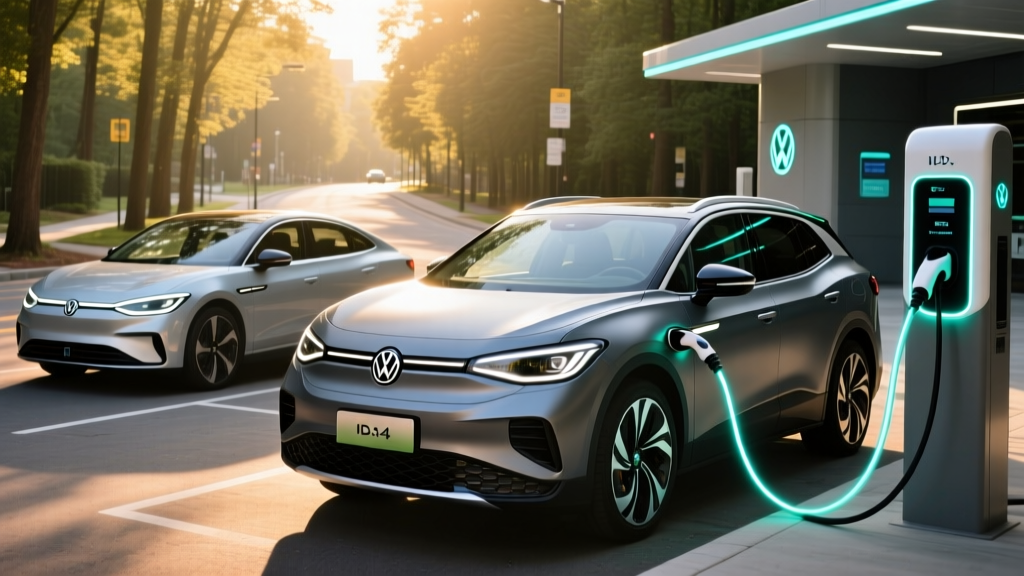
All 2026 Volkswagen electric models sold in the U.S. come equipped with a native NACS (North American Charging Standard) port. This is a meaningful shift from earlier model years that used CCS1 and required adapters for Tesla Supercharger access. Here's what charging looks like in practice:
| Level | Power | Miles of Range Added per Hour | Typical Use Case |
|---|---|---|---|
| Level 1 (120V) | ~1.4 kW | ~4–5 mi/hr | Overnight top-up; emergency only |
| Level 2 (240V, 48A) | ~11.5 kW | ~33–38 mi/hr | Home daily charging; full charge in ~8 hr |
| DC Fast Charge | Up to 175–200 kW | ~170–200 mi in 10 min | Road trips; 10–80% in ~26–30 min |
Charging curve reality: The ID.4 and ID. Buzz peak at 175 kW but only sustain that rate between roughly 10–30% state of charge. From 50–80%, the rate tapers to 60–90 kW. The ID.7's 200 kW peak holds a slightly longer window but still tapers sharply past 80%. This means a 10–80% session takes ~28 minutes, but 10–95% takes closer to 50 minutes. Plan road-trip stops around the 80% mark for time efficiency.
Home charging setup: A Level 2 home charger is strongly recommended. Budget $500–$800 for a quality 48-amp hardwired EVSE (e.g., ChargePoint Home Flex, Emporia Vue) and $800–$2,500 for electrician labor, depending on whether your panel needs a 240V/60A circuit run. Total home install: $1,300–$3,300. If your panel is maxed out at 100A, a panel upgrade to 200A adds $1,500–$3,000. Always consult a licensed electrician for final specifications.
Total Cost of Ownership: 5-Year Breakdown
Purchase price is only part of the equation. Here's a 5-year / 75,000-mile ownership projection for the ID.4 AWD versus a comparably equipped gas compact SUV:
| Cost Category | VW ID.4 Pro S AWD | Gas Compact SUV (AWD) |
|---|---|---|
| MSRP | $39,735 | $34,000 |
| Federal Tax Credit (§30D) | Up to –$7,500* | $0 |
| Effective Purchase Price | $32,235 | $34,000 |
| Home Charger Install | $2,000 | $0 |
| Fuel / Energy (75k mi) | $3,300 | $8,250 |
| Maintenance (5 yr) | $1,200 | $3,500 |
| Insurance (5 yr est.) | $9,500 | $7,500 |
| Estimated Depreciation | $16,000 | $14,000 |
| 5-Year Total | $52,235 | $67,250 |
*§30D credit eligibility depends on battery critical-mineral sourcing, MSRP caps ($80,000 for SUVs/vans, $55,000 for sedans), and buyer income limits ($150k single / $300k joint). Verify current rules at IRS.gov. Credit may be applied at point of sale.
Key observations: EV insurance premiums run 15–25% higher on average due to repair costs and battery replacement risk. EV maintenance is dramatically lower — no oil changes, no transmission fluid, fewer brake replacements thanks to regenerative braking. Depreciation on EVs remains higher than gas counterparts, though this gap has narrowed since 2024 as the used-EV market stabilized.
Common Volkswagen EV Misconceptions — Fact vs. Fiction
| Myth | Fact |
|---|---|
| "VW's EV software is still broken." | Early ID.4 models (2021–2023) had significant infotainment bugs. VW rolled out major OTA updates through 2024–2025 (software v4.0+) that resolved most issues. The 2026 models ship with the updated ID.Software stack, which is responsive and stable, though still not class-leading versus Tesla or Hyundai's UX. |
| "I can't use Tesla Superchargers." | 2026 VW electric models come with a native NACS port. You can pull into any Tesla Supercharger stall and charge without an adapter. VW also supports Plug & Charge at participating networks. |
| "The battery will need replacing in 5 years." | VW warranties the traction battery for 8 years / 100,000 miles against degradation below 70% capacity. Real-world data from European ID.4 fleets shows ~5–8% degradation at 60,000 miles. Full battery replacement (if ever needed out of warranty) runs $15,000–$22,000, but is rare. |
| "EVs don't work in cold climates." | Cold weather reduces range by 20–35% due to battery chemistry and cabin heating demands. The ID.4 and ID.7 offer an optional heat pump (standard on some trims) that recovers ~10–15% of that loss. Preconditioning the battery while plugged in mitigates both range loss and slow cold-weather charging. |
| "Public charging is unreliable everywhere." | Network reliability varies. Tesla Superchargers consistently achieve 95%+ uptime. Electrify America and EVgo have improved but still experience 5–15% downtime at some stations. The NACS transition means VW owners now access the most reliable network. |
Who Should Buy a Volkswagen Electric — and Who Shouldn't
Decision Framework: Is a VW Electric Right for You?
Choose the VW ID.4 if:
- You need a compact SUV with ~275 miles of real-world range and a sub-$40k starting price.
- You have (or can install) Level 2 home charging and drive under 60 miles daily.
- You want Supercharger access without carrying adapters.
- You value a quiet, smooth ride over sporty handling.
Choose the VW ID.7 if:
- You prefer sedan efficiency and want 300+ real-world highway miles.
- You commute long distances and want fewer charging stops.
- You're willing to pay a ~$10,000 premium over the ID.4 for refinement and range.
Choose the VW ID. Buzz if:
- You need three rows and family hauling with zero tailpipe emissions.
- Your daily driving is under 150 miles and you can charge at home.
- You accept the efficiency penalty of a van form factor (~85 MPGe).
Look elsewhere if:
- You lack home charging access and your area has sparse DC fast-charging infrastructure. Range and charging logistics become a daily burden.
- You regularly tow over 2,700 lbs (the ID.4 maxes out at 2,700 lbs; the ID. Buzz at ~3,500 lbs). Consider a truck-based EV or PHEV.
- You need 400+ miles of range for remote road trips. Look at the Lucid Air, Tesla Model S, or a PHEV with gas backup.
- You prioritize cutting-edge ADAS. VW's Travel Assist is competent Level 2 driver-assist, but it doesn't match Tesla Autopilot or GM Super Cruise in highway lane-centering confidence.
ADAS Note: Volkswagen's Travel Assist and IQ.DRIVE suite are SAE Level 2 systems — the driver must remain fully engaged, hands on or near the wheel, eyes on the road. These are not self-driving systems. Level 4 autonomy (no driver required) remains limited to geofenced robotaxi services like Waymo in select cities.
Federal Tax Credit & Incentive Eligibility
The §30D Clean Vehicle Credit can reduce your effective purchase price by up to $7,500, but eligibility is not guaranteed. Here's the current checklist:
- MSRP caps: $80,000 for SUVs and vans (ID.4, ID. Buzz qualify); $55,000 for sedans (ID.7 qualifies on base trims).
- Buyer income limits: Adjusted gross income must not exceed $150,000 (single), $225,000 (head of household), or $300,000 (joint).
- Battery sourcing: A percentage of critical minerals and battery components must be sourced from the U.S. or free-trade-agreement countries. This requirement tightens annually. Verify current-year compliance on fueleconomy.gov.
- Point-of-sale transfer: You can transfer the credit to the dealer at purchase, reducing your out-of-pocket cost immediately rather than waiting for tax filing.
- Final assembly: Vehicle must undergo final assembly in North America. All U.S.-market ID.4 models are built in Chattanooga, TN. The ID.7 is built in Emden, Germany — verify current assembly-status as this affects eligibility.
Critical caveat: Because the ID.7 is assembled in Germany, it likely does not qualify for the §30D credit under current final-assembly rules. The ID.4 (Chattanooga-built) is far more likely to qualify, though battery-sourcing requirements must still be met. Always confirm before purchasing.
Frequently Asked Questions
What is the real-world range of the Volkswagen ID.4?
The EPA rates the 2026 ID.4 Pro S AWD at 275 miles and the RWD variant at 291 miles. In real-world highway driving at 70 mph, expect 230–250 miles (AWD). In freezing temperatures, plan for 190–215 miles. Always plan road-trip charging stops conservatively — use 70% of the EPA figure as your safe range budget in adverse conditions.
How fast does the Volkswagen ID.4 charge at home?
On a Level 2, 240V/48A home charger, the ID.4 accepts up to 11 kW (though some base trims are limited to 7.7 kW with the standard cord). At 11 kW, a full 0–100% charge takes roughly 8 hours — easily overnight. On a standard 120V outlet (Level 1), you'll add only ~4–5 miles per hour, which works for low-mileage drivers but is impractical as a primary charging method.
Does the Volkswagen ID.7 qualify for the $7,500 federal tax credit?
Likely not under current rules. The §30D credit requires final assembly in North America, and the ID.7 is manufactured in Emden, Germany. The ID.4, built in Chattanooga, Tennessee, is the stronger candidate for credit eligibility — but battery-sourcing requirements also apply. Always check the latest VIN-lookup tool on fueleconomy.gov before committing to a purchase.
Is the Volkswagen ID. Buzz practical as a daily driver?
It depends on your daily mileage. With ~234 miles of EPA range (and ~195–210 real-world highway), the ID. Buzz works well for families with predictable routines and home charging. The 91 kWh battery is large, but the van's 5,000+ lb curb weight and boxy aero drag efficiency down to ~85 MPGe. If your daily round trip exceeds 150 miles and you can't charge at work, range will feel tight. For road trips, plan DC fast-charge stops every 170–190 miles to stay comfortable.
What happens if the VW ID.4 battery degrades significantly?
Volkswagen warranties the high-voltage battery for 8 years or 100,000 miles, whichever comes first, against capacity loss below 70% of original. Real-world degradation data from European ID.4 fleets shows approximately 5–8% capacity loss at 60,000 miles — well within the warranty threshold. If the battery does fall below 70% within the warranty period, VW will repair or replace modules at no cost. Out-of-warranty full pack replacement is estimated at $15,000–$22,000, but this scenario is uncommon given current degradation curves.
How does VW's driver-assist compare to Tesla Autopilot or GM Super Cruise?
VW's Travel Assist (part of IQ.DRIVE) provides adaptive cruise control with lane centering — a competent SAE Level 2 system for highway use. However, it requires consistent hands-on-wheel input and doesn't offer the hands-free capability of GM Super Cruise (on approved highways) or the lane-change confidence of Tesla Autopilot. It's adequate for reducing fatigue on long drives, but it is not a differentiator in this segment. The driver must remain fully engaged at all times.