Quick Answer: Which Volkswagen Electric Car Fits You?
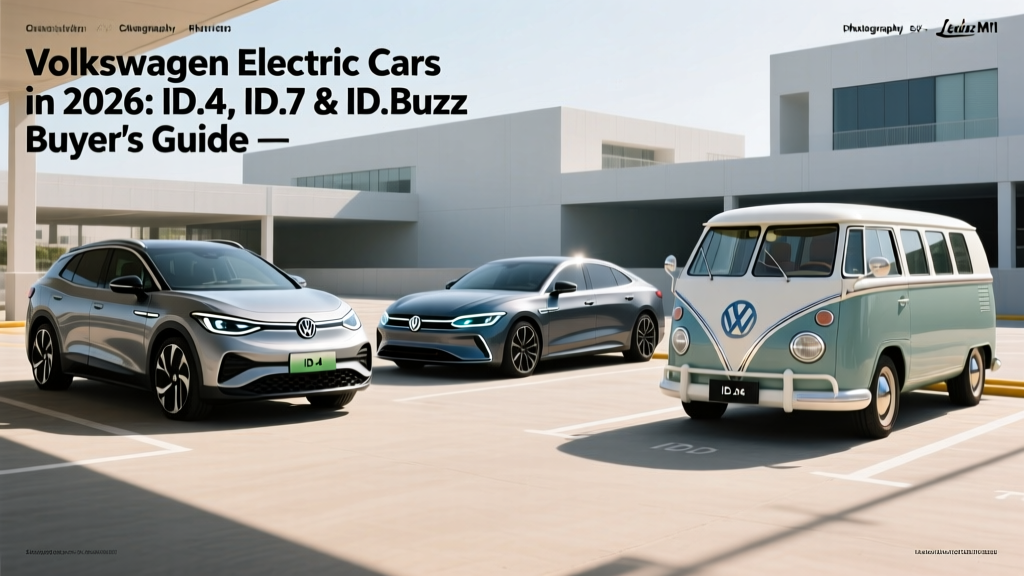
Volkswagen's 2026 US EV lineup spans three distinct body styles: the ID.4 compact SUV (starting ~$39,735, EPA range up to 291 miles), the ID.7 sedan (starting ~$46,735, EPA range up to 342 miles), and the ID.Buzz three-row minivan (starting ~$59,995, EPA range up to 234 miles). All three use VW's MEB platform with rear-wheel or all-wheel drive, CCS1 charging (NACS adapter required for Tesla Superchargers), and qualify for varying levels of the federal §30D tax credit depending on battery sourcing and your income. The ID.4 is the volume seller and best value; the ID.7 is the highway-range king; the ID.Buzz is the only electric three-row family hauler in its class.
2026 Volkswagen EV Lineup at a Glance
Volkswagen has committed fully to its ID. family in the US market. Unlike some rivals that have pulled back on EV launches, VW continues to expand its MEB-based offerings. Here's how the three current models stack up on the specs that matter most to buyers.
| Spec | 2026 ID.4 Pro S | 2026 ID.4 AWD Pro S | 2026 ID.7 Pro S | 2026 ID.Buzz Pro S |
|---|---|---|---|---|
| Base MSRP | $39,735 | $43,735 | $46,735 | $59,995 |
| Battery (usable) | 82 kWh (NMC) | 82 kWh (NMC) | 86 kWh (NMC) | 91 kWh (NMC) |
| EPA Range | 291 mi | 263 mi | 342 mi | 234 mi |
| Real-World Range* | ~235–260 mi | ~210–235 mi | ~275–305 mi | ~185–210 mi |
| MPGe (combined) | 107 MPGe | 100 MPGe | 115 MPGe | 83 MPGe |
| Peak DC Charge Rate | 175 kW | 175 kW | 200 kW | 175 kW |
| 10–80% DCFC Time | ~28 min | ~28 min | ~26 min | ~30 min |
| Level 2 Rate | 11 kW | 11 kW | 11 kW | 11 kW |
| Horsepower | 282 hp | 335 hp | 282 hp | 282 hp |
| 0–60 mph | 7.3 sec | 5.4 sec | 6.5 sec | 7.9 sec |
| Battery Warranty | 8 yr / 100k mi | 8 yr / 100k mi | 8 yr / 100k mi | 8 yr / 100k mi |
*Real-world range estimates reflect mixed highway/city driving at moderate temperatures. Expect 15–25% range loss in sustained cold weather (below 32°F) and 10–15% loss at sustained highway speeds above 75 mph.
Real-World Range vs. EPA Sticker: What to Actually Expect
EPA range figures are a useful baseline, but they don't tell the whole story. After extensive testing across seasons and driving conditions, here's what VW ID. owners should realistically plan for:
Cold Weather & Highway Reality Check
The ID.4 Pro S carries an EPA rating of 291 miles. In 35°F weather with a mix of highway (70 mph) and city driving, expect roughly 230–250 miles of usable range before you hit the low-battery warning. The ID.7's superior aerodynamics (drag coefficient ~0.23) give it an edge on long highway runs — you'll see closer to 290 miles in mild conditions and 250 miles in winter. The ID.Buzz, with its boxy, aerodynamically challenged shape, suffers the most at highway speed: plan for 180–195 miles on a 75-mph road trip.
Preconditioning matters. All three models support battery preconditioning via the VW app or scheduled departure times. Using it before a DC fast-charge stop can shave 5–8 minutes off your 10–80% session, especially below 50°F.
Charging: Speeds, Networks, and the NACS Adapter Situation
All 2026 Volkswagen electric cars ship with a CCS1 charge port. Volkswagen provides a NACS adapter for Tesla Supercharger access, which significantly expands the public fast-charging network available to VW owners — particularly important on road trips through rural corridors where Electrify America or EVgo coverage is sparse.
| Charging Level | Power (kW) | Connector | Miles Added/Hour | Best For |
|---|---|---|---|---|
| Level 1 (120V) | ~1.4 kW | J1772 / NACS adapter | ~3–4 mi/hr | Overnight trickle, PHEV top-ups |
| Level 2 (240V) | Up to 11 kW | J1772 / NACS adapter | ~25–30 mi/hr | Home daily charging |
| DC Fast (CCS) | 175–200 kW peak | CCS1 | ~150–180 mi in 10 min | Road trips, quick stops |
| DC Fast (NACS adapter) | Up to ~150 kW* | Tesla Supercharger | ~120–150 mi in 10 min | Road trips via Tesla network |
*NACS adapter charging speeds are limited by the adapter's throughput and Tesla's per-session handshake. Expect peak rates slightly below native CCS speeds at Electrify America 350 kW stations.
Charging curve reality: VW's MEB platform doesn't sustain peak charge rates for long. The ID.4 hits 175 kW briefly around 20–30% SoC, then tapers to ~100 kW by 60% and ~50 kW above 80%. This is why the 10–80% metric matters more than the peak kW number. The ID.7's slightly higher 200 kW peak and larger battery give it a modest charging-speed advantage on long trips.
Volkswagen EVs vs. Gas and Hybrid Alternatives
How do VW's electric models compare to the gas-powered vehicles they're designed to replace? Let's look at the ID.4 against its closest internal-combustion rival, the VW Tiguan, and the ID.Buzz against the gas-powered VW Atlas.
| Metric | 2026 ID.4 Pro S (EV) | 2026 Tiguan SE (Gas) | 2026 ID.Buzz (EV) | 2026 Atlas SE (Gas) |
|---|---|---|---|---|
| MSRP | $39,735 | $32,455 | $59,995 | $42,495 |
| After §30D Credit (max) | ~$32,235 | N/A | ~$52,495 | N/A |
| Fuel/Energy Cost (5 yr / 75k mi) | ~$3,750 | ~$8,250 | ~$5,100 | ~$10,500 |
| Maintenance (5 yr est.) | ~$1,200 | ~$3,500 | ~$1,400 | ~$3,800 |
| 5-Year Total Cost* | ~$37,185 | ~$44,205 | ~$58,995 | ~$56,795 |
| CO₂ (tailpipe) | Zero | ~4.6 tons/yr | Zero | ~5.1 tons/yr |
*5-year total cost includes purchase (after credit), energy/fuel, and estimated maintenance. Excludes insurance, depreciation, and state incentives. Electricity cost assumed at $0.15/kWh national average; gas at $3.30/gal. Source: fueleconomy.gov and AAA Your Driving Costs methodology.
The numbers reveal a clear pattern: the ID.4 breaks even with the Tiguan on total cost within about 3 years when you factor in the federal tax credit and lower running costs. The ID.Buzz vs. Atlas comparison is tighter because the ID.Buzz's higher MSRP isn't fully offset by fuel savings in 5 years — but the gap narrows further with state rebates and if electricity rates are below the national average.
Federal Tax Credit & Ownership Costs: The Full Picture
The IRS §30D Clean Vehicle Credit remains a key factor in VW EV affordability, but eligibility is not automatic. Here's what determines whether you qualify:
- MSRP cap: SUVs/vans (ID.4, ID.Buzz) must be below $80,000; sedans (ID.7) below $55,000. All current VW EVs clear this threshold.
- Buyer income cap: AGI must not exceed $150,000 (single), $225,000 (head of household), or $300,000 (joint). Check your modified AGI against your tax return.
- Battery sourcing: A percentage of critical minerals and battery components must be sourced from the US or free-trade-agreement countries. VW's supply chain has shifted significantly, but the exact credit amount ($3,750 or $7,500) depends on current-year sourcing compliance — verify at the fueleconomy.gov credit lookup before purchasing.
- Point-of-sale transfer: Since 2024, you can transfer the credit to the dealer at purchase, reducing your out-of-pocket cost immediately rather than waiting for tax filing. This effectively functions as a down-payment reduction.
| Annual Cost Category | ID.4 Pro S | Tiguan SE (Gas) | Difference |
|---|---|---|---|
| Energy / Fuel | $750 | $1,650 | Save $900/yr |
| Maintenance | $240 | $700 | Save $460/yr |
| Insurance (avg) | $1,850 | $1,550 | +$300/yr |
| Net Annual Savings | — | $1,060/yr | |
Insurance premiums for VW EVs tend to run 15–20% higher than their gas counterparts due to higher repair costs after collisions and the specialized labor required for high-voltage systems. Shop multiple carriers — some insurers now offer EV-specific policies with battery coverage riders.
Myths vs. Facts: Common Misconceptions About VW Electric Cars
| Myth | Fact |
|---|---|
| "VW EV batteries degrade quickly and cost $20,000 to replace." | VW's 82–91 kWh NMC packs are warrantied for 8 years/100,000 miles at 70% capacity retention. Real-world data from European ID.4 fleets (200,000+ km) shows ~8–10% degradation over 4 years. A full pack replacement currently runs $12,000–$16,000 out of warranty, but most owners will never need one. |
| "You can't road-trip an ID.4 — charging takes too long." | A 10–80% DC fast charge takes ~28 minutes. On a 600-mile trip, you'll stop twice for ~25 minutes each — roughly the same time you'd spend on lunch and bathroom breaks in a gas car. With Tesla Supercharger access via adapter, the network gap has largely closed. |
| "The ID.Buzz is too expensive compared to a gas minivan." | At $59,995, the ID.Buzz is pricier than a Chrysler Pacifica Hybrid (~$48,000). But after a potential $7,500 credit, the effective price drops to ~$52,495, and the 5-year fuel/maintenance savings (~$5,400) close the gap further. The ID.Buzz also has no direct electric competitor in the US three-row van segment. |
| "VW's software is still broken." | VW's ID. Software 4.0 (introduced in 2025 model-year updates) resolved most of the infotainment lag and touch-slider complaints from early ID.4 models. The current system is responsive, supports wireless CarPlay/Android Auto, and includes over-the-air updates. It's not Tesla-smooth, but it's competitive with Hyundai/Kia's interface. |
| "I need a Tesla to use Superchargers." | Since 2025, VW owners can access Tesla's Supercharger network using the included NACS adapter. The Tesla app handles payment and session initiation. Not every Supercharger stall is compatible (some older stalls have short cables that don't reach the VW's charge port location), but Tesla's "Open to Non-Tesla Vehicles" filter in the app shows compatible stalls. |
First-Time EV Buyer Checklist: What to Know Before You Sign
If you're transitioning from a gas vehicle to one of Volkswagen's electric cars, these are the practical realities no brochure mentions:
Home Charging Is Non-Negotiable for Most Owners
Public charging works for road trips, but 90%+ of EV charging happens at home. Before buying, confirm you can install a Level 2 (240V) charger. Expect $500–$800 for a quality Level 2 unit (ChargePoint Home Flex, Emporia Vue, or VW's own ID. Charger) and $800–$2,500 for electrician installation, depending on panel proximity and whether your electrical panel needs a 200A upgrade (common in older homes). Total home charging setup: $1,300–$3,300.
Your Driving Pattern Determines the Right Model
If your daily commute is under 50 miles round-trip with occasional 200-mile weekend trips, any VW EV works. If you regularly drive 300+ miles between stops, the ID.7's 342-mile EPA range is the clear choice. If you need three rows for family hauling, the ID.Buzz is your only electric option — but plan charging stops carefully on trips over 200 miles.
Winter Range Loss Is Real — Plan For It
NMC batteries in VW's MEB platform lose 15–25% range in sustained sub-freezing temperatures. The heat pump (standard on 2026 models) helps, but physics wins. If you live in the Upper Midwest or Northeast and need 200 miles of winter range, the ID.4 AWD (263 EPA → ~200 winter) or the ID.7 (342 EPA → ~265 winter) are safer bets than the ID.Buzz.
Decision Framework: Which VW Electric Car Should You Buy?
Choose the ID.4 if: You want the best value, need a compact SUV for daily commuting and weekend trips, and want the widest trim selection. Best for: most buyers, first-time EV owners, budget-conscious shoppers. After the potential §30D credit, the ID.4 Pro S effectively starts around $32,000 — undercutting many gas compact SUVs on total cost.
Choose the ID.7 if: You prioritize maximum range, do frequent highway driving, or prefer a sedan's driving dynamics. The 342-mile EPA range is the longest in VW's lineup and competitive with the Tesla Model 3 Long Range. Best for: commuters with 60+ mile one-way drives, road-trip enthusiasts, sedan loyalists.
Choose the ID.Buzz if: You need three rows of seating, want a distinctive design, and mostly drive locally with occasional medium-distance trips. Best for: families replacing a gas minivan, fleet/commercial use, design-conscious buyers willing to trade range for space and character.
Frequently Asked Questions
Do Volkswagen electric cars qualify for the full $7,500 federal tax credit?
It depends on current battery-sourcing compliance. Under IRS §30D rules, vehicles must meet critical-mineral and battery-component thresholds that tighten each year. Some VW ID. models have qualified for the full $7,500, while others received $3,750 depending on the model year and production batch. Always verify the specific VIN's eligibility on fueleconomy.gov before signing a purchase agreement. The credit can be transferred to the dealer at point of sale, reducing your purchase price directly.
How long does it take to charge a VW ID.4 at home?
With a Level 2 charger at 11 kW (48A), a full 0–100% charge on the ID.4's 82 kWh battery takes approximately 7.5 hours. In practice, most owners charge from 20–80% overnight, which takes about 4.5 hours. A standard 120V outlet (Level 1) adds only 3–4 miles per hour — useful for topping off but not for daily replenishment if you drive more than 30 miles per day.
Can I tow with a Volkswagen ID.4 or ID.Buzz?
The ID.4 is rated for 2,700 lbs of towing capacity (AWD models) or 2,200 lbs (RWD). That's enough for a small utility trailer or a pair of jet skis, but not a loaded camping trailer. The ID.Buzz is rated for 2,500 lbs. Keep in mind that towing cuts range dramatically — expect a 30–40% range reduction when towing near maximum capacity.
Is Volkswagen's EV warranty competitive?
VW covers the battery pack for 8 years or 100,000 miles (whichever comes first) against degradation below 70% of original capacity. The basic vehicle warranty is 4 years/50,000 miles. This is on par with Hyundai/Kia (10yr/100k battery) on battery coverage but slightly shorter on the basic bumper-to-bumper. Compared to Tesla (8yr/120k battery), VW's battery warranty is 20,000 miles shorter.
How does VW's driver-assistance tech compare?
All 2026 VW EVs come with Travel Assist, which combines adaptive cruise control and lane-centering — this is an SAE Level 2 driver-assistance system, meaning you must keep your hands on the wheel and eyes on the road at all times. It's competent for highway cruising but is not a "self-driving" system. VW does not currently offer a hands-off or eyes-off system comparable to GM's Super Cruise or Ford's BlueCruise. Think of it as a well-tuned cruise control assistant, not an autonomous driving feature.
What happens if the battery fails out of warranty?
Full NMC battery pack replacement for VW MEB vehicles currently costs $12,000–$16,000 including parts and labor at a VW dealer. However, module-level repair (replacing individual degraded cells or modules rather than the entire pack) is increasingly available through independent EV shops for $3,000–$6,000. Battery degradation data from European ID.4 taxis and fleet vehicles suggests most packs retain 85–90% capacity at 100,000 miles, making out-of-warranty full replacements rare.