Leasing a Volkswagen EV in 2026 isn't just about the monthly payment. With the ID.4 compact SUV and the new ID.7 sedan both eligible for federal incentives via the lease loophole, a Volkswagen electric car lease can undercut gas alternatives on total cost — but only if you account for insurance premiums, real-world charging costs, and residual-value risk that the lessor absorbs. Below, we run the full ownership math on VW's two main EVs so you can decide whether to lease, buy, or walk away.
Which Volkswagen EVs Can You Lease in 2026?
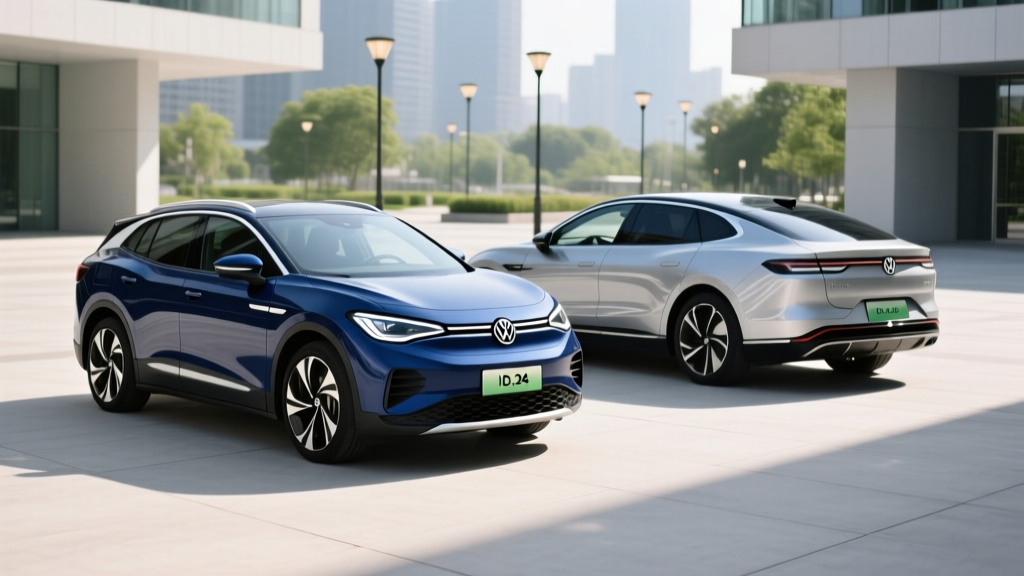
Volkswagen's US EV lineup for the 2026 model year centers on two vehicles built on the MEB platform:
- ID.4 (compact SUV): Available with a 62 kWh usable LFP battery (Standard Range, RWD) or an 82 kWh usable NMC battery (Pro/Pro S/AWD). EPA range spans 206 to 291 miles depending on trim and drivetrain. Base MSRP starts around $39,735 for the Standard trim.
- ID.7 (midsize sedan): VW's first electric sedan for North America, riding the upgraded MEB+ architecture with an 86 kWh usable NMC pack. EPA range targets up to ~340 miles (AWD Pro S). Base MSRP expected from $49,995.
Both models feature DC fast charging up to 175 kW (ID.4) and 200 kW (ID.7), with 10–80% sessions in roughly 28 and 26 minutes respectively under optimal battery preconditioning. Both come with VW's 8-year/100,000-mile high-voltage battery warranty (70% capacity retention threshold).
The Lease Loophole: Why a Volkswagen Electric Car Lease Captures $7,500
Here's the core financial reason buyers choose a Volkswagen electric car lease over a purchase: the IRS §30D commercial clean-vehicle credit. When VW Financial Services (the captive lessor) buys the car and leases it to you, the $7,500 federal credit flows to VW — and dealers typically pass it through as a capitalized-cost reduction, lowering your monthly payment.
§30D Purchase vs. Lease Rules at a Glance
- Buying outright (§30D): Buyer must meet income caps ($150K single / $300K joint), MSRP caps ($55K cars / $80K SUVs/trucks), critical-mineral and battery-component sourcing rules, and North American final assembly. The ID.4 built in Chattanooga, TN, qualifies; the Germany-built ID.7 does not for a direct purchase.
- Leasing (commercial credit, §45W): No buyer income cap, no MSRP cap, no battery-sourcing requirement. The lessor claims the credit and may pass savings to the lessee. Both the ID.4 and ID.7 qualify through a lease.
- Point-of-sale transfer: On purchases, the credit can be applied at the dealer to reduce the purchase price. On leases, the cap reduction is typically reflected in the capitalized cost.
- Caveat: Tax rules change. Confirm current eligibility with IRS guidance and a qualified tax professional before signing.
5-Year Total Cost of Ownership: ID.4 vs. Tiguan Baseline
To see whether a Volkswagen electric car lease actually saves money, we modeled a 5-year/60,000-mile ownership cycle for the ID.4 Pro AWD ($47,735 MSRP) against the comparably equipped Tiguan SE R-Line ($38,000 MSRP). The EV assumes the $7,500 lease cap reduction applied upfront.
| Category | ID.4 Pro AWD (Lease-Adjusted) | Tiguan SE R-Line (Gas) |
|---|---|---|
| Purchase / Cap Cost (after credit) | $40,235 | $38,000 |
| Energy (fuel / electricity) | $3,780 | $7,500 |
| Maintenance | $1,400 | $3,600 |
| Insurance (5-yr total) | $9,600 | $7,200 |
| Estimated Depreciation | $18,500 | $16,200 |
| Total 5-Year Cost | $73,515 | $72,500 |
| Cost per mile | $1.23 | $1.21 |
Key assumptions: electricity at $0.16/kWh national average with 70% home Level 2 charging and 30% DC fast charging at $0.40/kWh; gas at $3.50/gallon; Tiguan at 26 MPG combined (fueleconomy.gov); EV efficiency at 3.0 miles/kWh real-world; insurance sourced from industry averages showing EV premiums 20–35% higher than equivalent ICE models.
Charging vs. Gas: The Per-Mile Math That Matters
Fuel savings are where a Volkswagen electric car lease earns its keep. Here's how the ID.4's per-mile energy cost compares to the Tiguan under different charging scenarios:
| Scenario | Cost per Mile | Annual Cost (12,000 mi) |
|---|---|---|
| ID.4 — 100% home Level 2 ($0.16/kWh) | $0.053 | $640 |
| ID.4 — 70/30 home/DCFC blend | $0.063 | $756 |
| ID.4 — 100% DC fast charging ($0.40/kWh) | $0.133 | $1,600 |
| Tiguan — 26 MPG @ $3.50/gal | $0.135 | $1,620 |
At a blended home/DCFC mix, the ID.4 saves roughly $860/year over the Tiguan. Over five years, that's $4,300 in fuel savings alone. But if you rely entirely on public DC fast charging — a reality for apartment dwellers without home charging access — the EV's per-mile cost nearly matches the gas car. Home Level 2 charging is the single biggest variable in making a Volkswagen electric car lease financially viable.
State, Local & Utility Incentives
Beyond the federal $7,500, many states and utilities offer additional rebates that stack with a lease: Colorado's state credit (up to $5,000 for income-qualified buyers), California's CVRP (up to $7,000 for lower-income households), and utility rebates from providers like PG&E, ConEdison, and Xcel Energy for home charger installation ($300–$1,500). These vary by jurisdiction and change frequently — check your state energy office and utility provider for current programs before signing a lease.
Maintenance Savings: Where EVs Quietly Win
Internal combustion engines have hundreds of moving parts; the ID.4's APP550 electric motor has essentially one. Over five years and 60,000 miles, the maintenance gap is substantial:
| Service Item | ID.4 (EV) | Tiguan (Gas) |
|---|---|---|
| Oil changes | None | 6–10 changes (~$450–$750) |
| Transmission fluid | Sealed single-speed | 1–2 services (~$300–$500) |
| Brake pads | Regen braking extends life; likely 1 replacement (~$300) | 2 replacements (~$600–$800) |
| Air/engine filters | Cabin filter only (~$120) | Cabin + engine air (~$250) |
| Coolant / spark plugs | Coolant check; no plugs | Spark plugs at ~40K mi (~$400) |
| 5-Year Total | ~$1,400 | ~$3,600 |
Regenerative braking is the hidden hero: by using the motor to slow the car and recapture energy, the ID.4's friction brakes see far less wear. Some EV owners report original brake pads at 80,000+ miles. The caveat? EVs are heavier (the ID.4 AWD tips scales at ~4,700 lbs), which can accelerate tire wear — budget for one extra tire rotation or replacement set over five years.
Insurance: The Cost EV Lease Shoppers Underestimate
Here's where a Volkswagen electric car lease gets more expensive than a gas alternative. EV insurance premiums run 20–35% higher than comparable ICE vehicles. The ID.4 averages roughly $1,920/year vs. the Tiguan's ~$1,440/year — a $480/year or $2,400/5-year gap.
The reasons are structural, not conspiratorial:
- Higher repair costs: EV battery packs and power electronics are expensive to replace after collision damage. Even minor rear-end impacts near the battery housing can trigger total-loss declarations.
- Specialized labor: High-voltage system repairs require certified technicians, and fewer shops have that certification, driving up labor rates.
- Parts availability: VW's MEB-specific components (inverter, onboard charger, battery modules) have longer supply chains than Tiguan parts shared across the VW/Audi ICE lineup.
Shop quotes from EV-friendly insurers (Geico, Progressive, and Tesla's own insurance arm in some states offer competitive EV rates) before signing. A multi-policy discount can close the gap significantly.
Depreciation and Resale: Who Bears the Risk?
EV depreciation has been volatile. Early ID.4 models (2021–2022) saw steep value drops as Tesla's price cuts rippled through the used-EV market, with some 2-year-old ID.4s losing 45–55% of MSRP. The broader trend has stabilized in 2025–2026, but EVs still generally depreciate faster than Toyota or Honda ICE vehicles.
This is precisely why leasing a Volkswagen electric car is strategically sound: the lessor, not you, absorbs the residual-value risk. VW Financial Services sets the residual at signing (typically 45–52% of MSRP for a 36-month ID.4 lease). If used EV values tank by lease-end, you walk away. If they hold or rise, you can buy the car at the favorable residual price.
For buyers who insist on purchasing, expect 5-year depreciation of 45–55% on an ID.4 — roughly in line with the segment average for mainstream EVs but worse than VW's own ICE SUVs.
Real-World Range: What the EPA Sticker Doesn't Tell You
The ID.4 Pro AWD carries an EPA-estimated 263 miles of range. In real-world driving, expect:
- 70°F mixed driving: ~240–260 miles (close to EPA)
- Highway at 75 mph: ~220–235 miles (aerodynamic drag cuts efficiency ~10%)
- Cold weather (20°F) with cabin heat: ~175–200 miles (25–35% loss without a heat pump; the ID.4's optional heat pump reduces this to ~20–25% loss)
- DC fast charging taper: The ID.4 peaks at 175 kW but sustains that rate only between ~10–40% SoC. Above 80%, the curve drops to under 50 kW — plan to charge to 80% and go rather than wait for a full battery.
Is a Volkswagen Electric Car Lease Right for You?
Choose a VW EV Lease If:
- You have home Level 2 charging access (the economics collapse without it)
- You want the $7,500 federal incentive without meeting income, MSRP, or battery-sourcing requirements
- You drive 10,000–15,000 miles/year and want to avoid residual-value risk
- You prefer a 36-month commitment with the option to upgrade to future MEB+ or SSP-platform VWs
Consider Buying or Choosing Gas If:
- You rely exclusively on public DC fast charging (your per-mile cost approaches gas)
- You drive under 8,000 miles/year (fuel savings won't offset higher insurance and depreciation)
- You keep vehicles 8+ years (leasing locks you into perpetual payments; buying and holding is cheaper long-term if the battery survives)
- You live in a region with high electricity rates ($0.25+/kWh) and low gas prices
Frequently Asked Questions
How much does a Volkswagen electric car lease cost per month?
A 2026 ID.4 Pro lease typically runs $350–$450/month for 36 months and 10,000 miles/year with the $7,500 federal incentive applied as a cap cost reduction and $3,000–$4,000 due at signing. The ID.7 sedan leases for roughly $475–$600/month under similar terms. Exact pricing depends on dealer markup, money factor, residual, and trade-in equity.
Do I qualify for the $7,500 federal tax credit on a VW lease?
On a lease, the credit goes to the lessor (VW Financial Services), not to you directly. There are no buyer income caps, MSRP caps, or battery-sourcing requirements for the commercial-vehicle lease credit. However, VW must choose to pass the savings to you as a cap cost reduction — confirm this in writing before signing. For a direct purchase, §30D rules apply: income under $150K (single) / $300K (joint), MSRP under $80K (SUVs like ID.4), and strict critical-mineral sourcing requirements.
How much do I save on fuel and maintenance with an ID.4?
At a blended home/DCFC charging mix, expect ~$860/year in fuel savings vs. a Tiguan and ~$440/year in maintenance savings — roughly $1,300/year combined, or $6,500 over five years. Your actual savings depend on local electricity rates, gas prices, and whether you can charge at home.
Are Volkswagen EVs more expensive to insure?
Yes, typically 20–35% more than equivalent gas VWs. The ID.4 averages ~$1,920/year vs. the Tiguan's ~$1,440/year. Higher repair costs, specialized labor, and expensive battery components drive the premium gap. Shop multiple quotes and ask about EV-specific discounts.
What happens to the battery after the lease ends?
You return the car and walk away. VW's 8-year/100,000-mile battery warranty covers capacity loss below 70% — but on a 36-month lease, you'll never approach that threshold. Typical 3-year degradation on the ID.4's NMC pack is 3–6%, meaning you'll still have ~94–97% of original capacity at lease-end. No battery-replacement risk falls on you.
Can I buy the ID.4 at the end of my lease?
Yes. VW Financial Services sets a purchase-option price (the residual) at lease signing. If the used EV market has dropped and the residual is above market value, simply return the car. If the market has held, buying at the residual can be a strong deal.