The Short Answer on the Volkswagen Beetle EV
As of 2026, Volkswagen has not officially confirmed a production Volkswagen Beetle EV. The last Beetle rolled off the assembly line in July 2019, and while VW design chief Klaus Zyciora and other executives have publicly floated the idea of an electric Beetle revival on the MEB platform, no concept car, production timeline, or pricing has been announced. If you're searching for a Beetle EV to buy today, it doesn't exist yet — and VW's current EV roadmap prioritizes the ID.4, ID.7, ID.Buzz, and the upcoming ID.2/ID.1 budget models for the European and global markets.
That said, the Beetle nameplate carries enormous brand equity, and VW has a track record of reviving heritage models (see: the ID.Buzz microbus). Below, we break down what an electric Beetle could look like based on VW's current EV architecture, what it would likely cost, and which available VW EVs fill that retro-styled, practical-EV gap right now.
Why the Volkswagen Beetle EV Keeps Coming Up
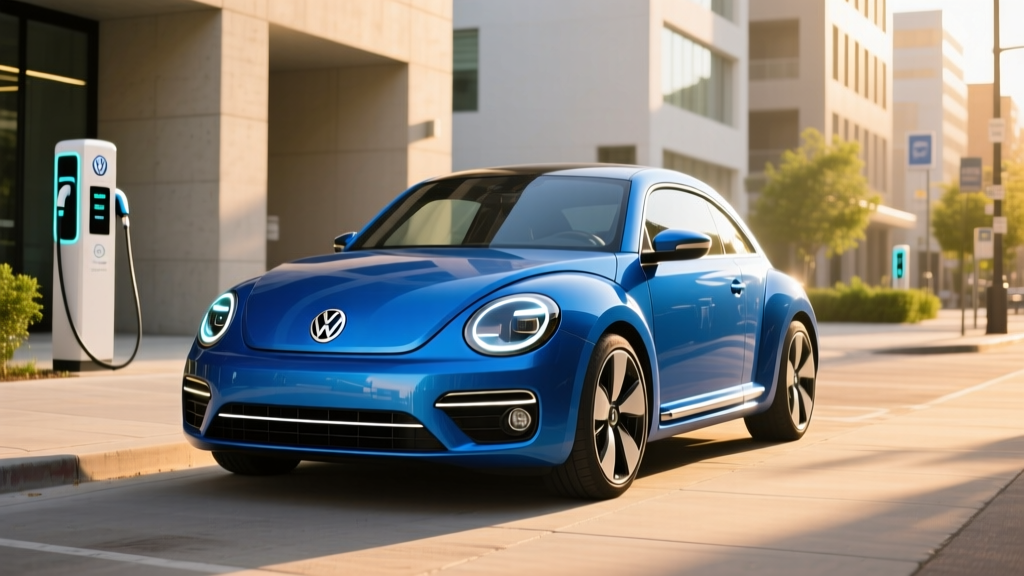
Volkswagen's MEB (Modular Electric Drive Matrix) platform is flexible enough to underpin vehicles from the compact ID.3 hatchback to the three-row ID.Buzz. The original Beetle's compact dimensions, rear-engine layout (the motor sat behind the rear axle), and iconic rounded silhouette make it a natural candidate for an EV revival — electric motors are compact, and placing one at the rear would echo the original Beetle's driving character while freeing up interior space.
In 2021, then-VW brand CEO Ralf Brandstätter acknowledged the Beetle as a possibility in the electric era. Design chief Klaus Zyciora (who designed the ID.Buzz) has been openly enthusiastic about retro EV designs. However, VW Group's post-2023 restructuring under CEO Oliver Blume has prioritized software fixes, cost reduction, and high-volume models over heritage halo cars. The ID.Buzz, which launched for the U.S. market as a 2025 model, effectively consumed VW's "retro EV revival" bandwidth for this product cycle.
What this means for buyers: A Volkswagen Beetle EV is speculative. If it arrives, the earliest realistic window would be the 2028–2030 model years, likely riding on a next-generation MEB+ or SSP (Scalable Systems Platform) architecture.
Speculative Specs: What a Beetle EV Could Look Like
Based on VW's current MEB platform capabilities and the segment the Beetle would occupy (compact, lifestyle-oriented, two-row coupe or convertible), here's an educated projection of what a production Volkswagen Beetle EV might deliver. These figures are estimates based on comparable VW MEB vehicles, not official specs.
| Spec | Estimated (Standard Range) | Estimated (Long Range) |
|---|---|---|
| Platform | MEB or MEB+ (rear-motor) | |
| Battery Chemistry | NMC (likely) or LFP (if budget variant) | |
| Battery Capacity (usable) | ~58 kWh | ~77 kWh |
| EPA Range (est.) | ~220–240 miles | ~290–320 miles |
| Motor Output | ~201 hp / 229 lb-ft | ~282 hp / 339 lb-ft |
| 0–60 mph | ~7.3 sec | ~6.0 sec |
| Peak DC Fast Charge | ~135 kW | ~175 kW |
| 10–80% DC Charge Time | ~30 min | ~28 min |
| Level 2 AC Charge Rate | 11 kW (est.) | |
| Starting MSRP (est.) | ~$32,000–$35,000 | ~$40,000–$44,000 |
Real-world range caveat: These are optimistic projections. For reference, the mechanically similar VW ID.4 with the 82 kWh (77 usable) battery pack achieves an EPA-estimated 291 miles in rear-wheel-drive form. A Beetle's smaller, more aerodynamic coupe body might squeeze slightly better efficiency, but real-world highway driving at 70+ mph typically yields 15–20% less range than the EPA sticker, and cold-weather (below 32°F) can reduce range by 20–30% depending on heat pump availability.
What You Can Buy Now: VW's Actual EV Lineup
If the Beetle EV is a dealbreaker timeline-wise, here's what Volkswagen actually sells in the U.S. market as of 2026, with real specs:
| Model | EPA Range | Battery (usable) | Peak DC kW | 10–80% | Starting MSRP |
|---|---|---|---|---|---|
| VW ID.4 (RWD) | 291 mi | 77 kWh (NMC) | 175 kW | ~28 min | ~$40,790 |
| VW ID.4 (AWD Pro S) | 275 mi | 77 kWh (NMC) | 175 kW | ~28 min | ~$48,790 |
| VW ID.Buzz | 234 mi | 86 kWh (NMC) | 175 kW | ~30 min | ~$61,495 |
| VW ID.7 (announced) | ~340 mi (est.) | ~82 kWh (NMC) | ~200 kW | ~25 min | TBA |
The ID.4 is VW's volume electric seller and the closest analog to what a Beetle EV would be — a practical, family-friendly EV. The ID.Buzz scratches the retro-styling itch but at a premium price point and with mediocre range for its size. The ID.4 is the pragmatic pick if you want a VW electric vehicle today.
Cost of Ownership: EV vs. Gas Compact (What a Beetle EV Would Save)
Even without confirmed Beetle EV pricing, we can model ownership costs using the projected specs above and compare them against a gas-powered compact in the same price range — something like a Honda Civic or Toyota Corolla, which are natural Beetle cross-shops based on price and lifestyle appeal.
| Cost Category | Beetle EV (est.) | Gas Compact (30 MPG) |
|---|---|---|
| Purchase Price | $35,000 | $28,000 |
| Federal Tax Credit (§30D)* | –$3,750 to –$7,500 | $0 |
| Effective Purchase | $27,500–$31,250 | $28,000 |
| Fuel/Energy (75,000 mi) | $2,400–$3,750** | $8,750*** |
| Maintenance (5 yr) | ~$1,200 | ~$3,500 |
| Insurance (5 yr avg.) | ~$9,500 | ~$7,500 |
| 5-Year Total (est.) | ~$40,600–$45,700 | ~$47,750 |
* §30D credit eligibility depends on MSRP caps ($55,000 for sedans/hatchbacks), buyer income limits ($150K single / $300K joint), and battery critical-mineral and component sourcing requirements. Rules are subject to change — verify at IRS.gov or consult a tax professional.
** Based on $0.13–$0.20/kWh home charging and 3.5 mi/kWh efficiency. Public DC fast charging adds cost.
*** Based on $3.50/gal gasoline at 30 MPG combined.
The numbers show the familiar EV pattern: higher upfront cost offset by dramatically lower energy and maintenance expenses. The Beetle EV would likely be competitive on total cost of ownership within 3–4 years if you can charge at home.
Real-World Ownership Considerations Before You Wait
Whether you're holding out for a Beetle EV or choosing an available alternative, these factors determine whether any EV actually works in your life:
Home Charging Access
This is the single biggest variable. A Level 2 home charger (240V, 32–48 amps) adds roughly 25–35 miles of range per hour of charging and costs $500–$2,000 for the equipment plus $800–$3,000 for electrician installation, depending on whether your panel needs an upgrade to 200A service. Without home charging, you're reliant on public infrastructure, which is more expensive ($0.30–$0.50/kWh at DC fast chargers), less reliable, and time-consuming.
Climate and Range Loss
If you live where winters regularly drop below freezing, expect 20–30% range reduction. A Beetle EV with a projected 240-mile standard-range battery would effectively deliver 170–190 miles in cold conditions. A heat pump (standard on some VW MEB vehicles, optional on others) mitigates this by 5–10 percentage points but doesn't eliminate it.
Driving Patterns
For daily commutes under 60 miles round-trip with home charging, even the shorter-range EV works effortlessly. If you regularly drive 200+ miles one-way, you'll need the long-range variant or a willingness to plan DC fast-charging stops — figure 25–35 minutes per stop at 150+ kW chargers on networks like Electrify America or EVgo.
Federal Tax Credit Eligibility
The §30D Clean Vehicle Credit offers up to $7,500 but is not guaranteed. Key requirements for 2026:
- MSRP cap: $55,000 for sedans, hatchbacks, and wagons (a Beetle would fall here)
- Buyer income cap: Modified AGI ≤ $150,000 (single) or ≤ $300,000 (married filing jointly)
- Battery sourcing: Escalating percentages of critical minerals and battery components must be sourced from the U.S. or free-trade-agreement partners
- Final assembly: Must occur in North America
- Point-of-sale transfer: You can apply the credit at purchase to reduce the sale price directly
Common Misconceptions About the Beetle EV
| Myth | Fact |
|---|---|
| "VW is releasing a Beetle EV in 2026." | No official announcement. VW's 2026 focus is ID.4 refresh, ID.Buzz ramp-up, and ID.2all development for Europe. |
| "The e-Beetle concept is the production version." | The 2019 e-Beetle was a one-off conversion by VW and partner eClassics using a vintage body on an electric drivetrain — not a production program. |
| "A Beetle EV would be cheap because it's small." | Battery cost dominates EV pricing. A 58–77 kWh pack alone costs VW roughly $7,000–$10,000, putting a Beetle EV in the $32K–$44K range, not budget territory. |
| "I can convert a classic Beetle to electric myself." | Aftermarket EV conversions exist (companies like Zelectric and eClassics offer them), but they cost $35,000–$80,000+ and produce a specialty vehicle, not a mass-market product with warranty and safety certifications. |
| "EVs don't work in cold weather." | They work, but range drops 20–30%. With a heat pump, preconditioning, and a home garage, cold-climate EV ownership is very practical — just plan for reduced range. |
Decision Framework: Should You Wait or Buy Now?
Wait for the Volkswagen Beetle EV if:
- You specifically want the Beetle's iconic design and no other EV appeals to you aesthetically
- You don't need a new vehicle for 3+ years and are comfortable with an unconfirmed timeline
- You currently drive a vehicle that's reliable and meets your daily needs
- You're willing to accept that VW may never build it
Buy an available VW EV now (ID.4 or ID.Buzz) if:
- You need a vehicle within the next 12 months
- You want a confirmed vehicle with real EPA range figures, warranty coverage, and dealer support
- Practicality (cargo space, family seating) matters more than retro styling
- You want to take advantage of current §30D tax credit rules, which could change under future legislation
Consider a non-VW retro-styled EV if:
- The design ethos matters — look at the Fiat 500e (2026, ~$36,000, 149 mi range) or the Mini Cooper SE / Mini Aceman for compact retro charm
- You want something available now with confirmed specs and a shorter wait
Frequently Asked Questions
Has Volkswagen officially announced a Beetle EV?
No. As of 2026, VW has not confirmed a production Beetle EV. Executives have expressed interest, but no concept, timeline, or pricing has been released. The ID.Buzz currently fills VW's retro-EV niche.
What platform would a Beetle EV use?
Most likely VW's MEB or the next-generation MEB+ platform, which underpins the ID.4, ID.Buzz, and Audi Q4 e-tron. A rear-motor layout would echo the original Beetle's engineering philosophy.
How much would a Volkswagen Beetle EV cost?
Based on VW's current MEB pricing and the compact segment, expect a starting MSRP around $32,000–$35,000 for a standard-range model and $40,000–$44,000 for a long-range variant, before any federal tax credits.
Would a Beetle EV qualify for the $7,500 federal tax credit?
Possibly, but it depends on the final MSRP (must be under $55,000 for a sedan/hatchback), your income, and whether the battery meets critical-mineral and component sourcing requirements. VW's U.S.-built EVs (like the ID.4 from Chattanooga, TN) have an advantage here. Check current rules at IRS.gov.
Can I convert a classic Beetle to electric power?
Yes, several specialty shops offer EV conversions for classic Beetles, typically using Tesla or NetGain drivetrains. Costs range from $35,000 to $80,000+, and the result is a custom vehicle without modern safety systems, ADAS features, or factory warranty. It's a passion project, not a practical daily driver.
What's the best VW electric vehicle to buy right now?
The VW ID.4 (291 miles EPA, starting ~$40,790) offers the best combination of range, price, and practicality. The ID.Buzz (234 miles, ~$61,495) is the choice if retro styling and three-row seating are priorities, though range and price are less competitive. Source: fueleconomy.gov.
Will VW make a Beetle EV convertible?
If a Beetle EV happens, a convertible variant is plausible — the original Beetle Cabriolet was iconic, and VW has offered convertible versions of nearly every Beetle generation. However, convertibles add weight and reduce structural rigidity, which impacts range. Nothing confirmed.
Sources: EPA fueleconomy.gov, IRS Clean Vehicle Credit, Volkswagen of America ID.4 specifications.