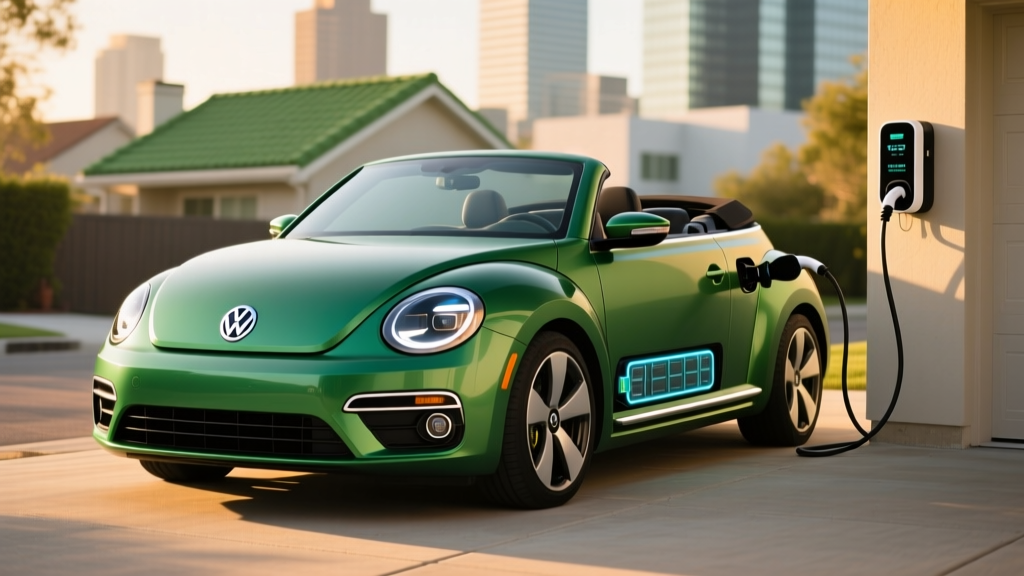
If you're considering a Volkswagen Beetle electric conversion, here's the practical reality: expect to spend between $15,000 and $35,000 on the conversion itself (on top of the donor car), gain roughly 60 to 150 miles of real-world range depending on battery size, and use standard Level 2 (J1772) charging at home. The result is a zero-tailpipe-emissions classic with dramatically lower per-mile fueling costs, but you'll sacrifice DC fast charging, modern safety features, and any federal EV tax credit eligibility. For most buyers, a Beetle EV conversion makes sense as a passion project or weekend cruiser — not a primary commuter replacing a modern EV.
Quick Answer: Is a VW Beetle EV Conversion Worth It?
Total project cost: $25,000–$55,000 (donor car + conversion kit + labor)
Real-world range: 60–150 miles (varies with battery kWh and driving conditions)
Charging: Level 1 (120V) or Level 2 (240V, J1772); no DC fast charging in most builds
Tax credit: Not eligible for the federal §30D credit (applies to new OEM EVs only)
Best for: Enthusiasts wanting a classic daily driver with low operating costs and no gas-engine maintenance
What a Volkswagen Beetle Electric Conversion Actually Involves
An EV conversion replaces the Beetle's original air-cooled flat-four engine, fuel tank, and exhaust system with an electric motor, motor controller, and lithium battery pack. The original transmission is sometimes retained (adapted to the electric motor via a coupling plate), though some builds use a direct-drive setup. The 12V electrical system is preserved for lights, wipers, and gauges, typically supported by a DC-DC converter stepping down from the high-voltage traction pack.
The most common donor vehicles are the 1966–1974 VW Beetle (Type 1) and the 1998–2010 New Beetle. Classic Beetles are popular because of their simple mechanical layout, light weight (roughly 1,800–2,000 lbs curb), and strong aftermarket support. New Beetles are heavier (~2,800 lbs) and more complex electrically, making conversions more involved.
Major conversion-kit suppliers in 2026 include EV West, Electric Classic Cars (UK-based, ships globally), and Zero EV. Kits range from basic motor-and-controller packages (~$5,000–$8,000) to turnkey solutions including batteries, BMS (battery management system), charger, and wiring harness ($12,000–$25,000).
Cost Breakdown: What You'll Actually Spend
The total investment for a Beetle EV conversion spans a wide range depending on battery capacity, motor power, and whether you do the work yourself or hire a shop. Here's a realistic breakdown based on 2026 component pricing and typical shop labor rates:
| Component | Budget Build | Mid-Range Build | Premium Build |
|---|---|---|---|
| Donor Beetle (running condition) | $5,000–$8,000 | $8,000–$15,000 | $15,000–$25,000 |
| Electric motor + controller | $3,500–$5,000 | $5,000–$8,000 | $8,000–$12,000 |
| Battery pack (LFP or NMC) | $4,000–$6,000 (15–20 kWh) | $8,000–$14,000 (25–40 kWh) | $14,000–$20,000 (40–60 kWh) |
| BMS + charger + DC-DC converter | $1,500–$2,500 | $2,500–$4,000 | $4,000–$6,000 |
| Wiring, adapters, hardware | $1,000–$2,000 | $2,000–$3,000 | $3,000–$5,000 |
| Professional labor (if not DIY) | $0 (DIY) | $5,000–$10,000 | $10,000–$20,000 |
| Registration / inspection / title | $200–$500 | $200–$500 | $200–$500 |
| Total | $15,200–$24,000 | $30,500–$54,500 | $54,200–$88,500 |
A few cost realities to keep in mind:
- Battery chemistry matters. LFP (lithium iron phosphate) cells are cheaper per kWh and offer longer cycle life (3,000+ cycles to 80% capacity), but are heavier and bulkier. NMC (nickel manganese cobalt) cells are lighter and more energy-dense — critical in a Beetle's limited packaging space — but cost more and degrade faster under high-heat conditions.
- Hidden costs add up. Brake upgrades (the stock drum brakes on classic Beetles are marginal for the added weight of batteries), suspension reinforcement, and custom battery enclosures can add $2,000–$5,000.
- No federal tax credit. The IRS §30D Clean Vehicle Credit applies only to new OEM electric vehicles meeting MSRP caps, income limits, and battery-sourcing requirements. A conversion does not qualify. Some states offer separate incentives for converted vehicles — check your state energy office.
Range, Efficiency, and Charging: The Numbers That Matter
Range is the single biggest compromise in a Beetle conversion. The car's limited physical space constrains battery size, and the Beetle's aerodynamics (a drag coefficient around 0.48 for classic models) hurt highway efficiency.
Real-World Range Expectations
15 kWh pack (budget build): ~50–65 miles real-world (40–50 miles highway or cold weather)
30 kWh pack (mid-range): ~90–120 miles real-world (70–90 miles highway or cold weather)
50 kWh pack (premium): ~140–170 miles real-world (110–140 miles highway or cold weather)
Note: Classic Beetles have no factory thermal management. In temperatures below 35°F, expect 20–35% range loss due to battery chemistry slowdown and cabin heating draw. This is a significant real-world limitation compared to modern OEM EVs with heat pumps and active battery preconditioning.
Efficiency typically falls between 250–350 Wh/mile depending on motor size, driving style, and whether you're running the original 4-speed transmission (which introduces drivetrain losses) or a direct-drive setup. For reference, a 2026 Tesla Model 3 achieves roughly 250 Wh/mile — the Beetle's boxy shape and older drivetrain components work against it.
Charging Speed and Connectors
| Charging Level | Power (kW) | Miles Added Per Hour | Full Charge Time (30 kWh pack) |
|---|---|---|---|
| Level 1 (120V household) | 1.2–1.4 kW | 3–5 miles | 22–26 hours |
| Level 2 (240V, J1772) | 3.3–7.2 kW | 10–25 miles | 4–9 hours |
| DC Fast Charging | N/A* | N/A* | N/A* |
*Most Beetle conversions do not support DC fast charging (CCS or NACS). Adding a DC-capable onboard charger and the necessary high-voltage architecture typically adds $3,000–$6,000 and requires significant packaging space that the Beetle lacks. Plan on Level 2 home charging as your primary fueling method.
For home Level 2 charging, you'll need a dedicated 240V circuit (typically 30A or 40A) and a J1772 wall connector. Installation by a licensed electrician runs $500–$2,000 depending on your panel capacity and the distance from your electrical panel to the charging location. If your home has a 100A electrical panel, a panel upgrade to 200A may be necessary — adding $1,500–$3,000.
Converted Beetle vs. Gas Beetle vs. Modern EV: Data Comparison
To put the conversion decision in context, here's how a typical mid-range Beetle EV conversion compares to keeping a stock gas Beetle or buying a new OEM electric vehicle:
| Metric | Gas Beetle (1973, stock) | Beetle EV Conversion (30 kWh) | 2026 Nissan Leaf (base) |
|---|---|---|---|
| Total upfront cost | $8,000–$15,000 | $30,500–$54,500 | $30,190 MSRP |
| Fuel/energy cost per mile | ~$0.16/mi (25 MPG, $3.90/gal) | ~$0.04/mi ($0.14/kWh, 280 Wh/mi) | ~$0.04/mi ($0.14/kWh, 270 Wh/mi) |
| Annual fuel cost (12,000 mi) | $1,920 | $480 | $480 |
| Real-world range | ~280 mi (11 gal tank) | ~90–120 mi | ~212 mi (EPA est.) |
| Maintenance (annual est.) | $800–$1,500 | $200–$400 | $300–$500 |
| 0–60 mph | ~18–22 sec | ~8–12 sec | ~7.4 sec |
| Safety features | None (lap belts only) | None (unless added) | AEB, lane-keep, BSW, airbags |
| Warranty | None | Kit mfr. (1–3 yr, varies) | 3 yr/36k mi basic; 8 yr/100k mi battery |
The financial case for conversion centers on operating cost savings and maintenance reduction, not total cost of ownership. At $0.12/mi savings versus gas, you'd need to drive roughly 150,000+ miles to recoup a $20,000 conversion premium over a stock gas Beetle. The conversion pays off in driving experience (instant torque, quiet operation, no carburetor tuning), not pure economics.
Compared to a modern OEM EV like the Nissan Leaf or Chevrolet Bolt, the conversion sacrifices range, charging speed, safety, warranty coverage, and daily usability. You gain uniqueness, classic styling, and the satisfaction of a custom build.
Real-World Ownership: What First-Time EV Converters Should Know
Before committing to a Beetle EV conversion, honestly assess these ownership factors:
Home Charging Access
This is non-negotiable. Without a garage or dedicated parking spot where you can install a 240V Level 2 charger, a conversion becomes impractical. Level 1 (120V) charging adds only 3–5 miles of range per hour — a full charge for a 30 kWh pack takes nearly a full day. Public Level 2 chargers (at grocery stores, workplaces) can supplement, but relying on them exclusively is inconvenient and often more expensive ($0.20–$0.35/kWh vs. $0.12–$0.16/kWh at home).
Climate Considerations
If you live where winter temperatures regularly drop below freezing, plan for significant range loss. LFP batteries are particularly sensitive to cold — a 30 kWh pack that delivers 110 miles at 70°F may deliver only 70–80 miles at 25°F. Some conversion kits offer battery heating pads ($500–$1,200), which mitigate this but draw energy from the pack. Cabin heating in a conversion typically uses a resistive PTC heater, which can pull 2–4 kW — a substantial range hit on short winter trips.
Insurance and Registration
Insuring a converted EV requires a specialty insurer familiar with modified vehicles. Companies like Hagerty and Grundy (known for classic car coverage) have begun offering policies for EV-converted classics, but expect premiums 20–40% higher than a stock classic Beetle. You'll need to provide documentation of the conversion components and their value. Registration requirements vary by state — some require a special inspection or a "constructed vehicle" title. Check your state DMV before starting the build.
Driving Patterns
A converted Beetle with a 30 kWh pack is viable as a daily driver only if your round-trip commute is under 60 miles and you can charge at home every night. For longer commutes, frequent highway driving (which increases consumption due to aero drag), or regular road trips, a modern OEM EV with DC fast charging is far more practical.
Common Misconceptions About Beetle EV Conversions
| Myth | Fact |
|---|---|
| "I'll get the $7,500 federal tax credit." | The IRS §30D credit applies only to new OEM EVs meeting MSRP, income, and battery-sourcing requirements. Conversions are not eligible. |
| "It'll charge at Tesla Superchargers." | Most conversions use J1772 (Level 2 AC) only. DC fast charging — including NACS/Tesla Supercharger access — requires hardware most kits don't include and that doesn't easily fit in a Beetle. |
| "The electric motor makes it fast." | While torque delivery is instant, most conversions use 50–100 kW motors. A mid-range build does 0–60 in roughly 8–12 seconds — brisk for a Beetle, but not sports-car quick. The car's drum brakes and swing-axle rear suspension (pre-1967) remain limiting factors. |
| "It's maintenance-free." | You eliminate oil changes and carburetor work, but EV conversions still require brake fluid flushes, suspension bushing replacement, tire rotation, coolant checks (if liquid-cooled motor/controller), and BMS firmware updates. Budget $200–$400/year. |
| "Any mechanic can service it." | Most general mechanics won't touch high-voltage systems. You'll need an EV-savvy technician or to perform maintenance yourself. The conversion community (forums like DIY Electric Car) is your primary support network. |
Decision Framework: Should You Convert Your Beetle?
Choose a Beetle EV Conversion If:
- You own or plan to buy a classic Beetle as a passion project and want to eliminate gas-engine maintenance headaches (carburetors, fuel lines, exhaust, oil leaks)
- Your daily driving is under 60 miles round-trip with reliable home Level 2 charging
- You value uniqueness and the DIY/build experience over warranty coverage and convenience
- You understand the total cost ($30K–$55K+) and accept that it won't be recouped through fuel savings alone
- You live in a mild climate or are willing to accept winter range penalties
Choose a Modern OEM EV Instead If:
- You need 200+ miles of range, DC fast charging for road trips, and modern safety features (AEB, airbags, stability control)
- You want federal tax credit eligibility (up to $7,500 for qualifying new EVs under §30D rules)
- You don't have reliable home charging access and need public fast-charging infrastructure
- You want a warranty-backed vehicle with dealer service support
- Your budget is under $35,000 and you need a primary daily driver
Keep the Gas Beetle If:
- The car is a numbers-matching collector vehicle where an EV swap would destroy resale value
- You drive it fewer than 2,000 miles per year (fuel cost savings won't justify conversion expense)
- You enjoy the mechanical simplicity and sound of the original flat-four
Frequently Asked Questions
How long does a VW Beetle electric conversion take?
A professional shop typically completes a conversion in 3–6 months, depending on parts availability and the build's complexity. A skilled DIY builder working weekends might take 6–12 months. Battery-pack fabrication and custom motor-mount machining are the most time-intensive phases.
What battery chemistry is best for a Beetle conversion?
For most builds, NMC cells are preferred because of their higher energy density — critical when packaging batteries into a Beetle's front trunk (frunk) and rear engine bay. LFP cells are safer (lower thermal runaway risk) and last longer, but their lower energy density means fewer kWh in the same physical space. A typical mid-range NMC build fits 25–35 kWh; the same space in LFP yields roughly 18–25 kWh.
Can I use Tesla batteries in a Beetle conversion?
Some converters salvage Tesla Model S or Model 3 battery modules and repurpose them, but this requires a custom BMS (the Tesla BMS is proprietary and difficult to integrate), high-voltage safety interlocks, and significant fabrication skill. Purpose-built conversion battery packs from suppliers like EV West or Zero EV are more straightforward and come with compatible BMS hardware.
Will a conversion increase or decrease my Beetle's value?
This depends on the buyer. Among classic VW collectors, an EV conversion generally decreases value because it removes the original drivetrain. Among EV enthusiasts and the "electromod" community, a well-executed conversion can command a premium. A $40,000 converted Beetle might sell for $35,000–$50,000 to the right buyer, but it's a niche market. Don't convert expecting a financial return.
Is a converted Beetle safe to drive?
A converted classic Beetle retains its original safety limitations: no airbags, no crumple zones, no ABS or electronic stability control (unless retrofitted). The added battery weight (typically 300–600 lbs) changes the car's center of gravity and braking dynamics. Upgrading to front disc brakes and reinforcing the suspension is strongly recommended. If safety is a priority, a modern OEM EV is objectively safer — see NHTSA crash ratings for comparison.
Do I need a special license or inspection to drive a converted EV?
Requirements vary by state. Most states require a "constructed" or "specially constructed" vehicle inspection, which checks lighting, brakes, VIN verification, and sometimes emissions equipment removal documentation. California's BAR (Bureau of Automotive Repair) has specific EV-conversion inspection procedures. Contact your state DMV before starting the project to understand your local requirements.