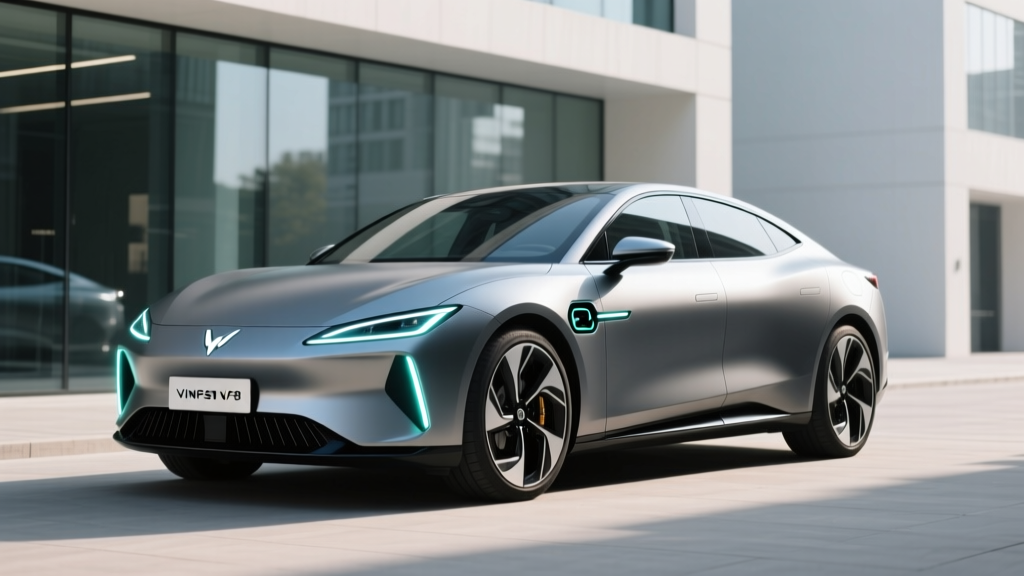
If you've seen the VinFast VF8 on the road or in headlines and wondered, "VinFast VF8 — who makes it?" you're not alone. The VF8 is built by VinFast, a Vietnamese automaker backed by Vingroup, one of Southeast Asia's largest conglomerates. VinFast launched its first EVs globally in 2022–2023 and has since established a manufacturing footprint in North Carolina to serve the U.S. market. The VF8 is the brand's midsize electric SUV, positioned against heavyweights like the Tesla Model Y, Hyundai Ioniq 5, and Ford Mustang Mach-E.
This review covers the 2026 VinFast VF8 in full: EPA range, real-world efficiency, DC fast-charging speeds, home charging, performance, interior space, pricing, federal tax credit eligibility under IRS §30D, and whether it deserves a spot on your shortlist. Let's get into the numbers.
VinFast VF8: Who Makes It and Where It's Built
VinFast Auto Ltd. is headquartered in Hanoi, Vietnam, and is a subsidiary of Vingroup, which operates across real estate, healthcare, retail, and technology. VinFast began vehicle production in 2019 with ICE models before pivoting entirely to battery-electric vehicles in 2022. The brand entered the U.S. market with direct-to-consumer sales and has since been building a dealer and service network across major metro areas.
For U.S. buyers, a key development is VinFast's manufacturing plant in Chatham County, North Carolina. While initial VF8 units were imported from Vietnam, the company has been ramping up North Carolina production to serve the American market and potentially qualify for more favorable tax treatment under evolving battery-sourcing rules.
VinFast is one of the few new EV-only automakers to enter the U.S. market in the 2020s, competing directly with established brands on price and warranty coverage.
Range, Battery, and Real-World Efficiency
The 2026 VinFast VF8 is offered in two primary trims — Eco and Plus — each with distinct battery and drivetrain configurations. Here's the core spec breakdown:
| Spec | VF8 Eco | VF8 Plus |
|---|---|---|
| EPA Est. Range | ~264 mi | ~243 mi |
| Battery Capacity (usable) | ~77 kWh (NMC) | ~87.7 kWh (NMC) |
| Battery Chemistry | NMC (Nickel Manganese Cobalt) | NMC |
| Drivetrain | Rear-Wheel Drive (single motor) | All-Wheel Drive (dual motor) |
| Horsepower | ~201 hp | ~402 hp |
| 0–60 mph | ~7.5 sec | ~5.5 sec |
| MPGe (combined) | ~93 MPGe | ~87 MPGe |
| Efficiency (kWh/100 mi) | ~36 kWh | ~39 kWh |
The EPA sticker says ~264 miles for the Eco and ~243 miles for the Plus (AWD). In real-world highway driving at 70–75 mph, expect roughly 220–240 miles from the Eco and 200–220 miles from the Plus. In cold weather (below 30°F), range can drop an additional 20–30%, putting the Plus closer to 170–190 miles on a full charge in winter highway conditions. City driving with regenerative braking can push efficiency closer to or slightly above the EPA estimate.
The VF8 uses NMC (nickel manganese cobalt) battery chemistry, which offers higher energy density than LFP (lithium iron phosphate) but typically comes with slightly faster long-term degradation and a lower recommended daily state-of-charge ceiling (80% for daily use, 100% only for long trips). VinFast has not announced an LFP variant for the VF8 as of this writing.
Charging Speed: DC Fast and Home Level 2
Charging speed is where many EV buyers focus, and the VF8 delivers competitive — though not class-leading — numbers.
| Charging Level | Power / Rate | Time / Miles Added |
|---|---|---|
| Level 1 (120V household) | ~1.4 kW | ~3–4 mi/hr |
| Level 2 (240V home/public) | ~11 kW onboard charger | ~30–35 mi/hr; full charge in ~8–9 hr |
| DC Fast Charge (CCS) | Up to ~160 kW peak | 10–80% in ~31 min (Eco); ~35 min (Plus) |
Charging curve reality: The VF8 peaks at approximately 160 kW on a capable DC fast charger, but like all EVs, it doesn't sustain that rate for the entire session. Expect the charge rate to taper significantly above 60–70% state of charge (SoC). If you're charging from 10% to 80%, the average sustained rate is closer to 100–120 kW, which is why the 10–80% time lands around 31–35 minutes rather than the theoretical minimum.
For home charging, the VF8's 11 kW onboard charger means you'll need a 48-amp or higher Level 2 circuit (hardwired, 60-amp breaker) to take full advantage. On a standard 32-amp Level 2 setup (common with NEMA 14-50 outlets), you'll see about 7.7 kW, adding roughly 22–25 miles per hour of charging — still enough for a full overnight charge for most daily driving needs.
The VF8 currently uses the CCS1 connector for DC fast charging in North America. As the industry shifts toward NACS (Tesla's charging standard), VinFast has signaled future NACS adoption, but 2026 models shipping to U.S. customers may still carry CCS1 ports. Verify the connector on any specific vehicle before purchase, and note that CCS-to-NACS adapters are widely available from third-party suppliers.
Pricing, Trims, and Federal Tax Credit Eligibility
Here's where the VF8 makes its strongest value argument — and where tax credit rules get complicated.
| Trim | Base MSRP | As-Tested (typical) | §30D Credit Eligible? |
|---|---|---|---|
| VF8 Eco (RWD) | ~$37,000 | ~$39,500 | Varies — see below |
| VF8 Plus (AWD) | ~$43,000 | ~$46,000 | Varies — see below |
Note: Pricing reflects 2026 MSRP estimates and may vary by model year and configuration. Destination charges, dealer fees, and optional packages can add $1,500–$3,000+.
Does the VF8 Qualify for the $7,500 Federal EV Tax Credit?
Under IRS §30D rules, eligibility for the full $7,500 new clean vehicle credit depends on several factors that change frequently:
- MSRP cap: SUVs must have an MSRP at or below $80,000 — both VF8 trims clear this easily.
- Buyer income cap: Modified adjusted gross income (MAGI) must not exceed $150,000 (single), $225,000 (head of household), or $300,000 (joint filers).
- Battery component sourcing: A percentage of battery components must be manufactured or assembled in North America, and critical minerals must be sourced from the U.S. or free-trade-agreement countries. These thresholds tighten annually.
- Final assembly: The vehicle must undergo final assembly in North America. VinFast's North Carolina plant is key here — vehicles assembled there may qualify, while Vietnam-built imports do not.
- Point-of-sale transfer: Eligible buyers can transfer the credit to the dealer at purchase, reducing the purchase price directly rather than waiting for a tax refund.
Bottom line: A VF8 assembled in North Carolina may qualify for partial or full credit depending on the current battery-sourcing thresholds. Vietnam-assembled units do not qualify for §30D. Always verify eligibility using the DOE's qualifying vehicle list on fueleconomy.gov and consult a tax professional before relying on the credit in your purchase decision.
Interior, Cargo, and Tech Features
The VF8 is a midsize two-row SUV with seating for five. Interior dimensions are competitive with the segment:
- Cargo volume (behind rear seats): ~27.8 cu ft
- Cargo volume (rear seats folded): ~62.5 cu ft
- Front legroom: ~41.1 in
- Rear legroom: ~38.6 in
- Frunk (front trunk): Minimal — the VF8 does not offer a substantial frunk like some competitors.
The cabin features a 15.6-inch central touchscreen running VinFast's proprietary infotainment OS, a digital instrument cluster, and a head-up display on Plus trims. Wireless Apple CarPlay and Android Auto are standard. The VF8 also includes a panoramic glass roof, ventilated front seats (Plus), and a suite of driver-assistance features branded as ADAS 2.0.
Driver-Assistance Systems
VinFast's ADAS 2.0 includes adaptive cruise control, lane-keeping assist, automatic emergency braking, blind-spot monitoring, and a 360-degree camera system. This is a SAE Level 2 driver-assist system — meaning the driver must remain fully attentive with hands on the wheel and eyes on the road at all times. It is not autonomous driving. On highway testing, the system performs adequately but trails the refinement of Tesla Autopilot, GM Super Cruise, or Ford BlueCruise in lane-centering smoothness and hands-free capability.
Warranty and Ownership Costs
VinFast offers one of the most aggressive warranty packages in the EV market, a strategic move to build buyer confidence for a newer brand:
- Battery warranty: 8 years / 100,000 miles (whichever comes first), covering capacity retention below 70% of original.
- Powertrain warranty: 8 years / 100,000 miles
- Bumper-to-bumper (basic): 5 years / 60,000 miles
- Roadside assistance: 5 years / 60,000 miles
The 8-year/100,000-mile battery and powertrain warranty matches or exceeds most competitors (Tesla offers 8 years / 120,000 miles on the Model Y; Hyundai provides 10 years / 100,000 miles). The 70% capacity retention threshold is standard industry practice, though some buyers may wish for a higher floor.
Insurance costs for the VF8 tend to run slightly higher than segment averages due to the brand's limited repair network and parts availability. Expect annual premiums 10–20% above a comparably priced Model Y or Ioniq 5, depending on your profile and location.
Who Should Buy the VinFast VF8?
- You want a sub-$40K midsize EV SUV with competitive range for daily commuting and moderate road trips.
- You primarily drive in urban or suburban environments where RWD is sufficient.
- You value a strong warranty and are willing to accept a newer brand's growing service network.
- You need AWD for snow, rain, or light off-pavement driving.
- You want dual-motor performance (402 hp, ~5.5 sec 0–60) and premium interior features.
- You frequently carry passengers and cargo and want the larger battery buffer for longer trips.
- You need best-in-class DC fast-charging speed (the Ioniq 5 and EV6 charge at up to 350 kW).
- You rely on the Tesla Supercharger network and want native NACS access without adapters.
- You want a proven service network with decades of U.S. presence.
VinFast VF8 vs. Key Competitors
Here's how the VF8 stacks up against three direct rivals in the midsize electric SUV segment:
| Spec | VinFast VF8 Plus | Tesla Model Y LR AWD | Hyundai Ioniq 5 LR AWD | Ford Mach-E ER AWD |
|---|---|---|---|---|
| EPA Range | ~243 mi | ~320 mi | ~290 mi | ~290 mi |
| Battery (kWh) | ~87.7 | ~75 | ~77.4 | ~91 |
| Peak DC Charge | ~160 kW | ~250 kW | ~238 kW | ~150 kW |
| 10–80% DC Time | ~35 min | ~22 min | ~18 min | ~45 min |
| 0–60 mph | ~5.5 sec | ~4.8 sec | ~5.1 sec | ~5.1 sec |
| Base MSRP | ~$43,000 | ~$48,000 | ~$50,000 | ~$48,000 |
| Battery Warranty | 8 yr / 100k mi | 8 yr / 120k mi | 10 yr / 100k mi | 8 yr / 100k mi |
The VF8's main advantages are its lower starting price and strong warranty. Its main weaknesses relative to these competitors are lower EPA range, slower DC fast charging, and a less mature service and charging ecosystem. The Tesla Model Y remains the efficiency and range leader; the Ioniq 5 is the charging-speed champion; the Mach-E offers a familiar brand with broad dealer coverage.
- Competitive pricing — among the most affordable midsize EV SUVs
- Strong 8-year/100,000-mile battery and powertrain warranty
- Comfortable ride quality and spacious rear seats
- Standard ADAS 2.0 suite across all trims
- North Carolina assembly may support future tax credit eligibility
- EPA range trails key competitors by 50–80 miles
- DC fast charging peaks at ~160 kW — slower than Ioniq 5, Model Y
- Infotainment software can feel less polished than rivals
- Limited service center network compared to legacy brands
- No native NACS port on current models (adapter required for Superchargers)
Frequently Asked Questions
Who makes the VinFast VF8?
The VF8 is manufactured by VinFast, a Vietnamese electric vehicle company owned by Vingroup. U.S.-market vehicles are increasingly assembled at VinFast's plant in Chatham County, North Carolina, though some units are still imported from Vietnam.
What is the real-world range of the VinFast VF8?
The EPA rates the VF8 Eco at approximately 264 miles and the Plus at 243 miles. In real-world highway driving, expect 220–240 miles (Eco) and 200–220 miles (Plus). Cold weather can reduce range by an additional 20–30%.
How fast does the VF8 charge at home and on the road?
At home on a Level 2 (240V) charger, the VF8 accepts up to 11 kW, adding about 30–35 miles of range per hour. On a DC fast charger, it peaks at approximately 160 kW and charges from 10% to 80% in roughly 31–35 minutes depending on trim.
Does the VinFast VF8 qualify for the federal EV tax credit?
Eligibility under IRS §30D depends on final assembly location (must be North America), battery component sourcing, critical mineral requirements, buyer income caps, and MSRP caps. VF8 units assembled in North Carolina may qualify; Vietnam-built units do not. Check the DOE's qualifying vehicle list and consult a tax professional.
Is the VinFast VF8 worth buying over a Tesla Model Y or Hyundai Ioniq 5?
The VF8 offers a lower entry price and strong warranty, making it a solid value pick if range and fast-charging speed are not your top priorities. If you need maximum range or the fastest DC charging on road trips, the Model Y or Ioniq 5 are stronger choices. Test-drive all three and compare total cost of ownership in your area.
What battery chemistry does the VF8 use?
The VF8 uses NMC (nickel manganese cobalt) lithium-ion battery cells. NMC offers higher energy density than LFP but typically requires more careful state-of-charge management for long-term longevity (daily charge to 80%, 100% only for trips).
How reliable is the VinFast VF8?
As a newer brand, VinFast has limited long-term reliability data in the U.S. market. Early owner reports have noted software glitches and panel-gap inconsistencies, though VinFast has been issuing over-the-air updates to address software issues. The generous warranty provides a safety net, but buyers should weigh the brand's track record against established competitors.
Sources: EPA range and efficiency data via fueleconomy.gov; federal tax credit rules via IRS.gov §30D; vehicle specifications via VinFast U.S. official site. All specifications reflect 2026 model-year data available at time of publication and are subject to change.