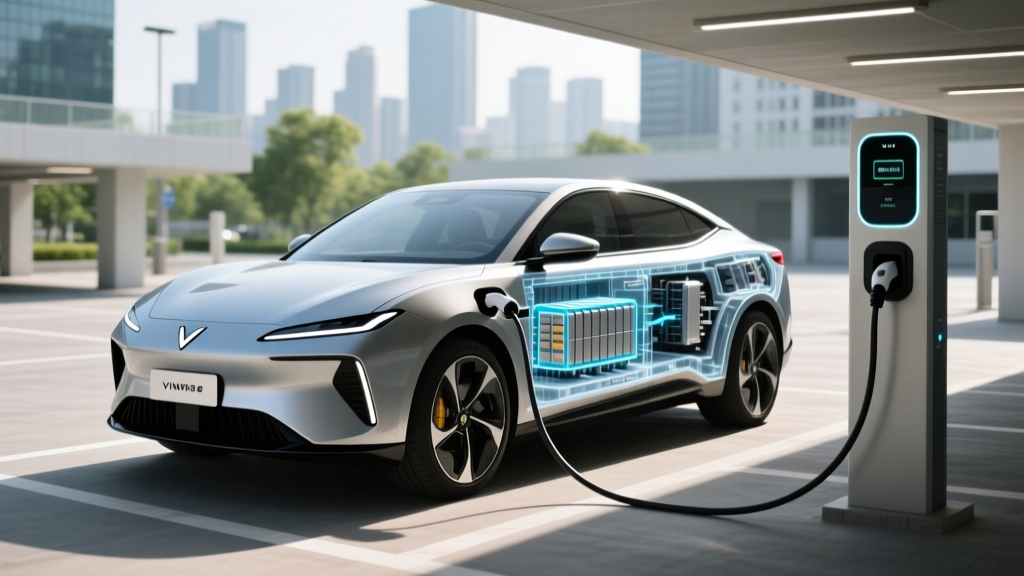
VinFast's rapid ascent from Vietnamese startup to global EV automaker has drawn intense scrutiny. Early reviews of the VF 8 were mixed, with software glitches and build-quality concerns dominating headlines. But the brand's manufacturing operations have evolved significantly since those first U.S. deliveries in 2023. With a new assembly plant in Chatham County, North Carolina, now operational and 2026 model-year refinements reaching dealers, it's time to reassess what VinFast manufacturing means for buyers considering the VF 8 midsize electric SUV.
This review covers the 2026 VinFast VF 8 in full — EPA range, real-world efficiency, DC fast-charging performance, battery chemistry, pricing, federal tax credit eligibility, and how the vehicle stacks up against the Hyundai Ioniq 5, Tesla Model Y, and Ford Mustang Mach-E. If you're weighing a VF 8 purchase, here are the exact numbers you need.
2026 VinFast VF 8: Core Specifications at a Glance
| Specification | VF 8 Eco (AWD) | VF 8 Plus (AWD) |
|---|---|---|
| EPA Range | 264 miles | 243 miles |
| Battery Capacity (usable) | 82.7 kWh (NMC) | 82.7 kWh (NMC) |
| Drivetrain | Dual-motor AWD | Dual-motor AWD |
| Horsepower | 348 hp | 402 hp |
| 0–60 mph | 5.3 seconds | 4.5 seconds |
| Max DC Fast Charge | 190 kW | 190 kW |
| 10–80% DC Charge Time | ~31 minutes | ~31 minutes |
| Level 2 Home Charge Rate | 11 kW (~33 mi/hr) | 11 kW (~33 mi/hr) |
| MPGe (combined) | 89 MPGe | 82 MPGe |
| Efficiency | 37 kWh/100 mi | 41 kWh/100 mi |
| Cargo Volume (rear seats up) | 28.8 cu ft | 28.8 cu ft |
| Cargo Volume (rear seats folded) | 63.5 cu ft | 63.5 cu ft |
| Rear Legroom | 38.0 in | 38.0 in |
| Battery Warranty | 8 yr / 100,000 mi | 8 yr / 100,000 mi |
| Vehicle Warranty | 7 yr / 75,000 mi | 7 yr / 75,000 mi |
| Base MSRP | $46,000 | $52,000 |
VinFast Manufacturing: From Vietnam to North Carolina
Understanding the VF 8 requires understanding where and how it's built. VinFast's primary production facility remains in Hai Phong, Vietnam — a massive, highly automated complex that the company claims can produce up to 250,000 vehicles annually. Early U.S.-spec VF 8 units were all Vietnam-built, and it was these vehicles that drew criticism for panel-gap inconsistencies, interior trim rattles, and software instability.
For 2026, the picture is changing. VinFast's Chatham County, North Carolina manufacturing facility has begun assembly operations, initially focused on the VF 8 and the smaller VF 7. Locally produced vehicles are expected to show tighter quality control, faster software update deployment, and reduced shipping-related damage. VinFast has also restructured its software development pipeline, partnering with established Tier 1 suppliers to address the infotainment bugs that plagued 2023–2024 models.
For buyers, the VIN on the window sticker matters. Vehicles with a U.S.-built VIN (starting with "1" or "4") from the North Carolina plant will likely reflect improved fit and finish compared to earlier Vietnam-sourced units. Ask your dealer for the build origin before committing.
EPA Range vs. Real-World: What to Actually Expect
EPA Sticker: 264 miles (Eco) / 243 miles (Plus)
Real-World Expectation: Expect 220–240 miles on mixed highway driving in moderate temperatures. In cold weather (below 30°F), plan for 180–200 miles due to battery thermal losses and cabin heating demands. City driving with frequent regenerative braking can push closer to or slightly above the EPA figure.
The VF 8's 82.7 kWh usable NMC (nickel manganese cobalt) battery is competitive for the class but not class-leading. The Eco trim's 89 MPGe combined translates to roughly 37 kWh per 100 miles — meaning the VF 8 is slightly less efficient than a Tesla Model Y Long Range (30 kWh/100 mi) but on par with the Ford Mustang Mach-E Extended Range AWD.
The Plus trim's higher-output motors and standard 21-inch wheels reduce range by 21 miles on the EPA cycle. If range is a priority, the Eco trim is the clear choice — and the performance difference (5.3s vs 4.5s to 60 mph) is modest in daily driving.
Charging Speed: DC Fast Charging and Home Level 2
The VF 8 supports DC fast charging at up to 190 kW via its CCS1 connector (North American models). VinFast has confirmed that 2026 models will include a NACS adapter for Tesla Supercharger access, expanding the available fast-charging network significantly.
| Charging Level | Power (kW) | Speed (miles of range per hour) | Notes |
|---|---|---|---|
| Level 1 (120V household) | 1.4 kW | ~4 mi/hr | Emergency/trickle only; ~60 hours for full charge |
| Level 2 (240V home) | 11 kW | ~33 mi/hr | Full charge in ~8 hours; ideal overnight setup |
| DC Fast Charge (peak) | 190 kW | ~210 mi/hr (at peak) | 10–80% in ~31 min; tapers significantly above 80% |
The 190 kW peak is respectable but not exceptional. The Hyundai Ioniq 5 peaks at 240 kW (with its 800V architecture) and achieves 10–80% in roughly 18 minutes. The VF 8's 31-minute 10–80% time is adequate for road trips with planned meal or restroom stops, but it's not the fastest in the segment.
At home, the 11 kW onboard charger is competitive. On a 48-amp Level 2 circuit (the most common home installation), you'll recover roughly 33 miles of range per hour, meaning an overnight charge from 20% to 100% takes about 7–8 hours. Ensure your electrician installs a NEMA 14-50 outlet or hardwired EVSE on a dedicated 60-amp circuit for optimal performance.
Performance, Ride, and Technology
The VF 8 is a dual-motor AWD vehicle across all trims. The Eco's 348 hp is more than adequate for highway merging and passing, while the Plus's 402 hp delivers genuinely quick acceleration at 4.5 seconds to 60 mph. Ride quality is firm but composed, with a suspension tuning that favors European-style composure over the softer American preference.
Inside, the 15.6-inch center touchscreen dominates the dashboard. The 2026 model year brings an updated software stack with improved voice recognition, wireless Apple CarPlay and Android Auto, and over-the-air update capability. The digital instrument cluster is minimal — VinFast routes most information through the central display and a head-up display, which takes adjustment.
Driver assistance includes adaptive cruise control, lane centering, blind-spot monitoring, and automatic emergency braking. This is an SAE Level 2 system, meaning the driver must remain fully engaged with hands on the wheel and eyes on the road. It is not autonomous driving. The lane centering performs adequately on well-marked highways but can hunt in construction zones — typical for the segment.
Notable drawbacks include the absence of a front trunk (frunk), which competitors like the Model Y and Ioniq 5 offer, and rear visibility that's compromised by thick C-pillars. The rearview camera partially compensates, but it's a design trade-off worth noting.
Pricing, Trims, and Federal Tax Credit Eligibility
The 2026 VF 8 starts at $46,000 for the Eco trim and $52,000 for the Plus trim, including destination. Fully loaded Plus models with premium paint and the ADAS package can approach $58,000.
| Trim | Base MSRP | As-Tested (typical) | Est. Federal Credit | Effective Price |
|---|---|---|---|---|
| VF 8 Eco | $46,000 | $47,500 | Up to $3,750* | ~$43,750 |
| VF 8 Plus | $52,000 | $56,500 | Up to $3,750* | ~$52,750 |
*Federal tax credit amounts depend on battery component and critical mineral sourcing requirements under IRS §30D rules. VinFast's battery supply chain has been evolving; as of early 2026, the VF 8 qualifies for a partial credit (up to $3,750 from the critical minerals requirement), but the full $7,500 requires both sourcing thresholds to be met. Check the latest fueleconomy.gov listings before purchasing, as eligibility can change with supply chain updates.
Buyer income caps also apply: adjusted gross income cannot exceed $150,000 (single), $225,000 (head of household), or $300,000 (joint). The MSRP cap for SUVs is $80,000, which the VF 8 clears comfortably. The credit can be transferred to the dealer at point of sale as an instant discount, per current IRS rules.
How the VF 8 Compares: Is It Worth Buying?
Pros
- Standard AWD across all trims at a competitive entry price
- Strong 7-year/75,000-mile vehicle warranty + 8-year/100,000-mile battery coverage
- Improving manufacturing quality from the North Carolina plant
- NACS adapter for Tesla Supercharger access in 2026
- Distinctive styling that stands out in a sea of crossover look-alikes
- Spacious rear seat with 38.0 inches of legroom
Cons
- EPA range (264 mi max) trails the Model Y LR (320 mi) and Ioniq 5 (303 mi)
- DC fast charging at 190 kW is slower than 800V competitors
- No frunk — a missed opportunity for the segment
- Brand-new dealer network still expanding; service access varies by region
- Software maturity improving but still behind Tesla and Hyundai benchmarks
- Efficiency (37–41 kWh/100 mi) is mid-pack, not best-in-class
The VF 8 makes the most sense for buyers who prioritize standard AWD, warranty coverage, and distinctive design over maximum range or bleeding-edge charging speed. If you drive under 200 miles daily and have reliable home charging, the VF 8 Eco at roughly $43,750 after the partial credit is a credible alternative to the Model Y and Mach-E. However, if road-trip range and charging speed are top priorities, the Hyundai Ioniq 5 (800V architecture, 303-mile range, 240 kW peak charging) remains the efficiency benchmark in this price range.
Who Should Buy the 2026 VinFast VF 8?
Best for: AWD-dependent commuters in snow-belt states, families needing a spacious rear seat, and buyers who value a long vehicle warranty. The VF 8's standard dual-motor AWD at $46,000 undercuts many AWD competitors by several thousand dollars.
Look elsewhere if: You regularly drive 300+ miles between charging stops, you need the fastest DC charging available, or you live in a region without a nearby VinFast service center. Check VinFast's dealer locator before committing.
Frequently Asked Questions
What is the real-world range of the 2026 VinFast VF 8?
The EPA rates the VF 8 Eco at 264 miles and the Plus at 243 miles. In real-world mixed highway driving at 70 mph in moderate temperatures, expect 220–240 miles. Cold weather (below 30°F) can reduce range to 180–200 miles. City driving with regenerative braking may approach or slightly exceed the EPA figure.
How fast does the VF 8 charge at home and on the road?
At home on a 240V Level 2 charger (11 kW), the VF 8 adds roughly 33 miles of range per hour, fully charging overnight in about 8 hours. On DC fast chargers, it peaks at 190 kW and charges from 10% to 80% in approximately 31 minutes. The 2026 model includes a NACS adapter for Tesla Supercharger compatibility.
Does the VinFast VF 8 qualify for the federal EV tax credit?
As of early 2026, the VF 8 qualifies for a partial federal tax credit of up to $3,750 under IRS §30D, based on critical mineral sourcing. The full $7,500 requires meeting both battery component and critical mineral thresholds. Buyer income caps ($150K single / $300K joint) and the $80,000 SUV MSRP cap also apply. Verify current eligibility at fueleconomy.gov before purchasing, as supply chain changes can affect qualification.
How does VinFast manufacturing quality compare to competitors?
Early Vietnam-built VF 8 units drew criticism for panel gaps and software issues. The 2026 model year benefits from VinFast's North Carolina assembly plant, updated software architecture, and Tier 1 supplier partnerships. U.S.-built units (check the VIN) are expected to show improved fit and finish. Long-term reliability data remains limited compared to established brands.
Is the VF 8 worth buying over a Tesla Model Y or Hyundai Ioniq 5?
The VF 8 Eco at ~$43,750 after credit offers standard AWD and strong warranty coverage at a competitive price. However, the Model Y Long Range delivers 320 miles of range and access to the mature Supercharger network, while the Ioniq 5 offers faster 240 kW charging and 303 miles of range. Choose the VF 8 if AWD value and warranty matter most; choose the Ioniq 5 or Model Y if range and charging speed are priorities.